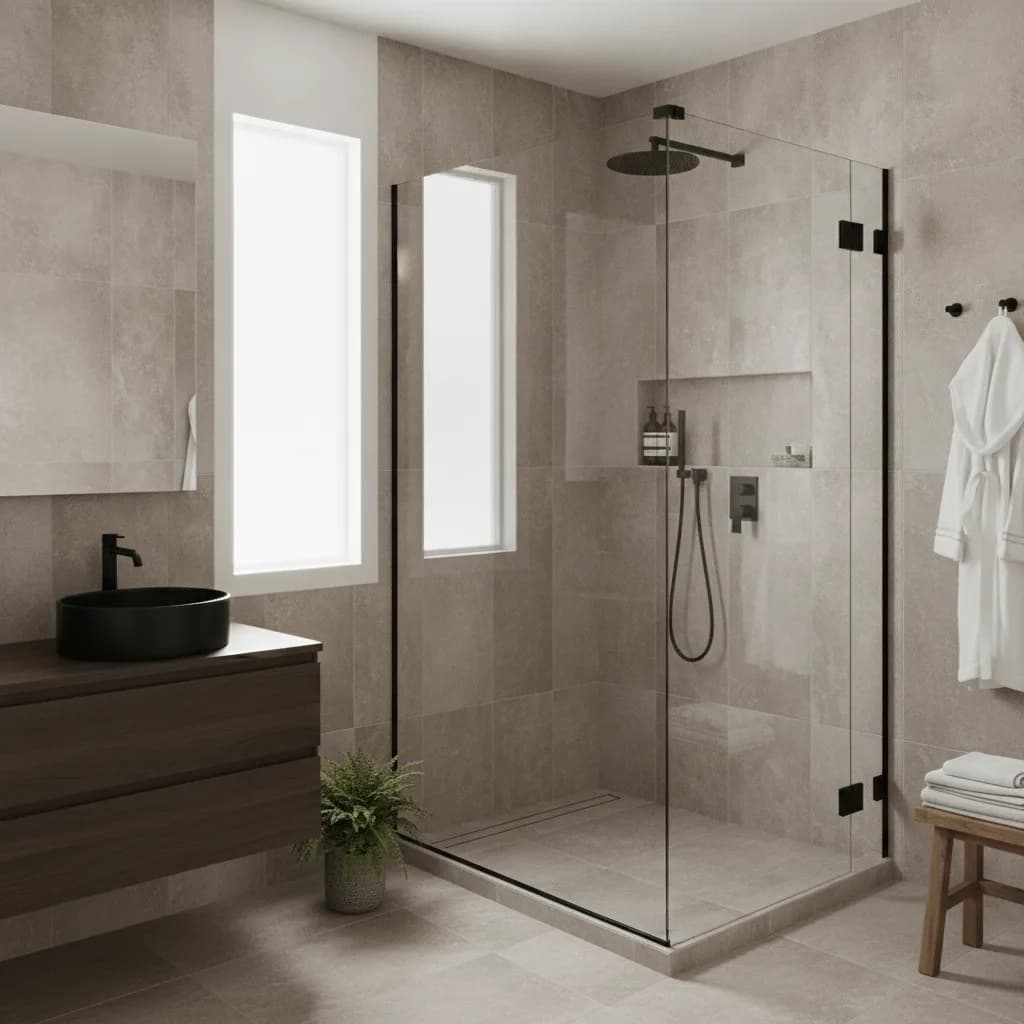
A tub to shower conversion costs between $2,000 and $12,000 in 2026, with most projects landing in the $3,000 to $7,000 range depending on whether you choose a prefab kit or custom tile. In Los Angeles, the average sits near $3,400 according to Angi's metro data. Those are the honest headline numbers, but this project has a wider spread than almost any other bathroom job, because "conversion" covers everything from a one day acrylic swap to a fully tiled curbless shower with relocated plumbing. This guide prices each version, compares franchise and local contractor bids, answers the Medicare question everyone asks, and covers the permit rules specific to California and Seattle.
In a Nutshell
- Prefab stall conversion: $2,000 to $6,000. The fastest, most budget-friendly path (This Old House, 2026).
- Walk-in shower conversion: $5,000 to $12,000, tiled versions $6,000 to $12,000 (This Old House).
- Curbless conversion: $8,000 to $15,000 nationally, and $8,000 to $18,000 in the Bay Area. The premium over a curbed shower is $2,000 to $5,000.
- The hidden-cost reality: in a January 2026 survey of 1,000 homeowners who did this project, about 70 percent hit at least one surprise cost, most often structural repair or water damage found behind the tub (This Old House).
- Resale rule: keep at least one bathtub in the house. Converting the only tub can shrink your buyer pool, especially among families with young children.
Tub to Shower Conversion Cost by Type
| Conversion type | Typical cost | Notes |
|---|---|---|
| Tub cut modification | $800 to $1,800 | Cuts a walk-through opening in the existing tub. Accessibility fix, not a remodel (HomeGuide) |
| Prefab shower stall | $2,000 to $6,000 | Acrylic or fiberglass kit in the tub footprint (This Old House). Kits alone run $350 to $4,100 (HomeGuide) |
| Walk-in shower | $5,000 to $12,000 | Low-threshold entry, glass panel or door (This Old House) |
| Custom tiled shower | $3,500 to $15,000 | Tile walls and pan, fully built on site (HomeGuide, Angi) |
| Curbless shower | $8,000 to $15,000 | Floor rebuilt with slope to a linear drain. Bay Area installs run $8,000 to $18,000+ |
Why the "Average" Depends on Who You Ask
Angi and HomeAdvisor put the average conversion near $3,000. HomeGuide says $7,000. Home Depot's installation service quotes $8,000 to $15,000. None of them are wrong, they are describing different projects. The $3,000 number is a kit swap with no plumbing changes. The $7,000 number includes tiled walk-ins. The retail installed price bundles a full wet-area rebuild with materials. When a contractor quotes you, the first thing to establish is which of these projects you are actually buying, because comparing a kit-swap bid against a tiled walk-in bid tells you nothing.
The Line Items Behind Every Quote
| Line item | Typical cost | Notes |
|---|---|---|
| Tub removal and disposal | $150 to $1,200 | Sources spread widely: Angi $150 to $300, This Old House $300 to $1,200. Cast iron tubs and tight hallways push it up |
| Plumbing adjustments | $300 to $2,400 | Rerouting supply and drain to shower configuration (Angi, HomeAdvisor) |
| Drain relocation | $500 to $3,000 | Showers need a 2 inch drain in most codes, tubs often have 1.5 inch. Concrete slabs cost more |
| Shower valve | $225 to $1,200 | HomeGuide low, This Old House high. Pressure-balanced valves are code in most areas |
| Waterproofing | $550 to $1,800 | A Schluter KERDI kit retails around $716 to $820 before labor. This is the layer where cheap bids fail |
| Shower door | $400 to $3,000 | Framed $400 to $1,200, frameless $1,200 to $3,000 (This Old House) |
| Tile | $2 to $30 per sq ft material | Ceramic and porcelain $2 to $15, natural stone $5 to $30. Tiled shower totals $900 to $10,000 |
| Permit | $100 to $1,500 | City-specific, see the California and Seattle section below |
Labor takes 40 to 60 percent of the total on a typical conversion, with plumbers billing $45 to $200 per hour (Angi, HomeGuide).
Franchise vs Local Contractor: The Comparison Nobody Publishes
The one day bath companies advertise heavily on this exact search, so here is how their pricing actually compares with independent contractors, from published third-party data rather than their own marketing.
| Who does the work | Typical conversion price | Source |
|---|---|---|
| Bath Fitter | $1,200 to $9,500 | HomeGuide, 2026 |
| West Shore Home | $9,000 to $15,000 | Modernize, 2026 |
| Re-Bath | $10,000 to $18,000 | HomeGuide, 2026 |
| Generic one day acrylic specialist | $4,000 to $9,000 | TubcuT industry guide, 2026 |
| Independent licensed contractor | $3,000 to $12,000 | Angi, HomeGuide, This Old House composite |
The franchise premium buys speed and a single-brand warranty on an acrylic system. A local contractor typically delivers tile and custom options at the same or lower price, on a longer timeline. Neither is wrong. Know which trade-off you are paying for.
The Hidden 70 Percent
This Old House surveyed 1,000 homeowners who completed a conversion in January 2026. About 70 percent hit at least one cost they did not plan for: structural repairs (38 percent), water damage discovered behind the tub (32 percent), and unplanned plumbing work (29 percent). Thirty-seven percent went over budget. The pattern is consistent with what contractors find when a tub that sat for decades comes out. The practical move is a contingency of 10 to 15 percent, and a bid that itemizes what happens if the subfloor is wet, before demolition day rather than after.
California and Seattle: Permits and Local Numbers
Los Angeles. Angi's LA metro data puts the average conversion at about $3,408, with most projects between $1,704 and $9,088. Plumbing changes require a permit, and non-structural walk-in conversions typically qualify for LADBS Express Permits without plan check. Budget a few hundred dollars for permits on a standard conversion. California also requires a CSLB-licensed contractor on any job of $1,000 or more, which every real conversion is.
Seattle. The code detail that surprises homeowners: showers require a 2 inch drain, and many older tubs drain through 1.5 inch lines. That drain change makes the project permitted plumbing work. All-in permit costs on Seattle bathroom projects commonly land between $500 and $1,500, with SDCI valuing the project at market rate. It is not a reason to skip the permit. An unpermitted wet-area rebuild is exactly the kind of thing that surfaces in a pre-sale inspection.
Who Helps Pay: The Accessibility Funding Answer
The most-asked question on this topic is whether Medicare pays for a tub to shower conversion. The straight answer: original Medicare generally does not, because it classifies bathroom conversions as home modifications rather than medical equipment. Some Medicare Advantage plans include home-safety benefits that can contribute. Beyond Medicare, real programs exist:
- VA HISA grants fund bathroom accessibility improvements for veterans, with lifetime caps in the low thousands of dollars. Verify current amounts at va.gov, and the application starts with a VA physician's recommendation.
- California: Medi-Cal's CalAIM Community Supports include Environmental Accessibility Adaptations, which can cover accessible bathroom conversions such as a tub to roll-in shower for qualifying members. L.A. Care lists this as a covered support.
- Washington: Medicaid waivers (COPES, New Freedom) can cover home modifications including accessible showers for recipients who qualify for nursing-home level of care. King County's Housing Repair Program and the Northwest Access Fund also fund accessibility modifications.
If the conversion is driven by mobility rather than style, check these programs before self-funding. A curbless conversion that qualifies can shift thousands of dollars off your budget.
Curbless: What the Premium Buys
3 bathroom remodelers, editor-screened. 4 questions.
See my 3 matchesA curbless shower costs $2,000 to $5,000 more than the same shower with a curb, because the floor itself is rebuilt: the framing is recessed or sloped, a linear drain is set, and the waterproofing extends across the bathroom floor. The floor system work alone runs $800 to $1,800. What the premium buys is a step-free entry that works for every age and stage, which is why curbless leads aging-in-place remodels, and a cleaner look that has moved from accessibility feature to design preference. In the Bay Area, expect $8,000 to $18,000 or more installed.
What It Means for Resale
The rule agents repeat: keep at least one bathtub in the house. This Old House states it directly, and industry guidance consistently warns that homes without any tub lose family buyers. A conversion returns roughly 60 percent of its cost at resale on Angi's estimate, and it can help in markets with older buyers while hurting in family neighborhoods if it removes the only tub. Notably, in the This Old House survey, homeowners ranked quality and cost far above resale as their reason for converting, and 97 percent were satisfied. Convert the secondary bathroom's tub freely. Think twice before converting the only one.
What Happens Week by Week
A tub to shower conversion is a short project with a hard middle. Knowing the sequence tells you when surprises surface and when the bathroom is unusable.
| Stage | Typical duration | What happens |
|---|---|---|
| Permit and prep | 3 days to 3 weeks | Plumbing permit filed. Express-permit paths in some cities are same-week; plan review adds time |
| Demolition | 1 day | Tub and surround out. This is when water damage and subfloor rot are discovered, which is why bids should say what happens if they are |
| Rough plumbing | 1 to 2 days | Drain resized or relocated, valve set. Inspection follows before anything is closed up |
| Waterproofing | 1 to 2 days | Pan and membrane installed, then a flood test. Rushing this stage is the single most common cause of failure years later |
| Tile and finish | 2 to 5 days | Tile set, cured, grouted, sealed. Prefab kits skip most of this and finish in a day |
| Glass | 1 to 2 weeks after tile | Custom glass is measured after tile is set, then fabricated. This is why the shower often sits unusable while waiting on a door |
Total: about one week for a prefab kit conversion, two to four weeks for a tiled walk-in, and longer if the glass is custom or a surprise appears at demolition.
Waterproofing: Where Cheap Bids Fail
Every part of this project is visible except the one that decides whether it lasts. Behind the tile is a waterproofing assembly, and it is the most common place for a low bid to save money invisibly.
A sheet membrane system runs $500 to $1,000 installed, and liquid-applied membranes $50 to $800 in material plus labor. A complete branded shower kit, tray and membrane together, retails around $716 for a standard size and $820 for a larger one before any labor. Those are not large numbers against a $6,000 project, which is exactly why a bid that omits them should be questioned rather than celebrated.
Two questions separate a real waterproofing scope from a hand-wave: which system is being installed by name, and whether a flood test is performed before tile goes on. A contractor who answers both without hesitating is quoting the job you actually want.
Materials: What Your Money Buys
| Material | Cost per sq ft | Notes |
|---|---|---|
| Fiberglass or acrylic surround | $0.75 to $12 | The prefab path. Fastest, lowest cost, fewest layout options |
| Ceramic and porcelain tile | $2 to $17 | The mainstream choice. Porcelain is denser and better suited to wet areas |
| Natural stone tile | $5 to $30 | Requires sealing and more careful substrate work |
| Cultured marble | $10 to $35 | Seamless panels, fewer grout lines to maintain |
| Quartz panels | $50 to $100 | The premium surround. Templated and fabricated like a countertop |
Tile labor is the other half of the equation, and it scales with pattern complexity rather than material price. A large-format tile set in a running bond is faster than a small mosaic that has to be cut around a niche, and the labor line reflects it.
How to Read a Conversion Bid
Because this project's honest range spans $2,000 to $15,000, comparing bids is only meaningful once you know they describe the same work. Check these seven lines in every quote.
- Shower type. Prefab kit, tiled walk-in, or curbless. If two bids differ on this, they are not comparable at any price.
- Drain. Is the existing drain being reused, resized to 2 inch, or relocated? This one line explains thousands of dollars of variance.
- Waterproofing system. Named product and whether a flood test is included.
- Glass. Framed, semi-frameless, or frameless, and whether it is stock or custom-measured. The spread is $400 to $3,000.
- Contingency language. What happens if the subfloor is wet. About 70 percent of these projects hit at least one hidden cost, so a bid that is silent on this is a bid that will be renegotiated mid-project.
- Permit. Named and priced, not assumed.
- What is excluded. Fixtures, niche, bench, and grab bars are frequently outside the base number.
Accessibility Details Worth Specifying Now
If any part of the reason for this conversion is mobility, present or future, a handful of decisions cost little during construction and a great deal to retrofit later.
- Blocking behind the walls. Adding plywood backing where grab bars might one day go costs almost nothing while the walls are open. Installing grab bars later without it means opening tile.
- Entry width. An accessible entry is at least 36 inches, and a minimum accessible shower footprint is 36 by 36 inches. Designing to those numbers now keeps every option open.
- A bench or fold-down seat. Easier to frame during construction than to add.
- Curbless entry. The $2,000 to $5,000 premium is the one item that genuinely cannot be retrofitted cheaply, since it means rebuilding the floor.
- Handheld on a slide bar plus a fixed head. A small fixture upgrade that makes the shower work for seated and standing use.
- Grab bars. $50 to $500 each installed, and accessibility features together typically add $75 to $1,900.
If the project qualifies for one of the funding programs in the previous section, these are exactly the items that tend to be covered, which makes specifying them upfront a budget decision as much as a design one.
Prefab or Tile: The Decision That Sets Your Budget
Almost every other decision in this project follows from this one, so it is worth making deliberately rather than by default.
A prefab acrylic or fiberglass system is a manufactured base and wall panels sized to the tub opening. It installs in about a day, costs $2,000 to $6,000 all in, has no grout to maintain, and is genuinely easier to clean for years afterward. The limits are real: the shower is the size and shape the manufacturer made, the finish reads as a unit rather than as a room, and a damaged panel is replaced rather than repaired.
A tiled shower is built on site over a waterproofing assembly. It costs $3,500 to $15,000, takes two to four weeks, and can be any size, shape, or finish, including a niche where you want it and a bench where you need it. The trade-offs are grout maintenance, a longer disruption, and far more dependence on the installer's skill, because the waterproofing behind the tile is invisible once the job is done.
The honest rule of thumb: if the bathroom is secondary, the budget is firm, and speed matters, prefab wins on every practical measure. If this is the primary bathroom, you plan to stay, or the layout is unusual, tile earns its premium.
Common Mistakes That Cost Real Money
- Converting the only tub in the house. The most expensive mistake here is not a construction error, it is a market one. Where another tub remains, this project is neutral to positive at resale.
- Comparing bids of different scopes. A prefab bid and a tiled walk-in bid are different products. The cheap one is not a better deal, it is a different purchase.
- Accepting "liner if needed" style language on the drain. An open-ended plumbing line item is a renegotiation waiting to happen. Get the drain question answered before signing.
- Skipping the permit. A plumbing alteration is permitted work in most jurisdictions, and unpermitted wet-area work is one of the standard findings in a pre-sale inspection.
- Not budgeting a contingency. Roughly 70 percent of these projects hit at least one unplanned cost, and 37 percent go over budget. A 10 to 15 percent contingency turns a crisis into a line item.
- Ordering glass before tile is set. Custom glass is measured against the finished opening. Ordering early produces a door that does not fit.
Sources & Methodology
See the Renology Methodology for how sources are reviewed, ranges are normalized, and planning-data limits are handled.
Cost ranges come from This Old House (including its January 2026 survey of 1,000 homeowners), Angi national and Los Angeles metro cost files, HomeGuide, and HomeAdvisor, all 2026 editions. Franchise pricing comes from HomeGuide and Modernize third-party data, not from the companies' own marketing. Accessibility program details reference VA, Medi-Cal CalAIM, Washington Medicaid waiver, and King County program documentation, and readers should verify current eligibility and amounts with each program directly. Where sources disagree on a line item, we show the spread and name each source rather than averaging silently.
Renology Take
This project has the widest honest price range in bathroom remodeling, and that range is the answer to why quotes feel inconsistent. Decide the project type first: kit swap, tiled walk-in, or curbless. Get the drain question answered before you sign anything, because that single line item swings the price by thousands. And if there is any mobility motivation behind the conversion, spend one afternoon on the funding programs above before spending your own money. The homeowners who regret this project are almost never unhappy with the shower. They are unhappy with the surprise costs a better bid would have priced upfront.
Turn the range into a scope you can compare
A prefab shower, a tiled shower and a curbless shower are different scopes. Ask whether drain changes, waterproofing, glass, disposal and permits are included.
| Scope | Ask the contractor to specify | Confirm before comparing prices |
|---|---|---|
| Prefab shower | Base, wall system, drain connection and enclosure | Is the existing drain location suitable for the selected system? |
| Tiled shower | Waterproofing system, tile allowance, labor and glass | Who specifies and warrants the waterproofing installation? |
| Curbless shower | Floor build-up, drainage, waterproofing and access | Does the floor structure require changes and local approval? |
Tell us your project and ZIP code so an advisor can check local contractor availability. Matching is free for homeowners; the contractor provides the project quote.
Find help with your tub-to-shower conversionAlready have a quote? Check its scope and exclusionsFrequently Asked Questions
What is the average cost to convert a bathtub to a shower?
How much would it cost to remove a bath and replace it with a shower?
Can you redo a bathroom for $5,000?
Does Medicare pay for a tub to shower conversion?
What does a $10,000 bathroom remodel look like?
How much does Home Depot charge for tub to shower conversion?
How much extra does a curbless shower cost?
Does converting a tub to a shower hurt resale value?
Get 3 bathroom bids in 48 hours.
Our editors already vetted bathroom remodelers. Answer 4 questions and we send 3 written bids inside 48 hours, with the real price for your scope, not their inflated first-call number.
- Free, no commission
- Pre-screened locally
- Bids inside 48 hours
Takes about 60 seconds. We'll text you when bids arrive.
Sources
- This Old House, Tub to Shower Conversion Cost (with Jan 2026 survey, n=1,000)
- Angi, Cost to Convert Tub to Shower
- Angi, Walk-In Shower Cost
- HomeGuide, Tub to Shower Conversion Cost
- HomeAdvisor, Convert Tub to Shower
- HomeGuide, Bath Fitter and Re-Bath cost files
- L.A. Care, CalAIM Environmental Accessibility Adaptations
- King County Housing Repair Program
- Renology Cost Index