One room
$800 to $4.8k
- A living or family room of 200 to 320 sq ft
- Flooring material and installation labor
- Carpet, laminate, luxury vinyl, engineered wood or hardwood
- Old floor removal and subfloor repair priced on top
Choose flooring for the room’s moisture, wear and maintenance needs, then price the preparation underneath it. Compare the same measured area, product and installation method. Removal, leveling, stairs and transitions can change the total as much as the finish material.
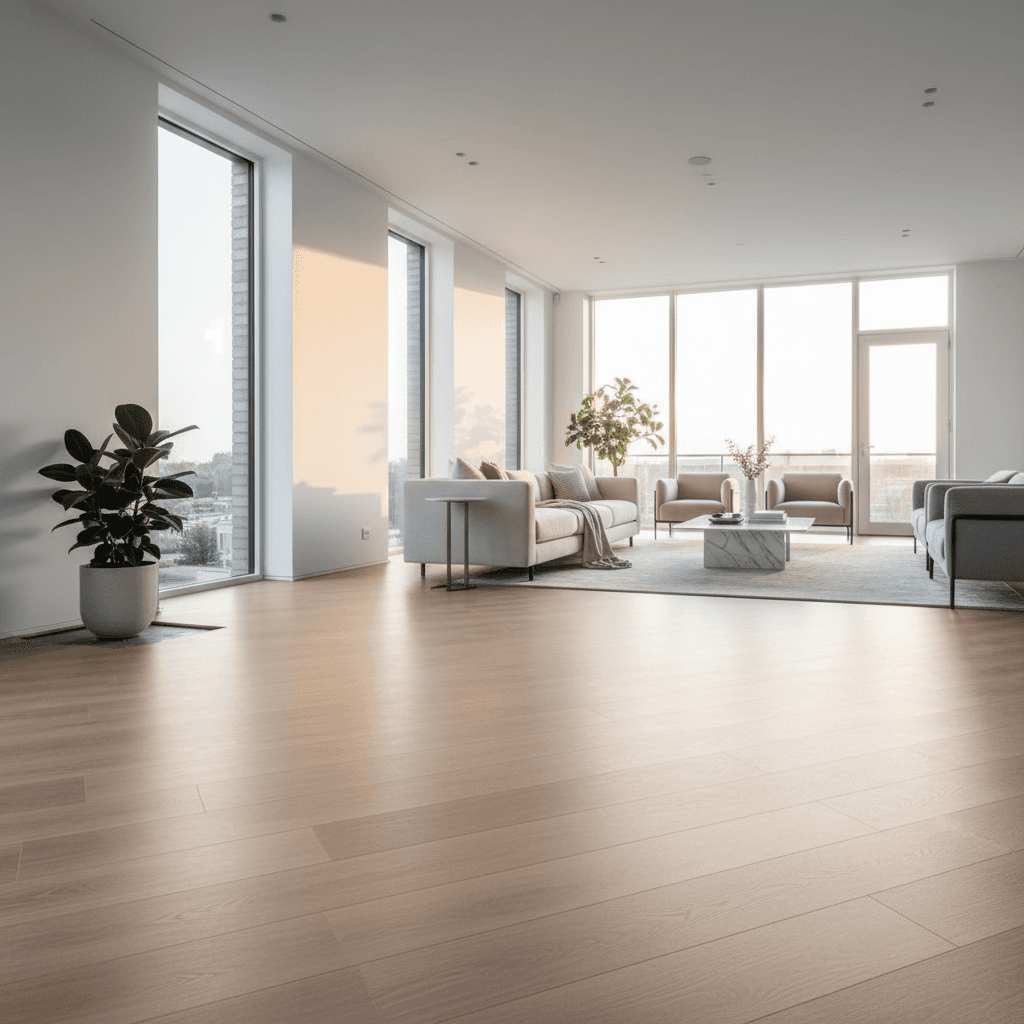
Match the budget to the work you need. Each tier is a published range for that scope, with its source listed at the end of this guide, and the local figures below show how your area compares. None of them is a quote. Confirm dimensions, preparation, materials, labor, fees and exclusions in each proposal.
$800 to $4.8k
$4k to $15k
$8k to $30k
Use the ranges to discuss scope and allowances. A site assessment and written proposals determine your actual cost. Material prices and service-life ranges below depend on product, installation and conditions; they are not warranties. References support their specific topics and do not validate all prices in this guide.
Compare project costs by areaHardwood, engineered, tile, luxury vinyl plank, and laminate. Real cost data, lifespan comparisons, and vetted local installers.
Flooring is the largest visible surface in your home. Get it right and the rest of the design comes together. Get it wrong and every room reads cheap. Luxury vinyl plank now gives a convincing wood look with better water resistance than laminate, and it starts at a lower installed price than engineered hardwood.
National pricing from HomeGuide: new flooring averages $4 to $15 per square foot installed, with material at $1 to $50 and labor at $2 to $8 per square foot. By material, installed: carpet $2 to $8, laminate $4 to $14, luxury vinyl plank $4 to $16, engineered wood $7 to $20, hardwood $11 to $25 and tile $10 to $50 per square foot.
Luxury vinyl plank (LVP) went from a budget category to a common choice for kitchens, bathrooms, basements and high-traffic areas. HomeGuide lists LVP at $4 to $16 per square foot installed and notes it is thicker and more durable than standard vinyl. Compare the wear layer and the written residential warranty before you choose a product line.
Traditional homes and higher-end listings still benefit from solid or engineered hardwood. Solid hardwood can last for generations with care and can be refinished, which HomeGuide prices at $2 to $8 per square foot. Engineered wood can be refinished only a limited number of times because of its thin top layer. Reserve hardwood for living areas, bedrooms and dry spaces. Use LVP or tile for kitchens, bathrooms, mudrooms and basements.
Material is only part of the bill. HomeGuide prices the common extras separately: carpet removal $0.70 to $1.60 per square foot, tile removal $2 to $7, underlayment $0.50 to $3.50, and subfloor replacement $2.20 to $4.75 per square foot. Carpeting a staircase runs $150 to $600. Many contractors also have a $200 to $500+ minimum project fee, which is why small rooms cost more per square foot.
Look for several reviewed installations of your specific material. Ask for the moisture meter readings on the subfloor before they install. Verify the warranty registration is in your name, not the contractor's. Get itemized bids: separate material, removal, prep, install and trim line items.
Compare the complete specification, not just the price per unit. Ask which preparation, installation and finish work the allowance includes.
Typical service life: 8 to 10 years · Regional fit: Both
Lowest installed price in the HomeGuide table
Typical service life: 15 to 25 years · Regional fit: Both
Stone, tile or wood look; not suited to humid spaces
Typical service life: 25 years · Regional fit: Both
Thicker and more durable than standard vinyl
Typical service life: 50+ years · Regional fit: Both
Refinishing limited by the thin top layer
Typical service life: 100+ years · Regional fit: Both
Can last for generations with care
Typical service life: 75 to 100 years · Regional fit: Both
Widest price range in the HomeGuide table
The guide’s planning timeline is 1 to 3 days for a typical installation. Ask the contractor to separate design, approvals, ordering and construction in the schedule for your scope.
Measure the rooms and agree on the product, layout and waste allowance. Compare samples in the actual rooms.
Check moisture, flatness and substrate condition against the selected flooring system’s requirements. Price repairs before installation.
Follow the selected manufacturer’s acclimation and environmental instructions. Requirements differ between products.
Agree on removal, disposal, protection and any hazardous-material assessment before disturbing the existing floor.
Install according to the selected system and allow for adhesive or grout cure times where relevant. Confirm room access during the work.
Finish transitions and trim, inspect the floor together and obtain care instructions and warranty documentation.
Give each contractor the same project description and product selections. Ask what is included, excluded or left as an allowance, who handles approvals, and how changes will be agreed in writing.
Cuts, mistakes and future repairs all need matching planks from the same dye lot. Ask the installer how much overage your layout needs and store the leftover in a closet for future patches.
This page uses three kinds of numbers. Per square foot prices are HomeGuide's national installed averages by material, and the tier ranges are HomeGuide's whole-project totals for one room, 1,000 sq ft and 2,000 sq ft. The local figures are what owners in each metro reported spending per flooring project in the Census housing survey, a different measure from a quoted price.
Start with the authority responsible for your property. Costs and requirements vary within a metro. Browse California city guides.
Editorial planning notes; confirm the current scope, requirements and prices locally.
The tier ranges above are national averages from HomeGuide. For a local measure, the Census American Housing Survey 2023 puts the median amount owners spent on a flooring, carpeting, paneling or ceiling tile project at $4,535 in the Los Angeles metro and $5,000 in the San Francisco metro. The survey publishes no San Diego figure. Labor rates, subfloor condition and how much old flooring comes out decide where a California quote lands.
The tier ranges above are national averages from HomeGuide. The Census American Housing Survey 2023 puts the median amount owners spent on a flooring, carpeting, paneling or ceiling tile project at $5,000 in the Seattle metro. Ask the installer to check subfloor moisture and how long the product needs to acclimate before install.
Carpet and standard vinyl sit at the bottom of HomeGuide's price table, at $2 to $8 and $2 to $10 per square foot installed. For a hard floor with a wood look, luxury vinyl plank runs $4 to $16 and laminate $4 to $14 per square foot installed, against $7 to $20 for engineered wood and $11 to $25 for solid hardwood. LVP also copes with moisture better than laminate, which does not suit humid spaces.
HomeGuide puts a typical flooring installation at 1 to 3 days. Removing old flooring and fixing problems found underneath can stretch that. Some products also need to sit in the room for a day or more before install to adjust to temperature and humidity, so schedule delivery ahead of the crew. Tile needs extra time for mortar and grout to cure before the floor takes full traffic.
Often, yes. Floating LVP can go over an existing hardwood floor that is flat, dry and firmly fastened, which saves the cost of tearing it out. Check door clearances and the transitions to adjoining rooms, since the new layer raises the floor. Follow the LVP manufacturer's flatness and subfloor requirements, because installing outside them can void the warranty.
It depends on the wear layer, the core and the traffic the floor gets. HomeGuide describes LVP and LVT as thicker and more durable than standard vinyl. Compare the wear-layer thickness and the residential warranty term in writing, since both vary by product line. Keep grit off the floor, put felt pads under furniture and clean with a damp mop to protect the surface.
HomeGuide notes that new hardwood floors tend to give the biggest return among flooring types, while the value added depends on the floor type, its quality and the local market. LVP makes sense in kitchens, bathrooms and basements where water resistance matters more than refinishing. Solid hardwood can be refinished, which extends its life in living areas and bedrooms.
A Renology representative calls to understand your plans and connects you with suitable contractors.
Find a ProFree to request a match. No obligation to hire.
Permits, costs and local conditions change by city. Pick the guide for your area.