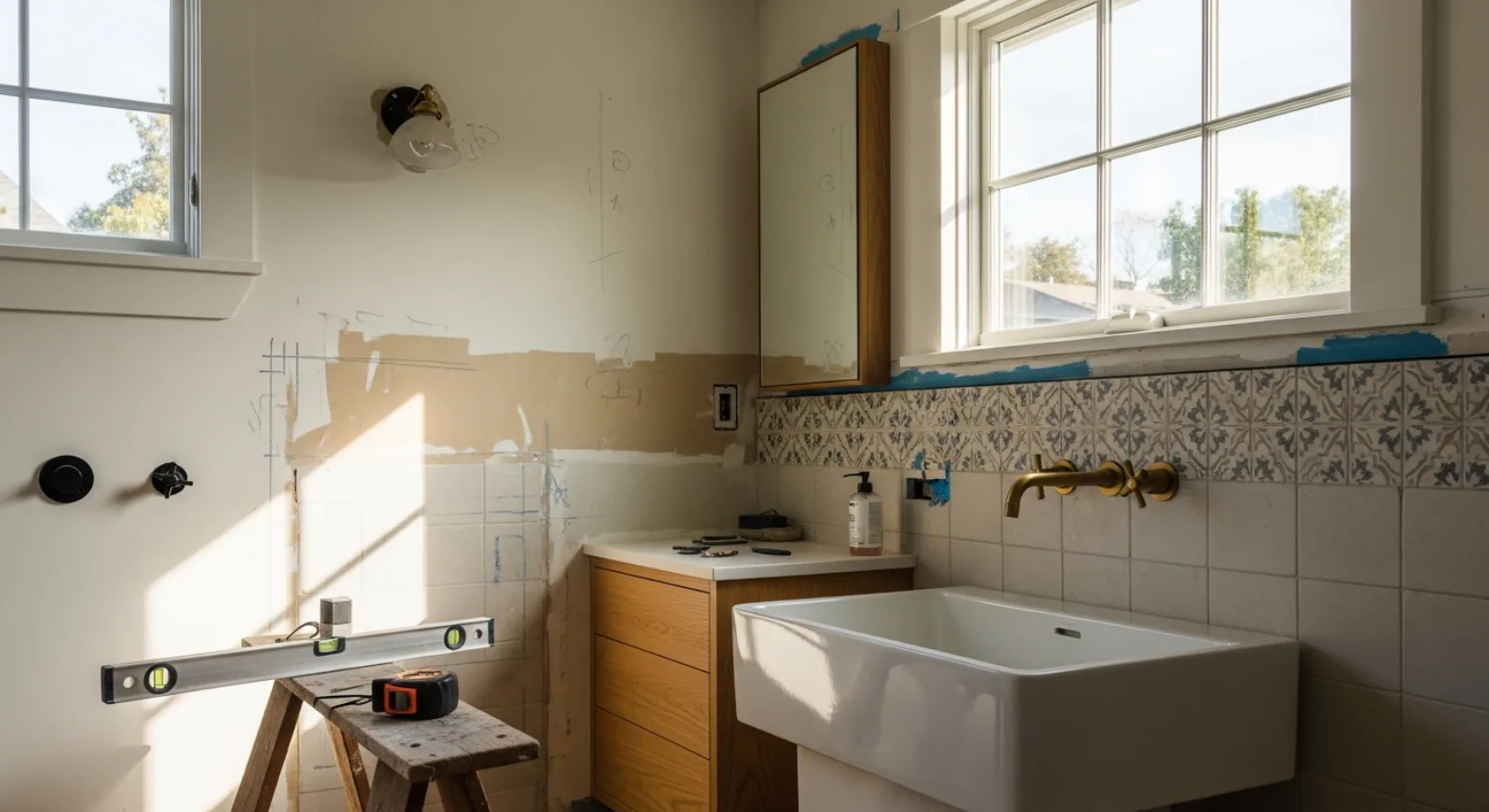
A bathroom remodel that goes wrong costs more than money. It costs time, sanity, and resale value. Most projects in major metros run twenty to thirty-five percent over budget, adding weeks or even months to the timeline. Most costly bathroom remodel mistakes stem from poor planning, improper hiring, and wishful thinking on material selection. The homeowners who avoid these outcomes are the ones who learn which bathroom mistakes to avoid before demolition begins. This isn't about luck; it's about process.
In a Nutshell
The average bathroom cost for a full remodel now sits between $28,000 and $65,000 (Renology Cost Index, updated 2026-06). The most frequent and costly bathroom mistakes to avoid are hiring an unvetted contractor, failing to waterproof correctly, and making late-stage changes to the plan. Your first move: create a binder with every single finish selection, from tile to towel bars, before you request a single bid.
Key Remodel Stats
- National Average Cost Range: $28,000, $65,000
- Typical Budget Overrun: 20-35%
- Recommended Contingency Fund: 10-15% (per NAHB)
- Most Common Cause of Delay: Change orders during construction
Mistake #1: Rushing the Planning Phase
Most homeowners are so eager to see progress they rush to demolition with only a vague idea of the final product. This is the foundational error that causes a cascade of other problems. Why it's wrong: Every decision made under pressure, with a torn-up bathroom and a waiting crew, costs a premium in both dollars and mistakes. A single change order to move a vanity light box after drywall is up can add $500 and a day's delay. What to do instead: Finalize every single selection before your contractor gives a final bid. I mean everything: the exact model of faucet (like a Brizo Litze in Luxe Gold), the tile (Ann Sacks, not just 'white subway tile'), the grout color (Mapei 'Warm Gray'), the paint (Benjamin Moore Aura Bath & Spa in Chantilly Lace), the vanity, the toilet, and the light fixtures. This forces you to confront layout and compatibility issues on paper, which is free, rather than in the field, which is expensive. A complete spec book is your single best defense against budget creep and a key part of avoiding common bathroom mistakes to avoid.
Mistake #2: Hiring the Wrong Contractor
Homeowners often default to the first available contractor or the one with the lowest bid, skipping the rigorous vetting process. This is a gamble with the most expensive room in your house. Why it's wrong: A low bid can signal unlicensed labor, inadequate insurance, or a plan to make up the difference with expensive change orders. An unqualified contractor can cause catastrophic damage, from failed waterproofing that rots your subfloor to faulty wiring that creates a fire hazard. The cost to fix these errors can exceed the original budget. What to do instead: Vet your contractor methodically. Get three quotes. Check three references. Visit one finished job before signing. Verify their license and insurance are active. Ask how they handle waterproofing (they should name a system like Schluter-KERDI or Laticrete Hydro Ban). A professional's bid will be detailed, breaking down labor, materials, and permits. It won't be the cheapest, but it will be the most realistic. For more on this, see our guide to hiring a general contractor.
Mistake #3: Underestimating the True Cost
Many people anchor their budget to outdated blog posts or TV shows, ignoring the current reality of labor and material costs. They build a plan around a fantasy number. Why it's wrong: An unrealistic budget guarantees you will either run out of money mid-project, be forced to make significant quality compromises, or rack up debt. The average bathroom cost for a full, to-the-studs remodel in a major U.S. city now runs $28,000 to $65,000 according to the Renology Cost Index for 2026. Refresh projects or small condo bathrooms can start lower, but that higher figure reflects projects with tile work, plumbing moves, and quality fixtures. What to do instead: Anchor your budget in reality. We use a ten to fifteen percent contingency as a planning assumption; for comparison, HUD's Standard 203(k) loan rules require a reserve of at least 10 percent on homes 30 years or older. If your budget is $40,000, plan to spend $36,000 and hold $4,000 in reserve for the unexpected, like discovering old galvanized pipes that need replacing. Lock in your scope and budget before work begins, and treat your contingency fund as a non-negotiable part of the total cost.
Mistake #4: Ignoring Waterproofing and Ventilation
3 bathroom remodelers, editor-screened. 4 questions.
See my 3 matchesHomeowners focus on the visible finishes, the tile and faucets, and completely overlook the waterproofing membrane behind the walls and the fan overhead. This is the single most destructive mistake you can make. Why it's wrong: Improper waterproofing leads to slow leaks, hidden mold growth, and structural rot that can cost tens of thousands to remediate years later. An undersized or nonexistent exhaust fan allows humidity to build up, peeling paint, warping cabinetry, and fostering mildew. This is a particular risk in coastal areas like San Francisco or Seattle where ambient humidity is already high. What to do instead: Insist on a modern, top-tier waterproofing system. Your contractor should be using a membrane system like Schluter-KERDI or a liquid-applied system like RedGard over cement board. Green board or standard drywall is not acceptable in a wet area. For ventilation, install a high-capacity fan (measured in CFM, or cubic feet per minute) that is properly vented to the exterior of the house, not just into the attic. It’s a small upfront cost that prevents catastrophic long-term damage.
Mistake #5: Choosing Finishes That Won't Last
It's easy to get seduced by a trendy finish seen on social media, like a matte black faucet or a porous natural stone, without understanding its long-term maintenance reality. Why it's wrong: Finishes that aren't durable for a high-use, high-moisture environment will look worn and dated within a few years, erasing the value of your investment. Matte black finishes from cheap brands can scratch easily, showing the brass underneath. Unsealed marble or travertine will stain and etch from common bathroom products. Polished nickel looks beautiful but requires constant polishing to avoid tarnishing. What to do instead: Choose finishes for longevity, not just for the trend. For faucets, look for PVD (physical vapor deposition) finishes, which are far more durable than powder coating. For tile, porcelain is the workhorse: it's non-porous, durable, and comes in thousands of styles. If you must have natural stone, understand and commit to the sealing and cleaning regimen required. For walls, use a paint specifically formulated for bathrooms, like Sherwin-Williams Emerald, which has superior moisture and mildew resistance. Learn more about material choices in our guide to porcelain vs. ceramic tile.
Mistake #6: Creating a Poor Layout
Many remodels keep the existing plumbing layout to save money, even if that layout is awkward or inefficient. Why it's wrong: A bad layout is something you live with every single day. Cramped shower doors, vanities with no counter space, and poor traffic flow make the expensive new finishes feel wasted. You invest thousands of dollars only to perpetuate the room's core functional problem. What to do instead: Question the existing layout. Even small changes can have a huge impact. Can the door swing be reversed to open against a wall? Can a smaller, wall-mounted toilet free up floor space? Can you replace a bulky vanity with a floating one to create a sense of openness? Spend time with blue tape on the floor of the empty room, mapping out the placement of each fixture to get a real-world feel for clearances. Consult the National Kitchen & Bath Association (NKBA) planning guidelines for recommended minimum distances. Changing the layout costs more due to plumbing and electrical work, but it's often the most valuable part of the investment.

Mistake #7: Designing a Bad Lighting Plan
Most bathrooms have a single, sad vanity light or a central ceiling fixture. This is treated as an afterthought. Why it's wrong: Poor lighting is not just an aesthetic failure; it's a functional and safety failure. A single overhead light casts shadows on your face, making grooming difficult. A dark shower is a slipping hazard. Incorrect color temperature can make a carefully chosen paint color like Benjamin Moore's 'Pale Oak' look sickly green. What to do instead: Implement a layered lighting strategy. You need three types of light. One, task lighting, like vertical sconces on either side of the mirror, to provide even, shadow-free light on your face. Two, ambient lighting, typically a central flush-mount or recessed lights on a dimmer, to fill the room. Three, accent lighting, like a waterproof recessed light in the shower (a 'can' light rated for wet locations). Use dimmers everywhere possible. Pay attention to the specs: look for a high CRI (Color Rendering Index) of 90+ and a color temperature of around 3000K for a clean but not sterile light.
What no one else covers
The conversation about bathroom costs often misses the granular details of what drives expenses beyond the obvious tile and labor. The 'invisible' infrastructure is where budgets truly break. For example, moving a toilet more than a few feet can involve not just the plumber, but also a framer to cut and reinforce joists, potentially changing the structure of the floor below. The cost isn't just the plumber's time; it's the cascading impact. Similarly, homeowners fall in love with heavy freestanding tubs without considering the structural engineering required. A cast iron tub filled with water can weigh over 1,000 pounds, requiring a structural engineer's assessment and potentially thousands in floor reinforcement, a cost almost never included in initial estimates. Labor rates themselves are a major variable. According to the U.S. Bureau of Labor Statistics Occupational Employment and Wage Statistics, the mean hourly wage for a plumber in a high-cost area like the San Francisco-Oakland-Hayward metro can be over 50% higher than in a lower-cost region. This regional wage difference is a primary driver of cost variation nationwide. Finally, understanding the permit process is critical. Minor updates may not require a permit, but moving plumbing or electrical requires one. The process itself can add weeks and hundreds or thousands of dollars. Our guide to permits can help you prepare for this easily overlooked step: read the national bathrooms permit playbook for 2026.
Three representative projects from 2026
Three modeled project scenarios for 2026, built from the Renology Cost Index and typical local scopes. These are illustrative estimates, not completed client projects:
- $31,500 Guest Bathroom Refresh (Seattle): A 5x8 foot guest bathroom in a Queen Anne condo. The project kept the original layout but replaced all finishes. It included a new porcelain tile floor, a prefabricated vanity, a new toilet, and tiling the shower/tub combo with Daltile ceramic tile. The plumbing and electrical were not moved, which kept costs down.
- $48,000 Primary Bathroom Remodel (Los Angeles): A 10x12 foot primary bath in a Silver Lake home. This project involved moving the shower plumbing to accommodate a larger, curb-less shower with a frameless glass enclosure and a Schluter-KERDI drain. It featured a custom-built vanity with a quartz countertop, designer fixtures, and a comprehensive lighting plan with recessed cans and sconces.
- $67,000+ Primary Bathroom Expansion (San Diego): A major renovation in a La Jolla home that involved removing a non-load-bearing wall to combine a small bathroom with a closet. This project included significant plumbing and electrical rerouting, a freestanding tub, a separate walk-in shower, a double vanity, and high-end finishes like marble tile and unlacquered brass fixtures from Waterworks. Permitting and structural review were significant cost factors.
Sources & Methodology
See the Renology Methodology for how sources are reviewed, ranges are normalized, and planning-data limits are handled.
Cost ranges in this guide draw on the following named industry sources, public agency datasets, and Renology editorial research.
- Renology Cost Index (2026-06)
- National Association of Home Builders (NAHB), Remodeling Market Index (Q1 2026)
- National Kitchen & Bath Association (NKBA), Bathroom Design Trends Report (2026)
- U.S. Bureau of Labor Statistics, Occupational Employment and Wage Statistics (May 2025)
- Remodeling Magazine, Cost vs. Value Report (2026)
- Harvard Joint Center for Housing Studies (JCHS), Leading Indicator of Remodeling Activity (LIRA) (Q2 2026)
- AIA Contract Documents, A101-2017 Standard Form of Agreement (2017)
- U.S. Census Bureau, Monthly Construction Spending (April 2026)
- Tile Council of North America (TCNA), Handbook for Ceramic, Glass, and Stone Tile Installation (2026)

Renology Take
The meta-mistake that enables all the others is impatience. Homeowners are so focused on the 'after' photo that they refuse to spend adequate time in the 'before' phase of deep planning. They want the sledgehammers to swing next Monday. This rush forces a reactive, rather than proactive, remodeling process. It leads to hiring the first available contractor, not the best one. It means making design decisions on a job site instead of from a detailed plan. It results in change orders, blown budgets, and profound regret. The single most effective way to guarantee a successful bathroom remodel is to have the discipline to finalize one hundred percent of your decisions before demolition begins. Create a binder, physical or digital, with every spec sheet, every sample, every paint chip. If you can’t wait six weeks to plan, you will almost certainly spend an extra six months in construction chaos.
Frequently Asked Questions
What's the most expensive mistake in a bathroom remodel?
How do I know if my contractor is padding the quote?
When should I walk away from a quote?
What's the fastest way to blow a bathroom budget?
Can I save money by buying my own materials?
How important is a lighting plan in a bathroom?
What is the biggest regret homeowners have after a remodel?
How much does it really cost to move a toilet?
Ready to find a pro?
Tell us what you are planning and where. A Renology advisor can help you explore contractor matching.
Find a Pro- Free for homeowners
- Licensed, vetted local contractors
- No obligation to hire
Sources
- Renology Cost Index
- National Association of Home Builders (NAHB), Remodeling Market Index
- National Kitchen & Bath Association (NKBA), Bathroom Design Trends Report
- U.S. Bureau of Labor Statistics, Occupational Employment and Wage Statistics
- Remodeling Magazine, Cost vs. Value Report
- Harvard Joint Center for Housing Studies (JCHS), Leading Indicator of Remodeling Activity (LIRA)
- AIA Contract Documents, A101-2017 Standard Form of Agreement
- U.S. Census Bureau, Monthly Construction Spending
- Tile Council of North America (TCNA), Handbook for Ceramic, Glass, and Stone Tile Installation
Follow Renology on Google
Choose Renology as a preferred source and our guides show up more often in your Google results, including Top Stories and AI Overviews.