Open-Plan Finish
$18k to $24k
- One open room of about 600 square feet
- Framing, insulation, drywall and paint
- Flooring, wiring and lighting
- No bathroom; HomeGuide prices a basement bathroom addition at $10k to $25k
Start by assessing moisture, ceiling height, access and the intended use of the basement. A family room, bedroom and separate dwelling need different planning. Resolve water problems before finishes, and confirm the proposed use and approvals with the local authority.
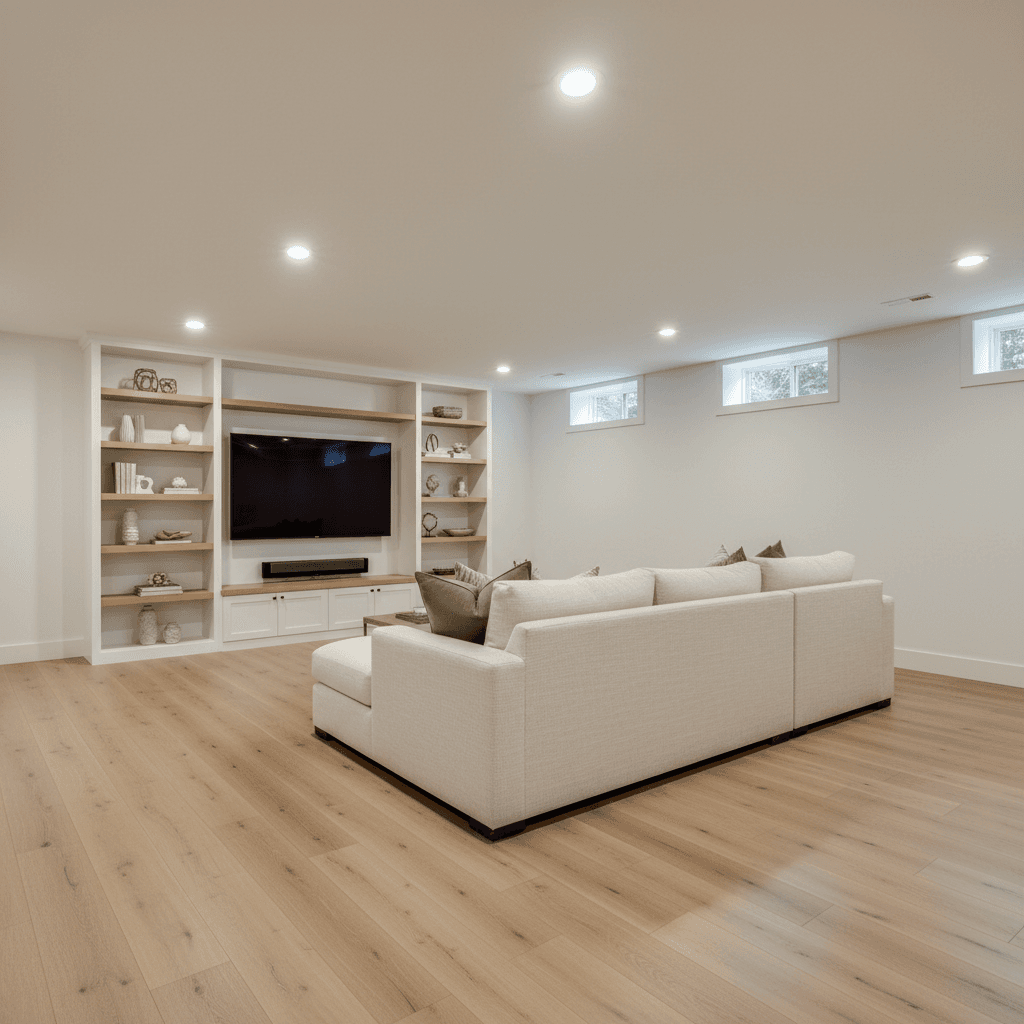
Match the budget to the work you need. Each tier is a published range for that scope, with its source listed at the end of this guide, and the local figures below show how your area compares. None of them is a quote. Confirm dimensions, preparation, materials, labor, fees and exclusions in each proposal.
$18k to $24k
$24k to $30k
$30k to $60k
Use the ranges to discuss scope and allowances. A site assessment and written proposals determine your actual cost. Material prices and service-life ranges below depend on product, installation and conditions; they are not warranties. References support their specific topics and do not validate all prices in this guide.
Compare project costs by areaConvert unfinished Pacific Northwest basements into livable square footage. Family rooms, ADUs, home offices, and rental suites.
A finished basement is one of the best ways to add living space without expanding your home's footprint. In Pacific Northwest markets where basements are common (Seattle, Tacoma, Olympia), finishing the basement turns space you already have into rooms you use. HomeGuide (updated February 6, 2026) puts the average cost at $30 to $50 per square foot, or $15,000 to $75,000 total depending on size and the number of rooms, and HomeAdvisor gives the same $15,000 to $75,000 range with most homeowners spending around $32,000. In the 2025 Cost vs Value Report, a basement remodel recoups 70.8% of its cost at resale in the Pacific region and 68% in Seattle.
Pricing for a 600 square foot basement, from HomeGuide: $18,000 to $24,000 for an open-plan finish, $24,000 to $30,000 for a three-room finish, and $30,000 to $60,000 to turn it into an ADU with a living area, bedroom, bathroom and kitchen. A basement bathroom addition on its own runs $10,000 to $25,000.
An existing basement may offer useful space without a new exterior footprint. Check moisture, ceiling height, access, daylight and the intended use first. A family room, bedroom and separate dwelling are different scopes; an unfinished room is not automatically approved living area.
Have water intrusion, drainage and indoor humidity investigated before closing walls or installing flooring. A simple visual check or plastic-sheet test does not identify every source of moisture. Ask for a site-specific repair and drying plan, and confirm compatibility of the wall and floor assemblies.
Legal bedrooms need an emergency escape opening. The International Residential Code (R310) sets a net clear opening of at least 5.7 square feet, at least 24 inches high and 20 inches wide, with the sill no more than 44 inches above the floor. HomeGuide prices an egress window at $2,000 to $5,000 installed in its basement finishing guide and $6,000 to $8,000 in its basement remodeling guide, so get a site quote.
Without egress, you can call the room a "den" or "office" but not a bedroom, and that label follows the house when you sell.
Washington state law (RCW 36.70A.680 and 36.70A.681) requires cities and counties planning under the Growth Management Act to allow two ADUs per lot in urban growth areas, and an ADU can be a separate unit inside an existing home, such as a basement (MRSC, last modified July 27, 2026). The unit needs its own kitchen, sleeping area and bathroom. HomeGuide prices a 600 square foot basement ADU at $30,000 to $60,000, depending on finishes. Rent depends on your street; price comparable legal rentals nearby before you count on the income.
Compare the complete specification, not just the price per unit. Ask which preparation, installation and finish work the allowance includes.
Typical service life: 100+ years · Regional fit: PNW
Helps regulate moisture, temperature and sound
Typical service life: 75 years · Regional fit: Both
Texturing adds $0.80 to $2.00 per sq ft
Typical service life: 15 to 25 years · Regional fit: Both
One of the lower-priced basement floors
Typical service life: 75 to 100 years · Regional fit: PNW
Hard surface for damp-prone areas
Regional fit: Both
Basement bedrooms or living spaces need an egress window or door
Typical service life: 7 years · Regional fit: PNW
Part of a waterproofing system with a drain
The guide’s planning timeline is 4 to 16 weeks. Ask the contractor to separate design, approvals, ordering and construction in the schedule for your scope.
Investigate moisture, water entry and drainage. Resolve the source and agree on suitable assemblies before covering the space.
Confirm the intended legal use, access and emergency escape requirements with the local authority. Identify the required approvals.
Coordinate framing and service routes to the project design. Complete required rough-in inspections before covering work.
Install the specified moisture-compatible insulation and wall system. Follow inspection and drying requirements.
Coordinate flooring, paint, trim and any bathroom finishes. Confirm access and ventilation during the work.
Complete applicable inspections and approval for the intended use. Review outstanding items and closeout documents.
Give each contractor the same project description and product selections. Ask what is included, excluded or left as an allowance, who handles approvals, and how changes will be agreed in writing.
The single biggest predictor of basement-finishing failure is unaddressed moisture. Tape a square of plastic sheeting to the floor, leave it for a couple of days, and check both sides for condensation. Fix every moisture problem before framing.
Basement walls sit against damp concrete, so the insulation choice matters as much as its price. Ask each bidder which insulation they plan to use against the concrete, how it controls moisture, and what it costs per square foot.
You will meet two kinds of basement numbers on Renology. The tiers above are HomeGuide's national contractor price ranges by scope for a 600 square foot basement, while Cost vs Value prices one fully defined contractor job, a 20 by 30 foot room with a wet bar and a full bathroom, city by city. That is why its Seattle figure sits above the tiers.
Start with the authority responsible for your property. Costs and requirements vary within a metro. Browse California city guides.
Editorial planning notes; confirm the current scope, requirements and prices locally.
Basements are less common in California. The 2025 Cost vs Value Report prices the same defined basement remodel at $53,279 in Los Angeles and $64,351 in San Francisco. The tier ranges above are national HomeGuide prices.
The tier ranges above are national HomeGuide prices for a 600 square foot basement. In Seattle, the 2025 Cost vs Value Report prices one defined basement remodel (a 20 by 30 foot entertaining area with a wet bar and a 5 by 8 foot full bathroom) at $68,358, against $55,483 for the Pacific region and $52,012 nationally. It recoups 68% of its cost at resale in Seattle.
For a 600 square foot basement, HomeGuide prices an open-plan finish at $18,000 to $24,000, a three-room finish at $24,000 to $30,000 and a basement ADU with living area, bedroom, bathroom and kitchen at $30,000 to $60,000. Across all sizes, HomeGuide and HomeAdvisor both put basement finishing at $15,000 to $75,000. Seattle runs higher: the 2025 Cost vs Value Report prices one defined basement remodel with a wet bar and full bathroom at $68,358 there.
Often, yes. Washington state law (RCW 36.70A.680 and 36.70A.681) requires cities and counties planning under the Growth Management Act to allow two ADUs per lot in urban growth areas, and a unit inside an existing home, such as a basement, can qualify. The unit needs its own kitchen, sleeping area and bathroom, egress for bedrooms, and approval for occupancy from your city. In Seattle, that goes through SDCI.
Yes for any habitable conversion. Permits cover plumbing, electrical, framing and HVAC work. HomeGuide puts a basement finishing permit at $200 to $1,000, or 1% to 2% of total costs, and HomeAdvisor at $1,200 to $2,000, a fee that often covers the required inspections. Skipping permits creates resale problems and insurance gaps, and an unpermitted room may not count as living space.
Test for water intrusion and humidity before any framing. Fix the source first: grading, gutters, cracks, or a perimeter drain and sump pump where needed. HomeGuide puts full basement waterproofing, including sealing the walls and adding a pump and drain, at $6,000 to $18,000, and a sump pump alone at $600 to $2,500 installed. Then choose wall and floor assemblies that suit damp concrete, and run a dehumidifier.
In the 2025 Cost vs Value Report, a basement remodel recoups 71% of its cost at resale nationally, 70.8% in the Pacific region and 68% in Seattle. The project priced is a 20 by 30 foot entertaining area with a wet bar and a 5 by 8 foot full bathroom. HomeGuide gives basement remodels a 65% to 70% return. Rental income from a legal ADU is a separate question; price it from comparable legal rentals.
A Renology representative calls to understand your plans and connects you with suitable contractors.
Find a ProFree to request a match. No obligation to hire.
Permits, costs and local conditions change by city. Pick the guide for your area.