Service Guide
Replacing Siding
in California
How stucco, fiber cement, wood, metal and stone compare on price, sun and fire, with 2026 installed costs and the rules for fire hazard zones.
$6 to $17
Per sq ft installed
UV
Main cause of wear here
Class A
Fiber cement fire rating
50 to 75 Yrs
Fiber cement, per HomeGuide
Before You Choose
What California Asks of Siding
Siding is the layer that keeps weather out of the walls. In most of California the hard part is not snow or months of rain but sun. Long, dry summers of UV break down paint, bleach color and wear out weaker materials well ahead of schedule.
Stucco is still the default finish, but fiber cement now takes a large share of re-siding work. James Hardie, the best-known maker, sells different formulations for different climates. The boards look like wood, do not burn like wood, and hold up in sun. Plenty of good-looking exteriors mix two or three materials rather than one.
Color and Sun
HomeGuide notes that vinyl color can fade in direct sunlight, while fiber cement resists UV rays. Choose the finish as carefully as the board underneath it.
Siding Cost in California for 2026
Siding in California runs $6 to $17 per square foot installed in 2026 for the common materials, with stone veneer higher at $10 to $45. Those are HomeGuide's national figures: fiber cement (James Hardie) at $6 to $15, cedar at $6 to $16, steel at $7 to $16 and stucco at $7 to $17. On a 2,500 square foot house, HomeGuide's average total is $10,000 to $32,500, depending on the material, whether the old siding has to come off, and how complicated the walls are.
Quick Answer: Siding Materials by Price
| Material | Installed / sq ft | Lifespan | Upkeep |
|---|---|---|---|
| Fiber cement | $6 to $15 | 50 to 75 years | Minimal; factory finish |
| Cedar | $6 to $16 | 20 to 40 years | Refinish often |
| Steel or metal | $7 to $16 | 40 to 70+ years | Minimal |
| Stucco, three-coat | $7 to $17 | 50 to 80 years | Repaint when worn |
| Stone veneer (manufactured) | $10 to $45 | 50 to 75 years | Minimal |
Installed prices and lifespans are HomeGuide's national figures.
For a local benchmark, Cost vs Value 2025 prices a defined 1,250 square foot fiber cement re-side at $21,879 in Los Angeles and $24,197 in San Francisco.
Stucco: The Default California Exterior
Stucco covers more California houses than any other material. In the West, the Census Bureau counted it as the main wall material on 55 percent of new single-family houses completed in 2025. If you own a house here, the odds are good you own stucco, so it pays to know the types and what repairs cost.
Three-Coat Stucco
Traditional stucco goes on in three layers, a scratch coat, a brown coat and a finish coat, over metal lath fastened to the sheathing. HomeGuide prices it at $7 to $17 per square foot installed and gives it 50 to 80 years, while noting it is not ideal for rainy climates, a limit that leaves most of California in good shape. Cement stucco does not burn, with no added treatment. Its mass soaks up heat during the day and lets it go at night, which evens out indoor temperatures. Color is open-ended, and textures range from smooth to sand, dash and lace.
EIFS, or Synthetic Stucco
EIFS (Exterior Insulation and Finish System) puts a thin acrylic finish over foam insulation board. The foam insulates better than cement stucco does, and HomeGuide describes EIFS as softer and easier to repair. Its weak point is water: badly installed EIFS has a record of trapping moisture around windows and other openings. Dry weather lowers that risk here, but flashing and drainage still have to be right, which is easiest on new construction where the drainage plane goes in from the start.
Repair or Replace
Cost depends on how far the damage goes. Hairline cracks are cosmetic; HomeGuide says cracks 1/16 to 1/8 inch wide can be closed with caulk and paint for under $30 as a DIY job. Wider cracks can point to movement or problems behind the surface. Small professional repairs run $200 to $800, and larger jobs such as fixing water damage $1,000 to $4,000. Stripping everything to the sheathing and starting over costs about the same as new stucco: $17,500 to $42,500 for a 2,500 square foot house on HomeGuide's figures. Lean toward replacement when cracking is widespread, the surface bubbles or peels away, water keeps getting in, or the wall sounds hollow when you tap it.
Why Stucco Suits the Climate
Stucco does best where it is dry, which describes most of California. Its thermal mass also trims cooling load by storing daytime heat and releasing it after dark, a good match for warm days and cool nights.
Siding That Stands Up to Wildfire
Wildfire risk now reaches well past mountain towns, so homeowners across the state weigh siding on fire performance, insurance and resale, not looks alone.
Fiber Cement
HomeGuide prices fiber cement siding at $6 to $15 per square foot installed. It has a Class A fire rating and resists termites, and James Hardie, which tunes its formulas to regional climates, backs its siding with a 30-year limited warranty. Made from cement, sand and cellulose fiber, it does not burn. It handles UV far better than vinyl or wood, and Hardie's factory finish carries a 15-year finish warranty. Lap, board and batten, shingle and panel profiles let it stand in for almost any look.
Stucco
Cement stucco is noncombustible by its makeup. A well-applied three-coat system forms one continuous skin with no joints, which slows flame spread and keeps embers out. Siding with seams gives embers more places to lodge, so stucco has an edge in fire zones.
Metal
HomeGuide puts steel siding at $7 to $16 per square foot installed, and metal panels do not burn. Steel and aluminum panels suit modern California houses with clean lines. Aluminum is the lighter and cheaper of the two, and HomeGuide says metal siding lasts 40 to 70+ years with proper care. Insulated metal panels put the cladding and the insulation into a single product.
What to Leave Off in a Fire Zone
Vinyl softens and can melt at temperatures far below what a passing wildfire produces, so it is a poor choice in a Very High Fire Hazard Severity Zone (VHFHSZ). Natural wood burns and is generally ruled out in those zones unless it is a fire-retardant-treated product approved as ignition-resistant. At the base of the wall, the state's Safer from Wildfires program asks for at least 6 inches of noncombustible material, measured up from the ground or from an attached surface such as a deck, so embers cannot pile up and ignite the wall.
Short List for Fire Zones
Fiber cement, stucco and metal lead the list. Each is noncombustible or ignition-resistant and suits a VHFHSZ. Fiber cement gives the most design range, stucco the classic California look, and metal the most modern one.
What You Gain
What the Right Siding Does for a California House
Fire Resistance
Stucco and fiber cement do not burn, which counts most in Very High Fire Hazard Severity Zones (VHFHSZ), where wind-blown embers are the main threat to a house.
Color That Lasts in the Sun
Factory-applied finishes are made to resist UV fading through long summers. James Hardie backs its factory finish for 15 years, per HomeGuide.
Better Insulated Walls
A re-side can add continuous insulation outside the studs, which cuts heat flow and thermal bridging and eases cooling in hot inland areas.
A Different-Looking House
Siding is most of what you see from the street, so new cladding changes how the whole house reads, sometimes more than any other single project.
Built for Ground Movement
Siding installed correctly moves with the house in an earthquake instead of cracking. Fiber cement and other engineered products take vibration better than rigid finishes.
Decades of Service
HomeGuide gives fiber cement siding and manufactured stone veneer 50 to 75 years each, with little upkeep along the way.
Step by Step
How a Re-Siding Job Runs
Inspection
Day 1The contractor checks the existing siding, sheathing, water barrier, trim and structural connections, and notes damage, moisture and code problems. You should come away with photos and a straight answer on whether repair or replacement makes sense.
Choosing Materials
PlanningMaterial and color get matched to the house style, budget, fire zone and the look you want, often mixing two or more products. Ask to see large samples held against your own walls before you commit.
Permit
Before Work StartsA permit is needed when the job changes structure, adds a new water barrier, or switches to a material with a different fire rating. In the City of Los Angeles, LADBS takes the application. A simple re-stucco or like-for-like swap may qualify for an over-the-counter permit.
Installation
7 to 14 DaysHomeGuide says fiber cement goes on in 7 to 14 days on average, plus 4 to 5+ days if pre-primed boards need paint. The crew strips the old siding if it is coming off, repairs the sheathing, installs a new water-resistive membrane, hangs the siding, adds trim and flashing, caulks the joints and applies finish coats, covering plants and cleaning up each day.
Final Inspection
CompletionThe crew walks the job with you, the city inspects, the site is cleared and the warranties start. James Hardie warranties its fiber cement siding for 30 years; ask the installer for a written workmanship guarantee as well.
Side by Side
How Siding Materials Compare
| Attribute | Three-Coat Stucco | Fiber Cement ★ | Wood | Stone Veneer | Metal |
|---|---|---|---|---|---|
| Installed price per sq ft | $7 to $17 | $6 to $15 | $6 to $16 | $10 to $45 | $7 to $16 |
| Expected life | 50 to 80 yrs | 50 to 75 yrs | 20 to 40 yrs | 50 to 75 yrs | 40 to 70+ yrs |
| Fire | Does not burn | Does not burn | Burns* | Does not burn | Does not burn |
| Upkeep | Repaint as the finish wears | Minimal | Frequent refinishing | Minimal | Minimal |
| Sun and color | Good; needs paint | Strong; baked-on color | Weak; fades and grays | Strong | Strong |
| In an earthquake | Can crack | Flexes well | Good | Heavy; needs correct anchoring | Strong |
| Good fit for | Spanish and traditional homes | Nearly any style | Accents only | Entries and wall bases | Modern houses |
Our pick: For most California homes, fiber cement gives the best mix of fire resistance, UV stability, design range and lifespan, ideally the James Hardie HZ10 line made for hot, sunny climates. Stone veneer at the entry or along the base adds contrast.
*In Very High Fire Hazard Severity Zones, wood siding is generally ruled out unless it is a fire-retardant-treated product approved as ignition-resistant.
Local Notes
Local Rules and Conditions to Plan Around
Fire Hazard Zone Rules
In a Very High Fire Hazard Severity Zone, exterior walls must be clad in noncombustible or approved ignition-resistant material. Wood is generally out unless it is a fire-retardant-treated product approved as ignition-resistant; stucco, fiber cement, metal and stone veneer each qualify. Eave soffits have to be closed in with noncombustible material, and exterior vents must resist embers. Los Angeles owners can look up a parcel at zimas.lacity.org.
Patch or Redo the Stucco
The Census Bureau counts stucco as the most common wall finish on new homes in the West. Hairline cracks usually need nothing more than patching and paint; HomeGuide says cracks 1/16 to 1/8 inch wide can be handled with caulk and paint. Wider cracks, bulges, peeling layers or signs of water behind the surface mean a bigger job: strip the stucco, fix the water barrier and lath, and apply a new three-coat system. HomeGuide puts stucco repair at $8 to $50+ per square foot, and water damage jobs at $1,000 to $4,000.
Hardie's HZ10 Line
James Hardie sells different fiber cement formulas by climate. HZ10 is the one it built for intense sun and heat, and Hardie's zip code lookup shows which zone your address falls in. Per HomeGuide, the factory finish carries a 15-year warranty. HZ10 comes in lap, board and batten, shingle and panel profiles.
Matching Siding to House Style
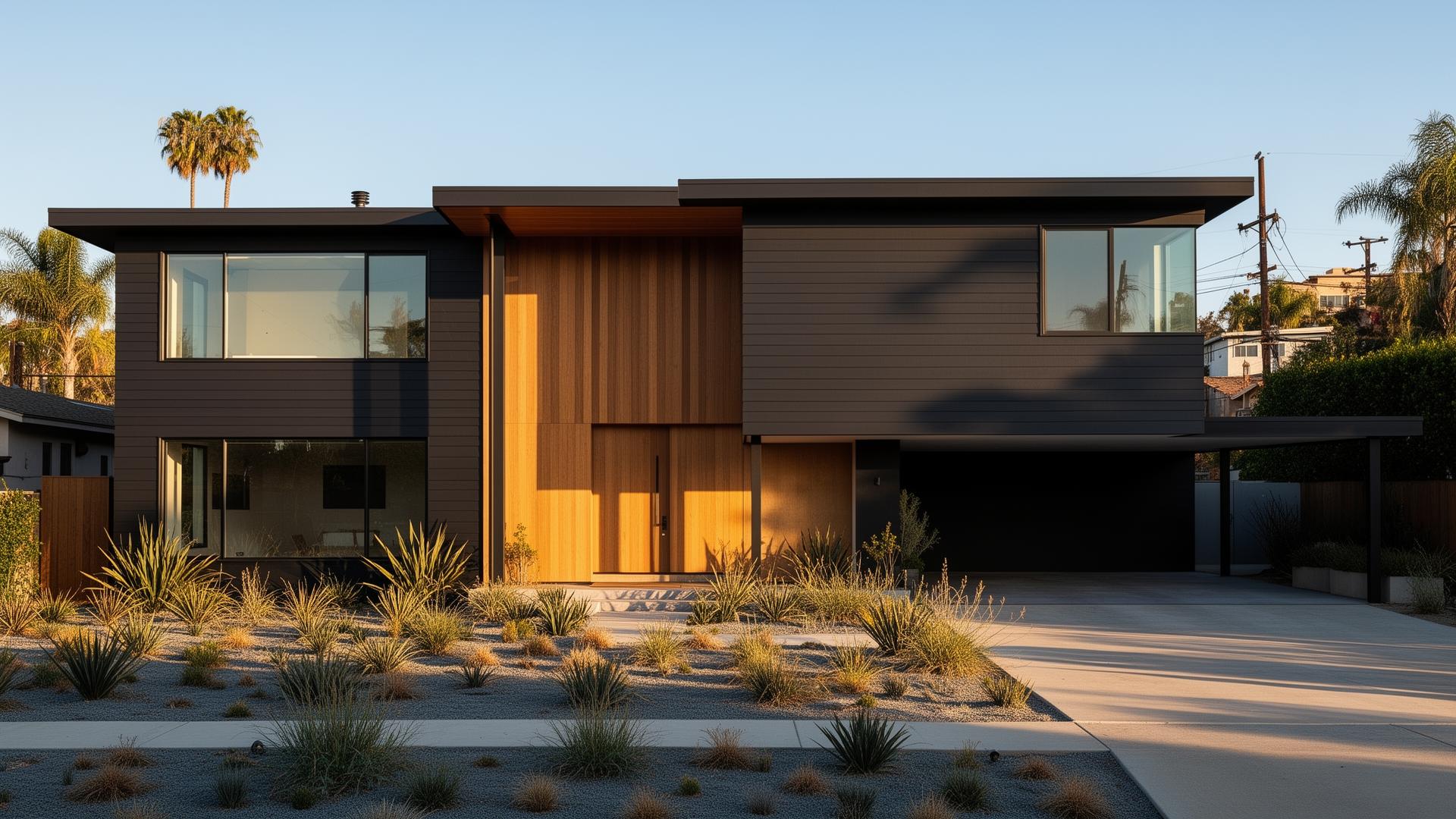
Spanish Colonial and Mediterranean: three-coat stucco in warm earth colors. Modern: dark fiber cement, either board and batten or flat panels, with metal accents. Craftsman: fiber cement shingles for a wood-shingle look without the upkeep. Mid-century: fiber cement panels that echo the original materials while performing like a new product.
FAQ
Siding Questions, Answered
Sources
- HomeGuide: Siding Cost (updated October 29, 2025)
- HomeGuide: Fiber Cement Siding Cost (updated June 23, 2025)
- HomeGuide: Stucco Repair Cost (updated February 9, 2026)
- HomeGuide: Stone Veneer Siding Cost (updated June 23, 2025)
- HomeGuide: Metal Siding Cost (updated August 1, 2023)
- James Hardie: The Hardie Zone System (accessed September 2026)
- JLC / Zonda: Cost vs Value 2025, Los Angeles (2025 report)
- JLC / Zonda: Cost vs Value 2025, San Francisco (2025 report)
- U.S. Census Bureau: Characteristics of New Housing, Primary Type of Exterior Wall Material of New Single-Family Houses Completed (2025 data)
- California Department of Insurance: Safer from Wildfires (accessed September 2026)
Find help with your siding project
A Renology advisor calls to understand your project and connect you with suitable contractors. Discuss your scope and request quotes directly from the contractors.
- Tell us about your project
- Speak with an advisor
- Connect with contractors
The contractors provide your project quotes.
Keep reading
Related renovation guides.
Continue through adjacent scopes so bids, permits, and material choices make sense together.
Your Next Step: Getting a Siding Quote in California
Browse top-rated siding contractors in California, compare options, and get matched for free.
Find a Trusted ProAn advisor discusses your project · Contractors provide the quotes