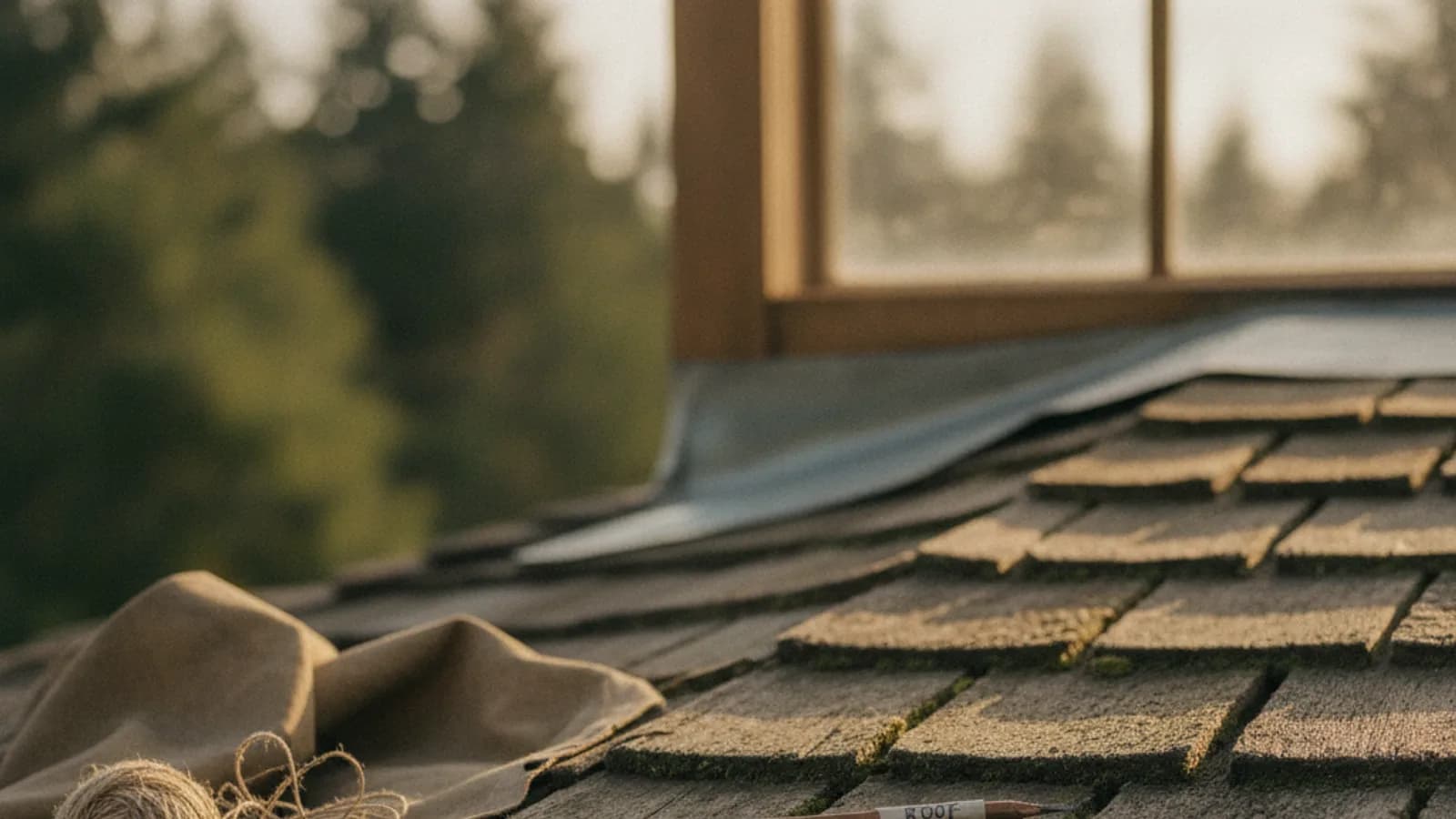
Planning a low-slope roof in West Seattle
Start with the roof assembly and drainage plan before choosing a finish. For a low-slope section, ask each roofer to document the following in the proposal:
- Existing conditions: measured slope, current roof layers, deck condition, and how hidden repairs will be priced.
- Water management: drainage routes, edges, penetrations, and connections to any pitched roof.
- The proposed system: named materials, manufacturer installation requirements, insulation and ventilation approach, and warranty responsibilities.
- Permit responsibility: who checks the property type and proposed scope with Seattle SDCI, and who handles any required permits.
Seattle lists permit exemptions with conditions; a replacement and a structural alteration can follow different paths. Check Seattle SDCI’s permit guidance for your project.
Use these questions to compare proposals alongside the design trends below. A contractor needs to assess your roof before recommending a system.
The era of the fifteen-year, builder-grade asphalt roof is officially over. Across Seattle, from Madrona to Magnolia, the defining trend in roofing is a pivot towards permanence and texture. We're seeing a fundamental shift where the roof is no longer a disposable necessity but a primary architectural statement. In fact, data from the Metal Roofing Alliance shows standing seam metal has captured over 18% of the residential replacement market, a figure that was in the single digits just a decade ago. This move towards durable materials is reshaping the city's skyline, one high-performance roof at a time.
In a Nutshell: Seattle Roofing Trends for 2026
- The Umbrella Theme: Resilience as a Design Statement. Homeowners are choosing materials that will last 50 years or more, treating the roof as a permanent part of the home's architecture, not a temporary cover.
- The Three Biggest Trends:
- Standing Seam Metal: Its clean lines and longevity, especially in matte black and charcoal, are making it the default choice for modern and updated Craftsman homes.
- High-Definition Architectural Shingles: Deep shadow lines and multi-tonal granules are adding visual weight and texture, a direct rejection of the flat, minimalist aesthetic.
- Smooth Solar Integration: The new generation of solar shingles and tiles blend directly into the roof plane, turning energy production into a design feature rather than a technological add-on.
- What's Being Replaced: Thin, builder-grade 3-tab asphalt shingles; high-gloss finishes; and visible, rack-mounted solar panels.
- What's Next: An increased focus on the complete roofing system, including advanced underlayments and ventilation designed specifically for the Pacific Northwest's damp climate. The conversation is moving from just shingles to the science of a high-performance roof assembly.
Trend 1: Standing Seam Metal Is the New Modernist Standard
Once reserved for commercial buildings or rustic cabins, standing seam metal roofing has become the signature of sophisticated residential design in Seattle. Its sharp, clean vertical lines complement everything from classic Tudors in Laurelhurst to new DADUs in Ballard. The appeal lies in its combination of minimalist aesthetics and extreme durability. Unlike asphalt that degrades with every season, a properly installed metal roof is a fifty-plus-year investment. We're seeing a strong preference for 24-gauge steel with a Kynar 500 finish, which resists fading and chalking from the persistent Pacific Northwest drizzle and UV exposure. The color palette has also matured. The dominant choices are no longer shiny galvalume but deep, light-absorbing hues like Matte Black, Charcoal Gray, and Burnished Slate. These colors anchor a home and pair beautifully with natural wood siding or dark-painted trim. Two of the largest architectural suppliers in the Georgetown area confirmed that orders for matte black standing seam panels have surpassed all other metal finishes combined for 2026 residential projects. This isn't a fleeting trend; it's the establishment of a new classic for modern Seattle architecture.
Trend 2: Architectural Shingles Add Depth and Texture
The minimalist decade is over, and nowhere is that more apparent than on the roof. Homeowners are rejecting the flat, uniform appearance of old 3-tab shingles for the rich, dimensional look of architectural (or laminated) shingles. Brands like GAF with their Timberline HDZ line and CertainTeed's Landmark PRO series have perfected the art of creating shadow and depth through multi-layered construction and sophisticated granule color blending. These shingles mimic the look of natural wood shake or slate but with the performance and warranty of modern asphalt. In neighborhoods like Queen Anne, where historic homes demand a certain visual weight, these high-definition shingles provide a cost-effective way to add character without compromising on performance. The key is the thickness and the randomized, varied look of the tabs, which breaks up the monolithic appearance of a large roof plane. This trend is about bringing texture back into the exterior palette, creating a surface that interacts with Seattle's soft, often-overcast light in a dynamic way. It’s a quiet rebellion against the flat and plain.
Trend 3: Solar Becomes an Integrated Design Element
For years, residential solar meant bolting bulky, blue-tinged panels onto a perfectly good roof, an aesthetic compromise for an environmental benefit. That compromise is no longer necessary. The most significant leap in roofing seattle 2026 is the arrival of truly integrated solar systems that function as the primary roofing material. Products like the GAF Timberline Solar system, which can be installed by any GAF-certified roofing contractor in Seattle, and the Tesla Solar Roof are changing the conversation. These are not panels on a roof; they are the roof itself. The solar-collecting shingles are designed to blend seamlessly with non-solar shingles on other parts of the roof, creating a uniform, aesthetically pleasing surface. This design-first approach is driving adoption in high-end remodels in areas like Mercer Island and new construction in tech-heavy corridors like Kirkland. Homeowners get the clean look of a traditional roof combined with the financial and environmental benefits of solar generation. The arc of this trend is clear: within the next five years, visible, rack-mounted panels will look as dated as a satellite dish.
Trend 4: Cool Roof Colors Are Now a Performance Choice
The concept of a "cool roof" used to evoke images of stark white commercial buildings. Today, advances in pigment technology allow homeowners to choose dark, dramatic colors that still reflect a significant amount of solar radiation. Major manufacturers now offer shingles and metal coatings with solar-reflective granules and pigments. These materials can lower roof surface temperatures by up to fifty degrees Fahrenheit, which translates into reduced cooling costs during Seattle's increasingly warm summers and a longer lifespan for the roofing material itself. This isn't just a feature for sunny climates; it's about mitigating heat island effects in urban areas and reducing thermal stress on the entire roof assembly. For example, CertainTeed's Landmark Solaris line offers a range of deep, rich colors that meet ENERGY STAR requirements for solar reflectance. Homeowners in sun-exposed neighborhoods like West Seattle are adopting these materials not just for energy savings but as a smart, long-term investment in the durability of their home. It's a subtle but powerful trend where aesthetic preference and building performance are perfectly aligned.
Trend 5: Composite Slate and Shake Offer Classic Looks Without the Upkeep
Seattle's architectural heritage is rich with homes that were originally roofed with cedar shake or natural slate. While beautiful, these materials come with significant maintenance, weight, and fire-risk concerns. The modern solution gaining traction in historic preservation projects and new traditional-style homes is high-end composite roofing. Companies like DaVinci Roofscapes and Brava Roof Tile have engineered products from polymer resins that are nearly indistinguishable from their natural counterparts. These composite tiles offer the color variation and texture of real slate or the rustic split of hand-hewn shake, but they are lightweight, impact-resistant, and carry Class A fire ratings. In neighborhoods like Capitol Hill and Broadmoor, architects are specifying these materials to maintain historical character while meeting modern performance standards. The key benefit in the Pacific Northwest is their resistance to moisture. Unlike cedar, these composites won't absorb water, curl, or grow moss and algae, which drastically reduces lifetime maintenance. This trend represents the pinnacle of having it all: timeless aesthetics backed by twenty-first-century material science.

Trend 6: Low-Slope Roofs Embrace High-Performance Membranes
3 Seattle roofers, editor-screened. 4 questions.
See my 3 matchesMany of Seattle's mid-century and modern homes feature flat or low-slope roof sections, which present unique challenges for water management. The old standard of hot-mopped tar and gravel is being decisively replaced by single-ply thermoplastic membranes like TPO (Thermoplastic Olefin) and PVC (Polyvinyl Chloride). These materials are heat-welded at the seams to create a single, continuous, waterproof sheet across the entire roof surface, eliminating the weak points inherent in older systems. The trend is moving toward lighter colors like white, tan, and gray, which are highly reflective and can significantly reduce heat absorption. For homeowners, this means a more comfortable living space below and lower energy bills. A top-tier seattle roofing company will now recommend a 60-mil or 80-mil thick TPO membrane for its superior puncture resistance and longevity. We're seeing this upgrade become standard in areas with a high concentration of modern homes, such as Beacon Hill and parts of Bellevue, where protecting the structure from water intrusion is the absolute top priority.
Trend 7: Underlayment and Ventilation Are the Unseen Heroes
A beautiful new roof is only as good as the system beneath it. The most knowledgeable homeowners and contractors in Seattle are now placing as much emphasis on underlayment and ventilation as they are on the shingles themselves. The standard 15-pound felt paper is being replaced by high-performance synthetic underlayments. These materials are lighter, more tear-resistant, and completely waterproof, providing a critical secondary barrier against wind-driven rain., in our damp climate, managing moisture within the attic space is non-negotiable. A properly ventilated attic prevents condensation, which can lead to mold, rot, and reduced insulation effectiveness. The trend is toward a balanced system of intake vents (at the soffits) and exhaust vents (like a continuous ridge vent). This creates a constant flow of air that keeps the roof deck dry and extends the life of the entire system. A reputable roofing contractor seattle will perform a detailed attic inspection and propose a comprehensive ventilation strategy as part of their quote. This focus on the complete roof assembly is a mark of a quality installation.
Trend 8: Dark, Muted Palettes Dominate Exterior Design
The roof is the fifth wall of the house, and its color choice is integral to the overall exterior palette. The prevailing trend across the Pacific Northwest is a move toward dark, sophisticated, and earthy tones. Think deep charcoals, off-blacks, rich bronzes, and dark greens. These colors recede into the landscape, complementing the lush greenery and often-gray skies of the region. They create a sense of grounding and permanence. This trend is a departure from the high-contrast color schemes of the past (e.g., a light gray house with a black roof). Instead, designers are opting for more tonal or monochromatic palettes where the roof, siding, and trim are all within a similar family of dark, muted colors. This creates a cohesive, modern, and understated look. Material manufacturers are responding with expanded color options in their premium lines. For example, Owens Corning's TruDefinition Duration shingles in Black Sable or Peppercorn have become go-to choices for designers aiming for this elegant, integrated aesthetic. It’s a look that feels both contemporary and timelessly suited to its environment.
What no one else covers
Beyond the choice of shingle or panel, the most critical and often overlooked aspect of a successful roof replacement in Seattle is the application of the "rainscreen principle" to the entire roof assembly. Most articles focus on shedding water, but in our climate, managing moisture is the real challenge. A roof here isn't just an umbrella; it needs to be a breathable jacket. The rainscreen principle, common in high-end wall construction, involves creating an air gap that allows for drainage and drying. For roofing, this translates into a meticulously designed system of underlayment, ventilation, and flashing. It starts with a high-performance, vapor-permeable synthetic underlayment that lets trapped moisture escape but prevents liquid water from getting in. Then, a proper ventilation channel, typically created by a continuous ridge and soffit vent system, allows air to flow freely from the eave to the peak. This constant airflow removes any moisture that accumulates from condensation or minor leaks before it can cause rot in the roof sheathing or mold in the attic. This is particularly vital for homes with complex rooflines, dormers, and valleys, where water and moist air can get trapped. Asking a potential roofing contractor seattle to explain their strategy for moisture management and ventilation is the single best way to separate the experts from the rest. It’s a conversation that goes beyond product names and gets to the core science of building a roof that will truly last in the Pacific Northwest.
Breaking Down the Cost of Roofing in Seattle for 2026
A full roof replacement is a significant investment, and understanding the costs involved is crucial for planning. According to the Renology Cost Index for the Seattle metro area, a typical architectural shingle roof replacement on a standard single-family home runs between $14,000 and $22,000 (updated 2026-05). While some smaller projects like a townhouse or a simple gable roof with no tear-off can start lower, this range represents the most common project scope. This roofing seattle cost can generally be broken down into three main categories: labor (40-50%), materials (30-40%), and overhead, permits, and disposal (10-20%). Labor costs in the region are a significant factor, informed by prevailing wages reported in the Washington State L&I contractor licensing and labor rate data. Choosing premium materials like standing seam metal or composite slate can easily push the total project cost to $30,000 or higher.
Three representative projects from 2026, scoped similarly, reconstructed from Renology's Project of the Day network and used here in aggregate form:
- Ballard Rambler (1,600 sq. ft. roof): A simple gable roof tear-off and replacement with GAF Timberline HDZ architectural shingles, including new synthetic underlayment and ridge vent. Total Cost: $15,500
- Queen Anne Craftsman (2,400 sq. ft. roof): A more complex roof with multiple dormers and valleys. Tear-off of two old layers, some minor sheathing repair, and installation of CertainTeed Landmark PRO shingles and an ice-and-water shield in all valleys. Total Cost: $21,800
- Magnolia Modern (2,200 sq. ft. roof): Replacement of a low-slope torch-down roof with a new standing seam metal roof in Matte Black, including new plywood sheathing and a high-performance ventilation system. Total Cost: $34,000
Factors that can increase the cost include the steepness of the roof, the number of stories, accessibility for crews and equipment, and the extent of any underlying rot or damage to the roof deck that is only discovered after the old roofing is removed. The National Association of Home Builders recommends a ten to fifteen percent contingency on renovations in homes over thirty years old.
How to Choose a Roofing Contractor in Seattle
Selecting the right contractor is the most critical decision you'll make for your roofing project. A great material installed improperly will fail. Start by verifying that any potential contractor is licensed, bonded, and insured in the state of Washington. Look for contractors who are certified by the manufacturer of the roofing material you are considering (e.g., a GAF Master Elite or CertainTeed SELECT ShingleMaster). These certifications require ongoing training and adherence to strict installation standards, and they often allow the contractor to offer enhanced warranties. Get at least three detailed, written quotes that break down the costs for materials, labor, and permits. A professional quote will specify the exact products being used, from the shingles down to the underlayment and starter strips. Be wary of any quote that is significantly lower than the others. Finally, check recent reviews and ask for local references you can contact. A reputable company will be proud to share their work. Before signing a contract, make sure you understand the scope of work and the permitting process. You can learn more about local requirements in our detailed guide: The Seattle Roofing Permit Playbook 2026.
Sources & Methodology
See the Renology Methodology for how sources are reviewed, ranges are normalized, and planning-data limits are handled.
Cost ranges in this guide draw on the following named industry sources, public agency datasets, and Renology editorial research.
- Renology Cost Index (2026-05)
- Washington State Department of Labor & Industries (L&I) (2026)
- National Association of Home Builders (NAHB) Remodeling Market Index (Q1 2026)
- Remodeling Magazine, Cost vs. Value Report (2026)
- U.S. Census Bureau, Construction Spending Survey (2026)
- Seattle Department of Construction & Inspections (SDCI) (2026)
- GAF Shingle & Accessory Limited Warranty documents (2026)
- CertainTeed Roofing Product Catalog (2026)
- Building Science Corporation, 'Understanding Drainage Planes' (2025)
- Renology Project of the Day (POTD) field interviews, Seattle Metro (2025-2026)
- DaVinci Roofscapes, Dealer Network Sales Data (2026)
- Metal Roofing Alliance, Market Share Report (2025)
Renology Take
The common thread connecting all these Seattle roofing trends is a profound shift toward long-term thinking. Homeowners are no longer asking, "What's the cheapest way to keep the rain out for the next decade?" Instead, they're asking, "What is the best possible system to protect and enhance my home for the next fifty years?" This is a direct response to a convergence of factors: increasing climate volatility, a desire for architectural authenticity, and a growing understanding of building science. The roof is being treated as a permanent, integral component of the home's protective envelope, not a consumable good. This investment in resilience, from high-performance underlayments to 50-year metal panels and integrated solar, marks the end of the disposable mindset. The minimalist decade, with its emphasis on the ephemeral and the plain, is over. The resilience decade, focused on permanence and performance, is here to stay.
This article is from The Renology Magazine, the renovation magazine and contractor-advisory for homeowners in Southern California, San Diego, and Greater Seattle. Want more renovation breakdowns? Search "The Renology Magazine" on Google.
Frequently Asked Questions
What is the best roofing material for the Seattle climate?
How long does a roof replacement take in Seattle?
Do I need a permit for a roof replacement in Seattle?
What is the difference between architectural shingles and 3-tab shingles?
How much does a metal roof cost compared to asphalt in Seattle?
Are solar roofs a good investment in a cloudy city like Seattle?
What should I look for in a roofing warranty?
How can I tell if my roof needs to be replaced?
What is an 'ice and water shield' and is it necessary in Seattle?
Seattle · pre-screened
Get 3 Seattle roof bids in 48 hours.
Our editors already vetted Seattle roofers. Answer 4 questions and we send 3 written bids inside 48 hours, with the real price for your scope, not their inflated first-call number.
- Free, no commission
- Pre-screened locally
- Bids inside 48 hours
Takes about 60 seconds. We'll text you when bids arrive.
Sources
- Renology Cost Index
- Washington State Department of Labor & Industries (L&I)
- National Association of Home Builders (NAHB) Remodeling Market Index
- Remodeling Magazine, Cost vs. Value Report
- U.S. Census Bureau, Construction Spending Survey
- Seattle Department of Construction & Inspections (SDCI)
- GAF Shingle & Accessory Limited Warranty documents
- CertainTeed Roofing Product Catalog
- Building Science Corporation, 'Understanding Drainage Planes'
- Renology Project of the Day (POTD) field interviews, Seattle Metro
- DaVinci Roofscapes, Dealer Network Sales Data
- Metal Roofing Alliance, Market Share Report