
Stop asking if you need a permit. You do. Any in-ground pool or spa in San Francisco requires a full building permit from the San Francisco Department of Building Inspection (DBI). The real question isn't *if* you need a permit, but *how many* different city departments will have to sign off on it and how long that will take. Most homeowners are shocked to learn the permitting process alone can take longer than the actual construction. The delays aren't arbitrary. They stem from San Francisco's unique combination of dense urban living, challenging geology, and rigorous seismic safety standards. Getting this wrong means stop-work orders, fines, and a half-finished hole in your yard. The contractors who succeed here don't just know how to build pools; they know how to work through the bureaucracy at 49 South Van Ness Avenue.
In a Nutshell
- Permit Required: Yes, always for in-ground pools. The San Francisco Department of Building Inspection (DBI) oversees a multi-departmental review process.
- Timeline: Expect six to twelve months for permit approval *before* any excavation begins. Complex projects in areas with challenging soil or access can take longer.
- Cost: A basic San Francisco pool installation starts around $150,000 and can easily exceed $400,000. This doesn't include extensive hardscaping, retaining walls, or high-end finishes.
- Key Hurdle: The biggest challenge isn't construction, it's the pre-construction phase. This includes securing a soils report, structural engineering plans, and navigating reviews from Planning, Public Works, and other city agencies.
- Contractor Vetting: Hire a pool contractor with a valid California C-53 license and a documented history of successful, permitted projects specifically within San Francisco. Ask for proof.
Do I Really Need a Permit for a Pool in San Francisco?
Yes. Let's be perfectly clear: any in-ground swimming pool, spa, or hot tub requires a building permit in the City and County of San Francisco. This isn't a gray area. The California Building Code and the San Francisco Building Code are explicit. The permit process is triggered by several factors inherent to any pool project: excavation, structural work (the pool shell itself), plumbing for filtration and drainage, and electrical work for pumps, lighting, and safety equipment. The San Francisco Department of Building Inspection (DBI) is the primary agency, but they act as a coordinator for a host of other departments. Your plans will be reviewed by the Planning Department for zoning compliance, Public Works for excavation and grading, and potentially the Fire Department for access. Attempting to build a pool without a permit is a fool's errand. Neighbors will report the construction noise and excavation. A stop-work order from a DBI inspector is the best-case scenario. The worst-case involves fines, mandated demolition of unpermitted work, and a permanent black mark on your property's record, creating massive problems when you eventually sell.
What Triggers the Need for a Pool Permit?
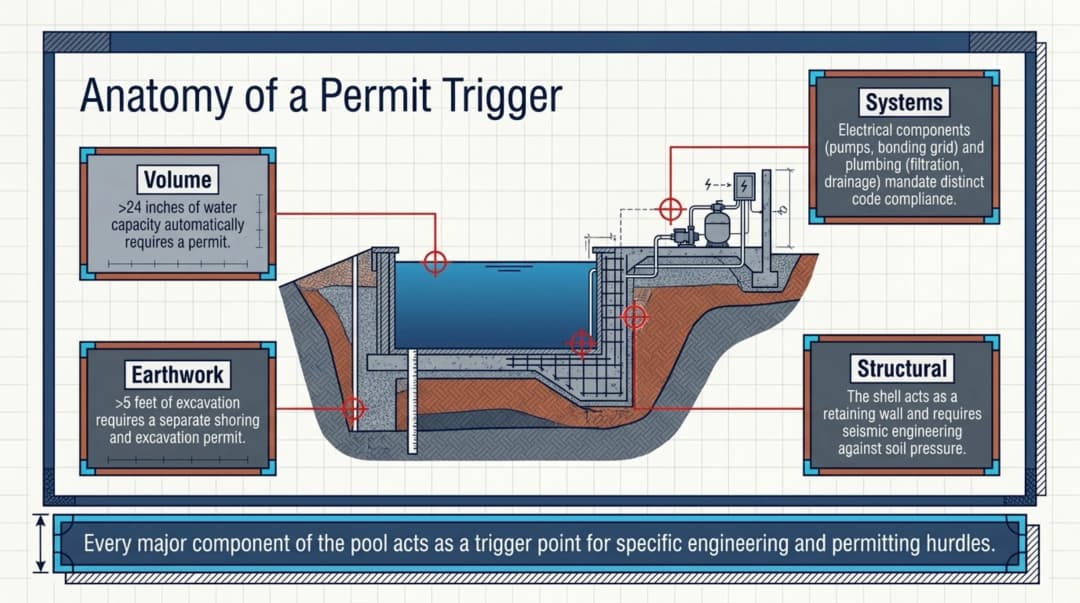
Virtually every aspect of a permanent pool installation triggers permit requirements. Most homeowners think it's just about the hole in the ground, but the city sees a complex construction project with public safety implications. The primary triggers are depth and water volume. Any structure intended to contain over 24 inches of water requires a permit. This rule alone covers every standard pool and most spas. Second, any excavation deeper than five feet requires a separate excavation and shoring permit, a common requirement for pool projects. Third, all electrical work, including pumps, underwater lighting (which is low-voltage but requires a transformer), and bonding to prevent shock, must be permitted and inspected. Fourth, all plumbing, from the filtration system to the drainage and backwash lines, falls under the plumbing code and requires a permit. Finally, the pool shell itself is a significant structure. The rebar and concrete or fiberglass shell must be designed by a licensed structural engineer to withstand soil pressure and seismic forces, and those plans are a core part of the permit application. In short, there is no way to build a safe, legal, permanent pool in San Francisco without a permit.
The Real Cost of a Pool in San Francisco in 2026
The sticker shock for a San Francisco pool is real. For a basic, medium-sized in-ground gunite pool, expect the all-in cost to range from $150,000 to $250,000 in 2026. This includes design, engineering, permits, excavation, the basic pool shell and equipment, and standard concrete decking. High-end projects in neighborhoods like Sea Cliff or Pacific Heights, featuring infinity edges, premium PebbleTec finishes, extensive retaining walls, and sophisticated hardscaping, routinely push past $400,000. These figures can start lower, of course. A small plunge pool or "spool" for a Noe Valley backyard might land in the $90,000 to $120,000 range, but these are smaller, simpler projects with less excavation and engineering. The key is to understand what's *not* in a basic quote. Most initial bids don't include landscaping, fencing (which is mandatory), pool covers, or potential soil remediation costs. Upgrades add up fast: an automatic cover adds $15,000, a high-efficiency Pentair variable-speed pump adds $2,000, and switching from standard plaster to a durable Wet Edge aggregate finish can add $10,000 or more to the final pool cost in San Francisco.
Why Is a Pool So Expensive in San Francisco?
There are four reasons a pool costs more here than almost anywhere else in the country. First is labor. San Francisco has some of the highest construction labor wages in the United States. According to the California Department of Industrial Relations prevailing wage data for San Francisco County, skilled tradespeople command premium rates. You are paying for their expertise in a difficult building environment. Second is access. Many properties in the Sunset District or Russian Hill have tight lot lines and limited access, meaning excavation often requires smaller equipment, conveyor belts, or even manual labor to remove soil, dramatically increasing time and cost. Third is geology and engineering. The region's seismic activity demands solid structural engineering. Your pool isn't just a basin; it's a small retaining wall that must be designed to handle ground movement without cracking. This requires a soils report and a licensed structural engineer, adding thousands to the pre-construction budget. Fourth, material logistics are complex. Getting a concrete truck or a delivery of James Hardie siding into a dense neighborhood requires traffic control, special permits, and careful timing, all of which add to the project cost. A pool contractor in San Francisco isn't just a builder; they are a logistics expert.
Three San Francisco Pool Project Budgets for 2026
Three modeled project scenarios for 2026, built from the Renology Cost Index and typical local scopes. These are illustrative estimates, not completed client projects:
- The Sunset District Plunge Pool: $135,000. This project involved a small 8x15 foot spool on a typical row-house lot. Access was the main challenge, requiring a mini-excavator and conveyor system to haul dirt through the house. The cost included a geotechnical report, structural engineering for the concrete shell, a basic Pentair equipment set, and a simple concrete paver deck. The homeowners opted for a manual safety cover to control costs. Permitting with SF DBI took seven months due to initial plan check corrections related to property line setbacks.
- The Pacific Heights Terrace Pool: $280,000. This was a more complex build on a sloped lot overlooking the bay, requiring a significant concrete retaining wall on the downhill side. The 15x30 foot pool featured an automatic cover, a high-end PebbleTec finish, and an attached spa with three jets. The decking was Ipe wood, adding significant material and labor cost. The project also required extensive drainage work to manage runoff from the hillside. The higher pool cost in San Francisco reflects the structural complexity and premium finishes demanded by the location.
- The St. Francis Wood Family Pool: $410,000. This was a full backyard renovation centered around a 20x40 foot pool. The budget included demolishing an old patio, major re-grading of the yard, and building a new outdoor kitchen and fire pit area alongside the pool. The pool itself featured a waterfall, LED lighting, and a fully automated Hayward OmniLogic control system. The cost ballooned due to the extensive site work and the integration of the pool into a larger hardscape and landscape design. This is a prime example of how a pool project often becomes a complete exterior overhaul.
Information Gain
3 San Francisco pool builders, editor-screened. 4 questions.
See my 3 matchesWhat no one else covers is the granular reality of San Francisco's multi-departmental permit review. Most homeowners and even some contractors fixate on the Department of Building Inspection (DBI), but the DBI is just the gatekeeper. The real gauntlet is the constellation of other city agencies that must approve your plans. First, the San Francisco Planning Department will scrutinize your project for zoning compliance, including setbacks from property lines, lot coverage limitations, and neighborhood-specific aesthetic guidelines. In historic districts, this review is even more intense. Next, San Francisco Public Works (SFPW) gets involved. They review your plans for grading, excavation, and potential impacts on the public right-of-way, like sidewalks or street trees. If you need to place a dumpster or park heavy equipment on the street, you'll need separate permits from them. The San Francisco Water Department will review your plans for water use and proper drainage, ensuring your pool's backwash and overflow don't overwhelm the city's sewer system. Finally, the San Francisco Fire Department reviews plans for access. They need to ensure their equipment can still reach your home in an emergency, a major issue on narrow, hilly streets. Each department has its own backlog and review timeline. A rejection or request for more information from any one of them sends your application back for revisions, restarting the clock. A savvy pool contractor in San Francisco has established relationships and knows the specific submission requirements for each of these agencies, not just the DBI.
Common Budget Busters for a Bay Area Pool
Most San Francisco pool projects go over budget. The reasons are predictable. The number one culprit is unforeseen geological conditions. You don't know what's under your yard until you start digging. Hitting serpentine rock means expensive, slow hydraulic hammering. Discovering unstable fill dirt means over-excavating and bringing in engineered fill, a massive unbudgeted cost. A proper geotechnical (soils) report is your only defense, but even it can't see everything. The second budget buster is retaining walls. Many SF lots are sloped. A pool installation often requires a new or larger retaining wall to create a level area, and these engineered structures are expensive, often adding $30,000 to $100,000 to the project. Third is drainage. Managing water runoff is critical and often underestimated. French drains, sump pumps, and connections to the city storm drain system add complexity and cost. We use a ten to fifteen percent contingency as a planning assumption; for comparison, HUD's Standard 203(k) loan rules require a reserve of at least 10 percent on homes 30 years or older. For a complex project like a pool on a challenging SF lot, a twenty percent contingency is smarter. Don't commit your last dollar to the initial contract price.
How Long Does the Permitting Process Take with SF DBI?
Set your expectations realistically. For a standard in-ground swimming pool in San Francisco, the permit approval process typically takes between six and twelve months from the initial submission to having the permit in hand. This timeline shocks homeowners who assume it's a matter of weeks. The delay is not from one single bottleneck, but from a sequential review process across multiple city departments. After your architect or engineer submits the plans to the San Francisco Department of Building Inspection (DBI), they are routed to various stations. Plan review at the DBI itself can take two to three months. Then, the plans go to the Planning Department, Public Works, and potentially other agencies. Each department has its own queue. If any one of them requires a correction or clarification, your plans are sent back, and you must revise and resubmit, which can add months to the process. The homeowners who get through fastest have two things in common: they hire an architect or contractor who has deep experience with the SF DBI's specific submission requirements, and they respond to city comments and requests within days, not weeks. Any delay on your end will be magnified by the city's own backlog.

Finding the Right Pool Contractor in San Francisco
Hiring the right team is the single most important decision you'll make. Most homeowners get distracted by glossy brochures and 3D renderings. The fix is to focus on credentials and local experience. First, verify their license. A pool builder must have a C-53 Swimming Pool Contractor license from the California Contractors State License Board (CSLB). Do not work with anyone who doesn't have this specific classification. Second, demand proof of experience *in San Francisco*. Ask to see a portfolio of at least three completed, permitted pool projects within the city limits. A contractor who works primarily in San Jose or Walnut Creek does not understand the unique challenges of the SF DBI. Get three quotes. Check three references. Visit one finished job. When checking references, ask specifically about communication, budget adherence, and how they handled unforeseen problems. A great contractor is a great problem-solver. Finally, ensure their bid process includes a detailed scope of work. Lock in every detail before signing. Our San Francisco pools permit playbook for 2026 provides a checklist for vetting contractors and their bids.
Key Documents Required for a San Francisco Pool Permit
A permit application isn't a single form; it's a comprehensive package of technical documents. Submitting an incomplete package is the fastest way to get your project sent to the back of the line. Your design and construction team will assemble this, but you need to know what to ask for. The core of the submission is the architectural and structural plan set. This includes a detailed site plan showing property lines, the pool's location, and all setbacks. It must also include structural drawings for the pool shell, stamped by a California-licensed structural engineer, detailing the rebar schedule, concrete thickness, and seismic design features. You will also need a geotechnical report, prepared by a licensed geotechnical engineer, that analyzes the soil stability, groundwater levels, and provides recommendations for the foundation. you'll need a complete drainage plan showing how rainwater and pool overflow will be managed, and separate electrical and plumbing plans for the pool equipment. Missing any of these documents will result in an immediate rejection of your application by the SF DBI intake counter.
Frequently Asked Questions About San Francisco Pool Permits
What are the setback requirements for a pool in San Francisco?
Setback requirements dictate how far the pool must be from your property lines, main residence, and other structures. In San Francisco, these are governed by the Planning Code and can vary by zoning district. Generally, the pool structure (including coping and decking) must be at least five feet from the rear and side property lines. The pool equipment, like pumps and heaters, has its own setback rules and often must be shielded from neighbors to comply with noise ordinances. The Planning Department will review your site plan meticulously to ensure compliance. It's critical to have a professional survey of your property done before design begins. Relying on old records or fence lines is a common and costly mistake. An experienced architect will verify the specific zoning for your parcel and design the pool location to meet all required setbacks, preventing a major redesign request from the city planners deep into the review process.
Are pool safety fences mandatory in San Francisco?
Yes, absolutely. California state law, specifically the Swimming Pool Safety Act, mandates safety features for all new residential pools, and San Francisco enforces this rigorously. The most common solution is an isolation fence that completely surrounds the pool area. This fence must be at least five feet high, have no handholds or footholds that would allow a child to climb it, and feature a self-closing, self-latching gate with a latch at least 54 inches from the ground. Other approved safety features can include a powered safety cover that meets ASTM F1346 standards or door and window alarms on the house that lead to the pool area. However, most homeowners find the isolation fence is the most straightforward way to meet the code. Your final inspection from the DBI will not pass until this safety barrier is installed and functioning correctly.
Do I need a permit for an above-ground pool?
It depends on the size and permanence. For most small, temporary, inflatable-type pools, you do not need a permit. However, the rules change when the pool becomes more permanent or substantial. The San Francisco Building Code generally requires a permit for any pool capable of holding water deeper than 24 inches. This means that larger, more rigid above-ground pools, especially those with their own pump and filtration system that requires electrical work, will almost certainly require a permit. The primary concerns are electrical safety and the structural stability of the pool and any associated decking. Before purchasing a large above-ground pool, it is wise to consult with the SF Department of Building Inspection to clarify the specific requirements for your intended model. It is always better to ask beforehand than to be issued a notice of violation later.
What is a geotechnical (soils) report and why do I need one?
A geotechnical report is a detailed analysis of the soil conditions on your property, prepared by a licensed geotechnical engineer. For a pool project in San Francisco, it is not optional; it is a required document for your permit application. The engineer will take soil borings from the proposed pool location to determine the soil type, stability, and presence of groundwater or rock. This information is critical for the structural engineer who designs the pool shell. The report provides recommendations on how to build a foundation that can withstand the specific pressures of your site, especially crucial in a seismically active area. It identifies potential problems like expansive clay soil or uncompacted fill that could cause the pool to shift, crack, or leak over time. While the report can cost between $3,000 and $7,000, it is an essential investment that prevents catastrophic structural failures and major budget overruns during excavation.
Can I build a pool on a sloped lot in San Francisco?
Yes, you can build a pool on a sloped lot, but it is significantly more complex and expensive than building on flat ground. San Francisco's hilly terrain means many stunning view properties in areas like Twin Peaks or Diamond Heights are on slopes. The primary challenge is creating a level, stable area for the pool. This almost always requires extensive excavation and the construction of one or more large retaining walls to hold back the hillside. These are not simple garden walls; they are major engineered structures that require their own permits and structural plans. The foundation of the pool itself must also be specially designed with piers or caissons to reach stable bedrock. Drainage is another critical consideration, as you must carefully manage all water runoff from the slope. Expect the engineering, earthwork, and structural concrete costs for a hillside pool to be at least double that of a comparable pool on a flat lot.
What happens during the pool permit inspection process?
The permit isn't just a piece of paper; it's an agreement that your project will be inspected at key stages by a DBI inspector. You cannot proceed to the next phase of construction until the previous one has been signed off. For a pool, there are typically four major inspections. The first is pre-excavation, to check site layout and shoring. The second, and most critical, is the pre-gunite inspection, where the inspector verifies the steel rebar placement, plumbing lines, and electrical bonding grid before any concrete is sprayed. If anything is wrong, it must be fixed before you can continue. The third inspection is for the decking and any surrounding structures. The final inspection occurs when the project is complete. The inspector will verify that all safety features, like fences and alarms, are operational and that the site is properly graded for drainage. Passing this final inspection closes out the permit.
How do I handle water usage and drainage regulations?
The San Francisco Public Utilities Commission (SFPUC) has strict regulations regarding water use and drainage that directly impact pool projects. First, filling the pool requires a significant amount of water, and you must comply with any drought-related water use restrictions that may be in effect. Second, and more importantly, is the disposal of drained or backwashed water. It is illegal to drain chlorinated or salt water directly into the street, as it flows into the storm drain system and harms aquatic life in the Bay. Your pool plumbing must be designed to discharge this water into the sanitary sewer system, which requires a specific connection point. Your plans must clearly show this drainage plan, and it will be reviewed as part of the permit process. A knowledgeable pool contractor will be familiar with these SFPUC requirements and design a system that is both effective and compliant from the start.
Does a pool increase my property taxes?
Yes, adding an in-ground swimming pool is considered a capital improvement that adds value to your property, and your property taxes will likely increase as a result. When your pool permit is finalized and closed out, the San Francisco Office of the Assessor-Recorder will be notified. They will then reassess the value of your property to include the value added by the new pool. The exact amount of the increase depends on the cost of the pool project and the city's current assessment formulas. It's a factor many homeowners forget to include in their long-term cost of ownership calculations. While the enjoyment of a pool is the primary motivation, it's important to be aware of the ongoing financial implications, including not just taxes but also increased insurance premiums, maintenance, and utility costs. You should factor in an annual cost of 3-5% of the initial pool price for these recurring expenses.
Sources & Methodology
See the Renology Methodology for how sources are reviewed, ranges are normalized, and planning-data limits are handled.
Cost ranges in this guide draw on the following named industry sources, public agency datasets, and Renology editorial research.
- San Francisco Department of Building Inspection (DBI) (2026)
- San Francisco Planning Department (2026)
- California Swimming Pool Safety Act (Health and Safety Code § 115920-115929) (2024)
- California Department of Industrial Relations, Prevailing Wage Data (2026)
- National Association of Home Builders (NAHB) (2025)
- California Contractors State License Board (CSLB) (2026)
- Remodeling Magazine Cost vs Value Report (2025)
- San Francisco Public Utilities Commission (SFPUC) Water & Wastewater Rules (2025)
- American Society of Testing and Materials (ASTM) Standard F1346 (2023)
- San Francisco Office of the Assessor-Recorder (2026)
Renology Take
Homeowners fixate on the visible elements: the shape of the pool, the color of the water, the texture of the deck. They spend weeks debating a Benjamin Moore Chantilly Lace for the cabana trim but only days reviewing the geotechnical report. This is a mistake. The success of any pool project in San Francisco is determined entirely by the invisible, pre-construction phase. The quality of your geological survey, the rigor of your structural engineering, and the expertise of your permit expeditor are far more critical than your choice of tile. Most of the catastrophic budget overruns and timeline delays happen because of something discovered underground or rejected by a city planner. The meta-pattern is clear: master the bureaucracy and the geology first. The beautiful finish is the easy part.
This article is from The Renology Magazine, the renovation magazine and contractor-advisory for homeowners in Southern California, San Diego, and Greater Seattle. Want more renovation breakdowns? Search "The Renology Magazine" on Google.
Frequently Asked Questions
What are the setback requirements for a pool in San Francisco?
Are pool safety fences mandatory in San Francisco?
Do I need a permit for an above-ground pool?
What is a geotechnical (soils) report and why do I need one?
Can I build a pool on a sloped lot in San Francisco?
What happens during the pool permit inspection process?
How do I handle water usage and drainage regulations?
Does a pool increase my property taxes?
Ready to find a pro?
Tell us what you are planning and where. A Renology advisor can help you explore contractor matching.
Find a Pro- Free for homeowners
- Licensed, vetted local contractors
- No obligation to hire
Sources
- San Francisco Department of Building Inspection (DBI)
- San Francisco Planning Department
- California Swimming Pool Safety Act (Health and Safety Code § 115920-115929)
- California Department of Industrial Relations, Prevailing Wage Data
- National Association of Home Builders (NAHB)
- California Contractors State License Board (CSLB)
- Remodeling Magazine Cost vs Value Report
- San Francisco Public Utilities Commission (SFPUC) Water & Wastewater Rules
- American Society of Testing and Materials (ASTM) Standard F1346
- San Francisco Office of the Assessor-Recorder
Follow Renology on Google
Choose Renology as a preferred source and our guides show up more often in your Google results, including Top Stories and AI Overviews.