
A typical San Francisco pool installation, quoted at $120,000, often finishes closer to $160,000, and can easily climb higher. That $40,000 overrun isn't from one big surprise. It's the result of seven predictable mistakes made before a single shovel hits the ground. These errors add weeks, sometimes months, to the timeline, turning a summer dream into a fall-time money pit. The homeowners who stay on budget do things differently, and they make their key decisions before construction starts.
In a Nutshell
- The Real Cost: Expect a 25-40% budget overrun on a typical San Francisco pool project due to poor planning. For a $150,000 project, that's an extra $37,500 to $60,000 you didn't plan to spend.
- Three Most Common Mistakes: Ignoring seismic engineering requirements for your specific soil type. Underbudgeting for excavation and soil removal on a tight urban lot. Choosing finishes based on photos, not performance in Bay Area microclimates.
- Your Next Step This Week: Before calling a single contractor, order a geotechnical report for your property. It costs around $3,500 and will save you ten times that in change orders. It is the foundational document for any serious pool project in this city.
Mistake #1: Skipping the Geotechnical Report
Most homeowners get quotes based on a visual inspection from a pool builder. This is a recipe for financial disaster in San Francisco. Your property in the Marina is built on liquefaction-prone fill, while a home in Diamond Heights sits on solid rock. These are not minor details; they define the entire engineering and excavation scope. A surprise of serpentine rock or expansive adobe clay, common throughout the Bay Area, can add $20,000 to $40,000 in unexpected excavation costs and require a completely different structural plan. The contractor's quote almost always contains a clause about “unforeseen site conditions,” which leaves you liable for these costs. The fix is to take control of the process by commissioning a geotechnical report before you design the pool. A licensed geotechnical engineer will take soil borings, analyze the samples, and provide a detailed report on your site's specific conditions: soil type, stability, and groundwater levels. This report, which typically costs between $3,000 and $6,000, is the single most important document you will procure. It dictates the foundation, drainage, and seismic reinforcement needed to build a pool that will last. Handing this report to your bidding contractors forces them to quote the real job, not an idealized one. It effectively voids their “unforeseen conditions” clause. It's not an expense; it's the cheapest and most effective insurance you can buy for a major construction project in this city.
Mistake #2: Underestimating Site Access & Excavation Costs
Contractors often provide a per-cubic-yard excavation price. That number is functionally meaningless without the context of access. In San Francisco, the real cost driver is getting machinery in and getting soil out. Can a full-size excavator fit through your side yard in Noe Valley, or will they need a mini-excavator and hand labor, tripling the time and cost? Where does the excavated dirt go? Hauling soil from a Pacific Heights property through dense city traffic to a disposal site in the East Bay can cost more than the digging itself. Most homeowners see a flat yard and assume excavation is simple. They are almost always wrong. The cost escalates dramatically with limited access, steep slopes, or the need for extensive shoring to protect adjacent properties and sidewalks. Expect to pay a 50-100% premium for excavation on a typical tight San Francisco lot compared to a spacious suburban property. The counter-move is to walk the access path with each bidding contractor. Have them state their exact equipment, excavation method, and dirt-hauling plan in the written quote. Ask for the cost of shoring, traffic control, and soil export as separate, guaranteed line items. This forces transparency and prevents a rosy $15,000 excavation budget from quietly becoming a $40,000 reality after the contract is signed.
Mistake #3: Choosing Finishes for Looks, Not Longevity
This is my specialty, and it's where long-term regret takes root. A brilliant white plaster finish, like a classic Diamond Brite, looks stunning in a catalog shot from a perpetually sunny location like Palm Springs. In the foggy Sunset or Richmond Districts, that same finish will show every speck of wind-blown debris and be prone to algae staining within three years without meticulous, weekly chemical balancing. The persistent salt air blowing through the Golden Gate will corrode cheap metal fixtures and unsealed travertine coping in less than five years, causing spalling and rust stains. Most homeowners pick their finishes from a two-inch sample chip under showroom lights. This is a mistake. The fix is to demand larger samples and see them in your own yard, in the specific light conditions of your property: morning fog, direct afternoon sun, and evening shadows. For plaster, consider a medium gray or blue aggregate finish like PebbleTec or StoneScapes. They hide small debris better, offer superior durability, and are far more resistant to chemical etching. For coping and decking, look at porcelain pavers or high-density, precast concrete like those from Stepstone. These materials are engineered to resist salt, stains, and the moderate freeze-thaw cycles of a Bay Area winter far better than porous natural stone. A premium finish package might add $10,000 to the upfront cost, but it saves you a $30,000 replastering and re-decking job in seven years instead of twenty.
Mistake #4: Ignoring Bespoke Seismic and Drainage Engineering
A swimming pool is a massive, rigid concrete box placed in geologically active soil. Standard-issue engineering is not sufficient here. San Francisco building codes, administered by the San Francisco Department of Building Inspection (SFDBI), are among the strictest in the nation for good reason. Attempting to cut corners on seismic engineering to save $5,000 to $7,000 upfront is the single most expensive mistake a homeowner can make. A minor tremor can crack a poorly engineered pool shell, leading to a catastrophic leak that can destabilize the soil, undermining your home's foundation and your neighbor's property. The cost to repair a cracked pool shell and perform the necessary soil stabilization can easily exceed $100,000, and is often not fully covered by insurance. The only solution is to hire a California-licensed structural engineer with specific, verifiable experience in San Francisco residential pool construction. They must work directly from the findings of your geotechnical report. They will specify the precise size and spacing of the rebar cage, the required compressive strength (PSI) of the shotcrete, and the installation of flexible connections for plumbing to withstand ground movement. Equally important is managing hydrostatic pressure. The heavy clay soils common in the city can become saturated during the rainy season, exerting immense pressure on the pool shell from the outside. A solid drainage system and a hydrostatic relief valve are non-negotiable components. Before signing, verify your contractor's engineer has a portfolio of completed projects in your specific neighborhood or one with similar geological conditions.
Mistake #5: Miscalculating the Total Ownership Budget
3 San Francisco pool builders, editor-screened. 4 questions.
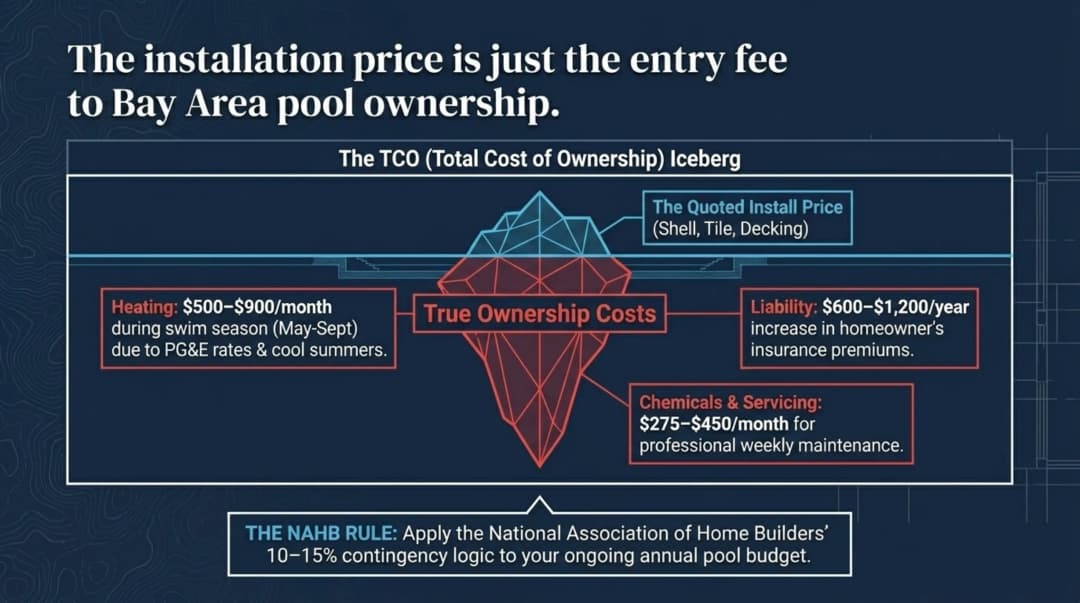
See my 3 matchesThe installation price is just the entry fee to pool ownership. The annual operating budget for a pool in San Francisco is significantly higher than the national average, a fact many contractors conveniently omit. The primary reason is heating. The city's famously cool summers mean you will be running a heater from May through September to keep the water at a comfortable 82 degrees. With Pacific Gas and Electric's (PG&E) residential electricity and gas rates among the highest in the country, a standard gas heater can easily add $500 to $900 to your monthly utility bill during swim season. An electric heat pump is more efficient but costs more upfront and works less effectively when the air temperature drops below 55 degrees. Most homeowners are shocked by their first summer utility bill. The fix is to build a detailed five-year ownership budget before you sign the construction contract. This budget must include line items for heating, chemicals ($75-$150/month), professional weekly servicing ($200-$300/month), and an annual fund for eventual repairs (pumps, filters, lights). You must also contact your insurance agent; adding a pool will likely increase your homeowner's liability premium by $600 to $1,200 per year. A comprehensive "pool cost in San Francisco" analysis must include these recurring expenses. The National Association of Home Builders recommends a ten to fifteen percent contingency on renovations in homes over thirty years old; you should apply a similar logic to your ongoing pool budget. Choosing to build without a clear picture of these costs is financially irresponsible.
Mistake #6: Accepting Vague Specs for the Equipment Pad
Homeowners fixate on the visible elements: the pool shell, the tile, the decking. Contractors know this and often keep the proposal language vague when it comes to the mechanical systems. The equipment pad is where they can claw back margin by installing basic, builder-grade components. Your quote might just say “pump and filter,” which is meaningless. This could mean a basic, single-speed pump (if they can find a loophole around code), an undersized filter that requires constant cleaning, and a cheap, manual chemical feeder. This is the bare minimum, and it will cost you dearly in time, frustration, and high energy bills. The fix is to specify every single piece of equipment by brand and model number in the signed contract. California's Title 20 and Title 24 energy codes mandate energy-efficient, variable-speed pumps for filtration, which is a positive. However, there is a wide range in quality and performance. For San Francisco pools, I recommend a top-tier variable-speed pump like a Pentair IntelliFlo VSF or a Hayward TriStar VS 950. Insist on an oversized cartridge filter (like a Clean & Clear Plus 520) to extend cleaning cycles from weeks to months. Demand an automated sanitation system. A salt chlorine generator (e.g., Pentair IntelliChlor) is popular, but be aware it requires more expensive, marine-grade stainless steel fixtures (316L) to prevent corrosion. A UV or ozone system is an excellent, low-chemical alternative that is gentler on finishes and skin. Specifying this complete, high-performance package upfront may add $6,000 to $8,000 to the quote, but it saves thousands in energy costs and countless hours of maintenance every year. Our San Francisco pool permit playbook details the latest Title 24 requirements your contractor must meet.

Mistake #7: Failing to Integrate Pool and Landscape Design
The pool is finished, the deck is poured, and the check has cleared. Then the landscape architect arrives and delivers the bad news: the drainage needs to be redone to prevent water from sheeting against the house, the wiring for the garden lights requires trenching through your new concrete deck, and the gas line for the fire pit is on the wrong side of the yard. This scenario is shockingly common. It leads to expensive and demoralizing rework, project delays, and massive budget fights. Most homeowners hire a "pool contractor san francisco" and plan to figure out the landscaping later. This is a fundamental strategic error. The correct approach is an integrated design-build process. The pool builder, landscape architect, and structural engineer must be on the same team, reviewing the same set of plans from day one. Their designs must be overlaid before a permit is ever pulled with the SFDBI. This collaborative process ensures that irrigation lines, low-voltage lighting conduits, gas lines, and, most critically, surface drainage are all accounted for in a single, comprehensive plan. The grading for the entire yard, not just the immediate pool area, must be part of the initial design to ensure water flows away from all structures. Get three quotes. Check three references. Visit one finished job before signing. And make sure the person you hire is either managing the entire outdoor scope or has a formal process for collaborating with your other designers. A unified plan prevents the soul-crushing sound of a jackhammer on a brand-new deck.
What No One Else Covers
Most articles on pool costs stop at installation. They fail to address the accelerated aging of materials in San Francisco's unique and varied microclimates. The total cost of ownership is defined by the durability of your finishes, and here, location is everything. A pool in sunny, protected Noe Valley will have a different set of challenges than one in the foggy, salt-sprayed air of the Outer Sunset. The constant condensation from marine layer fog creates a perfect environment for mildew on porous surfaces like natural stone and can accelerate the breakdown of certain deck sealants. The salt carried in that fog is highly corrosive to any metal components that are not marine-grade 316L stainless steel, from handrails to lighting fixtures and especially the heat exchanger in a gas heater. Conversely, in sunnier neighborhoods like the Mission or Potrero Hill, intense UV exposure is the primary enemy. It will fade lower-quality colored plaster and degrade plastic components like skimmer lids and valve handles at a faster rate., because you'll run your heater more often than in warmer climates, the water chemistry will be in greater flux, putting more chemical stress on interior finishes. High water temperatures can accelerate calcium leeching from standard plaster. This is why material specification is so critical. You need to budget for finishes that can withstand your specific environmental assault: dense porcelain pavers that resist moisture and salt, aggregate finishes like PebbleTec that are more chemically stable, and solid automation systems that maintain water balance precisely. Another often-overlooked cost is noise mitigation. In a city of tightly packed lots, the hum of a pool pump can become a major point of contention with neighbors. San Francisco has strict noise ordinances. Budgeting an extra $2,000 to $4,000 for an acoustically insulated equipment enclosure is not a luxury; it's a necessity for maintaining neighborhood peace.
What A Pool Really Costs in San Francisco in 2026
Homeowners anchor on the initial number from a builder, but the real cost of a San Francisco pool is a layered calculation of design, engineering, construction, and long-term operation. Prices can start lower for simple, pre-fabricated spool or plunge pool installations in a condo's backyard, but for a typical custom gunite pool, the budget is substantial. The primary cost driver is labor. According to the California Department of Industrial Relations prevailing wage data for San Francisco County, skilled construction labor rates are among the highest in the nation. This affects every stage of the project, from excavation to tile setting.
Three modeled project scenarios for 2026, built from the Renology Cost Index and typical local scopes. These are illustrative estimates, not completed client projects:
- Sunset District Small Plunge Pool ($115,000): A 10x18 foot concrete plunge pool on a tight lot. The high cost was driven by difficult access requiring a mini-excavator and significant shoring to protect the adjacent home. The budget included a solid drainage system to handle runoff from the sloped yard and an efficient heat pump to manage operating costs in the cool climate. Finishes were a durable gray aggregate and porcelain pavers.
- Noe Valley Family Pool ($185,000): A 15x30 foot rectangular pool with an integrated spa. The site had good access but required drilling into bedrock for a portion of the foundation, adding $25,000 in unforeseen excavation costs. The project featured a high-end equipment package with full smart-phone automation, a motorized safety cover, and an ozone sanitation system. The hardscape included a significant retaining wall and extensive landscape lighting.
- Pacific Heights Infinity Edge ($350,000+): A 15x40 foot geometric pool with a vanishing edge overlooking the Bay. The majority of the budget was dedicated to engineering and structure. This included deep-drilled piers for foundation stability on the hillside lot, a complex gutter and surge tank system for the infinity edge, and premium finishes like glass tile and limestone decking. The project required extensive coordination with a landscape architect and structural engineer over a six-month design and permitting phase.
Sources & Methodology
See the Renology Methodology for how sources are reviewed, ranges are normalized, and planning-data limits are handled.
Cost ranges in this guide draw on the following named industry sources, public agency datasets, and Renology editorial research.
- California Department of Industrial Relations, Prevailing Wage Data for San Francisco County (2026)
- San Francisco Department of Building Inspection (SFDBI), Permit Requirements (2026)
- Pool & Hot Tub Alliance (PHTA), ANSI/PHTA/ICC-7 Standard for Suction Entrapment Avoidance (2021)
- American Society of Civil Engineers, ASCE 7-22 Minimum Design Loads for Buildings and Other Structures (2022)
- National Association of Home Builders (NAHB), Remodeling Market Index (Q1 2026)
- Remodeling Magazine, Cost vs. Value Report (2026)
- U.S. Geological Survey (USGS), Earthquake Hazards Program, Northern California (2025)
- California Energy Commission, Title 24 Building Energy Efficiency Standards (2022)
- Pacific Gas and Electric (PG&E), Residential Rate Schedules (2026)
- Pebble Technology International, Finish Durability and Maintenance Guide (2025)
Renology Take
The meta-mistake is treating a pool as a product you buy, not a complex construction project you must actively manage. Homeowners want to pick a shape and a tile, then check out, expecting a turnkey process. But a pool is a foundation, a reinforced structure, a high-pressure plumbing system, and a high-voltage electrical system all built in some of the most challenging geological conditions in the country. The homeowners who succeed act as the CEO of their own project. They hire the experts, like the geotechnical and structural engineers, directly. They force coordination between the pool builder and the landscape architect. They obsess over the scope of work document until every pump model and tile grout color is specified. The contractor works for you; you are not a passenger on their ride. Your direct, informed involvement is the only thing that stands between a fixed budget and a thirty percent overrun.
This article is from The Renology Magazine, the renovation magazine and contractor-advisory for homeowners in Southern California, San Diego, and Greater Seattle. Want more renovation breakdowns? Search "The Renology Magazine" on Google.
Frequently Asked Questions
What's the most expensive mistake in a San Francisco pool installation?
How do I know if my pool contractor is padding the quote?
When should I walk away from a pool quote?
What's the fastest way to blow a San Francisco pool budget?
Are saltwater pools a good idea in San Francisco's climate?
How much does a geotechnical report cost in the Bay Area and is it really worth it?
What are the best low-maintenance pool finishes for the Bay Area?
Do I need a permit for a swimming pool in San Francisco?
San Francisco · pre-screened
Get 3 San Francisco pool bids in 48 hours.
Our editors already vetted San Francisco pool builders. Answer 4 questions and we send 3 written bids inside 48 hours, with the real price for your scope, not their inflated first-call number.
- Free, no commission
- Pre-screened locally
- Bids inside 48 hours
Takes about 60 seconds. We'll text you when bids arrive.
Sources
- California Department of Industrial Relations, Prevailing Wage Data for San Francisco County
- San Francisco Department of Building Inspection (SFDBI), Permit Requirements
- Pool & Hot Tub Alliance (PHTA), ANSI/PHTA/ICC-7 Standard for Suction Entrapment Avoidance
- American Society of Civil Engineers, ASCE 7-22 Minimum Design Loads for Buildings and Other Structures
- National Association of Home Builders (NAHB), Remodeling Market Index
- Remodeling Magazine, Cost vs. Value Report
- U.S. Geological Survey (USGS), Earthquake Hazards Program, Northern California
- California Energy Commission, Title 24 Building Energy Efficiency Standards
- Pacific Gas and Electric (PG&E), Residential Rate Schedules
- Pebble Technology International, Finish Durability and Maintenance Guide