
A kitchen remodel in 2026 costs about $20,000 for a minor update and $55,000 for a major one. Those are the median amounts homeowners reported in the 2026 Houzz U.S. Kitchen Trends Study, and for a major remodel of a kitchen 250 square feet or larger the median rises to $75,000. Coastal metros run higher. The 2025 Cost vs Value Report prices a midrange major kitchen remodel at $97,667 in San Francisco and $95,542 in Seattle, against $82,793 nationally. This kitchen cost breakdown for 2026 details where every dollar goes, from cabinetry to the final coat of paint.
In a Nutshell
- What Homeowners Spend: A median of $20,000 for a minor remodel, $55,000 for a major remodel, and $75,000 for a major remodel of a kitchen 250 square feet or larger (2026 Houzz U.S. Kitchen Trends Study). One in ten major remodels costs $150,000 or more.
- Coastal Metros: A contractor-built midrange major remodel is priced at $97,667 in San Francisco and $95,542 in Seattle, against $82,793 nationally (2025 Cost vs Value Report).
- Typical Timeline: HomeGuide's kitchen remodel cost guide (December 2025) puts an average remodel at 6 to 9 weeks, and 3 to 5 months for large or structural jobs once permits and materials are counted. Planning takes longer than building. In the 2026 Houzz and Home Renovation Trends Study, kitchen projects averaged 9.5 months of planning and 5.8 months of construction.
- Biggest Surprise Line Item: Mechanical, electrical, and plumbing (MEP) work. Homeowners focus on cabinets and countertops, but moving pipes, gas, and wiring adds up one item at a time. HomeGuide prices new plumbing pipes at $450 to $1,800 per fixture and a new gas line at $350 to $2,000, and HomeAdvisor puts an electrical panel upgrade at $520 to $2,000.
What Does a Kitchen Remodel Actually Cost in 2026?
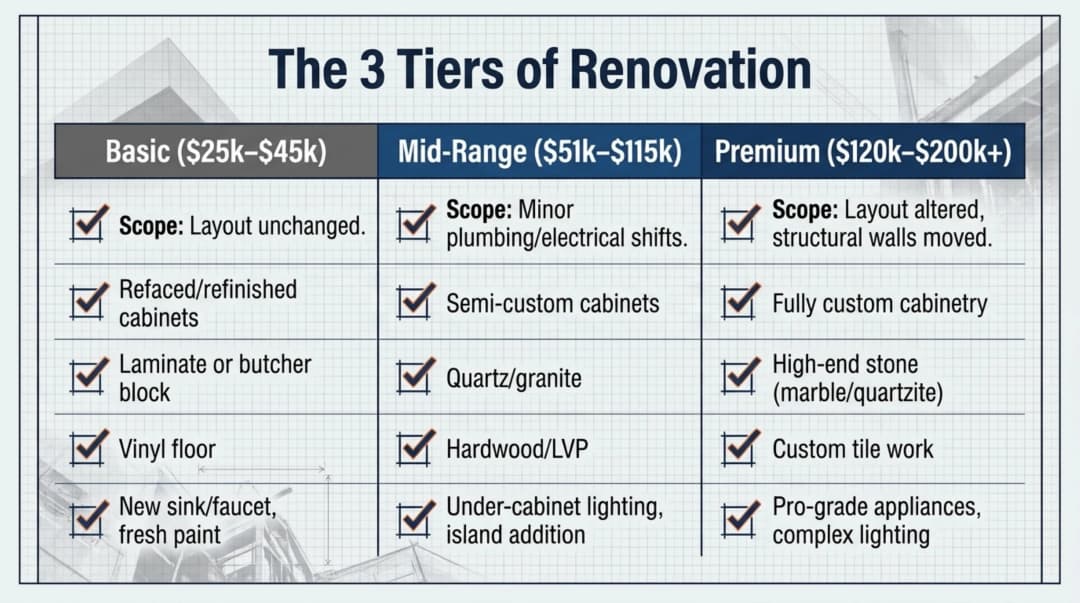
The total expenditure on a kitchen remodel is determined by three factors: the quality of materials, the scope of structural changes, and the cost of labor in your region. To provide a clearer picture, we have segmented kitchen cost into three tiers. Houzz calls a remodel major when at least all the cabinets and appliances are replaced, and minor when some of them stay. The Cost vs Value figures price a full contractor job on a 200-square-foot kitchen.
| Tier | What It Costs | Scope & Materials |
|---|---|---|
| Basic / Minor | Median $20,000. One in ten spends $50,000 or more (Houzz 2026). Cost vs Value 2025 midrange minor remodel: $28,458 nationally. | Layout unchanged. Refinished or refaced cabinets, laminate or butcher block countertops, vinyl flooring, basic appliance package, new sink/faucet, fresh paint. |
| Mid-Range / Major | Median $55,000, or $75,000 for kitchens of 250 sq. ft. or more (Houzz 2026). Cost vs Value 2025 midrange major remodel: $82,793 nationally. | New semi-custom cabinets, quartz or granite countertops, new island, tile backsplash, hardwood or LVP flooring, mid-grade appliance package, under-cabinet lighting, possible minor plumbing/electrical relocation. |
| Premium / Upscale | The top 10% of major remodels start at $150,000 (Houzz 2026). Cost vs Value 2025 upscale major remodel: $164,104 nationally. | Layout altered, walls moved. Fully custom cabinetry, high-end stone countertops (marble, quartzite), professional-grade appliances, extensive lighting plan, custom tile work, potential structural modifications. |
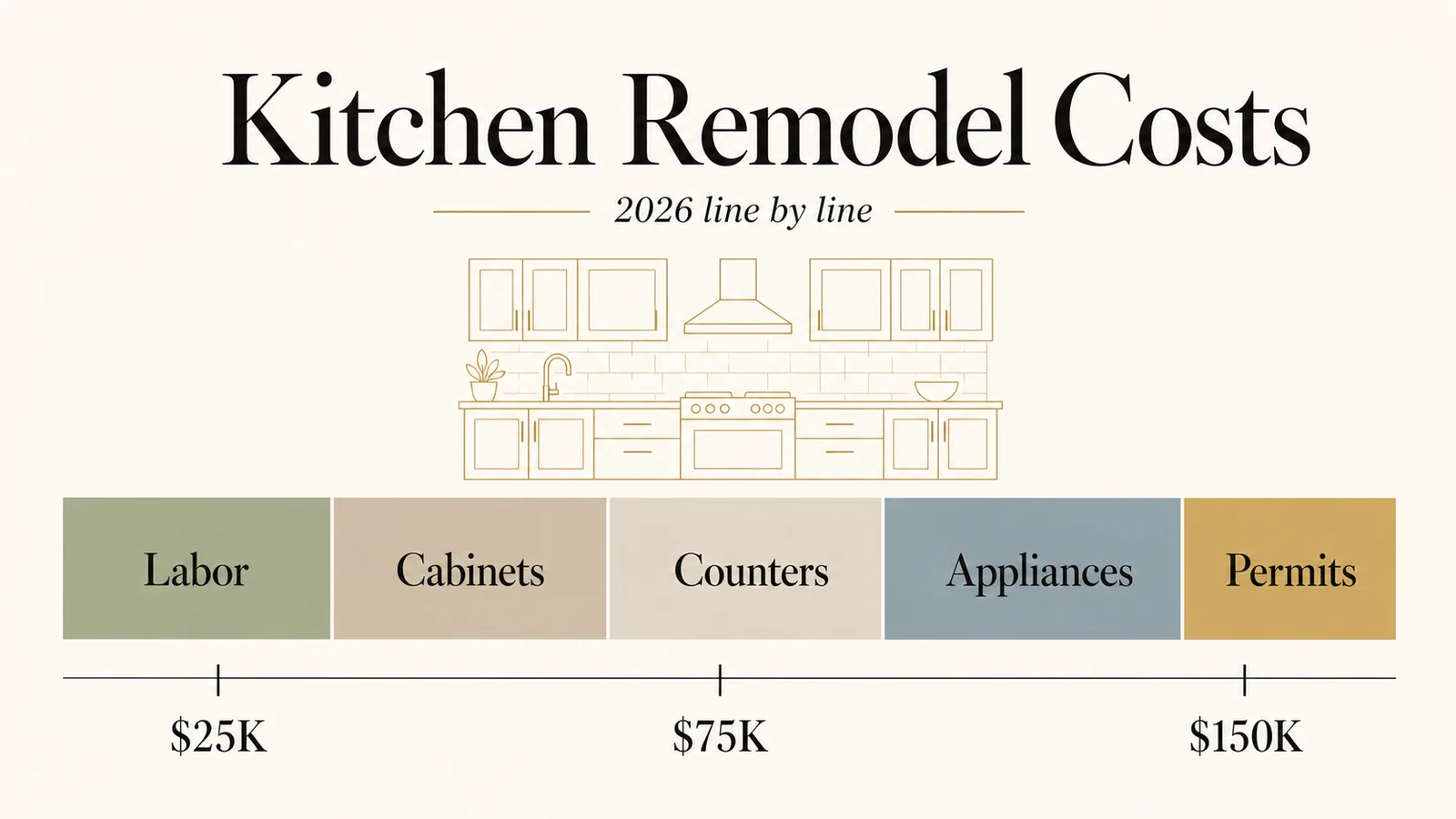
Where a Mid-Range Budget Goes:
- Cabinetry & Hardware: Usually the biggest single line. In the Houzz study, 68% of renovating homeowners replace all their cabinets, 27% replace some, and only 5% leave them alone.
- Labor & Installation: Demolition, carpentry, and installation by each trade.
- Appliances & Ventilation: Range, hood, refrigerator, dishwasher, microwave.
- Countertops: Material, templating, fabrication, and install.
- Plumbing & Electrical: New circuits, lighting, and any moved sink or gas line.
- Flooring: Material and labor.
- Design, Permits, Other: Drawings, permit fees, and inspections.
The bottom of the cost range, often cited by online estimators, typically applies to a cosmetic refresh in a smaller space like a condominium. These projects avoid the primary cost drivers: changing the layout, moving utilities, and using custom materials. Once every cabinet and appliance is replaced, the Houzz median climbs to $55,000.
Why Do Kitchen Remodel Costs Vary So Much by Region?
In the 2025 Cost vs Value Report, the same midrange major kitchen remodel is priced at $97,667 in San Francisco and $78,648 in Sacramento, just ninety miles away. That is 24% more for an identical project. Three primary factors drive these significant regional price differences: labor rates, material logistics, and local regulations combined with housing stock age. Understanding these variables is key to setting a realistic budget for your specific location.
Labor pricing varies with the trade, location, work and contractor overhead. Public-works prevailing wage schedules are not retail residential contractor quotes, and they cannot establish how much of a private kitchen bid comes from labor. Ask bidders to explain the work and assumptions behind the installation line rather than applying a public wage rate to the entire project.

Second, material costs and supply chain logistics play a significant role. Proximity to ports and distribution hubs can lower the cost of imported materials like tile and stone slabs. A contractor in Los Angeles or Seattle may have lower freight costs for certain materials than one in Denver. Third, local market dynamics influence pricing. High demand in affluent neighborhoods, such as La Jolla in San Diego or Beverly Hills in Los Angeles, creates a premium on both materials and contractor availability. Contractors who primarily work in these areas often have higher overhead and price their services accordingly, so the same job can be quoted higher there than in a less expensive suburb of the same metro.
Finally, the age and condition of the local housing stock affect costs. Older homes, common in established coastal cities, frequently require extensive system upgrades to meet modern building codes. A 1950s home in Seattle may need a full electrical panel upgrade, asbestos abatement, and seismic retrofitting as part of the kitchen project, adding thousands to the budget. In contrast, a home built in the last twenty years in a newer suburban development is less likely to hide costly surprises behind the drywall, leading to a more predictable and lower overall cost. Regional risks, like the need for earthquake-resistant bracing in California or managing high humidity and potential mold in coastal areas, also add specific line items not present elsewhere.
What Do Real Homeowners Spend in 2026?
Ask three reliable sources what a kitchen costs and you get three answers that look nothing alike. None of them is wrong. They are measuring different kitchens.
The 2026 Houzz U.S. Kitchen Trends Study surveyed 1,780 users with completed, ongoing or planned kitchen renovations. Its spending figures describe projects completed by mid-2025; they are not inflation-adjusted 2026 quotes. Homeowners who replaced at least every cabinet and appliance, a major remodel, reported a median spend of $55,000. Those who kept some cabinets or appliances, a minor remodel, spent a median of $20,000. Size mattered as much as scope. A major remodel of a kitchen 250 square feet or larger came in at a median of $75,000, against $46,000 for a smaller room, and one in ten major remodels reached $150,000.
The Census Bureau tells a smaller story. Its 2023 American Housing Survey asks owners about every home improvement job from the previous two years, so the paint-and-hardware refresh and the weekend tile job sit right next to the full gut. The median kitchen project came to $13,710 in the Seattle-Tacoma-Bellevue metro, $15,480 in San Francisco-Oakland-Hayward, and $17,140 in Los Angeles-Long Beach-Anaheim. Owners did the work themselves on 15,400 of the 53,800 kitchen jobs counted in the Seattle metro. In the San Francisco metro, the median do-it-yourself kitchen job was $5,714, while jobs done by professionals came to $20,000.
Cost vs Value, published by the Journal of Light Construction, answers a third question: a modeled cost and estimated resale value for a defined job. Its midrange major remodel takes an outdated 200-square-foot kitchen and installs 30 linear feet of semi-custom cabinets with a 3-by-5-foot island, laminate counters, new appliances, lighting, and flooring. In 2025 that job was priced at $97,667 in San Francisco, $95,542 in Seattle, $86,214 in Los Angeles, and $81,521 in Houston, against $82,793 nationally.
So why the spread? The Census median counts DIY work and small jobs, which pull it down. Cost vs Value models a complete contractor job with every cabinet and appliance replaced, which pushes it up. Houzz sits in between: it surveys its own registered users, people already planning design-led projects, and 87% of them hire at least one professional. If you are planning a full remodel with a contractor in a coastal metro, the Cost vs Value specification offers a scope benchmark to compare with a bid; it does not predict what an individual contractor will charge.
See it first
Numbers on a page are hard to picture. Upload a photo of your kitchen, pick a style, and the Renology visualizer returns three versions of the room with a local cost range for that scope. No signup.
Where Does the Money Actually Go? The Hidden Costs
A contractor's initial proposal often focuses on the visible items: cabinets, countertops, and appliances. However, a significant portion of a kitchen remodel budget is consumed by less obvious expenses. These are the line items that can cause budget shock if not anticipated. A good contractor will itemize these, but homeowners should be prepared for them regardless.
- Demolition and Debris Removal: HomeGuide prices gutting an average kitchen at $500 to $2,500, or $5.00 to $12.50 per square foot, to tear out the appliances, cabinets, counters, flooring, and drywall. Costs increase if hazardous materials like asbestos flooring or lead paint are discovered and require specialized abatement procedures.
- Structural Modifications: Removing a wall is a major expense. HomeGuide puts a non-load-bearing wall at $500 to $2,000 and a load-bearing wall at $4,000 to $15,000. Moving or removing walls usually calls for a structural engineer, which HomeGuide prices at $1,900 to $3,700 or more, or 1% to 5% of the project budget.
- MEP Upgrades (Plumbing, Electrical, HVAC): Moving a gas line for a range, relocating a sink drain, adding a pot filler, or upgrading an electrical panel to handle new appliances adds up quickly. HomeAdvisor's kitchen remodel guide (updated June 2026) prices moving a gas line at $375 to $750 and a panel upgrade at $520 to $2,000, and HomeGuide puts new plumbing pipes at $450 to $1,800 per fixture. Bringing old, ungrounded wiring or galvanized plumbing up to code is a common and costly surprise in older homes.
- Permitting and Inspection Fees: HomeGuide puts kitchen remodeling permits at $500 to $1,500, and HomeAdvisor at $460 to $2,770, depending on project scope and local rules. Most contractor bids include the permit fees. The amount varies widely by municipality.
- Temporary Kitchen Setup: A remodel can last for months. Plan for a temporary space with a microwave, refrigerator, and somewhere to wash dishes in another part of the house, plus eating out more often. No contractor bills for this, which is why it so often gets left off the budget.
- Finish Work and Site Protection: This includes protecting the rest of your home from dust with plastic barriers and floor coverings, as well as the final painting, trim work, and detailed cleanup required to make the space truly finished. For reference, HomeGuide prices drywall replacement at $2 to $6 per square foot and painting kitchen walls at $1 to $3 per square foot.
- Design and Project Management Fees: If you hire a kitchen designer or work with a design-build firm, their fees are a separate line item. HomeGuide puts a designer at $50 to $200 per hour or $450 to $1,500 to redesign the space, with high-end kitchen designers charging up to 10% of the total budget for full plans and oversight. HomeAdvisor says a designer uses an average of 3% of the renovation budget. In the 2026 Houzz Kitchen Trends Study, 22% of renovating homeowners hired a kitchen designer and 13% a design-build firm.
What Stops a Kitchen Remodel from Running Over Budget?
Budget overruns are common in remodeling, but they are not inevitable. Most stem from a few predictable sources. Proactively addressing these three areas can keep a project on track financially. The primary cause of budget creep is a lack of detailed planning before demolition begins.
First is scope creep. This happens when homeowners add or change elements of the project after work has started. Deciding to add a pot filler, upgrade to a different countertop material, or change the cabinet layout mid-project will generate a change order from the contractor. Each change order comes with costs for new materials, additional labor, and potential project delays, which have their own costs. The best defense is to finalize every single decision, from the cabinet hardware to the grout color, before the first hammer swings. A detailed general contractor agreement can help define the process for changes.
Second are unforeseen conditions. This is particularly common in older homes. Tearing down drywall can reveal termite damage, outdated knob-and-tube wiring, leaky pipes, or framing that does not meet modern structural codes. These issues must be addressed before the remodel can continue, and they may be excluded or covered only by an allowance in the original bid; check the agreement before assuming either. HomeGuide says to add at least 5% for unexpected issues, and HGTV's kitchen budgeting guide says to set aside 20%. Older homes argue for the higher number. In the 2026 Houzz and Home Renovation Trends Study, 37% of renovating homeowners went over budget, and 22% of those blamed unexpected construction-related issues. Keep the cushion in a separate account, ready for these surprises.
Third are material price fluctuations and availability issues. A specific tile or appliance model might be backordered for months, forcing a choice between waiting (and paying for the delay) or choosing a more expensive, in-stock alternative. This has become more common due to supply chain volatility. To mitigate this, order all long-lead-time items like cabinets, windows, and appliances as early as possible, even before demolition starts. Confirm availability and lock in pricing with suppliers to create a more predictable budget and timeline.
Understanding Kitchen Remodel Permit Requirements
Any kitchen remodel that involves altering the structure, electrical, or plumbing systems requires a building permit. A purely cosmetic update, such as painting cabinets, replacing a faucet, or installing new countertops on existing cabinets, typically does not. However, the moment you move a wall, add a new electrical outlet, or relocate a sink, you have entered permitted territory. The permit process ensures the work is performed to current safety and building codes, which is critical for your family's safety and your home's insurance and resale value.
The process generally involves submitting detailed plans of the proposed work to your local building department. These plans, often prepared by an architect or designer, show the existing layout and the proposed changes, including electrical schematics and plumbing diagrams. The city reviews these plans for code compliance. Once approved, a permit is issued, and work can begin. Throughout the project, a city inspector will visit the site at key milestones (e.g., after framing, after rough-in electrical and plumbing) to verify the work is being done correctly. A final inspection is required before the project is officially closed. Failing to get a required permit can result in fines, forced removal of unpermitted work, and significant problems when you try to sell your home. For a detailed guide, see our national kitchen permit playbook for 2026.
The 15-Year View: Total Cost of Ownership
Most cost guides focus exclusively on the upfront expense of a kitchen remodel. This is a critical piece of the puzzle, but it omits an equally important factor for homeowners: the total cost of ownership over the next fifteen to twenty years. The materials and appliances chosen today have long-term implications for maintenance, durability, and utility costs that are rarely discussed in a contractor's bid. A cheaper material now can lead to higher costs later.
Consider countertops. HomeGuide's marble guide prices marble at $40 to $150 per square foot installed, with Calacatta at $175 to $200 per square foot for the slab alone. It is beautiful, but it is porous. Sealing the counters in an average kitchen costs about $100 to $300, and the stone is susceptible to staining and etching; HomeGuide prices repair or refinishing at $5 to $25 per square foot. Engineered quartz runs $50 to $200 per square foot installed in HomeGuide's quartz guide, but it is non-porous and does not need sealing. Over fifteen years, the marble keeps asking for upkeep that the quartz does not.
The same logic applies to appliances. ENERGY STAR says a certified refrigerator is about 9 percent more efficient than the federal minimum, and that recycling an old refrigerator and replacing it with a certified one saves about $150 over the 12-year life of the product. Induction cooktops offer a more compelling case. They are more energy-efficient than both gas and electric resistance cooktops, and with growing concerns about indoor air quality and potential natural gas bans in cities like Seattle and in parts of California, choosing induction now can prevent a costly replacement later. The upfront cost difference is narrowing, making it a financially prudent long-term choice. This total cost of ownership framework, balancing upfront investment against future maintenance and utility expenses, provides a more complete kitchen cost breakdown and leads to more sustainable financial decisions.
The Gap Between Remodel Cost and Resale Value
The figures here refer to the 2025 report and its defined projects. They are not a transaction study of these readers’ remodels or a forecast of your home’s sale price.
Homeowners often view a kitchen remodel through the lens of personal use, but the financial implications at resale are a critical, and often misunderstood, part of the equation. The key metric is not whether the project is "worth it" in terms of enjoyment, but its cost-recouped percentage. Data consistently shows a significant gap between the cost of a remodel and the value it adds to a home's sale price. Understanding this delta is crucial for making sound financial decisions.
According to the 2025 Cost vs Value Report, published by the Journal of Light Construction, a midrange major kitchen remodel priced at $82,793 nationally adds $42,130 in resale value, recouping 50.9% of its cost. An upscale major kitchen remodel, priced at $164,104, recoups even less: 35.7%, or $58,561 in added value. These are modeled project costs and estimated resale values, not a guarantee for a particular home. Compare the defined project scopes; the percentages do not establish a universal return on every finish choice.
Interestingly, a minor kitchen remodel (cosmetic updates like refacing cabinets and replacing appliances and countertops without changing the layout) offers the highest financial efficiency. Priced at $28,458 nationally, it adds $32,141 in value, recouping 112.9% of its cost, one of the few projects that returns more than it costs. This suggests that for homeowners primarily focused on resale value, less is more. The goal should be to refresh and modernize to appeal to the broadest market, not to build a highly specific, custom kitchen.
These recoupment percentages also vary by region. In the Pacific region, which includes California and Washington, a midrange major kitchen remodel recoups 57.2% of its cost, against 50.9% nationally. Within the region the spread is wide: 62% in Sacramento, 53.1% in Seattle, and 48.5% in San Francisco, where the job itself costs the most. The critical takeaway is that a kitchen remodel is a consumption expense with a partial value return, not a traditional investment that generates a positive financial ROI.
How does a material allowance change the final price?
Before choosing finishes, ask what each allowance buys. As an arithmetic example, replacing a $4,000 material allowance with a $6,000 selection creates a $2,000 difference before any applicable tax, freight, installation changes or agreed markup. These are illustrative amounts, not a market estimate.
Ask the contractor to show both the allowance credit and the replacement charge so that the same item is not counted twice. Have the revised product, quantity, total and any schedule effect approved through the contract's change process before ordering. Carry this calculation into the quote checklist below.
For countertop decisions, compare the slab, fabrication and installation scope. For a San Diego project, check which kitchen changes require local permit review before treating a cosmetic allowance as the whole project.
What Should Your Contractor's Quote Include?
A legitimate and professional quote is not a one-page summary. It is a detailed, multi-page document that breaks down the project into specific line items. This level of detail protects both you and the contractor by creating a clear, shared understanding of the scope of work. Vague quotes are a red flag. Your contractor's proposal should include, at a minimum, the following fourteen items:
- Detailed Scope of Work: A narrative description of the entire project from start to finish.
- Itemized Material List: Specific model numbers for appliances, brand and style for cabinets, and type of countertop material. Allowances for items you will select later should be clearly stated.
- Itemized Labor Costs: A breakdown of labor charges for each part of the job (demolition, framing, electrical, plumbing, installation, painting).
- Demolition and Debris Removal: A specific line item for the cost of gutting the existing space and legally disposing of the waste.
- Site Protection and Preparation: Costs for dust barriers, floor protection, and any other measures to protect the rest of your home.
- Plumbing Work: Details on all plumbing modifications, including fixture installation and any necessary pipe relocation or upgrades.
- Electrical Work: Details on all new wiring, outlets, switches, and lighting installation, including any required subpanel or main panel work.
- Cabinetry Details: A line item specifying the brand, style, finish, and cost of cabinets, plus installation labor.
- Countertop Fabrication and Installation: The cost for the material, templating, fabrication, and final installation.
- Flooring and Backsplash Installation: Costs for materials and labor for both surfaces.
- Painting and Finishing: A clear description of all surfaces to be painted and the number of coats included.
- Permit Costs: The estimated cost of all required building permits. The contract should specify who is responsible for securing them.
- Payment Schedule: A clear schedule of payments tied to project milestones (for example, a deposit at signing, then payments after the rough-in inspection and at completion).
- Project Timeline: An estimated start date and completion date, with acknowledgements of potential delays.
Sources & Methodology
See the Renology Methodology for how sources are reviewed, ranges are normalized, and planning-data limits are handled.
Cost figures in this guide come from the sources below, and each one is named where it appears. Where two sources disagree, we show both. Some HomeGuide pages carry an older last-updated date than their 2026 title; the dates below are the ones shown on each page.
- Houzz, 2026 U.S. Houzz Kitchen Trends Study (survey fielded July 2025)
- Journal of Light Construction, Cost vs Value Report (2025), national and city data
- U.S. Census Bureau, American Housing Survey 2023, Table 16: Home Improvement Costs
- ENERGY STAR, Refrigerators
- California Department of Industrial Relations, Prevailing Wage Determinations
- Washington State Department of Labor & Industries, Prevailing Wage Rates
- Texas Workforce Commission, Labor Market Information
- Houzz, 2026 U.S. Houzz and Home Renovation Trends Study
- HomeGuide, How Much Does a Kitchen Remodel Cost? (updated December 31, 2025)
- HomeGuide, How Much Do Kitchen Cabinets Cost? (updated April 5, 2023)
- HomeGuide, How Much Do Marble Countertops Cost? (updated April 5, 2023)
- HomeGuide, How Much Do Quartz Countertops Cost? (updated December 14, 2023)
- HomeGuide, General Contractor Charges, Hourly Rates and Fee Percentage (updated September 5, 2023)
- HomeAdvisor, How Much Does It Cost to Remodel a Kitchen? (updated June 17, 2026)
- HomeAdvisor, How Much Does Cabinet Refacing Cost? (updated June 20, 2026)
- HGTV, 10 Steps to Budgeting for Your Kitchen Remodel (updated July 28, 2025)
Renology Take
The single greatest point of failure in a kitchen remodel is the disconnect between aesthetic ambition and functional reality. Homeowners spend months collecting images of beautiful, trend-forward kitchens, but they spend far less time analyzing how their family actually uses their current space. This leads to expensive choices that are impractical for daily life, such as installing high-maintenance marble countertops in a busy family kitchen or prioritizing a massive, professional-style range when the homeowners primarily use a microwave and air fryer. The most successful projects are not the most expensive or the most stylish. They are the ones rooted in a rigorous, honest assessment of workflow, storage needs, and family patterns. Before you hire a designer or fall in love with a specific backsplash tile, map out your movements in the kitchen for a week. The data you collect will be more valuable than any inspiration photo.
This article is from The Renology Magazine, the renovation magazine and contractor-advisory for homeowners in Southern California, San Diego, and Greater Seattle. Want more renovation breakdowns? Search "The Renology Magazine" on Google.
Planning the work? Compare kitchen scopes and prepare a contractor brief. No contact details needed.
Turn the range into a scope you can compare
Keep the layout or move plumbing? Compare cabinet, appliance, installation and permit allowances on the same basis.
| Scope | Ask the contractor to specify | Confirm before comparing prices |
|---|---|---|
| Surface refresh | Cabinet condition, paint or refacing, counters and selected appliances | Do cabinet replacement, electrical changes or new fixtures add separate costs? |
| Same-layout replacement | Cabinet specification, appliance schedule and installation allowances | Are demolition, disposal, permits and finish repairs included? |
| Layout changes | Plumbing relocation, wall changes, electrical work and design | What requires site investigation before a fixed quote? |
Tell us your project and ZIP code so an advisor can check local contractor availability. Matching is free for homeowners; the contractor provides the project quote.
Find help with your kitchen remodelAlready have a quote? Check its scope and exclusionsFrequently Asked Questions
How much does a small kitchen remodel cost in 2026?
What is the most expensive part of a kitchen remodel?
How long does a typical kitchen remodel take?
Can I save money by managing my own kitchen remodel?
What is the ROI on a kitchen remodel in 2026?
Do I need a permit for a kitchen remodel?
How much should I set aside for a contingency fund?
What are the key differences between stock, semi-custom, and custom cabinets?
Is it cheaper to reface or replace kitchen cabinets?
What kitchen trends are worth the cost in 2026?
How much should I budget for a kitchen remodel in 2026?
What is the biggest hidden cost in a kitchen remodel?
What kitchen remodel items have the best return on value?
How much do new kitchen cabinets cost?
What's the difference between a mid-range and a high-end kitchen remodel?
Ready to find a pro?
Tell us about your project and location. A Renology advisor can help you explore contractor matching.
Free for homeowners. No obligation to hire.
Find a ProSources
- Houzz, 2026 U.S. Houzz Kitchen Trends Study
- Journal of Light Construction, Cost vs Value Report 2025 (national averages)
- Cost vs Value 2025: San Francisco, California
- Cost vs Value 2025: Seattle, Washington
- Cost vs Value 2025: Los Angeles, California
- Cost vs Value 2025: Houston, Texas
- Cost vs Value 2025: Sacramento, California
- Cost vs Value 2025: Pacific region
- Cost vs Value: Major Kitchen Remodel, Midrange (project definition)
- U.S. Census Bureau, American Housing Survey 2023, Table 16: Home Improvement Costs
- ENERGY STAR, Refrigerators
- California Department of Industrial Relations, Prevailing Wage Determinations
- Washington State Department of Labor & Industries, Prevailing Wage Rates
- Texas Workforce Commission, Labor Market Information
- Houzz, 2026 U.S. Houzz and Home Renovation Trends Study
- HomeGuide, How Much Does a Kitchen Remodel Cost? (updated December 31, 2025)
- HomeGuide, How Much Do Kitchen Cabinets Cost? (updated April 5, 2023)
- HomeGuide, How Much Do Marble Countertops Cost? (updated April 5, 2023)
- HomeGuide, How Much Do Quartz Countertops Cost? (updated December 14, 2023)
- HomeGuide, General Contractor Charges, Hourly Rates and Fee Percentage (updated September 5, 2023)
- HomeAdvisor, How Much Does It Cost to Remodel a Kitchen? (updated June 17, 2026)
- HomeAdvisor, How Much Does Cabinet Refacing Cost? (updated June 20, 2026)
- HGTV, 10 Steps to Budgeting for Your Kitchen Remodel (updated July 28, 2025)