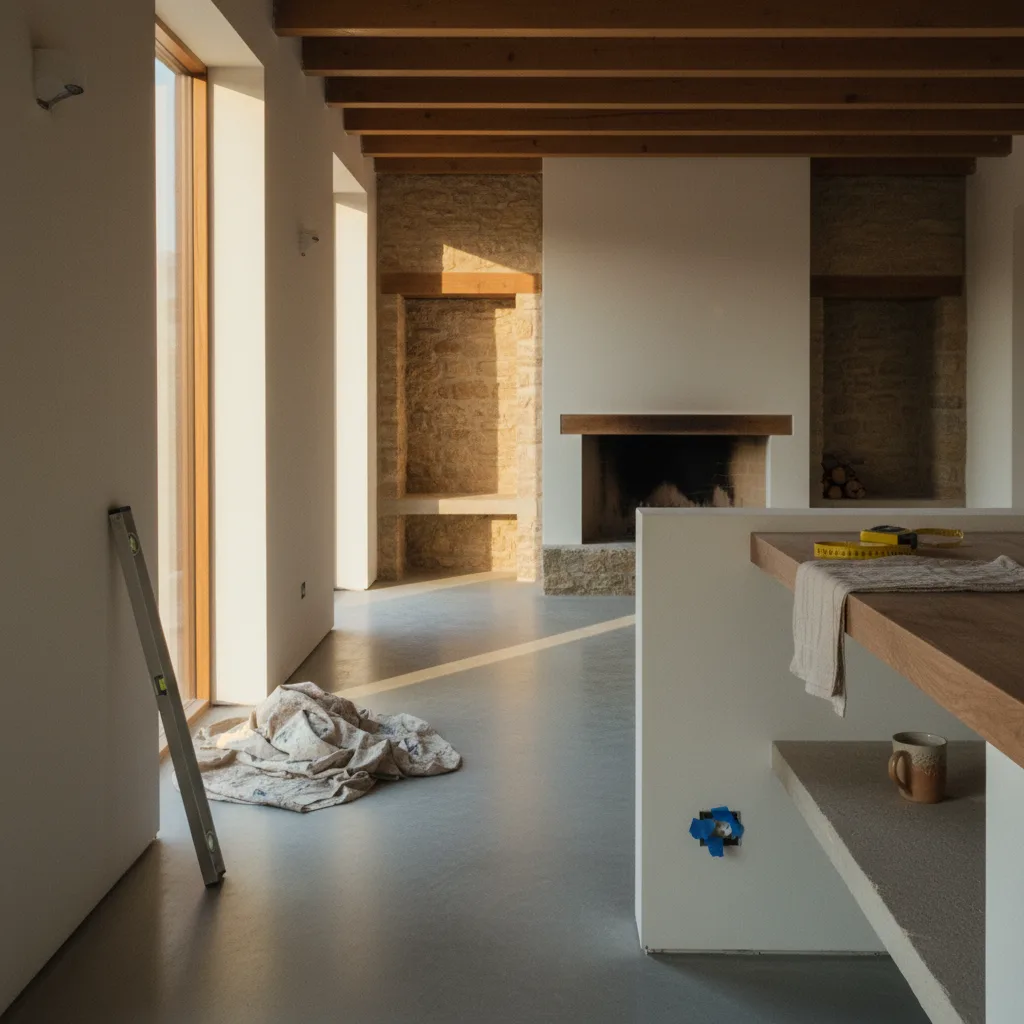
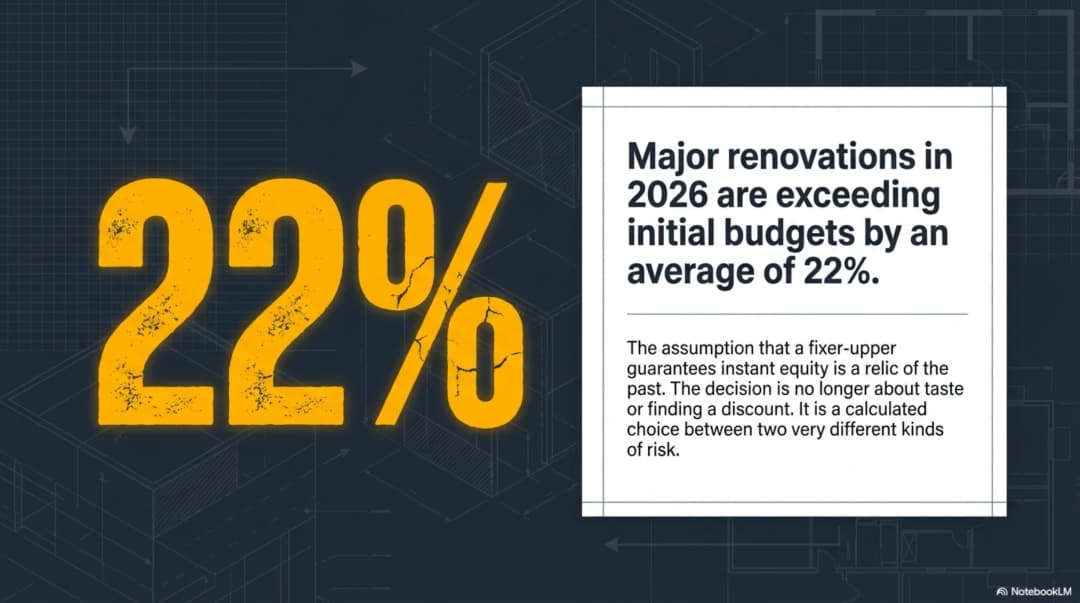
In this episode, we tackle the one question every potential home buyer faces: fixer-upper or move-in ready? It’s the central conflict of every house hunt. Most buyers assume the fixer-upper is the financially savvy move, but our data shows that major renovations in 2026 are exceeding initial budgets by an average of 22 percent. The decision of whether to take on a project or pay a premium for a finished home is not about taste. It’s a calculated choice between two very different kinds of risk. We're going to break down the 2026 math that decides the fixer upper vs move in ready debate, showing you how to choose between minimizing project risk or minimizing market risk.
What This Episode Is About
If you take three things from this episode, make them these. First, the real cost of a fixer-upper isn't the purchase price, it's the purchase price plus the total renovation cost, plus financing costs, plus your time. Second, the decision is less about money and more about your personal tolerance for risk and chaos. Third, the 2026 market has specific pressures, from interest rates to material lead times, that change the calculation your parents might have made a decade ago. This is about making the right choice for right now.
The choice between a fixer-upper and a move-in ready home is a trade-off. A move-in ready property offers cost certainty and convenience at a premium price, minimizing project risk. A fixer-upper provides a lower entry price and customization potential but introduces significant project risk, including budget overruns, timeline delays, and unforeseen complications.
The Real Numbers (National Picture)
Let's get straight to the numbers. Most buyers look at the price gap between a turnkey home and a fixer-upper and see instant equity. The reality is more complicated. Nationally, a home needing significant updates might sell for 15-25% below the median price for a comparable, updated home. Sounds great, but that gap is where the renovation budget lives. According to the 2026 Cost vs. Value Report from Remodeling Magazine, a major kitchen remodel now averages between $80,000 and $160,000, and a primary suite addition can easily top $200,000. These ranges can start lower for a simple cosmetic refresh in a condo, but for a single-family home gut renovation, the costs add up fast. Remember, these are just averages. In high-cost-of-living areas, those numbers can be 30-50% higher, a variation driven largely by labor rates documented in U.S. Bureau of Labor Statistics reports on regional construction wages. A fixer-upper isn't a discount, it's a down payment on a second job. Three modeled project scenarios for 2026, built from the Renology Cost Index and typical local scopes. These are illustrative estimates, not completed client projects:
- Minor Kitchen Remodel (Mid-Range): $29,000 - $45,000. Includes cabinet refacing, new countertops like Caesarstone quartz, updated sink and faucet, new hardware, and a fresh coat of Benjamin Moore Advance paint.
- Primary Bathroom Remodel (Mid-Range): $35,000 - $65,000. Includes a new double vanity, tile floor with Schluter-DITRA uncoupling membrane, a new toilet, and a semi-frameless glass shower enclosure.
- Whole-House Window Replacement (Vinyl): $22,000 - $38,000. Replacing 10-15 windows with energy-efficient vinyl units. This is often a non-negotiable update for energy savings and comfort.
- Exterior Siding Replacement (Fiber Cement): $25,000 - $50,000. Using a pre-finished product like James Hardie ColorPlus siding to improve curb appeal and reduce long-term maintenance.
What Most Homeowners Get Wrong About This
Most homeowners think buying a fixer-upper is a guaranteed way to build wealth. They watch a 30-minute TV show and assume they can replicate the results. This is the single biggest mistake. The shows never cover the permitting delays, the failed inspections, or the discovery of asbestos behind a wall. The concept of 'sweat equity' is romanticized, but it's often a fantasy. Unless you are a licensed electrician or plumber, your sweat is worth very little in the eyes of a building inspector. The real fix is a mental shift. Stop thinking of it as saving money. Start thinking of it as a job you are hiring yourself for. This reframing exposes the three things most people miss. They underestimate the final cost. They underestimate the total time commitment. And they dramatically overestimate their own ability to contribute meaningful labor.
The 3 Questions Every Homeowner Should Ask
Before you even look at a listing described as an 'opportunity,' you need to ask yourself three direct questions. Get these answers wrong, and you're headed for trouble. First: What is my absolute, all-in budget? This matters because the number needs to include the purchase price, all renovation costs, and a mandatory contingency fund. A good answer is a hard number, like '$750,000 all-in,' not a soft range. Second: How much of my personal time can I dedicate to this project per week? This matters because managing a renovation is a demanding part-time job requiring dozens of decisions and site visits. A good answer sounds like 'I can realistically spend eight hours per week for the next six months on this.' Third: What is my primary goal, a custom home or a financial return? This matters because these goals often conflict. A good answer is honest: 'My priority is creating a home exactly to our tastes, and we plan to stay for ten years,' or 'My priority is maximizing resale value within five years.' Your answer dictates every choice, from finish level to layout.
The Hidden Costs: What Your Inspection Won't Catch
3 pros, editor-screened. 4 questions.
See my 3 matchesA standard home inspection is a vital first step, but it is not a forensic investigation. The inspector can't see through walls. Most homeowners are blindsided by what the inspection *doesn't* cover. These are the budget-destroying surprises. We're talking about galvanized plumbing that needs a full PEX-A repipe, knob-and-tube wiring that requires a complete electrical overhaul to be insurable, or an original sewer line that's cracked and needs replacement. None of these are typically found in a standard visual inspection. We use a ten to fifteen percent contingency as a planning assumption; for comparison, HUD's Standard 203(k) loan rules require a reserve of at least 10 percent on homes 30 years or older, and this is exactly why. Other common surprises include discovering asbestos in old drywall compound or vinyl flooring, which requires expensive professional abatement. Or finding that floor joists have been improperly cut by a previous DIYer, compromising the structure. These are the real costs of a fixer-upper, and they can add $50,000 or more to your budget before you've even picked out paint colors. A smart buyer gets specialized inspections for sewer lines, foundations, and electrical systems on any home built before 1970.
Financing the Fixer: Renovation Loans Explained
You can't just use a standard mortgage to buy a fixer-upper and pay for the renovation. Most lenders won't approve a loan on a property that isn't habitable, and your down payment cash is usually needed for the purchase itself. This is where renovation loans come in. Products like the FHA 203(k) loan or Fannie Mae's HomeStyle loan combine the purchase price and the renovation budget into a single mortgage. The loan amount is based on the home's projected value *after* the renovation is complete. It sounds perfect, but there are major trade-offs. These loans are more complex, have stricter qualification requirements, and often come with slightly higher interest rates and fees. You'll need to provide detailed contractor bids and plans *before* you can close on the house. The renovation funds are then held in an escrow account and released to your contractor in stages, only after an inspector verifies the work is complete. This process adds layers of paperwork and weeks, sometimes months, to your closing timeline. It's a powerful tool, but it's not fast or easy. For a deeper dive on project finances, check out our guide on how to budget for a home remodel.
When to Walk Away: Red Flags for Any Fixer-Upper
Not every project is worth the effort. The key is knowing which problems are manageable and which are financial black holes. There are three red flags that should make you seriously consider walking away. First, major foundation issues. We're not talking about minor settling cracks. Look for horizontal cracks in the foundation walls, stair-step cracks in brickwork, or doors and windows that are severely out of square. These signal deep structural problems that can cost six figures to fix. Second, evidence of persistent, unresolved water intrusion. This could be signs of mold in the attic or basement, spongy floors around bathrooms, or water stains that appear on ceilings below a flat roof. Fixing the cosmetic damage is easy; finding and fixing the source of the water can be a nightmare. Third, unfixable location problems. The house might back up to a noisy commercial district, have a shared driveway with a difficult neighbor, or be in a designated flood zone with skyrocketing insurance rates. You can change the house, but you can never change its location. Ignoring these red flags is how a 'dream project' becomes a decade-long financial drain.
What Changed in 2026
The math for the 'fixer upper vs move in ready' debate is not static. It changed significantly between 2024 and 2026. The primary driver is the interest rate environment. With mortgage rates stabilizing in the 5-6% range, higher than the historic lows of the early 2020s, the cost of financing both the purchase and the renovation is more significant. This makes the all-in cost of a fixer-upper higher, narrowing the potential equity gap. On the other hand, the Inflation Reduction Act's home energy tax credits, like the 25C and 25D credits, are now a major factor. A fixer-upper that needs new windows, insulation, and a heat pump HVAC system allows you to take full advantage of these federal incentives, which can total thousands of dollars. Material supply chains have largely recovered from pandemic disruptions, but lead times for specialty items like custom cabinetry and high-performance windows remain long, often 12 to 20 weeks. This requires more meticulous planning than ever before. Finally, building codes continue to tighten. Many jurisdictions are now enforcing the 2024 International Residential Code (IRC), which has stricter requirements for insulation, air sealing, and electrical systems, potentially adding costs to your renovation project.
Information Gain: The Break-Even Horizon
Here is the one thing no one else talks about. The decision isn't just about the upfront cost. It's about your break-even horizon. This is the amount of time you need to own the home for the fixer-upper investment to become more profitable than buying the move-in ready house next door. Let's do the math. Start with the 'renovation premium.' This is your total project cost (renovation + financing fees + carrying costs during construction) minus the initial discount you got on the purchase price compared to a turnkey home. For example, you buy a fixer for $500,000, which is $150,000 less than the updated house next door. You spend $180,000 on the renovation. Your renovation premium is $30,000. You effectively paid $30,000 more for the privilege of customizing your home. The question is, how long will it take for your home's value to overcome that premium? This depends on the appreciation rate in your market and the quality of your renovation. If homes are appreciating at 4% per year, your newly renovated $680,000 home will gain about $27,200 in value the first year. The turnkey home, starting at $650,000, will gain $26,000. You're barely closing the gap. Most financial advisors say the average homeowner moves every seven to ten years. You must calculate if your break-even horizon fits within your actual life plan. If the math says you'll break even in year three, it's a great investment. If it says year twelve, you are likely to lose money when you sell.
The Renology Take
Everyone frames this as a financial decision. It's not. The choice between a fixer-upper and a move-in ready home is a decision about which type of risk you are more comfortable with. It's a personality test. If you buy a move-in ready home, you are accepting market risk. You might be paying at the top of the market, and its value could decline if the economy shifts. Your risk is primarily financial and external. If you buy a fixer-upper, you are accepting project risk. You are betting on your ability to manage a complex, expensive, and stressful project within a certain budget and timeline. Your risk is primarily operational and internal. There is no right answer, only the answer that's right for your financial stability, your time availability, and your mental fortitude. The homeowners who get this right are the ones who are brutally honest with themselves about which category of risk they can sleep with at night.
Sources & Methodology
See the Renology Methodology for how sources are reviewed, ranges are normalized, and planning-data limits are handled.
- NAHB/Wells Fargo Housing Market Index (HMI), Q1 2026
- Remodeling Magazine: 2026 Cost vs. Value Report
- National Kitchen & Bath Association (NKBA) 2026 Design Trends Report
- U.S. Census Bureau, Monthly Construction Spending, March 2026
- U.S. Bureau of Labor Statistics (BLS), Occupational Employment and Wage Statistics, Construction Trades, 2025 Data
- Harvard Joint Center for Housing Studies (JCHS), Leading Indicator of Remodeling Activity (LIRA), April 2026
- U.S. Department of Energy, Inflation Reduction Act of 2022 Residential Credit Guidance
- Fannie Mae, HomeStyle Renovation Mortgage Guidelines, 2026
- Renology Editorial Methodology and Project Data Analysis, 2023-2026
Frequently Asked Questions
How much should I budget for a fixer-upper renovation?
What is 'sweat equity' and is it realistic for most homeowners?
Are renovation loans harder to get in 2026?
What's the first thing I should renovate in a fixer-upper?
Can I live in the house during a major renovation?
How do I find a reliable contractor for a fixer-upper project?
Does a fixer-upper always have a better ROI?
What are the biggest unexpected costs in a renovation?
Ready to find a pro?
Tell us what you are planning and where. A Renology advisor can help you explore contractor matching.
Find a Pro- Free for homeowners
- Licensed, vetted local contractors
- No obligation to hire
Sources
- NAHB/Wells Fargo Housing Market Index (HMI)
- Remodeling Magazine: 2026 Cost vs. Value Report
- National Kitchen & Bath Association (NKBA) 2026 Design Trends Report
- U.S. Census Bureau, Monthly Construction Spending
- U.S. Bureau of Labor Statistics (BLS), Occupational Employment and Wage Statistics, Construction Trades
- Harvard Joint Center for Housing Studies (JCHS), Leading Indicator of Remodeling Activity (LIRA)
- U.S. Department of Energy, Inflation Reduction Act of 2022 Residential Credit Guidance
- Fannie Mae, HomeStyle Renovation Mortgage Guidelines
- Renology Editorial Methodology and Project Data Analysis
Follow Renology on Google
Choose Renology as a preferred source and our guides show up more often in your Google results, including Top Stories and AI Overviews.