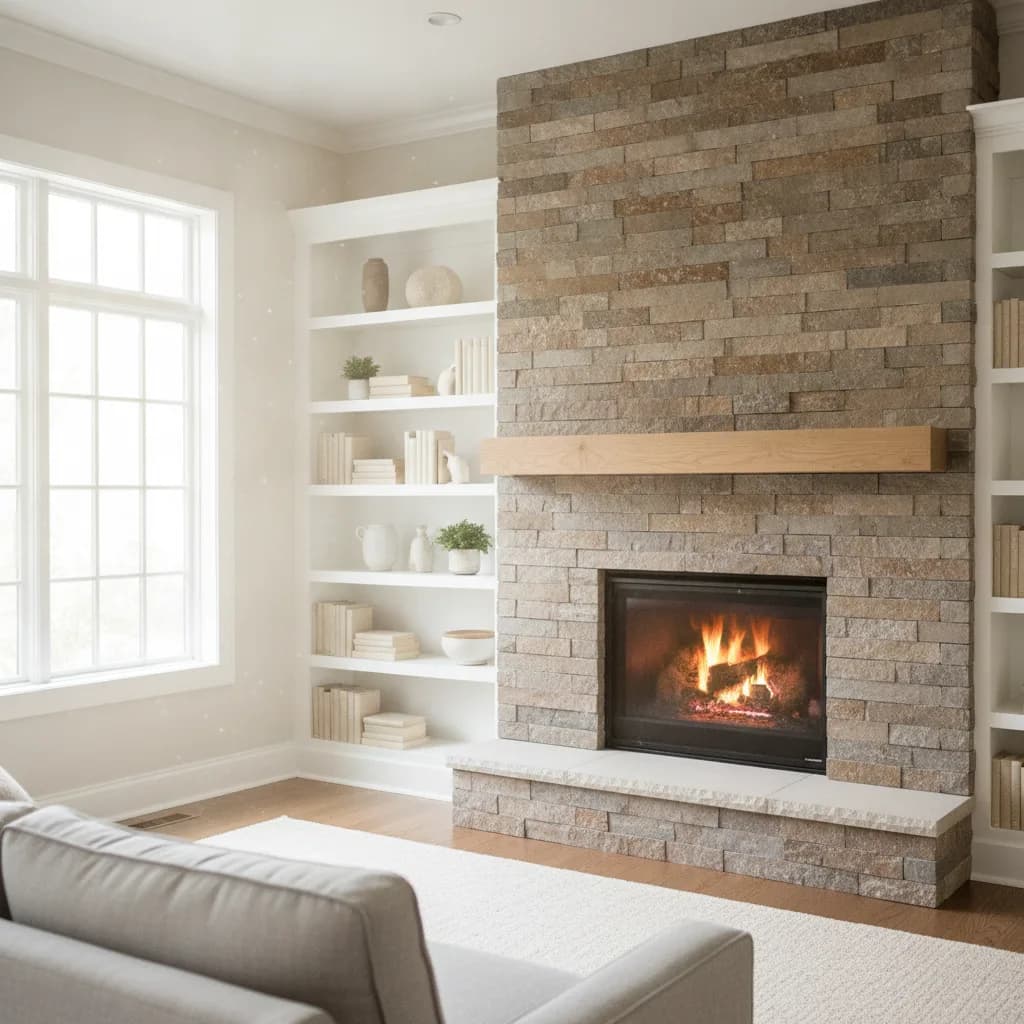
A fireplace remodel costs between $600 and $4,500 for a typical refacing, and a full rebuild runs $2,400 to $10,000 or more, according to 2026 data from Angi and HomeGuide. A gas insert, the most common upgrade inside that range, lands between $2,300 and $8,000 installed. Those are the national numbers. If you live in the Bay Area or the Seattle metro, the price is only half the story, because clean-air rules now decide what you are allowed to burn in the first place. This guide prices every option line by line, shows where real quotes leave the published ranges behind, and covers the 2025 rule changes that are pushing West Coast homeowners toward inserts.
In a Nutshell
- Cosmetic refresh: paint or limewash runs $350 to $650. A simple refresh with new hearth accents lands between $400 and $2,000 (Angi, 2026).
- Refacing: $600 to $4,500 depending on material, with stone veneer at the top of the range (Angi, HomeGuide).
- Gas insert: $2,300 to $8,000 installed on paper. Real quotes with chimney liner and electrical work often land between $7,000 and $10,000, and this guide explains exactly why.
- Full rebuild: $2,400 to $10,000 and up. Chimney work alone can run $1,000 to $15,000 (HomeGuide).
- Bay Area and Seattle: wood-burning restrictions tightened again in late 2025. For many homeowners an EPA-certified insert is now the only practical path, which changes the budget conversation before style ever comes up.
What Does a Fireplace Remodel Cost by Project Type?
The word "remodel" covers everything from a weekend paint job to demolishing the chimney. Costs group cleanly by project type, and the ranges below come from Angi and HomeGuide's 2026 cost files.
| Project type | Typical cost | What it includes |
|---|---|---|
| Paint or limewash | $350 to $650 | Surface prep and heat-rated paint over existing brick |
| Simple refresh | $400 to $2,000 | New hearth accents, minor repairs, cosmetic updates |
| Refacing | $600 to $4,500 | New surface material over the existing structure |
| New mantel | $500 to $5,000 | Stock beam at the low end, custom millwork at the top |
| Gas insert, installed | $2,300 to $8,000 | Unit, labor, and basic hookup. Venting often extra, see below |
| Wood to gas conversion | $1,500 to $8,000 | Gas log set at the low end, sealed insert with new line at the top |
| Full replacement or rebuild | $2,400 to $10,000+ | Demolition, new firebox, new surround. Chimney rebuilds add $1,000 to $15,000 |
| Outdoor fireplace, prefab kit | $1,500 to $9,000 | Modular kit set on an existing patio |
| Outdoor fireplace, custom masonry | $6,000 to $20,000 | Footing, masonry, and finish work |
| Electric feature wall | $1,200 to $12,000 | Recessed unit with a built-out media wall at the high end |
Labor is roughly a quarter of a typical project, with fireplace installers charging $40 to $150 per hour and general contractors $50 to $150 per hour or 10 to 20 percent of the project (HomeGuide, 2026).
Surround Materials: The Two Price Tags Nobody Separates
This is where fireplace cost guides quietly contradict each other. One source says brick refacing costs $3 to $10 per square foot. Another says $25 to $50. Both are right, because one is quoting the material alone and the other is quoting the installed price with labor. Almost nobody labels which is which, so here are both columns side by side.
| Surround material | Material only, per sq ft | Installed, per sq ft |
|---|---|---|
| Brick | $3 to $10 (Angi) | $25 to $50 (HomeGuide) |
| Manufactured stone veneer | $11 to $18 (Angi) | $45 to $75 (HomeGuide) |
| Natural stone | $60 to $70 (Angi) | $50 to $150 (HomeGuide) |
| Ceramic or porcelain tile | $1 to $40 (Angi) | varies with tile grade and pattern |
| Marble slab | $55 to $150 (Better Marble, 2025) | |
| Quartz | $50 to $200 (Granite Selection) | fabrication and templating added at install |
When you compare quotes, ask each contractor whether their number is material only or installed. A "cheap" veneer bid that excludes labor is not cheap.
Why Real Quotes Run $7,000 to $10,000 When the Guides Say $2,300
The most upvoted fireplace threads on Reddit exist because homeowners keep getting quotes two to three times higher than the published averages. The gap is not price gouging. The published floor assumes your chimney needs nothing, and most chimneys need something. Here is how a $3,500 insert becomes a $9,000 project.
| Line item | Typical cost | Why it appears on real quotes |
|---|---|---|
| Gas insert unit, direct vent | $2,500 to $3,500 | The part the published averages describe (HomeGuide) |
| Chimney liner | $1,500 to $4,000 | Most older chimneys need a new stainless liner for an insert (HomeGuide, Angi) |
| Install labor | $500 to $1,500 | Setting, sealing, and commissioning the unit (Angi) |
| Venting and chimney work | $1,000 to $6,000 | Cap, chase cover, masonry repairs uncovered on inspection (Angi) |
| Electrical run for blower | $200 to $500 | Most inserts need an outlet inside the firebox |
| New or extended gas line | $250 to $2,000 | $12 to $25 per linear foot, more in California (HomeGuide, Forbes Home) |
| Permit | $100 to $500 | Gas appliance and venting work is permitted work (Angi, HomeGuide) |
Budget for the middle of that stack, not the bottom of the advertised range, and a quote of $7,000 to $10,000 for an insert with liner and electrical stops being a surprise. If a bid comes in far below that, check what the bid leaves out.
The Rules Changed: What Bay Area and Seattle Homeowners Must Know
In much of California and western Washington, the first question is no longer what a fireplace costs. It is what you are still allowed to burn.
San Francisco Bay Area. Air District Regulation 6, Rule 3 already prohibits installing anything but EPA-certified devices, and bans wood-burning devices entirely in new construction. In October 2025 the district lowered its Winter Spare the Air trigger from 35 to 25 micrograms per cubic meter, which the district expects to produce 19 to 41 no-burn days per winter, up from a historical average of about 15. A traditional open hearth in the Bay Area is now unusable for a meaningful part of the season, and an EPA-certified insert is the only compliant upgrade path for wood. Ventless gas inserts, the cheap ones at $700 to $2,500, are not legal in California at all.
Seattle metro. The Puget Sound Clean Air Agency runs staged burn bans across King, Kitsap, Pierce, and Snohomish counties. Stage 1 bans fireplaces and uncertified stoves while EPA-certified inserts and pellet stoves may keep burning. Stage 2 bans all wood burning, certified or not. If you remodel a fireplace in the Seattle area and stay with wood, a certified insert is what keeps it usable through most of the winter.
The practical effect on budgets: West Coast fireplace remodels increasingly mean a $2,300 to $8,000 insert project rather than a $600 cosmetic reface, because the insert is what makes the fireplace legal to enjoy.
Gas vs Electric vs Wood: What It Costs to Run
Install price is half the math. Operating cost is the other half, and it depends heavily on how often you burn, so the assumptions are stated here.
| Fuel | Cost to run | Annual upkeep |
|---|---|---|
| Natural gas | $0.20 to $0.60 per hour. A season of regular evening use runs $400 to $640 (Angi). Occasional use can stay under $200 per year (Inspire) | Inspection $75 to $200 per year |
| Electric | $0.12 to $0.24 per hour, roughly $22 to $34 per month at five hours a day (Electric Fireplaces Direct) | Effectively none |
| Wood | Firewood $200 to $500 per year for regular use | Chimney sweep $100 to $800 plus inspection $55 to $130 |
Does a Fireplace Remodel Pay Back at Resale?
Honest answer: the data here is softer than the industry likes to admit. The widely quoted claim that a fireplace adds $1,000 to $5,000 of value, and that 77 percent of buyers would pay more for one, comes from a 2016 Angi survey that is now a decade old. Remodeling Magazine's Cost vs Value report, the standard for remodel ROI, does not track fireplaces at all. On the other side, the NAHB's buyer research finds only about 16 percent of buyers rate a fireplace as essential. The fair conclusion: a clean, working, code-compliant fireplace helps a listing show well, a dated or non-compliant one can hurt it, and nobody should remodel a fireplace expecting a measurable resale profit. Remodel it because you will use it.
Permits and Who Does the Work
3 pros, editor-screened. 4 questions.
See my 3 matchesAnything involving gas lines, inserts, or venting is permitted work, typically $100 to $500 depending on the city (Angi, HomeGuide). In California, any job of $1,000 or more requires a CSLB-licensed contractor, and gas line work belongs with a licensed plumber or gas fitter at $45 to $150 per hour. Cosmetic refacing and painting are fair DIY territory. The moment fuel, venting, or structure is involved, it is not.
What Drives Your Number Up or Down
Two homes on the same street can get fireplace quotes $6,000 apart. These are the variables that explain almost all of that gap, in the order they usually matter.
| Driver | Cost impact | Why it moves the number |
|---|---|---|
| Chimney condition | $0 to $15,000 | The single biggest swing. A sound flue needs nothing. A failed one needs a liner ($1,500 to $4,000) or a rebuild ($1,000 to $15,000) |
| Fuel change | $250 to $8,000 | Staying with the same fuel is cheap. Adding gas means a line, a permit, and a licensed plumber |
| Surround height | $500 to $4,000 | Floor-to-ceiling stone costs three to four times a standard mantel-height surround in the same material |
| Structural support | $500 to $3,000 | Natural stone is heavy. Some walls need reinforcement before it can be installed |
| Electrical | $200 to $500 | Inserts with blowers need an outlet inside the firebox, which usually means fishing a new circuit |
| Access | $300 to $2,000 | Second-floor fireplaces, steep roofs, and tight urban lots add labor hours to every stage |
| Hearth extension | $3 to $200 per sq ft | Code requires a non-combustible hearth of a set depth. Changing the firebox often forces a new one |
How to Read a Fireplace Quote Line by Line
A good fireplace bid separates the appliance from everything attached to it. A vague one hides the chimney work, which is where the money is. Here is what each section should say, and the specific red flags in each.
- The appliance. Should name the make, model, and vent type. "Gas insert" with no model is not a spec. Direct-vent and ventless are different products at different prices, and ventless is not legal in California.
- Chimney and venting. Should state whether a liner is included and at what diameter and material. If the bid says "liner if needed", you have an open-ended line item. Ask for the inspection first, then a fixed number.
- Gas. Should say whether the line already reaches the firebox, and if not, the linear footage being run. At $12 to $25 per foot, twenty feet is a real cost, not a rounding error.
- Electrical. Blower models need power. If no electrical line appears in the bid, either the outlet exists or the item is missing.
- Permit and inspection. Should be a named line, typically $100 to $500. A bid with no permit line on gas work is a bid that plans to skip the permit.
- Surround and finish. Should state material, square footage, and whether the price is material-only or installed. This is where the two price tags in the table above cause most disputes.
- Demolition and disposal. Removing an old surround runs $500 to $1,000, and full firebox demolition $500 to $2,500. Somebody is paying for the dumpster.
Choosing Your Fuel: A Decision Framework
Most homeowners arrive asking about surrounds and leave having made a fuel decision, because fuel drives both the budget and what the fireplace can legally do. Here is the honest framework.
Choose a gas insert if you actually use the fireplace, you live in the Bay Area or Seattle where wood is restricted on an increasing number of days, and you want heat rather than ambiance. It is the most expensive path once venting is included, and the only one that reliably delivers usable warmth on a no-burn day.
Choose electric if you want the look, you burn a few times a season, or you are working with a wall where no chimney exists. Installed cost of $1,200 to $3,400 for a standard unit is the lowest real-world entry point, running cost is roughly $0.12 to $0.24 per hour, and there is no venting, no permit for the appliance itself, and no annual inspection.
Keep wood if you are outside the restricted air districts, you already have a sound chimney, and burning is part of why you love the house. Understand the running cost honestly: $200 to $500 a year in firewood plus $100 to $800 for a sweep and $55 to $130 for inspection.
Consider an EPA-certified wood insert if you want to keep burning wood inside a restricted district. It is the compliant version of wood, it burns cleaner, and in a Puget Sound Stage 1 ban it is still legal while an open fireplace is not.
Outdoor Fireplaces: A Different Cost Structure
An outdoor fireplace is priced more like hardscape than like an appliance. The two paths diverge sharply.
Prefab kits run $1,500 to $9,000 installed. The unit arrives as modular components, sits on an existing patio slab if it can carry the weight, and goes together in days rather than weeks. The trade-off is a limited set of shapes and finishes.
Custom masonry runs $6,000 to $20,000, and complex builds reach $25,000. That number buys a footing poured below frost or to local code, block or brick construction, a real chimney, and a veneer finish of your choosing. It is a small construction project with a permit, an inspection, and a schedule measured in weeks.
The variables that decide which end of those ranges you land on are the same every time: whether a gas line has to be trenched to the location, whether the existing slab can carry the load or a new footing is required, the finish material, and whether seating, storage, or a pizza oven get folded into the same structure.
Cost by Metro: California and Seattle
National ranges are a starting point, not a quote. Labor and code carry a real premium on the West Coast.
- Los Angeles. California construction runs roughly 35 percent above the national average, and gas line work is quoted at $500 to $2,000 rather than the national $250 to $2,000. Expect the upper half of every range in this guide.
- San Francisco Bay Area. Labor runs 30 to 50 percent above national. Add the regulatory layer: only EPA-certified devices may be installed, no wood device may go into new construction, and the October 2025 amendment means more no-burn days each winter than at any point in the rule's history.
- Seattle metro. Permit costs on remodel work are among the highest tracked nationally, and the Puget Sound burn ban stages decide when a fireplace is usable. A certified insert is the difference between a fireplace you can light in January and one you cannot.
In all three, the practical takeaway is the same. Get the chimney inspected, price the compliant version of what you want, and treat any bid that ignores local air rules as incomplete.
Do This Before You Collect a Single Bid
The reason fireplace quotes vary so wildly is that most homeowners ask three contractors to price an unknown. Each one guesses differently about the chimney, and the guesses become the spread. Two steps fix that.
Step one: get a Level 2 chimney inspection. It costs $55 to $130 for a basic inspection, and a camera scan of the flue costs somewhat more. It tells you whether the liner is intact, whether the masonry is sound, and whether the flue is sized for the appliance you want. That single document turns your project from an unknown into a defined scope, and every bid you receive afterward prices the same work.
Step two: decide the fuel before you shop surrounds. Contractors quote what you ask for. If you ask for a stone reface and later add a gas insert, you are paying to open the same wall twice. Fuel first, structure second, finish last.
Homeowners who do both routinely find the spread between their three bids collapses from thousands of dollars to hundreds, because the contractors are finally pricing the same job.
Common Mistakes That Cost Real Money
- Buying the appliance separately to save money. Many installers will not warranty a unit they did not supply, and some will not install one at all. The saving on the box gets eaten by the labor premium or by having no warranty path.
- Skipping the permit on gas work. It surfaces at resale, and an unpermitted gas appliance is the kind of finding that stalls a sale at exactly the wrong moment.
- Choosing ventless to avoid venting costs. It is not legal in California, and where it is legal it introduces moisture and combustion byproducts into the room.
- Ignoring the hearth extension. Code sets a minimum non-combustible depth in front of the firebox. Discovering that after the flooring is finished is an expensive sequence.
- Refacing over a firebox that is failing. New stone over a cracked firebox is money spent on the part you will have to remove.
Sources & Methodology
See the Renology Methodology for how sources are reviewed, ranges are normalized, and planning-data limits are handled.
National cost ranges in this guide come from Angi and HomeGuide 2026 cost files, HomeAdvisor conversion data, and material pricing from Better Marble and Granite Selection. Regulatory details come directly from the Bay Area Air Quality Management District (Regulation 6-3 and the October 2025 Winter Spare the Air amendment) and the Puget Sound Clean Air Agency burn ban stages. Resale figures are date-stamped in the text because the underlying surveys vary in age. Where published ranges and real-world quotes diverge, we show both and explain the gap rather than averaging it away.
Renology Take
Most fireplace guides sell you a $600 fantasy or a $15,000 scare. The truth sits in the stack-up: the insert is a known price, and everything attached to your specific chimney is where quotes diverge. Get the chimney inspected before you collect bids, so every contractor prices the same known scope. And if you are in the Bay Area or Seattle, start from compliance. The prettiest surround in the world is a decoration if you cannot legally light a fire behind it.
Turn the range into a scope you can compare
An insert replacement is different from a new fireplace wall with custom cabinetry. Compare the appliance, venting, surround and built-ins separately.
Tell us your project and ZIP code so an advisor can check local contractor availability. Matching is free for homeowners; the contractor provides the project quote.
Find help with your fireplace projectAlready have a quote? Check its scope and exclusionsFrequently Asked Questions
How much does it cost to redo an existing fireplace?
How do you modernize a fireplace?
How much does it cost to reopen a fireplace?
Is it worth fixing an old fireplace?
How much does it cost to install a gas insert in a fireplace?
Can I put a gas fireplace insert in an existing fireplace?
Is a gas fireplace insert worth it?
How much does an outdoor fireplace cost?
Get 3 renovation bids in 48 hours.
Our editors already vetted contractors. Answer 4 questions and we send 3 written bids inside 48 hours, with the real price for your scope, not their inflated first-call number.
- Free, no commission
- Pre-screened locally
- Bids inside 48 hours
Takes about 60 seconds. We'll text you when bids arrive.
Sources
- Angi, Fireplace Remodel Cost
- Angi, Gas Fireplace Insert Cost
- HomeGuide, Fireplace Remodel Cost
- HomeGuide, Gas Fireplace Insert Cost
- HomeAdvisor, Convert Wood Fireplace to Gas
- BAAQMD, Wood Smoke Rule (Reg 6-3) and October 2025 amendment
- Puget Sound Clean Air Agency, Burn Bans
- NAHB, What Home Buyers Really Want
- Renology Cost Index