An accessory dwelling unit build in Los Angeles takes between six and ten months, from the first call to a contractor to the final inspection sign-off. That's for a standard detached new build in a neighborhood like Mar Vista. The timeline can start lower, maybe four to seven months, if you're looking at a garage conversion, a prefab unit, or a Junior ADU (JADU) carved from existing space. The biggest single delay is, and always has been, the Los Angeles Department of Building and Safety (LADBS) plan check process. A clean submittal sails through. One with errors can add two months of back-and-forth before you ever break ground.
In a Nutshell
- Total Timeline: 24 to 40 weeks for a standard, detached new-build ADU.
- Four Key Phases: 1. Design & Permits; 2. Site Prep & Foundation; 3. Framing & Rough-In; 4. Finishes & Final Inspection.
- Biggest Delay Risk: Plan check revisions required by LADBS. A complex design on a tricky lot can get stuck in review for months.
- Contingency Fund: A ten to fifteen percent cash reserve is not optional. The National Association of Home Builders (NAHB) confirms this is standard for dealing with the surprises hidden in any residential lot.
Phase 1: Design and Permits (Weeks 1, 12)
This is the paperwork phase, and it's the most unpredictable. It begins with hiring an architect or designer to create a full set of construction documents. This includes floor plans, elevations, structural engineering for the foundation and load path, and Title 24 energy calculations. Once the plans are complete, they're submitted to the Los Angeles Department of Building and Safety (LADBS) for review. The owner's job here is to make decisions quickly and sign checks. The architect and potentially a permit expediter handle the city interface. Common holdups include incomplete submissions, zoning conflicts, or corrections required for fire safety or seismic codes. California state laws like AB 68 streamline the process, but they don't eliminate it. Using one of the city's pre-approved RTI (Ready-to-Issue) Standard Plans is the fastest way through this phase.
Phase 2: Site Prep and Foundation (Weeks 13, 16)
Once you have an approved permit, the physical work begins. This phase clears the stage for the structure. It involves any necessary demolition, grading the site for proper drainage, and trenching for the new utility lines. Your contractor will coordinate with the Los Angeles Department of Water and Power (LADWP) and SoCalGas for the new sewer, water, electrical, and gas connections. The final step is forming and pouring the concrete foundation, either a monolithic slab or a raised foundation with footings. The main risk here is the unknown. Hitting bedrock, dealing with uncompacted fill, or discovering old, abandoned septic tanks can stop work and require a soils engineer. Rain is the other enemy. You can't pour a slab in a downpour.
Phase 3: Framing and Rough-In (Weeks 17, 24)
This is when your ADU starts to look like a building. A framing crew erects the walls, sets the roof trusses, and applies sheathing and house wrap. Windows and exterior doors go in next, making the structure weather-tight. Then begins the critical sequence of rough-in work. The plumber runs supply and drain lines, the electrician pulls wire to every box, and the HVAC technician installs ductwork. Each of these trades must have their work inspected and signed off on the inspection card by a city official before anything can be covered up. A failed inspection is a hard stop. The entire project waits until the correction is made and re-inspected. A good adu contractor in los angeles manages this sequence tightly to avoid dead days on site.
Phase 4: Finishes and Final Inspection (Weeks 25, 32)
With the rough-in inspections passed, the walls get closed up. This phase includes insulation, drywall, taping, and texturing. From there, it's all the visible surfaces: paint, flooring, tile, and cabinetry. The finish trades, like carpenters, painters, and tilers, work in a careful ballet of scheduling. A delay in cabinet delivery can halt the countertop template, which halts the tile backsplash, which halts the final plumbing fixture installation. It is a chain reaction. Once all fixtures are in and the building is complete, you'll have a final inspection from LADBS. The inspector walks through with a punch list, checking everything from smoke detector placement to outlet covers. Once they sign off, the city issues a Certificate of Occupancy, and the ADU is legally habitable.
Three Representative Projects from 2026
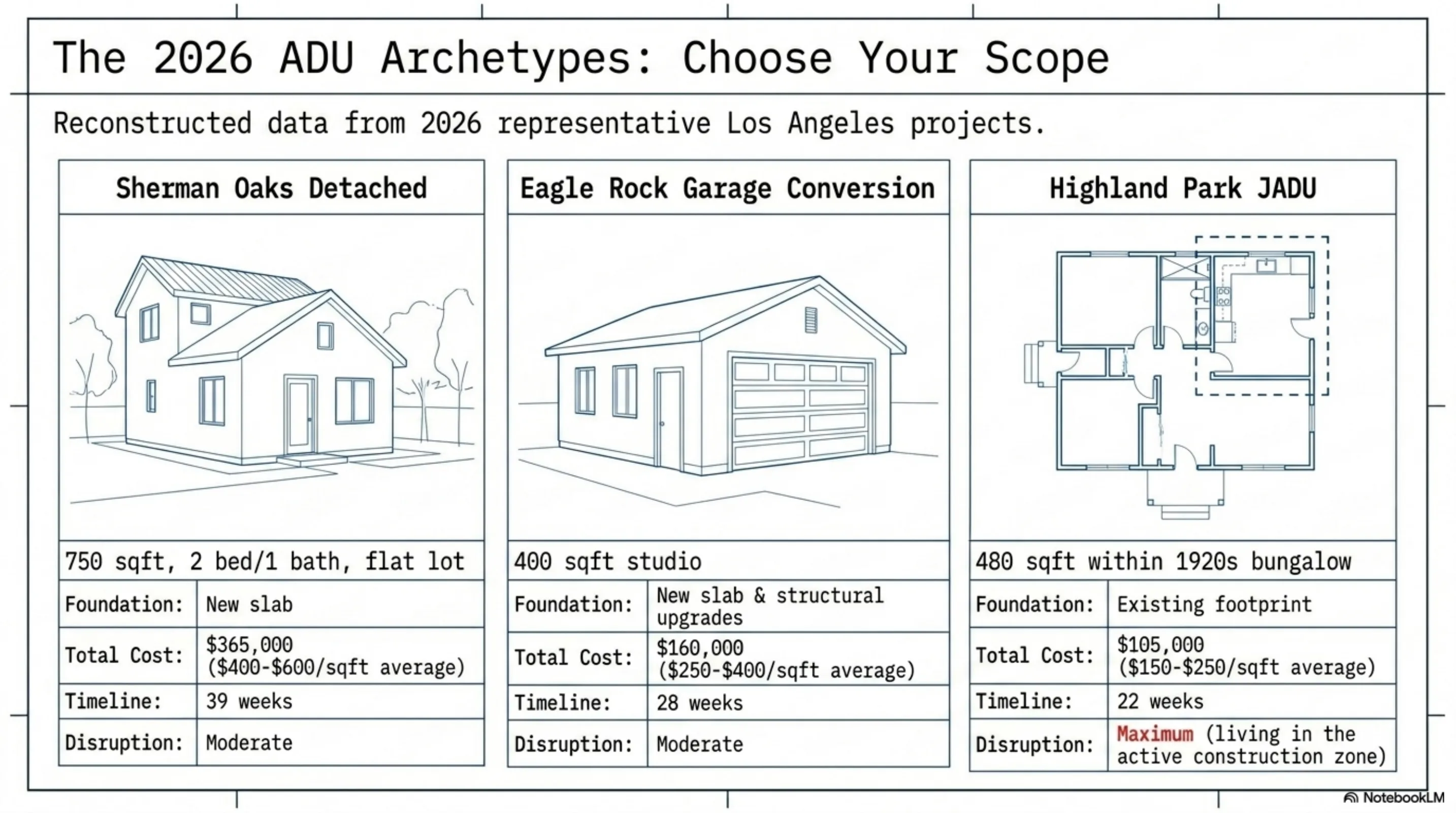
Three representative projects from 2026, scoped similarly, reconstructed from Renology's Project of the Day network and used here in aggregate form:
- Sherman Oaks Detached ADU: A 750-square-foot, two-bedroom, one-bath new build on a flat lot. Stick-built with a slab foundation and stucco finish. Total Cost: $365,000. Total Timeline: 39 weeks.
- Eagle Rock Garage Conversion: Converted a 400-square-foot detached garage into a studio ADU. Required a new foundation slab and significant structural upgrades. Total Cost: $160,000. Total Timeline: 28 weeks.
- Highland Park JADU: Created a 480-square-foot Junior ADU within the existing footprint of a 1920s bungalow. Included a new kitchenette, bathroom, and exterior entrance. Total Cost: $105,000. Total Timeline: 22 weeks.
What Can Compress This Timeline
The homeowner who saves six weeks does three things before signing a contract. First, they choose a design from the LADBS RTI Standard Plan Program. This cuts the plan check phase down from months to days. Second, they finalize every single material and finish selection before the scope-lock date. Every faucet, tile, and paint color is documented. No changes. Change orders are timeline killers. Third, they hire an ADU specialist, not just a general contractor. An experienced adu contractor los angeles knows the specific codes, the inspectors, and the sub-contractors who show up on time. They have a system. You are paying for the system.
What Blows It Up
Three things reliably turn a six-month project into a ten-month ordeal. The first is unforeseen site conditions. This could be expansive clay soil requiring deeper footings or an un-permitted sewer line right where the foundation needs to go. The second is a permitting quagmire. Building in a Hillside Area or a Historic Preservation Overlay Zone (HPOZ) adds layers of review and complexity that can stall a project for months. The third, and most common, is homeowner-driven change orders. Deciding to move a wall after the electrical is already run is not a small tweak. It is a demolition, a re-work, and a re-inspection, all of which cost time and money. The National Association of Home Builders recommends a ten to fifteen percent contingency on renovations in homes over thirty years old.
What Should Be in Your Contractor's Schedule
A real construction schedule is more than a start and end date. It's a detailed document with dependencies. Yours must include these line items at a minimum:
- Scope-lock date for all owner selections
- Permit set submittal to LADBS
- Target date for permit approval
- Foundation form and pour dates
- Target date for foundation inspection
- Framing inspection date
- Rough electrical, plumbing, and HVAC inspection dates
- Cabinet and appliance order-by dates (based on lead times)
- Target date for final inspection
- Target date for Certificate of Occupancy
A professional schedule shows the critical path. For a full breakdown of the city's requirements, see our [permit playbook](/guides/los-angeles-adu-permit-playbook-2026).
Renology Take
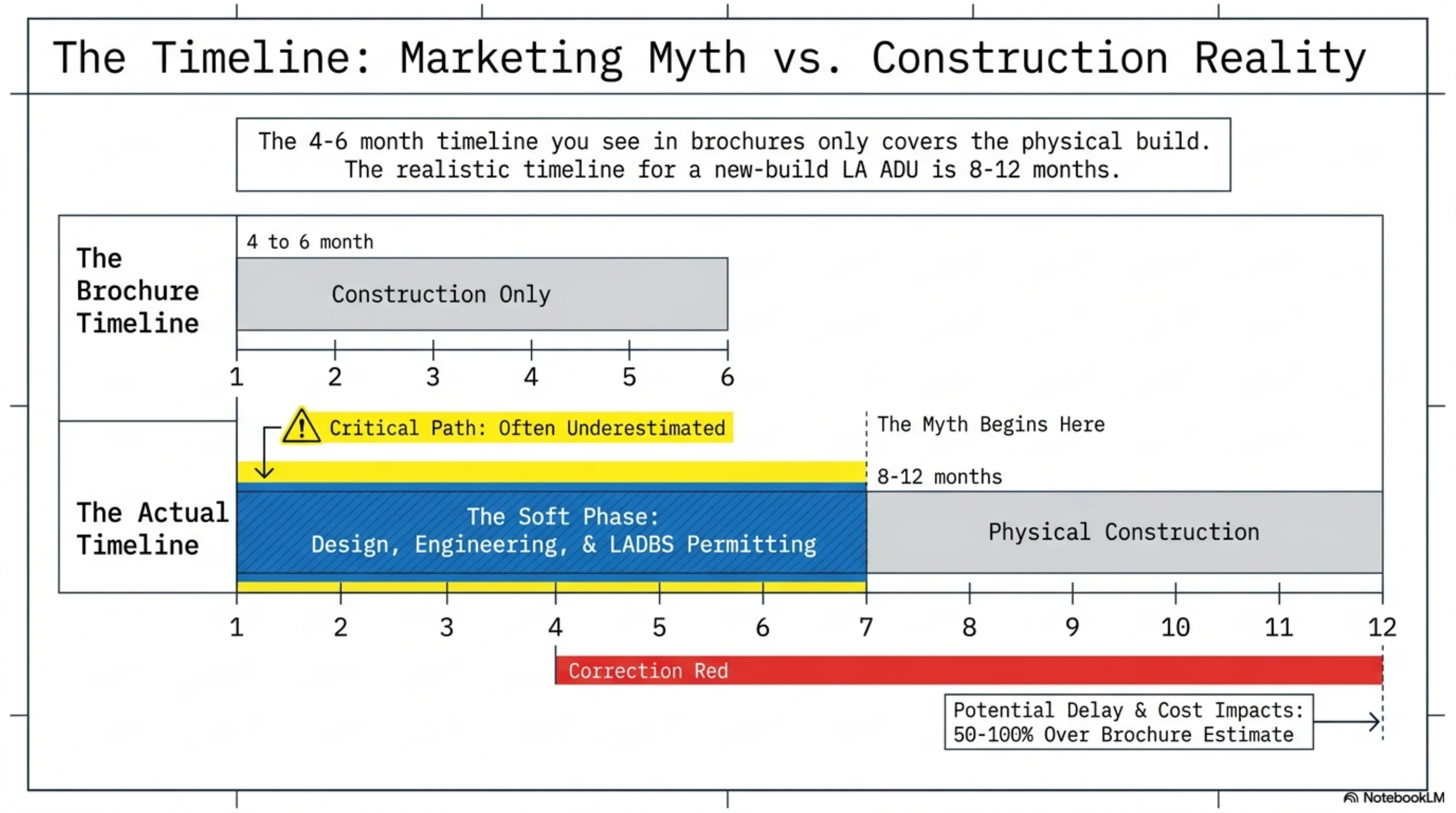
The marketing timeline for an ADU is four to six months. That's what you'll see in brochures. That timeline only covers the construction phase, from foundation to final paint. It's not a lie, but it's not the whole truth. The realistic timeline, from the day you hire an architect to the day you receive the Certificate of Occupancy for a new-build ADU in Los Angeles, is closer to eight to twelve months. The part most people don't account for is the 'soft' phase: design, engineering, and permitting. This administrative work often takes as long as the physical build itself. The most successful projects are run by homeowners who understand that building a small house is still building a house. They respect the process, make decisions quickly, and trust the professionals they hired to execute.
Sources & Methodology
Renology reviews public permit and labor signals, supplier pricing, remodeler quote patterns, comparable projects, the Renology Cost Index, and the Renology Methodology. Cost references are planning ranges for Los Angeles ADU projects, not fixed bids.
- National Association of Home Builders (NAHB), Remodeling Market Index, Q1 2026
- California Department of Industrial Relations (DIR), Prevailing Wage Data, Los Angeles County, 2026
- Los Angeles Department of Building and Safety (LADBS), ADU Information Portal and RTI Standard Plans, 2026
- National Kitchen & Bath Association (NKBA), 2026 Design Trends Report
- Remodeling Magazine, 2025 Cost vs. Value Report (Los Angeles data)
- Renology Project of the Day (POTD) Network Data, Los Angeles Metro, 2024-2026
- California Department of Housing and Community Development (HCD), Accessory Dwelling Unit Handbook, 2025 Update
Sources & methodology
How Renology builds this guide
Renology combines public permit and labor signals, supplier pricing, remodeler quote patterns, and editorial review of comparable projects. Cost references are planning ranges, not fixed bids, because site conditions, materials, access, permits, and finish level can change the final price.
- Benchmarked against the Renology Cost Index, related service guides, and the Renology Methodology.
- Reviewed for Los Angeles market context when a local market is available.
- Focused on ADU scope, materials, timeline, contractor risk, and budget drivers.
Get 3 Los Angeles ADU bids in 48 hours.
Our editors already screened Los Angeles ADU builders. Answer 4 questions; we send 3 written bids inside 48 hours, with the real price for your scope, not their inflated first-call number.
Send my 3 bidsFree. No commission. If a match doesn't fit, we'll send another.