Why a basement finish inside the Village's 1-acre lots is not a Denver basement finish with a higher zip code, and what to look for in a contractor who has actually opened up the wall on one.
In a Nutshell
- Cherry Hills Village has its own building department at 2450 East Quincy Avenue, independent of Denver County, Greenwood Village, and Englewood. Permits, inspections, and the fee schedule are all separate.
- Basement finishes inside the Village run roughly $42,000 to $220,000 in 2026, split into three observable tiers driven by lot, lot, footprint, and add-on stack.
- Village zoning makes above-grade additions difficult enough that the wealthy market has historically built down rather than out, producing the largest finished basements in metro Denver.
- The 1955-1975 housing stock surfaces 7-foot 4-inch original ceilings, sub-slab radon paths through fractured aggregate, and unreinforced poured walls that national contractors routinely misjudge.
The Cherry Hills Park Drive teardown
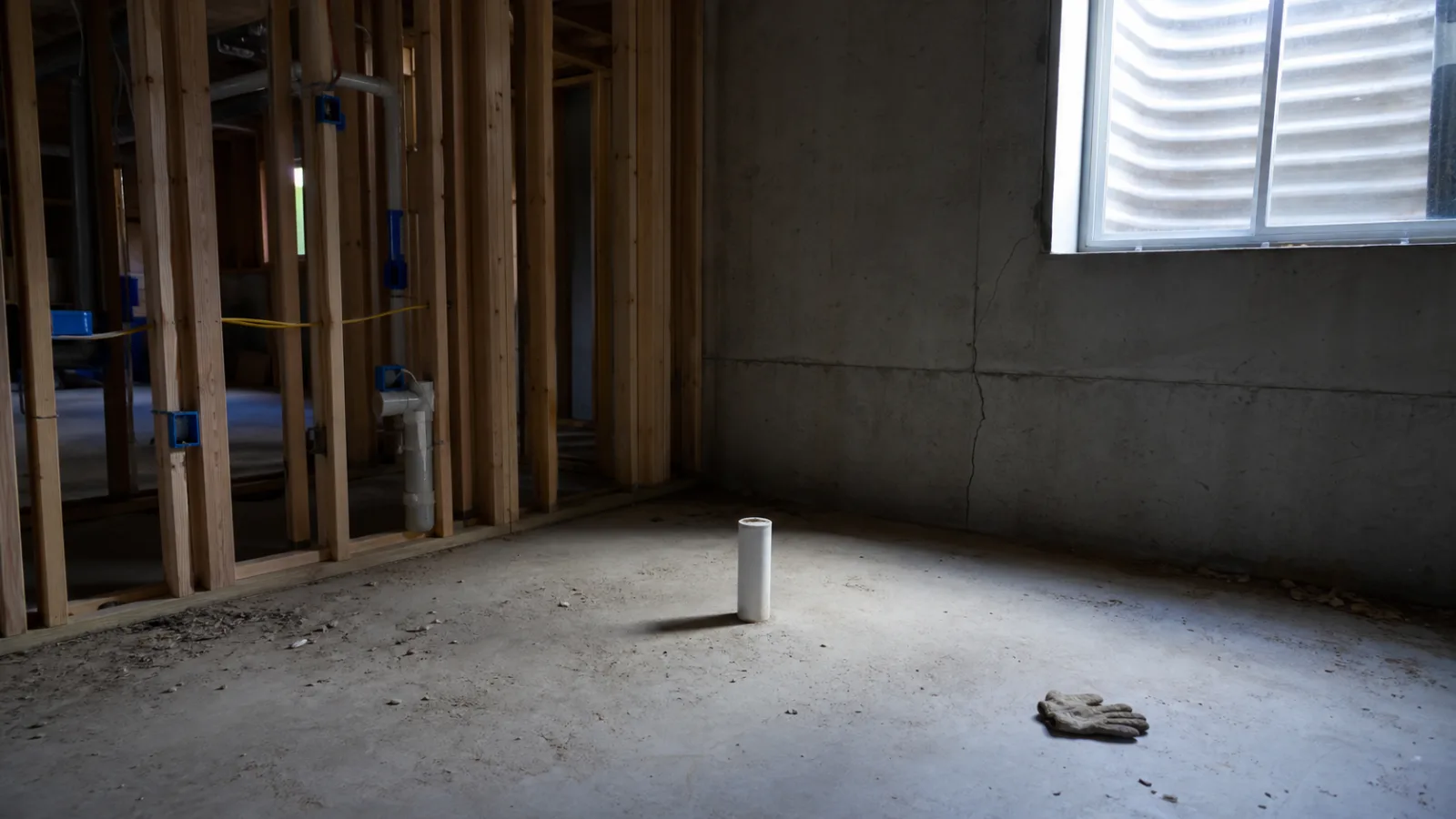
The first time I walked a Cherry Hills Village basement under demo it was a 1972 ranch on Cherry Hills Park Drive in 80113. The owners had bought the house in 2023 and lived through three seasons of an unfinished 2,650 square foot lower level with a single utility room, a slab-mounted furnace from 1989, and the original poured walls showing two hairline cracks running diagonal from the southwest corner.
The general contractor pulled the wall furring on a Wednesday. By Thursday afternoon he had three things on the floor that the home inspection had not surfaced. The first was a section of original radon stack capped at the slab with foam sealant instead of a glued PVC coupling, venting nothing. The second was an under-slab water line for the future wet bar that the previous owner had stubbed and then capped without a shutoff or pressure test. The third was a 1989-era 200-amp panel that had no available breaker slots for the planned theater, gym, and second-kitchen circuits, and a feeder lug that showed the heat discoloration that means the lug has been at the upper edge of its temperature spec for a long time.
None of those are unusual on a Cherry Hills Village 1970s ranch. All three reset the budget. The owners had been quoted $94,000 for a mid-tier finish. The project came in at $128,000. The overrun was not scope creep. It was the wall telling the truth.
This is the part of a Cherry Hills basement that a metro-Denver-shaped contractor does not budget for. A franchise outfit working from a Denver-metro pricing playbook will quote the surface job. The wall does not care about the playbook.
Why Cherry Hills is its own municipality, and why that matters
Cherry Hills Village is an incorporated home-rule municipality inside Arapahoe County, not a Denver neighborhood and not part of any unincorporated county service area. Its building department operates from City Hall at 2450 East Quincy Avenue. Permits filed there are reviewed by Village staff, inspected by a Village inspector, and assessed against the Village fee schedule, which is published separately from Denver and from neighboring municipalities.
The practical consequences are concrete. A basement finish inside the Village requires the contractor to pull the permit at Village Hall, not at the Denver Development Services counter or the Arapahoe County office. Plan review is conducted by Village staff who know the housing stock and have seen what 1968 builds typically hide behind a slab. Inspections are scheduled through the Village, on the Village's calendar, with lead times that are usually shorter than Denver if the packet is complete and longer than Denver if it is not.
The Village also has the strictest above-grade limit in metro Denver. Lot coverage is capped at 25 percent on R-1 (1-acre minimum) lots. Setbacks are 100 feet front, 50 feet rear, 30 feet side. Architectural Review Committee approval is required for any visible exterior change, including a basement walk-out modification that touches the exterior wall.
The combined effect is that homeowners who would otherwise build out, the way wealthy homeowners do in Greenwood Village or unincorporated Arapahoe, build down instead. The result is a Village basement-finish market that is larger and more sophisticated than any other in metro Denver. Wine cellars, golf simulators, full second kitchens, home theaters with riser seating, dedicated gyms with sauna and cold plunge wiring, these are basement-tier features in Cherry Hills, not luxury home additions.
The contractor's first job in the Village is to know which jurisdiction he is in. The second is to file the permit correctly. A homeowner can verify either by asking, on the first call, "where will you file the permit." A contractor who answers "Denver" or "the county" is not the contractor for a Village project. The answer is "Cherry Hills Village, at 2450 East Quincy."
What is actually behind the wall
Village housing stock concentrates in two waves. The first is 1955 to 1975, ranch and split-level, original poured-concrete foundations, 7-foot 4-inch to 7-foot 8-inch basement ceilings, single-phase 100 to 150-amp panels, gravity-fed gas. The second is 1985 to 2005, spec-build on 1-acre minimum lots, engineered 8-foot to 9-foot basement ceilings, 200-amp panels, often a stubbed second-kitchen rough.
The materials of the older era have predictable failure modes inside a basement finish:
Original poured-concrete walls without modern waterproofing. Cherry Hills sits on a clay-rich soil that swells and shrinks with snowmelt cycles. Walls poured in 1968 are typically sound but show hairline diagonal cracks at the corners that need epoxy injection before furring. A contractor who skips this step is signing up for water staining behind drywall in year four. Budget $1,800 to $4,200 for crack injection on a typical 1970s Village basement.
Sub-slab aggregate with no vapor barrier. The 1955-1975 builds were poured over a few inches of gravel directly on the native clay, with no polyethylene sheet between. Radon enters through this aggregate, and slab moisture migrates up. The fix during a finish is a sub-slab depressurization system (a sealed sump or perforated pipe network connected to an exterior vent stack with an active fan), at $1,800 to $4,500. The fix after the finish, retrofitting, runs $4,500 to $7,500.
Undersized electrical panels. A 1989 panel with 30 spaces is typically full on a Cherry Hills home that has been added to over time. A new basement finish with a wet bar, gym, theater, and possibly a guest suite needs 8 to 14 new circuits. Either a sub-panel in the basement or a service upgrade is the right answer, at $3,200 to $9,500 depending on path.
Ceiling height. A 7-foot 4-inch original ceiling will not pass code as habitable space without specific ceiling-height variances or strategic soffit planning that keeps the central living area at 7-foot 6-inch (the IRC minimum for finished basement habitable space, with 7-foot 4-inch under beams). Working with this constraint on a 1968 Village ranch is a skill that adds 6 to 10 percent to framing labor.
Egress windows in a high-water-table corner. Some lots in the Cherry Hills Park subdivision, particularly closer to the High Line Canal corridor, have seasonal high water tables. Cutting an egress window well below grade in these locations requires drainage planning that goes beyond the standard well-and-drain detail. A contractor who has not built one in this neighborhood will under-budget the drainage and end up with water in the well by the next spring snowmelt.
A contractor who walks the basement and then asks to see the panel, the slab corners, the exterior grade, and the High Line Canal flow direction is reading the house. A contractor who quotes from a tape measure and a photograph is selling a number.
The three pricing tiers I have observed in the Village
3 Cherry Hills Village pros, editor-screened. 4 questions.
See my 3 matchesAcross the Cherry Hills Village basement projects I have walked or reviewed quote packages for over the past two years, basement-finish pricing falls into three observable tiers in 2026 dollars. These are not list prices. They are what the houses produce after the walls have come down.
Tier 1, Functional finish: $42,000 to $68,000. Drywall, lighting, carpet or LVP, one bath, no wet bar, no second kitchen. Existing rough plumbing and electrical untouched except where code requires (AFCI on new circuits, GFCI on the bath). This tier works in the Village only on smaller-footprint basements (under 1,800 sq ft) or for homeowners reselling within 24 months who want a Certificate of Occupancy on the lower level and nothing more.
Tier 2, Full finish: $72,000 to $110,000. 2,200 to 2,800 sq ft. New rough plumbing for a wet bar. Two baths. Theater wiring. One guest bedroom with code-compliant egress window. New circuits via sub-panel. Radon mitigation system installed during framing. Mid-grade flooring (engineered hardwood or luxury vinyl plank), painted shaker millwork on the bar and bath vanities. This is the most common Cherry Hills Village basement finish, and the one where contractor selection matters most.
Tier 3, Luxury build: $135,000 to $220,000. Tier 2 scope plus wine cellar with cooling unit, indoor golf simulator with reinforced ceiling and 16-foot screen wall, full second kitchen with range and hood, home theater with riser seating and acoustic treatment, gym with sauna pre-wire. Architectural Review Committee touch if any exterior change (a walk-out modification, a window-well visible from the front). Custom rift-cut white oak millwork, full-slab quartzite on the bar and bath. This tier requires structural engineering review if framing is moved or if the golf simulator adds point loads to the floor above.
The middle tier is where most Cherry Hills homeowners land. The Functional tier is rare inside the Village because the houses are usually old enough that a surface finish leaves money on the table at sale. The Luxury tier is where the Architectural Review Committee tends to engage, because the basement finish almost always touches the exterior on a walk-out lot.
The right way to read these numbers is not as a menu. It is as a screen. A contractor who quotes a full Cherry Hills basement finish at $58,000 is missing line items. A contractor who quotes Tier 2 scope at $138,000 is padding.
What to ask a Cherry Hills Village basement contractor
Five questions that filter the contractor list quickly. None are gotchas. Any Village-experienced GC has answered all five in the first walk-through.
-
Where will you file the permit. The correct answer is "Cherry Hills Village, at 2450 East Quincy Avenue." Any other answer means he has not pulled a Village permit recently or he is going to subcontract the filing to an expediter without disclosing the markup.
-
How do you handle radon. The right answer is a sub-slab depressurization system installed during framing, with a passive stack and active fan. A contractor who answers "we test after, and mitigate if needed" is signing the homeowner up for a retrofit later at twice the cost.
-
What is your egress window detail in this part of the Village. The honest answer references the specific subdivision and the drainage path. "Standard well kit" is wrong on a Cherry Hills Park lot near the canal corridor.
-
How is the payment schedule milestoned. The right structure is five milestones tied to Village inspection sign-offs: contract, rough framing, rough MEP, drywall and flooring, final. Not percentages by month. Not 50 percent up front. Reddit threads about Denver-metro basement contractors are full of money-paid-forward stories. The Village is not exempt.
-
Can I see your last three Village basement projects, with streets named. Not a portfolio gallery from 2022. The last three Village basements. He should be able to name the streets (University Boulevard, Quincy Avenue, Belleview Avenue, Cherry Hills Park Drive), the year, and the scope. Reference calls go to actual homeowners.
A contractor who answers all five concretely is, statistically, the contractor worth getting a fixed-price quote from. A contractor who reframes any of them ("we don't get hidden conditions on our projects") has not opened enough Village walls.
Why the small Village-specialist crew beats the franchise
There is a Denver-area habit of trusting the high-marketing-spend franchise basement-finish company and suspecting the small-crew specialist. In Cherry Hills Village specifically, the math runs the other way.
The franchise advantage is volume: marketing reach, financing options, a sales floor, a national supply chain. None of those advantages matter inside a 1968 Cherry Hills Village basement. The wall does not care about the financing. The wall cares about the foreman.
The small-crew specialist who has pulled forty Village permits across his career has met the Village inspector enough times to be on a first-name basis. He has a tile setter he uses on every Village job, a plumber who has run copper through Village slab cutouts for fifteen years, and a structural engineer he can call for a same-week stamp when a beam pocket needs review. None of that is on his website. All of it is in the work.
The way to tell the two apart is the question list above. The franchise will struggle on questions one, three, and five. The Village specialist will answer all five before the coffee cools.
The Renology Take
Cherry Hills Village is unusual among premium American zip codes in how clearly its remodel market separates by jurisdiction and housing era. The Village's independent building department is a real wedge, not a marketing one. The 1968 ranch behind every basement finish really does drive the tier system. And the gap between the contractor who has filed forty Village permits and the one who has filed two is real money on real walls.
The reader's job here is not to find the cheapest quote. It is to find the contractor whose answers to five questions are concrete. The wall will be honest with him or her. The contractor who knows the wall is the one worth hiring.
Sources & Methodology
Renology reviews public permit and labor signals, supplier pricing, remodeler quote patterns, comparable projects, the Renology Cost Index, and the Renology Methodology. Cost references are planning ranges for Cherry Hills Village renovation projects, not fixed bids.
- City of Cherry Hills Village, Building Division. Permit and inspection information. https://www.cherryhillsvillage.com/206/Building
- 2024 International Residential Code, Section R310 emergency escape openings and Section R305 ceiling heights for habitable basements.
- Colorado Department of Public Health and Environment, Radon Program. https://cdphe.colorado.gov/radon
- Arapahoe County Assessor, parcel data for the 80113 and 80111 ZIP codes, year-built distributions.
- 2026 Cost vs. Value Report, Remodeling Magazine, Mountain region basement-finish data.
- Denver Metro Association of Realtors, 2026 Q1 comparable market analysis on finished vs. unfinished basement sale comps for Cherry Hills Village.
Frequently Asked Questions
Does Cherry Hills Village have its own building department, separate from Denver?
How much does a basement finish cost in Cherry Hills Village in 2026?
Why do Cherry Hills Village basement quotes vary so much between contractors?
Do Cherry Hills Village basement finishes require Architectural Review Committee approval?
What is the typical timeline for a Cherry Hills Village basement finish?
Do I need radon mitigation on a finished Cherry Hills Village basement?
Ready to find a pro?
Tell us about your project and location. A Renology advisor can help you explore contractor matching.
Free for homeowners. No obligation to hire.
Find a ProSources
- City of Cherry Hills Village, Building Division. Permit and inspection information
- 2024 International Residential Code, Section R310 emergency escape openings and Section R305 ceiling heights for habitable basements
- Colorado Department of Public Health and Environment, Radon Program
- Arapahoe County Assessor, parcel data for the 80113 and 80111 ZIP codes, year-built distributions
- 2026 Cost vs. Value Report, Remodeling Magazine, Mountain region basement-finish data
- Denver Metro Association of Realtors, 2026 Q1 comparable market analysis on finished vs. unfinished basement sale comps for Cherry Hills Village
Follow Renology on Google
Choose Renology as a preferred source and our guides show up more often in your Google results, including Top Stories and AI Overviews.