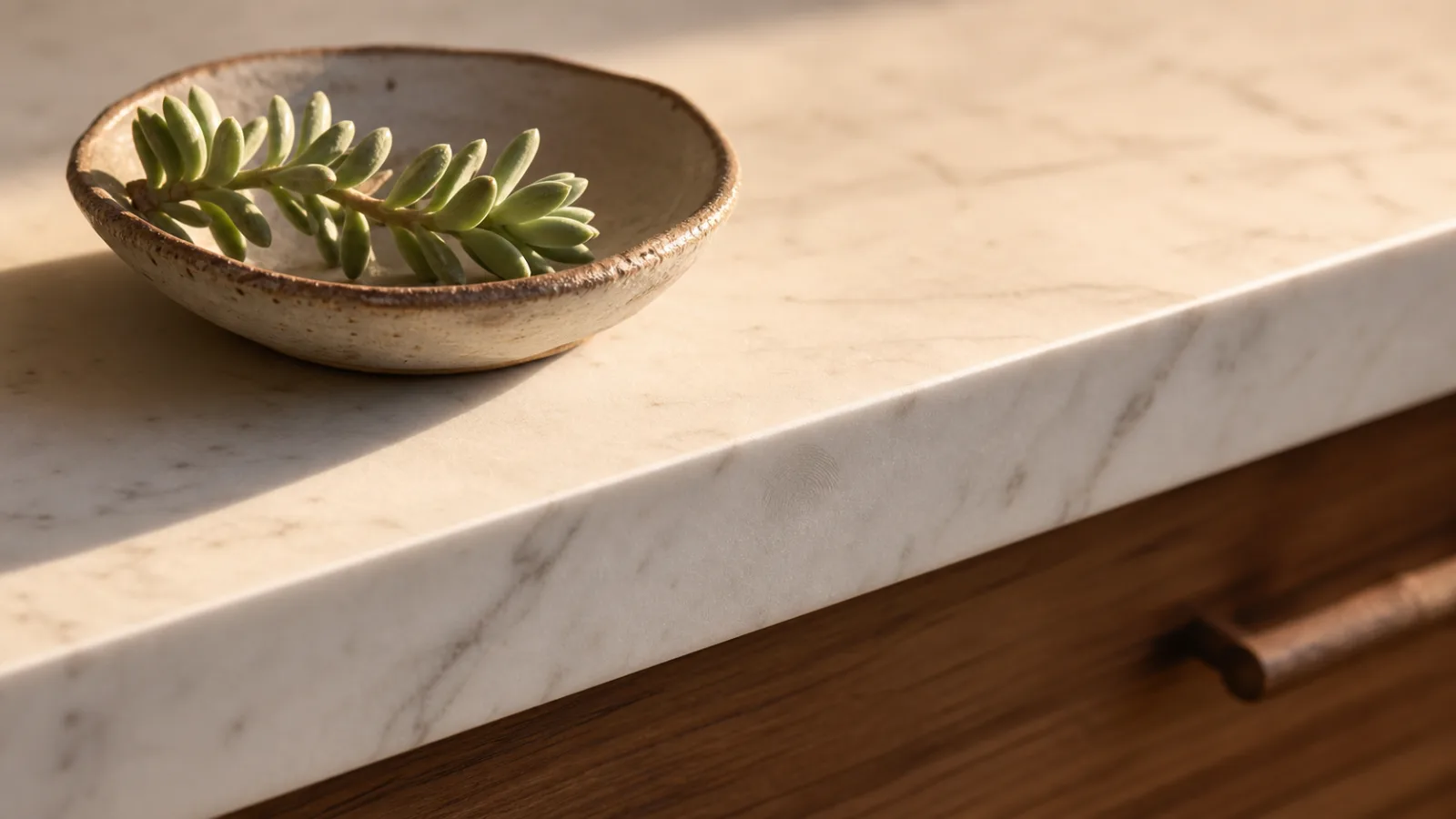
Why a primary bath inside the Town of Paradise Valley reads as either correct or wrong within ten seconds, and what the right one is made of.
In a Nutshell
- Paradise Valley bath design holds a narrow line between desert modernism (Al Beadle, Bennie Gonzales, Hiram Hudson Benedict influences) and an older Arizona heritage language (territorial adobe, copper, hand-thrown ceramic).
- The defining design constraint is morning and late-afternoon Sonoran light, which reads stock white subway as glaring and reads honed travertine as alive.
- A correct Paradise Valley bath in 2026 typically costs $52,000 to $165,000, with materials accounting for roughly 35 percent of the spend.
- The wrong materials reduce future sale price by more than the material savings, every time.
The Mockingbird Lane brief
The first Paradise Valley bath I walked through under design review was a 1968 home off Mockingbird Lane. The owners had bought it as the second owners ever and lived in the original bath for two summers before deciding to renovate. The original bath was a salmon-pink Formica vanity, white subway tile, chrome fittings, and a single small window facing northeast. The contractor's first quote came in at $58,000 for what he called a "clean modern update." The designer's first proposal was a full white-and-grey scheme: white slab quartz vanity, white subway tile to the ceiling, polished chrome.
The owners rejected both. Not because of the budget. Because of the light.
Their reason, paraphrased from a long conversation over a kitchen table looking out at Camelback: the morning light off the mountain comes through the small window for about forty minutes at sunrise, golden and low. The afternoon light comes through a clerestory in the hallway at a hard angle. The white subway scheme would have rendered the bath as an institutional space for forty-five minutes a day and a dead space the rest of the time. The salmon pink, ugly as it was, at least held a tone.
The design that won the brief, eighteen months later: honed travertine slab on the shower walls, a hand-thrown Arizona ceramic vessel sink, a vanity in mesquite with copper pulls, brushed brass Waterworks fittings, and a single rammed-earth accent wall behind the soaking tub. Final material cost: $46,800. The room reads correctly at 7 AM, at noon, and at 6 PM. That is the test.
Why Paradise Valley is its own design problem
Paradise Valley is an independent town inside Maricopa County, not a Phoenix neighborhood. Its building department, town code, and Hillside Development standards govern construction inside the roughly 16 square miles of town limits. The Town's permit office is at 6401 East Lincoln Drive. Permits filed there are reviewed by Town staff, inspected by Town inspectors, and assessed against the Paradise Valley fee schedule.
The Hillside Building Committee reviews construction on slope-qualifying lots. For interior bath remodels the Committee is rarely triggered, but a relocated vent stack on a hillside-facing facade, a new window on a visible elevation, or a skylight added to a hillside roof line will pull a project into Committee review. The Committee meets monthly and the review process adds four to eight weeks to the schedule when triggered.
The Town's design culture, more than its code, is what shapes the bath. Paradise Valley is one of the small number of American zip codes where the residents largely know who Al Beadle was, what Frank Lloyd Wright built at Taliesin West twelve miles away, and why Bennie Gonzales mattered to Arizona public architecture. That cultural literacy filters into bath design as a baseline expectation that materials and proportions will reference the desert-modernist tradition. A national chain remodeler who arrives with a generic luxury package misses the brief.
The Sonoran light test
The single most underweighted variable in Paradise Valley bath design is light. The Sonoran morning light is golden, low-angle, and high in red-orange wavelengths. The midday light is harsh, vertical, and high in blue. The late-afternoon light is golden again, longer-shadowed than morning. A bath that reads correctly under all three conditions is a bath designed around a tone, not around a color palette pulled from a magazine.
Three material rules that survive the Sonoran light test:
Honed surfaces over polished. Polished white quartz throws hot reflections under midday light and reads cold under morning light. Honed travertine, honed Calacatta-look porcelain, and honed limestone hold a tone across the day.
Warm metals over cool. Brushed brass, aged copper, and oil-rubbed bronze read consistently across the light shift. Polished chrome and brushed nickel read cold in morning and hot in afternoon. The metal choice is the single most visible design decision in a Paradise Valley bath and the one most often defaulted by national designers.
Texture over flatness. Hand-thrown ceramic, hand-trowel plaster finish, rammed-earth accent walls, and irregular travertine fields hold visual interest across the light shift. Flat ceramic and flat slab quartz read as institutional when the angle is wrong.
The light test is not a style claim. It is observable. Stand in a Paradise Valley bath at 7 AM, noon, and 5 PM. The wrong materials look wrong twice a day and right once a day. The right materials look right three times a day.
The three pricing tiers I observe in Paradise Valley
3 Paradise Valley pros, editor-screened. 4 questions.
See my 3 matchesAcross Paradise Valley bath projects I have walked or reviewed quote packages for over the past two years, pricing falls into three observable tiers in 2026 dollars. These are not list prices. They are what the houses produce after the wall has been opened.
Tier 1, Refresh: $28,000 to $38,000. Vanity replacement, surface plumbing fixtures, mirror, lighting, paint, and a partial tile field. Existing rough plumbing and electrical untouched. This tier works in Paradise Valley only when the inspection from the most recent sale found no surprises and the homeowner is reselling within two years. It is a holding move, not a remodel.
Tier 2, Full remodel: $52,000 to $78,000. Demo to studs and sub-floor. New rough plumbing where required by what is found behind 1960s drywall. New tile substrate to current code. Honed travertine or honed Calacatta-look porcelain. Mesquite or walnut vanity in semi-custom millwork. Mid-tier brass fittings. Curbless or low-curb shower if drain location allows. This is the most common Paradise Valley remodel and the one that rewards a designer who understands the light brief.
Tier 3, Luxury build: $88,000 to $165,000. Tier 2 scope plus footprint changes, slab travertine or quartzite walls, hand-thrown Arizona ceramic detail, custom rift-cut mesquite or walnut vanity built locally, integrated stone sink, designer brass fittings on twelve-week lead times. Steam shower with a Mr. Steam or Thermasol generator. Heated floor zoned independently. This tier requires structural engineering review if framing is moved and may trigger Hillside Committee review if exterior surfaces are touched.
The middle tier is where most Paradise Valley homeowners land. The Refresh tier is rare here because the homes are usually too far from current code to make a surface job honest. The Luxury tier is where the Hillside Committee tends to bite.
What to ask a Paradise Valley bath designer
Five questions that filter the designer list quickly. Any Paradise Valley-experienced designer has answered all five in the first walk-through:
-
Where will you see the room at three times of day before you propose materials. The honest answer is 7 AM, noon, and 5 PM, at minimum, with a description of how the light reads on the existing surfaces. A designer who proposes a palette from a floor plan and a Pinterest board has not done the work.
-
Which Tempe or Scottsdale stone yards do you source from. The honest answer names specific yards (Arizona Tile, Stone Source Phoenix, Walker Zanger Scottsdale) and acknowledges current slab inventory and lead times. A designer who orders from a national distributor adds 4 to 8 weeks of lead time and loses the slab-selection benefit.
-
How do you handle Hillside Committee review when exterior changes are involved. The honest answer is a written submittal scope and a built schedule that absorbs the 4 to 8 week review window. A designer who reframes the question is one who has not been through the Committee.
-
Who is your tile setter and how long has that crew worked your projects. The honest answer names a specific lead setter with at least five years on the designer's projects. Travertine and honed Calacatta-look porcelain set differently than stock subway. The setter matters more than the material.
-
Show me three Paradise Valley baths you finished in the last twelve months, with street names and the homeowner permitting reference. Not the 2020 highlight reel. The last twelve months. The designer should be able to name Tatum, Mockingbird, Invergordon, Cheney, Mummy Mountain, the year, and the scope.
A designer who answers all five concretely is the one worth hiring. A designer who reframes any of them is selling something that does not fit Paradise Valley.
The Renology Take
Paradise Valley sits in a small group of American design markets where the design tradition is mature enough that the wrong choice is visible immediately and the right choice is recognized by neighbors. The Sonoran light is the design constraint that does not appear on the floor plan but governs the outcome. The Town's independent governance and Hillside Committee review change the schedule and the permit path. And the housing era between 1955 and 1985 set the visual grammar that still defines what reads correctly here.
The reader's job is not to find a designer who flatters the home. It is to find a designer who reads the light, knows the yards, has the setter, and respects the tradition. The wrong bath at this price point removes money from the future sale every day it exists. The right bath does the opposite.
Sources & Methodology
Renology reviews public permit and labor signals, supplier pricing, remodeler quote patterns, comparable projects, the Renology Cost Index, and the Renology Methodology. Cost references are planning ranges for Paradise Valley renovation projects, not fixed bids.
- Town of Paradise Valley, Building Safety Department. Permit procedures, fee schedule, Hillside Development ordinance. https://www.paradisevalleyaz.gov/192/Building-Safety
- Arizona Tile, Tempe yard. Travertine inventory and lead time information, 2026 catalog. https://www.arizonatile.com/
- NKBA Bath Remodel Cost Survey, 2026 edition, regional Southwest pricing tables.
- Frank Lloyd Wright Foundation, Taliesin West archives on Sonoran design tradition. https://franklloydwright.org/taliesin-west/
- Schluter Systems, Kerdi waterproofing membrane technical data sheet, 2026 revision.
- Maricopa County Assessor's Office, residential parcel data for 85253, year-built distributions.
Frequently Asked Questions
What design language reads correctly in a Paradise Valley bath?
How much does a Paradise Valley bath remodel cost in 2026?
Does the Town of Paradise Valley require permits for bath remodels?
When does the Hillside Building Committee get involved in a bath remodel?
What is the typical timeline for a Paradise Valley bath remodel?
Ready to find a pro?
Tell us about your project and location. A Renology advisor can help you explore contractor matching.
Free for homeowners. No obligation to hire.
Find a ProFollow Renology on Google
Choose Renology as a preferred source and our guides show up more often in your Google results, including Top Stories and AI Overviews.