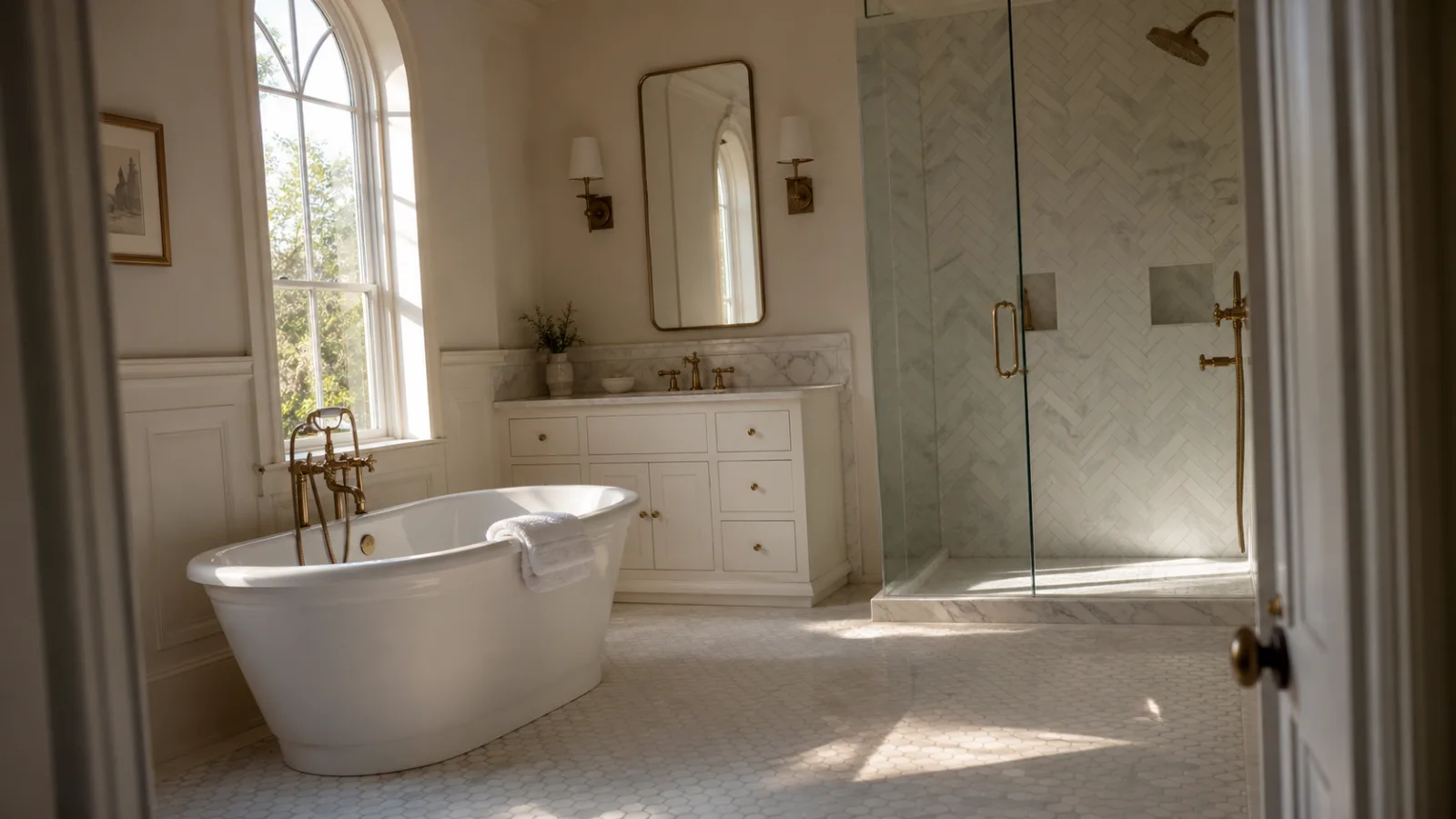
Why a bath remodel inside 75205 and 75219 plays by different rules than a bath remodel in Dallas, and what to look for in a contractor who knows the difference.
In a Nutshell
- The Town of Highland Park has its own building department, independent of City of Dallas. Permits, inspections, and the fee schedule are all separate.
- Bath remodels inside HP run roughly $24,000 to $110,000 in 2026, split into three observable tiers driven by what is found behind the wall.
- The 1915 to 1955 HP housing stock surfaces clay drain tile, knob-and-tube wiring, and lath-and-plaster substrates that national chains routinely under-budget.
- The small-crew specialist outperforms the franchise outfit on this kind of work. The reasons are structural, not anecdotal.
The Beverly Drive teardown
The first time I stood in a Highland Park bath under demo, it was a 1948 colonial off Beverly Drive in 75205. The owners had bought it eighteen months earlier and lived through one season of the primary bath as it was: cream subway tile to the ceiling, a cast-iron tub on a slab that turned out not to be a slab, and a vanity wall that hummed faintly when the upstairs light switched on.
The GC pulled the tile field on a Tuesday. By Wednesday afternoon he had three things on the floor that the inspection from purchase had not surfaced. The first was a section of clay drain tile, original to the house, mortar-jointed, running to the main stack. The second was knob-and-tube wiring spliced into modern Romex with a wire nut and a prayer. The third was a sub-floor patch of two different plywood thicknesses laid over the original 1948 board floor, which itself had sagged about three-eighths of an inch toward the exterior wall.
None of these are unusual in HP housing of this vintage. All three reset the budget. The owners were quoted $52,000 for a mid-tier remodel. The room came in at $71,000. The overrun was not scope creep. It was the wall telling the truth.
This is the part of a Highland Park bath that a Dallas-shaped contractor does not budget for. A franchise outfit working from a national pricing playbook will quote the surface job. The wall does not care about the playbook.
Why Highland Park is its own municipality
Highland Park is an independent town inside Dallas County, not a Dallas neighborhood. Its building department operates out of the HP Department of Public Safety building at 4700 Drexel Drive. Permits filed there are reviewed by HP staff, inspected by an HP inspector, and assessed against the Town of Highland Park fee schedule, which is published separately from the City of Dallas schedule.
The practical consequences are concrete. A bath remodel inside HP requires the contractor to pull the permit at HP Town Hall, not at the Oak Cliff Municipal Center. The plan review is conducted by HP staff who know the housing stock. Inspections are scheduled through HP, on HP's calendar, with a different lead time than a Dallas project. The plumbing inspector who walks the rough-in has likely walked a hundred HP baths in homes from this era. He knows where the clay tile starts.
There is also a conservation overlay in parts of the town that affects the exterior envelope of older homes. For a bath remodel that stays inside the building footprint, the overlay rarely changes the project. For one that touches a window opening, an exterior vent location, or a setback, it changes everything. A contractor who knows this asks about the window line in the first walk-through. One who does not finds out at inspection.
The contractor's first job in HP is to know which jurisdiction he is in. The second is to file the permit correctly. The reader can verify either by asking, on the first call, "where will you file the permit." A contractor who answers "Dallas" is not the contractor for an HP project. The answer is "the Town of Highland Park, at 4700 Drexel."
What is actually behind the wall
HP housing stock concentrates between roughly 1915 and 1955, with a smaller wave of 1970s and 1980s teardowns and rebuilds. The 1948 colonial on Beverly is the median, not the exception. The materials of that era have predictable failure modes inside a bath remodel:
Clay drain tile in original waste lines. Brittle, mortar-jointed, and prone to root intrusion at the joints. When a contractor opens a tile field and finds clay, the rough plumbing scope expands. Budget another $3,500 to $6,500 for partial replumb to copper or PEX-A with code-compliant cleanouts, depending on the run length.
Knob-and-tube wiring spliced into later circuits. Not always present, but present often enough that an experienced HP GC walks the basement or crawl with a flashlight before quoting. A bath that needs a panel-side upgrade to support a new exhaust fan, heated floor, sconce circuit, and steam shower controller can add $2,800 to $7,000.
Lath and plaster substrate behind the original tile. Lath is not a tile substrate by any 2026 code. The contractor either removes it back to studs and rebuilds with cement board or Schluter Kerdi-Board, or he tiles over a failed assembly and the homeowner pays again in seven years. The right answer is removal. Budget the time.
Sub-floor irregularity in older platform-framed bathrooms. A second-floor HP bath above the kitchen typically reveals a 3/8 inch to 5/8 inch sag toward an exterior wall. Self-leveling underlayment plus an isolation membrane (Schluter Ditra is the common spec) corrects it before tile. Skipping the step is how tile cracks at the threshold in year three.
Hidden venting routes. Older HP plans frequently routed bath exhaust into the attic, not through the roof. 2026 code calls for termination outside the building envelope. Re-routing through the roof in a slate-roofed HP home is a roofing scope, not a plumbing scope, and the slate work has a separate sub.
A contractor who walks the room and then asks to see the basement, the crawl, the attic, and the panel is reading the house. A contractor who quotes from a photograph is selling a number.
The three pricing tiers I have observed in HP
Across the HP projects I have walked or reviewed quote packages for over the past two years, bath remodel pricing falls into three observable tiers in 2026 dollars. These are not list prices. They are what the houses produce after the wall has been opened.
Tier 1, Refresh: $24,000 to $32,000. Vanity replacement, surface plumbing fixtures, mirror, lighting, paint, and a partial tile field (typically the shower surround held in plane, no floor change). Existing rough plumbing and electrical untouched. This tier works in HP only when the inspection from the most recent sale found no surprises and the homeowner is reselling within two years. It is a holding move, not a remodel.
Tier 2, Full remodel: $42,000 to $58,000. Demo to studs and sub-floor. New rough plumbing where required by what is found. New tile substrate to current code (Schluter Kerdi or equivalent waterproofing system, not a quick set over moisture-resistant drywall). Mid-range quartzite or Calacatta-look porcelain on the vanity and shower bench. Curbless or low-curb shower if drain location allows. New vanity, mirror, sconces, exhaust to exterior. This is the most common HP bath remodel, and the one that benefits most from a GC who knows the housing stock.
Tier 3, Luxury build: $68,000 to $110,000. Tier 2 scope plus footprint changes (typically expanding into an adjacent closet or hallway), steam shower with a Mr. Steam or Thermasol generator, heated floor zoned independently, full-slab honed marble or quartzite (Cambria, Caesarstone Eternal Calacatta Gold, or natural Calacatta Viola), custom rift-cut white oak vanity built locally, integrated sink, designer brass fittings on six-week lead times. This tier requires structural engineering review if framing is moved.
The middle tier is where most HP homeowners land. The Refresh tier is rare inside the town because the houses are usually too far from current code to make a surface job honest. The Luxury tier is where the conservation overlay tends to bite.
The right way to read these numbers is not as a menu. It is as a screen. If a contractor quotes a full HP bath at $28,000, the wall is going to be reopened in eighteen months. If a contractor quotes at $89,000 for a Tier 2 scope, something is being padded.
What to ask a Highland Park bath contractor
3 Highland Park pros, editor-screened. 4 questions.
See my 3 matchesFive questions that filter the contractor list quickly. None of them are gotchas. Any HP-experienced GC has answered all five in the first walk-through:
-
Where will you file the permit. The correct answer is "the Town of Highland Park, at 4700 Drexel Drive." Any other answer means he has not pulled an HP permit recently, or he is going to subcontract the filing.
-
How do you price structural surprises. The honest answer is a written allowance line in the contract. Something like, "we carry a $4,500 contingency for hidden conditions, billed at $X/hour over that with photos and your signature before work proceeds." A flat "we'll let you know" is a change-order trap.
-
What are your supplier lead times this quarter. Quartzite slabs from Dallas yards run six to ten weeks in spring 2026. Schluter waterproofing is in stock at most local plumbing supply houses. Designer brass from European brands runs twelve to sixteen weeks. A contractor who quotes a four-week project without naming the fixture lead time has not specified the project.
-
How is the payment schedule milestoned. The right structure is five milestones tied to verifiable progress: deposit, demo complete, rough-in passed inspection, tile set, final. Not a percentage schedule by month. Not a "50 percent up front." Reddit threads are full of stories about money paid forward and a contractor who never came back. HP is not exempt.
-
Can I see your last three HP projects, with addresses on the street. Not the highlight reel from 2022. The last three HP baths. He should be able to name the streets (Lakeside, Drexel, Armstrong, Beverly), the year, and the scope. Reference calls go to actual homeowners, not site managers.
A contractor who answers all five concretely is, statistically, the contractor worth getting a quote from. A contractor who reframes any of them ("we don't get hidden conditions on our projects") is a contractor who has not opened enough HP walls.
The "white van guy" suspicion is wrong here
There is a Dallas-area Reddit habit of suspecting the small-crew contractor and trusting the franchise. In Highland Park specifically, the math runs the other way.
The franchise outfit's competitive advantage is volume. Marketing reach, financing options, a sales floor, a national supply chain. None of those advantages matter inside a 1948 HP bath. The wall does not care about the financing. The wall cares about the foreman.
The small-crew specialist, the one with three to six guys and twenty years in the trade, has typically pulled fifty HP permits across his career. He has met the HP inspector enough times to be on a first-name basis. He has a tile setter he uses on every HP job, a plumber who has run copper through HP joist bays for fifteen years, and a slate roofer he can call when the bath exhaust route requires it. None of that is on his website. All of it is in the work.
The Reddit homeowner who got burned by "the white van guy" usually got burned by an unlicensed handyman selling himself as a GC. That is a different species. A licensed Texas GC with a small crew and an HP track record is, in practice, the highest-trust option in the town. The franchise outfit is, in practice, the riskiest, because its incentive structure rewards selling the surface scope and forcing change orders when the wall opens.
The way to tell them apart is the question list above. The franchise will struggle on questions one, three, and five. The small-crew specialist will answer all five before the coffee cools.
The Renology Take
Highland Park is unusual among premium American zip codes in how clearly its remodel market separates by jurisdiction and housing era. The town's separate building department is a real wedge, not a marketing one. The 1948 colonial behind every HP bath remodel really does drive the tier system. And the gap between the contractor who has filed forty HP permits and the one who has filed two is real money on real walls.
The reader's job here is not to find the cheapest quote. It is to find the contractor whose answers to five questions are concrete. The wall will be honest with him or her. The contractor who knows the wall is the one worth hiring.
Sources & Methodology
Renology reviews public permit and labor signals, supplier pricing, remodeler quote patterns, comparable projects, the Renology Cost Index, and the Renology Methodology. Cost references are planning ranges for Highland Park renovation projects, not fixed bids.
- Town of Highland Park, Building Inspection Division. Permit information and fee schedule. https://www.hptx.org/200/Building-Inspection
- 2024 International Plumbing Code (IPC), Sections 702 and 906, on waste and vent routing for residential bathrooms.
- NKBA Bath Remodel Cost Survey, 2026 edition, regional Southwest pricing tables.
- Schluter Systems, Kerdi waterproofing membrane technical data sheet and installation handbook, 2026 revision. https://www.schluter.com/schluter-us/en_US/Shower-System
- D Magazine, "The Highland Park House That Doesn't Want to Be a McMansion," 2024 archive feature on HP residential renovation patterns.
- Dallas Central Appraisal District, residential parcel data for 75205 and 75219, year-built distributions.
Frequently Asked Questions
Does Highland Park have its own building department, separate from Dallas?
How much does a bath remodel cost in Highland Park, TX in 2026?
Why do Highland Park bath quotes vary so much between contractors?
Do Highland Park bath remodels require historic district approval?
What is the typical timeline for a Highland Park bath remodel?
Ready to find a pro?
Tell us about your project and location. A Renology advisor can help you explore contractor matching.
Free for homeowners. No obligation to hire.
Find a ProSources
- Town of Highland Park, Building Inspection Division. Permit information and fee schedule.
- 2024 International Plumbing Code (IPC), Sections 702 and 906, on waste and vent routing for residential bathrooms.
- NKBA Bath Remodel Cost Survey, 2026 edition, regional Southwest pricing tables.
- Schluter Systems, Kerdi waterproofing membrane technical data sheet and installation handbook, 2026 revision.
- D Magazine, "The Highland Park House That Doesn't Want to Be a McMansion," 2024 archive feature on HP residential renovation patterns.
- Dallas Central Appraisal District, residential parcel data for 75205 and 75219, year-built distributions.
Follow Renology on Google
Choose Renology as a preferred source and our guides show up more often in your Google results, including Top Stories and AI Overviews.