The short answer
What can you build on a San Diego lot: ADU, JADU or both?
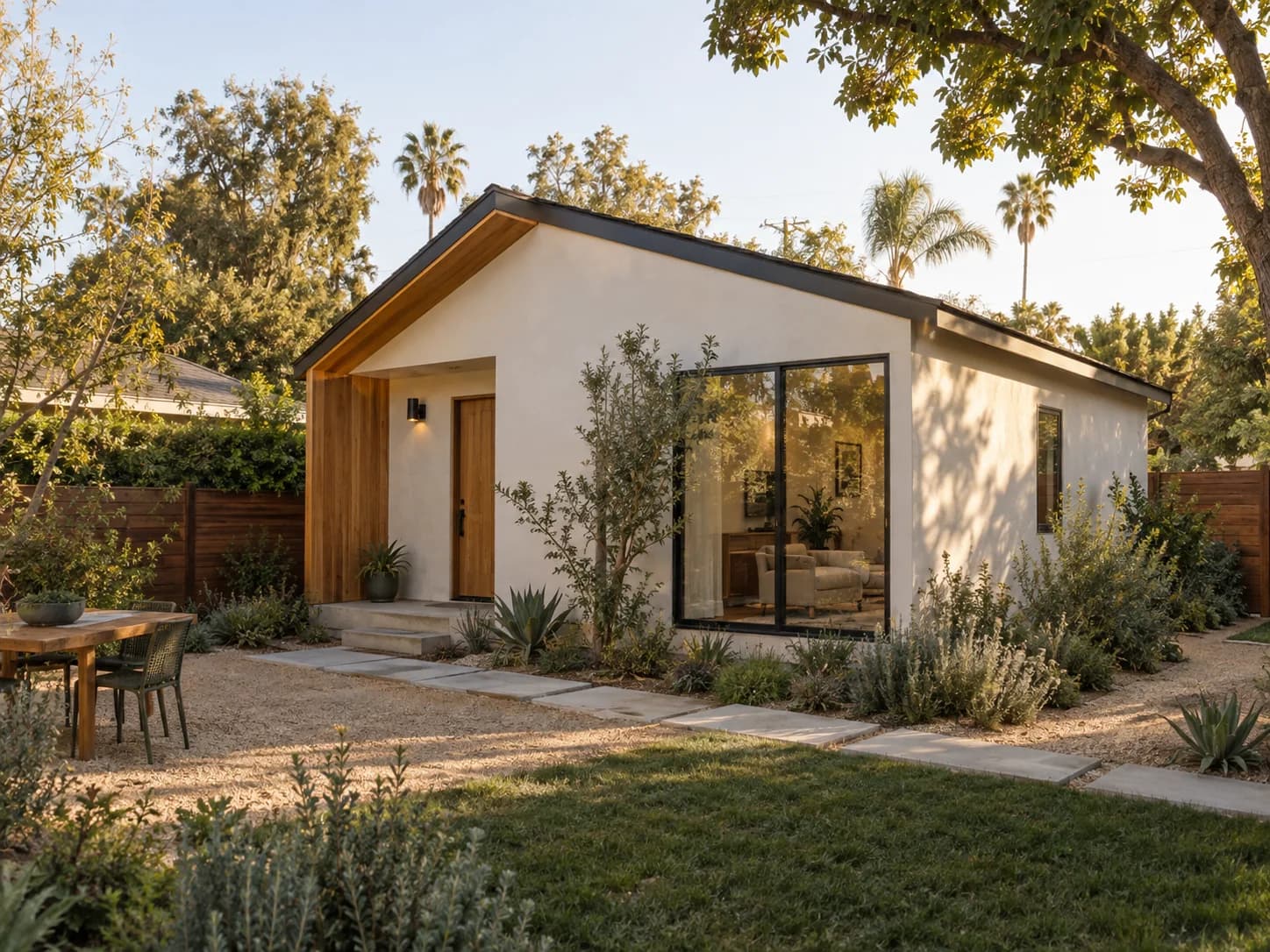
Every ADU or JADU in the City of San Diego needs a building permit, with no exemptions. A single-family lot can add one attached or detached ADU, one ADU converted from the house or an existing accessory structure such as a garage, and one JADU of up to 500 square feet. New ADUs top out at 1,200 square feet, but a conversion is not held to that cap. At 16 feet or less, a new unit can sit on the side and rear property lines; taller, it needs 4 feet from residential neighbors. State law gives the City 60 days to act on a complete application.
Draw the utility routes and the path for equipment on the site plan before anyone bids. A long trench to the sewer, or a yard a mini excavator cannot reach, costs the same on a small unit as on a large one. Price restoring the main yard apart from the unit's interior finishes.
Discuss your scope with a Renology advisor and check suitable contractor options. Free for homeowners, with no obligation.
Convert existing space: inclusions & limits
A converted ADU can keep the old structure's setbacks and is not held to the 1,200 square foot cap, and the City allows up to 150 extra square feet only for ingress and egress. A garage demolished and rebuilt at the same spot and size keeps its setbacks too. Lost garage parking need not be replaced, except in the Beach Impact Area, a parking-restricted zone near the coast, outside transit priority areas. Conversions skip the Energy Code solar rule. If the unit leaves the driveway curb out of compliance, the City Engineer can require the curb cut closed.
Detached ADU: inclusions & limits
The unit must keep the zone's front setback. It may sit on the side and rear lines at 16 feet or less, needs 4 feet from residential neighbors above that, and needs 4 feet regardless in a Very High Fire Hazard Severity Zone. Building code fire separation can push it further in. A new site-built detached ADU needs solar panels, which can go on the ADU or the main house. The City accepts County of San Diego, Chula Vista and Encinitas preapproved plans with a 30-day review, but you license the plan from its provider.
Attached addition: inclusions & limits
An addition for an ADU keeps the zone's front setback and a street side setback of the zone's figure or 4 feet, whichever is less. It can reach the side and rear lines within building code limits. Exterior stairs, decks and balconies must still meet base zone setbacks. Fire sprinklers follow the house: if the main home has them, the ADU needs them. In the City's fee bulletin, an attached ADU or JADU up to 1,100 square feet is priced with additions and remodels.
What an ADU project costs in San Diego in 2026.
San Diego puts a number on every ADU it permits, and the median is $107,792. That is the City's valuation across 2,357 permits for a single ADU or junior unit on a house or duplex, filed September 2024 through August 2026, and half of them landed between $69,153 and $189,692.
$107,792
The City does the math, not the builder. San Diego values an ADU by multiplying its floor area by a rate from its own tables, which is why 78 percent of these values carry cents. The rate that shows up most often is $165.67 a square foot, and the single most common value, $198,804, is exactly a 1,200 square foot unit, the cap for a new ADU, at that rate. The valuation sets fees. It was never meant to include design, trenching, utility connections or the finishes you pick, and that is where real bids part ways with it.
All the numbers and where they come from
| Figure | Value | What it measures |
|---|---|---|
| Median City valuation | $107,792 | Median valuation on 2,357 permits for one ADU or JADU on a single-family or duplex lot, filed September 2024 to August 2026. Half fall between $69,153 and $189,692. The City computes these from floor area; they are not contract prices. (City of San Diego development permits, open data) |
| Garage conversion | $91,806 | Median City valuation on 1,038 garage conversion ADU permits. (City of San Diego development permits, open data) |
| New detached ADU | $137,672 | Median City valuation on 745 permits for a new detached ADU. One in ten topped $232,408. (City of San Diego development permits, open data) |
| Junior unit (JADU) | $73,364 | Median City valuation on 251 JADU permits, for units of up to 500 square feet inside the house. (City of San Diego development permits, open data) |
| Most common City rate | $165.67 a sq ft | The valuation rate seen most often on ADU permits that list floor area. At that rate, a 1,200 square foot unit is valued at $198,804, the most common single value in the data. (City of San Diego development permits, open data) |
| City plan check and inspection | $5,741.21 | Base rates in IB 501, the City's construction fee bulletin, for a detached ADU up to 500 square feet: $3,512.92 plan check plus $2,228.29 inspection. Over 500 square feet the base rates are $8,085.26 and $8,401.90, or $16,487.16 together. (City of San Diego DSD, Information Bulletin 501: Fee Schedule for Construction Permits (August 2026)) |
| Development Impact Fees | $0 on most units | The Municipal Code exempts the first two ADUs on a lot whatever their size, every ADU under 750 square feet and every JADU. School fees and the General Plan Maintenance Fee still apply. (San Diego Municipal Code Chapter 14, Article 2, Division 6: Development Impact Fees (ADU exemptions)) |
| Carpenter wage | $35.19 an hour | Median carpenter wage in the San Diego-Chula Vista-Carlsbad metro, May 2025. Electricians earned a median $36.62 and construction laborers $27.49. Contractors bill above wages. (U.S. Bureau of Labor Statistics, May 2025 wages, San Diego-Chula Vista-Carlsbad) |
Median City ADU valuation by community planning area
- College Area$177,984 median, 122 permits
- La Jolla$143,675 median, 132 permits
- Encanto Neighborhoods$131,376 median, 128 permits
- Mira Mesa$129,885 median, 165 permits
- Clairemont Mesa$128,945 median, 276 permits
- Skyline-Paradise Hills$109,839 median, 124 permits
- Mid-City: Eastern Area$106,194 median, 141 permits
- Mid-City: City Heights$86,977 median, 124 permits
| Budget line | Define it | Watch for |
|---|---|---|
| City permit fees | IB 501, the City's construction fee bulletin, sets the base rates. A detached ADU up to 500 square feet is priced with additions: $3,512.92 plan check and $2,228.29 inspection. Over 500 square feet it is priced like a new house: $8,085.26 and $8,401.90. | School fees and the General Plan Maintenance Fee also apply to ADUs and JADUs. Ask each bidder to show City fees apart from design fees. |
| Development Impact Fees | The Municipal Code exempts the first two ADUs on a lot from Development Impact Fees whatever their size, and exempts every ADU under 750 square feet and every JADU. | Units built under SB 9, the state law that lets owners split a single-family lot, pay the fees above 750 square feet, and bonus program ADUs add a Community Enhancement Fee. Confirm which route your plan uses. |
| Site, utilities and code items | Trenching and service connections, the Water Meter Data Card (the City form used to size the water meter), solar for a new detached unit, fire sprinklers where the house has them, and any curb closure. | Title 24 energy calculations and structural calculations are required submittals. Ask whether the design fee covers them or they arrive later as extras. |
For inclusions, allowances and exclusions, see how to read a contractor quote line by line. For broader benchmarks, see the Renology Cost Index.
What an ADU project budget buys in San Diego.
About $73,000
The median City valuation for a junior unit, $73,364. A JADU of up to 500 square feet sits inside the house or its attached garage, needs no parking or solar panels, and pays no Development Impact Fees. It can share the house's bathroom, but then the owner must live on site.
About $92,000
The median valuation for a garage conversion, $91,806. The old structure keeps its setbacks and is not held to the 1,200 square foot cap, and conversions skip the Energy Code solar rule. The costs that surprise people here are the slab, framing and roof: if they cannot become living space, the job turns into a rebuild on the same footprint.
$135,000 to $200,000
From the median valuation for a new detached ADU, $137,672, to $198,804, the City's value for a 1,200 square foot unit at its most common rate. A new site-built detached unit needs solar panels, and over 500 square feet its IB 501 base rates for plan check and inspection come to $16,487.16.
$250,000 and up
The top tenth of all ADU valuations begins at $255,121, above the City's value for a 1,200 square foot unit at its most common rate. Large conversions, which are not held to the 1,200 square foot cap, can reach this range. In La Jolla the top tenth starts at $499,392.
Why a San Diego ADU bid lands above the City's valuation.
The City's number is floor area times a table rate, used to set plan check and inspection fees. Two units of the same size get almost the same valuation. It makes no difference that one sits on a flat lot next to the sewer line and the other needs a long trench and a new electrical service. A bid prices the real site: design, structural and Title 24 energy calculations, trenching and utility connections. It also carries the Water Meter Data Card, solar for a new detached unit and fire sprinklers if the house has them.
Fees are where bids quietly differ. One may carry City fees, school fees and the General Plan Maintenance Fee, another may list them as the owner's cost, and a third may not mention a possible curb closure after a garage conversion. An ADU also pulls in more trades than most jobs. Carpenters in the San Diego metro earned a median $35.19 an hour in May 2025, electricians $36.62 and construction supervisors $46.08, and a contractor's rate covers much more than those wages.
Bring the bid checklist to every contractor so the numbers describe the same job.
Make the guide yours
Garage conversion, backyard unit or addition in San Diego?
Each route has its own San Diego catch. A garage conversion keeps its old setbacks and escapes the 1,200 square foot cap, but it can cost you the curb cut. A new backyard unit can hug the side and rear lines at 16 feet or less, then needs 4 feet above that. An addition inherits the house's fire sprinklers, if it has them.
No scope selected. The guide and checklist are available without choosing a project tier or leaving contact details.
Compare two complete projects, not two building prices
On paper a garage conversion is the cheaper San Diego ADU. The City's median valuation is $91,806, against $137,672 for a new detached unit. Part of that gap is real, since a conversion keeps the garage's old setbacks and skips the solar rule. Much of it disappears if the slab, framing or roof cannot become living space and the garage has to be rebuilt on its footprint.
IB 400, the City's ADU bulletin, covers both routes. A conversion carries one cost a new unit does not: if the driveway no longer leads to parking, the City Engineer can require the curb cut closed. Ask both bidders to price that possibility.
Official starting point: San Diego ADU resources.
A decision to work through · illustrative scenario
A garage conversion versus a backyard ADU
The garage slab is cracked and the roof framing is too light for a living space. Converting it would mean rebuilding on the same footprint, which keeps the old setbacks but gives back much of the saving over a new detached unit.
Before you compare bids: Ask both bidders to price slab, framing, trenching, solar where required and any curb closure, so the two totals describe finished units.
How does a San Diego ADU get from lot check to move-in?
The City is required to move quickly on an ADU. State law gives it 15 business days to call an application complete and 60 days to act on it, and preapproved plans get a 30-day review. The slow parts tend to sit on the owner's side: the coastal question, the structural and energy calculations and, for a JADU, an agreement signed before the permit issues.
- 1
Check the lot. Look up the zone in ZAPP, the City's online zoning map, confirm whether the Coastal Overlay Zone applies, and choose a conversion, detached unit, addition or JADU. In the coastal zone most new ADUs need a Coastal Development Permit, which the City can issue as a building permit in the non-appealable area.
- 2
Apply online. Upload the site plan, floor and roof plans, elevations, structural plans and Title 24 calculations through the Development Services portal. State law gives the City 15 business days to say whether the application is complete and 60 days to act on a complete one; preapproved plans get a 30-day review.
- 3
Build and close out. For a JADU, sign the Junior Unit Agreement before the permit issues. Build through inspections, then rent for at least 31 days at a time, since neither an ADU nor a JADU can be a short-term rental.
Ask for separate dates for design, permit review, ordering and construction.
Five things to settle before a San Diego ADU bid
Most of the questions that change a San Diego ADU bid can be answered from the City's ZAPP portal before anyone draws a line: the zone, the coastal overlay, a fire hazard zone. Height matters as much as footprint, because 16 feet is where the setbacks begin. And for a conversion, the garage's slab and framing decide whether you are converting or rebuilding.
- Your zone from the City's ZAPP portal, and whether the lot sits in the Coastal Overlay Zone
- Whether the lot is in a Very High Fire Hazard Severity Zone or a Brush Management Zone
- A target height: 16 feet or less, or taller with 4-foot side and rear setbacks
- For a conversion, the garage slab, framing and roof, and whether they stay or get rebuilt in place
- Who prepares the Water Meter Data Card, Title 24 calculations and school fee paperwork
If you ask for help, a Renology advisor talks through your scope and checks local contractor availability. You decide whether to go ahead.
Already have a proposal? Check its scope and exclusions with the quote-review tool before your next contractor conversation.
ADU costs, permit requirements and JADUs in San Diego
Much of the City's cost in San Diego is written down. IB 501 sets the plan check and inspection base rates, and the Municipal Code waives Development Impact Fees on the first two ADUs. Your build price is the part nobody can publish. These are the questions homeowners here ask most, answered from the City's own rules.
Can I use a preapproved ADU plan in the City of San Diego?
Yes. The City accepts preapproved plans from the County of San Diego, Chula Vista and Encinitas and reviews them in 30 days. You license the plan from its provider, and someone still has to fit it to your lot and to current code.
How much would it cost to build an ADU in San Diego?
The City of San Diego valued 2,357 ADU and junior unit permits filed since September 2024 at a median of $107,792, with half between $69,153 and $189,692. The City computes that figure from floor area to set fees, so it is not a contract price. New detached units had a median valuation of $137,672 and garage conversions $91,806. Plan check and inspection base rates add $5,741.21 for a detached unit up to 500 square feet.
What are the requirements to obtain an ADU permit in San Diego?
A building permit, applied for online. The City's minimum submittal is a site plan and vicinity map, floor and roof plans, elevations and sections, structural plans and calculations, and Title 24 energy calculations, plus the general application, a Water Meter Data Card and a storm water checklist. State law requires ministerial approval, with no hearing, for an application that meets the rules.
What is a JADU in San Diego?
A unit of 150 to 500 square feet inside a house or its attached garage, with its own exterior entry and at least an efficiency kitchen. It can share the house's bathroom, but then the owner must live on site. A Junior Unit Agreement bars selling it separately, it cannot be rented for 30 days or less, and it needs no parking or solar panels.
Check contractor credentials with California CSLB. Match the business identity and scope to the proposal.
Sources
- City of San Diego DSD, Information Bulletin 400: Accessory Dwelling Unit/Junior Accessory Dwelling Unit (January 2026)
- City of San Diego DSD, Accessory Dwelling Unit/Junior Accessory Dwelling Unit program page
- San Diego Municipal Code Chapter 14, Article 2, Division 6: Development Impact Fees (ADU exemptions)
- City of San Diego DSD, Information Bulletin 501: Fee Schedule for Construction Permits (August 2026)
- California Government Code section 66317 (ADU permit timelines)
- City of San Diego development permits, open data
- U.S. Bureau of Labor Statistics, May 2025 wages, San Diego-Chula Vista-Carlsbad
Keep planning.
Explore the general ADU & garage conversion guide for project-wide ideas.
- Kitchen remodeling in San Diego →
- Bathroom remodeling in San Diego →
- Roof replacement in San Diego →
- Outdoor living in San Diego →
- Decks & pergolas in San Diego →
- Driveways & walkways in San Diego →
- Flooring installation in San Diego →
ADU & garage conversion in other regions
Ready to hire? See vetted San Diego contractors →
Planning guidance, not a quote. Confirm current requirements for your address with the official sources linked above.