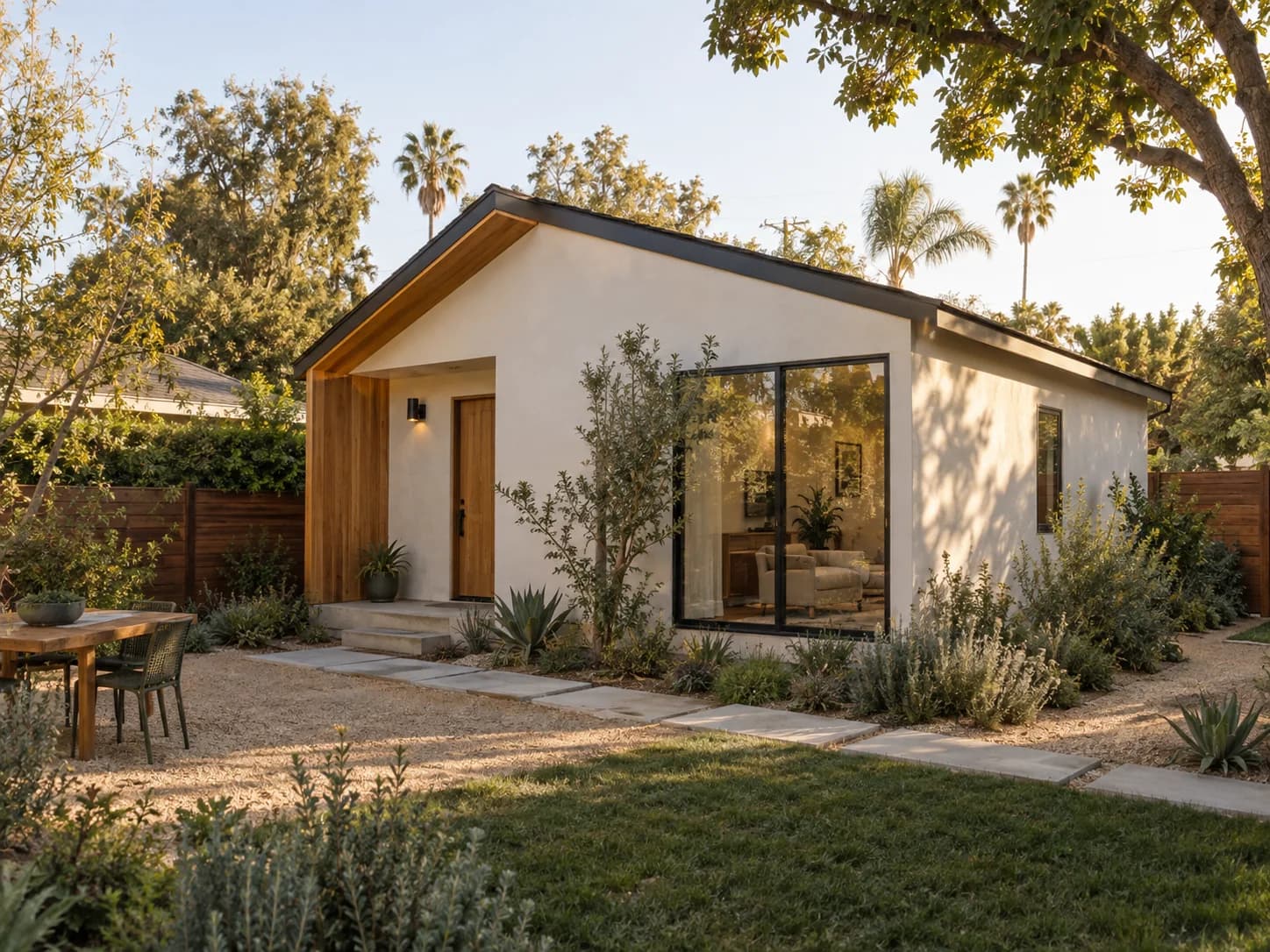
The short answer
How big can a Seattle ADU be, and what permit does it need?
A Seattle lot can hold up to two accessory dwelling units, attached or detached. Under the middle housing codes SDCI summarized in March 2026, each may be up to 1,000 square feet, or 1,200 with three or more bedrooms. Adding a unit takes a regular building permit, and SDCI's Tip 316 names converting an existing structure to an ADU among the jobs that need plan review. A pre-approved plan for a detached ADU (DADU), from the city's ADUniverse gallery, can be permitted in 2 to 6 weeks in most cases. Once the unit is on the sewer, King County bills $46.01 a month for 15 years at 2026 rates.
Before choosing a design, have the old side sewer inspected by camera. Seattle Public Utilities says the homeowner owns that line all the way to the main under the street, and the new unit will drain into it.
Discuss your scope with a Renology advisor and check suitable contractor options. Free for homeowners, with no obligation.
Convert existing space: inclusions & limits
SDCI's Tip 116B lets the director grant exceptions to development standards so an existing structure can be converted. The converted building must still fully comply with the Seattle Energy Code, so an uninsulated garage gets its walls, slab and roof brought up to current levels. Every room used for sleeping needs an escape window with at least 5.7 square feet of opening. Tip 316 rules out the quick STFI permit for this job.
Detached ADU: inclusions & limits
SDCI's pre-approved standard plan route is limited to NR1, NR2 and NR3 zones and to lots with no environmentally critical area (ECA), such as a steep slope or wetland. Total ground disturbance, driveways included, must stay under 750 square feet. Neighborhood Residential rules set a 5 foot setback for ADUs, or none where the lot abuts an alley, and ADUs count toward the 50 percent lot coverage cap. New or altered electric service needs its own Seattle City Light application.
Attached addition: inclusions & limits
Tip 116A requires a separate locking entrance, breakers and heating controls inside the unit or in a common area, smoke and carbon monoxide alarms, and fire and sound separation from the main house. SDCI waives the separation if interconnected smoke alarms run through the whole structure. Two attached units in one existing house move it into Existing Building Code review, the code for altering buildings already standing, as an apartment building with sprinkler, seismic, egress and energy upgrades.
What an ADU project costs in Seattle in 2026.
A Seattle ADU can be a unit carved out of the lower floor or a new cottage off the alley, and the city's permit records price the two very differently. On 126 permits SDCI took in since September 2024 that add an attached or interior unit to an existing house, owners declared a median of $100,000; on 198 permits for new detached units, the median was $194,886, and half of those fell between $164,150 and $214,600.
$100,000
Read the two numbers differently. Half of the attached values are round multiples of $5,000, the way owners and builders estimate. The detached values are rarely round, only about 6 percent, which fits a value computed from floor area rather than a builder's quote, so treat $194,886 as the value of the building shell. Neither figure includes what comes after the permit: King County's sewer capacity charge of $46.01 a month for 15 years, a Seattle City Light service application, and a side sewer the owner is responsible for all the way to the main under the street.
All the numbers and where they come from
| Figure | Value | What it measures |
|---|---|---|
| Attached or interior ADU | $100,000 | Median declared project cost on 126 SDCI permits adding one attached or interior unit to an existing single-family house, filed September 2024 to September 2026. Half fall between $46,067 and $200,000. These values are mostly figures owners or builders wrote on the form. (Seattle SDCI building permits, open data) |
| Detached ADU (DADU) | $194,886 | Median on 198 permits for a new detached unit behind an existing house. Half fall between $164,150 and $214,600. Only about 6 percent are round multiples of $5,000, consistent with a value computed from floor area, so read it as a building shell value, not an all-in cost. (Seattle SDCI building permits, open data) |
| Permits that mention a garage | $187,178 | Median on 69 ADU permits whose descriptions mention a garage. Many of them remove the old garage and build a new cottage in its place, so this figure tracks new detached units more than true conversions. (Seattle SDCI building permits, open data) |
| Top tenth, attached units | $350,000+ | One in ten attached or interior ADU permits declared $350,000 or more. (Seattle SDCI building permits, open data) |
| Sewer capacity charge | $46.01 a month | King County counts an ADU as 0.59 of a standard house connection for this charge. At the 2026 rate of $77.99, that is $46.01 a month for 15 years. King County allows a discounted lump-sum payoff at any time during those years. (King County, About the capacity charge) |
| Carpenter wage | $36.74 an hour | Median carpenter wage in the Seattle-Tacoma-Bellevue metro, May 2025. Electricians earned a median $48.93 and plumbers $45.78. Contractors bill above wages. (U.S. Bureau of Labor Statistics, May 2025 wages, Seattle-Tacoma-Bellevue) |
Median declared ADU value by ZIP code
- 98115 (Wedgwood, View Ridge)$200,000 median, 31 permits
- 98126 (West Seattle)$188,989 median, 32 permits
- 98117 (Ballard, Crown Hill)$170,471 median, 41 permits
- 98103 (Fremont, Wallingford)$149,032 median, 31 permits
| Budget line | Define it | Watch for |
|---|---|---|
| Permit and plan review fees | SDCI charges an intake fee and a plan review fee based on the value of the work. It collects about 75 percent when plans are submitted and the rest at issuance, plus hourly fees for reviews such as drainage. | Adding or replacing more than 750 square feet of building footprint or hard surface triggers SDCI stormwater review, which adds a review of its own. |
| Sewer capacity charge | King County's charge for new sewer connections. The county counts an ADU as 0.59 of a standard house connection, which is $46.01 a month at the 2026 rate, billed quarterly for 15 years. | The charge belongs to the current owner, so carry it into rent or resale math. King County allows a discounted lump-sum payoff at any time during the 15 years. |
| Utility connections | A Seattle City Light application for new or altered service, a Public Health plumbing permit, and a side sewer permit when the unit ties into the existing line. | SPU says the homeowner owns the side sewer all the way to the main under the street. Have it inspected by camera before the new unit is designed to drain into it. |
For inclusions, allowances and exclusions, see how to read a contractor quote line by line. For broader benchmarks, see the Renology Cost Index.
What an ADU project budget buys in Seattle.
$45,000 to $100,000
From the bottom quarter of attached and interior ADU permits, at $46,067, to their median of $100,000. This is a unit made from space the house already has, such as a lower floor. Tip 116A, SDCI's guide to attached units, asks for a separate locking entrance, breakers and heating controls inside the unit or in a common area, and smoke and carbon monoxide alarms. It also asks for fire and sound separation, which SDCI waives when interconnected smoke alarms run through the whole house.
$160,000 to $215,000
The middle half of detached ADU (DADU) permits, from $164,150 to $214,600, with the median at $194,886. A pre-approved plan from the ADUniverse gallery usually permits in 2 to 6 weeks. It only works in NR1, NR2 and NR3 zones, Seattle's Neighborhood Residential house-lot zones, on a lot with no environmentally critical area and under 750 square feet of ground disturbance. Permits that mention a garage show a median of $187,178 because many of them tear the garage down and build a new cottage. The few that keep and convert the garage mostly declared less, but the converted building must meet the full Seattle Energy Code.
$350,000 and up
One in ten attached or interior permits declares $350,000 or more. Descriptions at this end include additions and substantial alterations to the house. Two attached units in one existing house also send it into review as an apartment building, under the code for existing buildings, with sprinkler, seismic, egress and energy upgrades.
Why a Seattle backyard cottage's permit value is not its price.
SDCI uses the permit value to set its plan review fee, and it collects about 75 percent of that fee when plans go in. For a detached unit, the value describes the building shell. A contractor's price also has to carry site work, utility tie-ins, overhead and margin, plus a cushion for what is under the ground and inside the walls.
So check each bid for the pieces that sit outside the shell. One may include a site logistics plan, the City Light service application, the Public Health plumbing permit and a side sewer permit with a camera inspection first. It may also cover stormwater review, which starts once more than 750 square feet of footprint or hard surface changes, and a 5.7 square foot escape window in every bedroom. Another may leave half of that for later. Carpenters in the Seattle-Tacoma-Bellevue metro earned a median $36.74 an hour in May 2025, electricians $48.93 and plumbers $45.78. The $46.01 monthly sewer charge follows the unit for 15 years whoever builds it.
Bring the bid checklist to every contractor so the numbers describe the same job.
Make the guide yours
Garage conversion, backyard DADU or a unit inside the house?
The three routes to a Seattle ADU split on paper before they split on site. A converted garage has to meet the full Seattle Energy Code and cannot use the quick STFI permit. A backyard cottage can ride a pre-approved plan if the lot passes three tests. A unit inside the house needs its own locking entrance and separation from the main dwelling.
No scope selected. The guide and checklist are available without choosing a project tier or leaving contact details.
Your lot decides whether a pre-approved plan fits
The fastest Seattle ADU is a pre-approved plan from the city's ADUniverse gallery, and the lot decides whether you can use one. It has to sit in an NR zone, clear of any environmentally critical area. The job also has to disturb under 750 square feet of ground, driveway included. Fail one test and the same cottage goes through custom review.
Check the lot on SDCI's GIS map before choosing a plan. It shows the zone, any critical area and whether the lot backs onto an alley. On an alley, an ADU can sit with no rear setback instead of 5 feet.
Official starting point: Seattle ADU resources.
A decision to work through · illustrative scenario
A garage on the alley: keep it or replace it?
The owners want a cottage where an old garage stands on the alley. Keeping it means bringing walls, slab and roof up to the full Seattle Energy Code, with plan review instead of the quick STFI permit. Replacing it opens the pre-approved plan route if the lot passes the three tests.
Before you compare bids: Ask for both options priced side by side, with energy upgrades, the side sewer camera inspection and the City Light service application on their own lines.
From ADUniverse to final inspection: the Seattle ADU timeline
Seattle gives ADU owners a fast lane and a regular lane. Pre-approved DADU plans usually permit in 2 to 6 weeks. A custom design waits on an initial review SDCI aims to finish in 2 to 3 weeks for simple permits and 8 weeks for complex ones. Utilities run on their own clock, and the county sewer bill arrives months after the connection.
- 1
Test the lot. Check zoning, environmentally critical areas and alley access on SDCI's GIS map, and browse the ADUniverse pre-approved gallery. A standard plan needs an NR zone, no ECA and under 750 square feet of ground disturbance; if the lot fails any test, plan for a custom design and regular review.
- 2
Apply and wait for review. Start with the Building & Land Use Pre-Application on the Seattle Services Portal. SDCI aims to finish an initial review in 2 to 3 weeks for simple permits and 8 weeks for complex ones, while standard plans usually permit in 2 to 6 weeks. Open the City Light service application alongside.
- 3
Build, inspect, move in. Electrical work needs its own SDCI permit, pulled by the electrical contractor unless the owner does all of it, and plumbing goes through Public Health. After final approval a tenant may occupy the unit, and King County's first capacity charge bill arrives about three months or more after SDCI reports the sewer connection.
Ask for separate dates for design, permit review, ordering and construction.
What a Seattle ADU bid and permit set should cover
An ADU bid can look complete and still leave out the pieces that decide whether the unit is built on time. Look for the floor area against the 1,000 and 1,200 square foot limits and escape windows in every bedroom. Then look for the side sewer, which the owner is responsible for all the way to the street, and a City Light service plan. Ask for each by name.
- Zone, environmentally critical area and alley access checked on SDCI's GIS map before choosing a standard plan or a custom design.
- Floor area under 1,000 square feet, or 1,200 with three or more bedrooms, shown on the plans.
- An escape window in every sleeping room: 5.7 square feet open, 24 inches tall, 20 inches wide, sill no higher than 44 inches.
- The King County capacity charge acknowledgment, completed during the permit application.
- A camera inspection of the side sewer and a City Light service plan for the second unit.
If you ask for help, a Renology advisor talks through your scope and checks local contractor availability. You decide whether to go ahead.
Already have a proposal? Check its scope and exclusions with the quote-review tool before your next contractor conversation.
Selling, sizing and naming: Seattle DADU questions
The first question here is where to start: the lot or the plan catalog. After that come cost, names, size, and the rule that an ADU can never be sold apart from the house.
Should I start with the city's pre-approved plans?
Start with the lot. ADUniverse plans usually permit in 2 to 6 weeks, but only on a lot in an NR zone, with no environmentally critical area and under 750 square feet of ground disturbance. If the lot passes, the gallery is a fast start. If not, plan on a custom design and regular review.
How much does it cost to build an ADU in Seattle?
On 126 Seattle permits adding an attached or interior unit to an existing house since September 2024, owners declared a median project cost of $100,000. New detached units had a median of $194,886 on 198 permits, a value that looks computed from floor area, so read it as the building shell. The middle half of detached permits runs from $164,150 to $214,600. After the build, King County bills a sewer capacity charge of $46.01 a month for 15 years.
What is the difference between an ADU and a DADU?
In Seattle, ADU is the umbrella term. A legally permitted unit inside the house is an attached ADU, or AADU; one elsewhere on the property, like a backyard cottage, is a detached ADU, or DADU. Both must be established by permit to be legal, both count toward the lot's density, and a lot may have no more than two. SDCI treats a tiny house on a foundation as a DADU.
Can you sell a DADU in Seattle?
Not as a separate lot. SDCI says accessory dwelling units may not be subdivided from the main house, and its Neighborhood Residential summary repeats that an ADU may not be separated from the principal unit through subdivision. When the whole property sells, the new owner needs no SDCI permit to keep the unit, but removing it takes a permit to take out the features that make it a separate dwelling.
What is the maximum size for an ADU in Seattle?
SDCI's March 2026 summary of the new middle housing codes puts the limit at 1,000 square feet in all zones, or 1,200 square feet for a unit with three or more bedrooms. ADUs still count toward lot coverage, capped at 50 percent in Neighborhood Residential zones, and while most NR lots can now hold up to four units, only two of them may be ADUs.
Check contractor credentials with Washington Labor & Industries. Match the business identity and scope to the proposal.
Sources
- SDCI, Accessory Dwelling Unit
- SDCI Building Connections, New Middle Housing Codes to Boost Housing Supply (March 2, 2026)
- SDCI, Neighborhood Residential Code
- SDCI, Neighborhood Residential zoning summary
- SDCI Tip 116A, Establishing an Attached Accessory Dwelling Unit
- SDCI Tip 116B, Establishing a Detached Accessory Dwelling Unit
- SDCI Tip 316, Subject-to-Field-Inspection Permits
- SDCI, Construction Permit: Addition or Alteration
- Seattle Services Portal Help Center, Applying for a DADU with a Pre-Approved Standard Plan
- City of Seattle, ADUniverse
- King County, About the capacity charge
- Seattle City Light, Apply for New or Upgraded Electric Service
- Seattle Public Utilities, Your Side Sewer
- SDCI, Stormwater Code
- Seattle SDCI building permits, open data
- U.S. Bureau of Labor Statistics, May 2025 wages, Seattle-Tacoma-Bellevue
Keep planning.
Explore the general ADU & garage conversion guide for project-wide ideas.
- Kitchen remodeling in Seattle →
- Bathroom remodeling in Seattle →
- Roof replacement in Seattle →
- Outdoor living in Seattle →
- Basement remodeling in Seattle →
- Decks & pergolas in Seattle →
- Flooring installation in Seattle →
ADU & garage conversion in other regions
Ready to hire? See vetted Seattle contractors →
Planning guidance, not a quote. Confirm current requirements for your address with the official sources linked above.