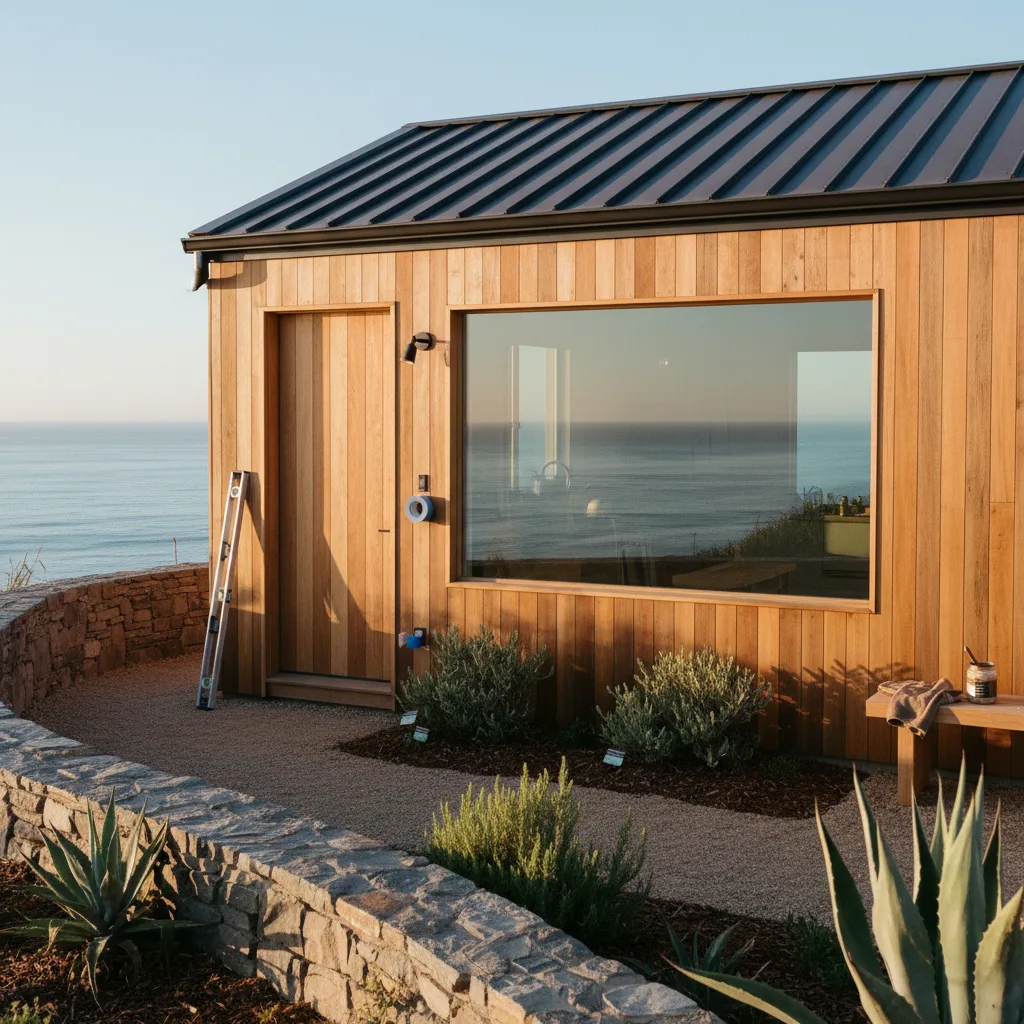
Planning an ADU and garage project in Malibu? A full build-out typically runs $215,000 to $385,000 in 2026. Cosmetic conversions start near $130,000, while premium custom work on a challenging lot can easily climb past $460,000. This is what your budget actually covers, what drives the price up, and how to vet a contractor who truly understands Malibu's unique terrain and permitting process.
The Honest 2026 Price for an ADU & Garage in Malibu
Let's get straight to the point. Building in Malibu is not like building anywhere else, and anyone who gives you a simple square-foot price without seeing your lot is guessing. The numbers we track at Renology show a wide but predictable range for 2026. A standard, well-built Accessory Dwelling Unit (ADU) combined with a garage project will land somewhere between $215,000 and $385,000. This figure represents the most common project scope: a new-build detached unit or a significant conversion of an existing structure with mid-grade finishes.
For homeowners with a structurally sound garage ready for a more straightforward conversion, costs can be lower, starting around $130,000. This assumes you are not changing the footprint, adding a second story, or dealing with major seismic or utility upgrades. On the other end of the spectrum, a premium, architect-designed ADU on a hillside lot with high-end finishes, extensive site work, and custom features will push your budget to $460,000 and well beyond $700,000. These are not just numbers on a page; they reflect the real invoices from completed projects in your area.
Key takeaway
The single biggest factor that separates these price tiers is not the cost of tile or windows, but the complexity of the site itself. Access, soil stability, and proximity to the coastline dictate a huge portion of your final budget before a single 2x4 is ordered.
What Drives ADU & Garage Costs in Malibu
See what a ADU build actually costs in your Malibu zip.
Take 4 questions →Understanding the "why" behind the price tag is the first step to controlling your budget. In Malibu, the costs are not arbitrary. They are a direct result of specific local conditions that demand more from your builder, your materials, and your timeline. A project here is a battle against geography, regulation, and logistics.
Labor and Logistics
Malibu is a destination, not a distribution hub. Every truck carrying lumber, concrete, or drywall has to work through the Pacific Coast Highway or wind down a narrow canyon road. This "last mile" delivery cost is baked into every material quote., the pool of highly skilled tradespeople willing and able to work in Malibu is smaller and in high demand. They command premium wages, reflecting not just their skill but the time and cost of commuting. You are not just paying for their work; you are paying for their time in traffic on the PCH.
Materials and Methods
The coastal environment is relentlessly corrosive. Salt spray, intense UV exposure, and the constant threat of wildfire demand a higher class of materials. Standard-grade lumber, fasteners, and windows that work inland will fail prematurely here. Your budget must account for stainless steel hardware, marine-grade finishes, non-combustible siding, and dual-pane windows with high-performance coatings. These are not upgrades; they are the baseline for a structure that lasts. Add to that California's stringent seismic building codes, which require more solid foundations, shear walls, and structural connectors than in almost any other state.
Permits and Professional Fees
The "soft costs" of a Malibu project can be a shock. Before you break ground, you will pay for a team of professionals: an architect or designer, a structural engineer, and often a geotechnical engineer to assess soil and slope stability. The fees for these experts, along with city and county plan check fees, permit issuance fees, and potentially a coastal development permit, can easily account for 15 to 25 percent of your total project cost. Under-budgeting for this critical pre-construction phase is a common and costly mistake.
Malibu ADU & Garage by Tier: Three Real Project Examples
To make these numbers tangible, let's look at three composite projects based on real scopes we have seen in Malibu. These examples illustrate how budget, scope, and timeline are interconnected. Minor changes in scope can have major impacts on the other two variables.
| Tier | Scope of Work | Cost Range | Timeline |
|---|---|---|---|
| Cosmetic Conversion | Converting an existing, permitted garage. No change to footprint or roofline. Adding insulation, drywall, and code-compliant electrical and plumbing. Installing pre-fab cabinetry, LVP flooring, and mid-grade fixtures. Basic landscaping and paint. | $130,000 to $215,000 | 4 to 6 months |
| Mid-Range New Build | New construction of a 600 sq. ft. detached ADU with a two-car garage. Standard concrete slab foundation on a relatively flat lot. Wood frame construction, stucco exterior, and asphalt shingle roof. Semi-custom cabinets, quartz countertops, and quality appliance package. Includes utility trenching and connection. | $215,000 to $385,000 | 8 to 14 months |
| Premium Custom ADU | Architect-designed 1,000 sq. ft. ADU over a garage on a hillside lot. Involves caisson or deep pile foundation, structural steel elements, and extensive site grading. High-end custom windows, standing seam metal roof, Fleetwood doors, custom cabinetry, designer finishes, and a smart home system. May include a deck or outdoor living space. | $460,000 to $695,000+ | 12, 18+ months |
Pro tip
Notice the timeline jump between tiers. It is not just about construction. The design and permitting phase for a premium, custom project on a difficult lot can take six to nine months alone, before any construction begins. Factor this into your planning.
Permits and Local Code in Malibu
This is where projects get made or broken. The permitting process in Malibu is famously rigorous, often involving multiple agencies with overlapping jurisdictions. Getting this right requires a contractor or architect with deep local experience.
The Dual Gatekeepers: City and Coast
Virtually all of Malibu lies within the Coastal Zone. This means most significant projects require a Coastal Development Permit (CDP) from the City of Malibu, which must adhere to the state's stringent guidelines enforced by the California Coastal Commission. The commission's priorities are protecting public access, coastal views, and environmentally sensitive habitats. Your ADU project will be scrutinized for its height, massing, visual impact from the PCH, and potential environmental effects. This dual-layer of review adds significant time and uncertainty compared to inland cities.
Key Local Regulations
Beyond the coastal rules, your project must comply with a host of other codes. Here are a few critical ones:
- California Title 24: These are the state's mandatory energy efficiency standards. Your ADU will need high-performance insulation, efficient windows, and specific heating, cooling, and lighting systems to comply.
- Fire Code (Chapter 7A): After devastating fires, Malibu has adopted extremely strict building codes for structures in the Wildland-Urban Interface (WUI). Expect requirements for non-combustible siding, enclosed eaves, fire-rated vents, and defensible space around your new structure.
- Geotechnical and Septic Requirements: On a hillside lot, the city will require a geological and soils report to ensure stability. If you are on a septic system, you will also need to prove your existing system can handle the additional load of an ADU, which can sometimes trigger a costly system upgrade.
The Malibu Neighborhoods Where ADU & Garage Costs Diverge
Malibu is not a monolith. An ADU project in the flatlands of eastern Malibu is a completely different animal from one perched on a cliff in the west. The character and constraints of the neighborhood itself become a primary cost driver.
In my last walkthrough in Big Rock, the challenge was obvious. The lots are steep and the roads are narrow. The contractor I spoke with had budgeted an extra $25,000 just for logistics: smaller delivery trucks, a dedicated staging area down the hill, and extensive grading and shoring for the foundation. Every phase, from pouring concrete to craning in roof trusses, costs more because of the difficult access. This is a common story in the canyon neighborhoods.
Contrast that with a project over in Point Dume. The lots are generally larger and flatter, which simplifies construction. However, many properties here are subject to stricter environmental overlays protecting native vegetation or blufftop stability. The pre-construction phase is often longer and more expensive, involving biologists and environmental consultants to ensure the project meets local habitat preservation rules. The build itself might be more straightforward, but the path to getting the permit is more complex.
Your lot, not your floor plan, will have the final say on your budget.
Then you have areas like Carbon Beach. Here, the lots are narrow and sandwiched together, with zero-lot-line construction being common. The primary challenges are logistical, with no room for material storage, and material selection, as everything must be rated for direct marine exposure. Scrutiny from neighbors and the Coastal Commission is also at its peak, as every project impacts a world-famous coastline.
Timeline: Realistic Week-by-Week Expectations
A contractor who tells you they can build your ADU in four months is either omitting the pre-construction phase or is not being realistic. A typical project timeline is much longer and is front-loaded with critical planning and approval steps. Here is a more grounded breakdown of a 12-month mid-range project:
Phase 1: Design and Permitting (Months 1-5)
- Weeks 1-4: Initial design concepts, feasibility study, and contractor selection.
- Weeks 5-12: Development of construction documents. This involves your architect, structural engineer, and potentially a soils engineer. This is where the real blueprint for your project is created.
- Weeks 13-20: Plan submittal and review. Your plans are submitted to the City of Malibu Planning Department. Expect at least one round of comments and revisions. If a CDP is required, this timeline can easily double. Do not expect to break ground quickly.
Phase 2: Construction (Months 6-12)
- Weeks 21-25: Site preparation, demolition (if any), and foundation work. This includes grading, excavation, and pouring the concrete slab or footings.
- Weeks 26-32: Framing, sheathing, and roofing. The skeleton of your ADU goes up. This is often the fastest-moving and most visually dramatic phase.
- Weeks 33-40: Rough-ins and exterior finishes. Plumbers, electricians, and HVAC technicians run pipes, wires, and ducts through the walls. Windows, doors, and siding are installed.
- Weeks 41-48: Insulation, drywall, and interior finishes. The interior space takes shape. This includes painting, flooring, tile work, and cabinet installation.
- Weeks 49-52: Fixture installation, final inspections, and punch list. Appliances, faucets, and light fixtures are installed. The city inspector signs off on the final project. Your contractor walks through with you to identify and fix any remaining small items.
Important
This timeline is for a standard project. A complex custom build on a difficult lot can take 18 months or more. Supply chain delays for specialty items like custom windows or high-end appliances can also add weeks or months to your schedule.
How to Vet a Malibu Contractor
Choosing the right general contractor is the most important decision you will make. A great contractor is your project manager, advocate, and problem-solver. A bad one can turn your investment into a nightmare. In Malibu, local experience is not a bonus, it is a prerequisite.
Key Questions to Ask
When you interview potential contractors, go beyond "what's your price?" Their answers to these questions will reveal their true level of experience:
- How many ADU projects have you completed in Malibu specifically in the last three years?
- Can you walk me through your process for securing a Coastal Development Permit?
- Show me an example of a project you have built on a hillside lot similar to mine. What were the biggest challenges?
- How do you handle material staging and site access on tight lots?
- Who will be my day-to-day point of contact? Will the person who sold me the job also be the one managing it?
- How do you handle change orders? Is your process documented in the contract?
Red Flags to Watch For
Be wary of any contractor who:
- Provides a bid that is significantly lower than others. This often means they have missed something in the scope or are using unrealistic allowances.
- Is hesitant to provide their license number (CSLB), proof of insurance, and a list of recent references.
- Cannot speak confidently about the specifics of the City of Malibu's permit process or the Coastal Commission.
- Pressures you to sign a contract immediately or asks for a very large upfront deposit. California law limits deposits to 10 percent of the contract price or $1,000, whichever is less.
- Offers a vague, one-page proposal. A professional bid will be highly detailed, breaking down costs for each phase of the project.
Editor's note
Always verify a contractor's license on the California Contractors State License Board (CSLB) website. It is free and takes less than a minute. Check for their license status, workers' compensation insurance, and any public complaints or disciplinary actions.
Renology Take
After tracking hundreds of projects and walking dozens of job sites in Southern California, a clear pattern emerges in Malibu. Homeowners consistently budget for the visible parts of the project: the framing, the finishes, the appliances. They see the construction. What they often fail to properly budget for, in both time and money, is everything that happens before the first shovel hits the dirt. The geology report, the structural engineering for a cantilevered deck, the months of back-and-forth with city planners, the biologist's survey, the septic analysis. These are the invisible, unglamorous, and absolutely critical costs that define a Malibu project. Plan for a 20 percent budget allocation and a six-month timeline for pre-construction. If you get that part right, the rest of the project has a fighting chance.
Sources & Methodology
These cost ranges are reconstructed from publicly available labor and permit data, the latest Remodeling Magazine cost-vs-value report, and Renology's own Project of the Day network, a rolling sample of real homeowner invoices we collect from Malibu-area contractors. Last refreshed April 2026.
- National Association of Home Builders (NAHB) Remodeling Market Index, Q1 2026
- California Department of Industrial Relations, Los Angeles County Prevailing Wage Data, 2026
- City of Malibu Planning Department Permit Data, 2026
- California Coastal Commission Permit Filings, 2026
- Remodeling Magazine, 2026 Cost vs. Value Report
- Renology Project of the Day Network, aggregated 2026 contractor invoices in Malibu
- California Contractors State License Board (CSLB) License Database
Methodology
How Renology estimates adu / garage conversion costs in Malibu.
Renology treats this page as a planning benchmark for Malibu, California, not a final quote. We compare published local guide data, contractor scope patterns, permit-sensitive work, climate or site constraints, and finish-level assumptions.
Cost range
$215,000-385,000
Timeline
32-56 weeks
Source type
Editorial dataset
Local factor: Mediterranean (Köppen Csa): 14 inches annual rain, hot dry summers, mild winters. UV intensity is high year-round.
Use these numbers to shape a scope and spot missing line items. Confirm permits, structural work, electrical, plumbing, gas, waterproofing, drainage, and code-sensitive details with the local building department and a licensed professional.
Compare against the full Renology Cost IndexMalibu · pre-screened
Get 3 Malibu ADU bids in 48 hours.
Our editors already vetted Malibu ADU builders. Answer 4 questions and we send 3 written bids inside 48 hours, with the real price for your scope, not their inflated first-call number.
- Free, no commission
- Pre-screened locally
- Bids inside 48 hours
Takes about 60 seconds. We'll text you when bids arrive.