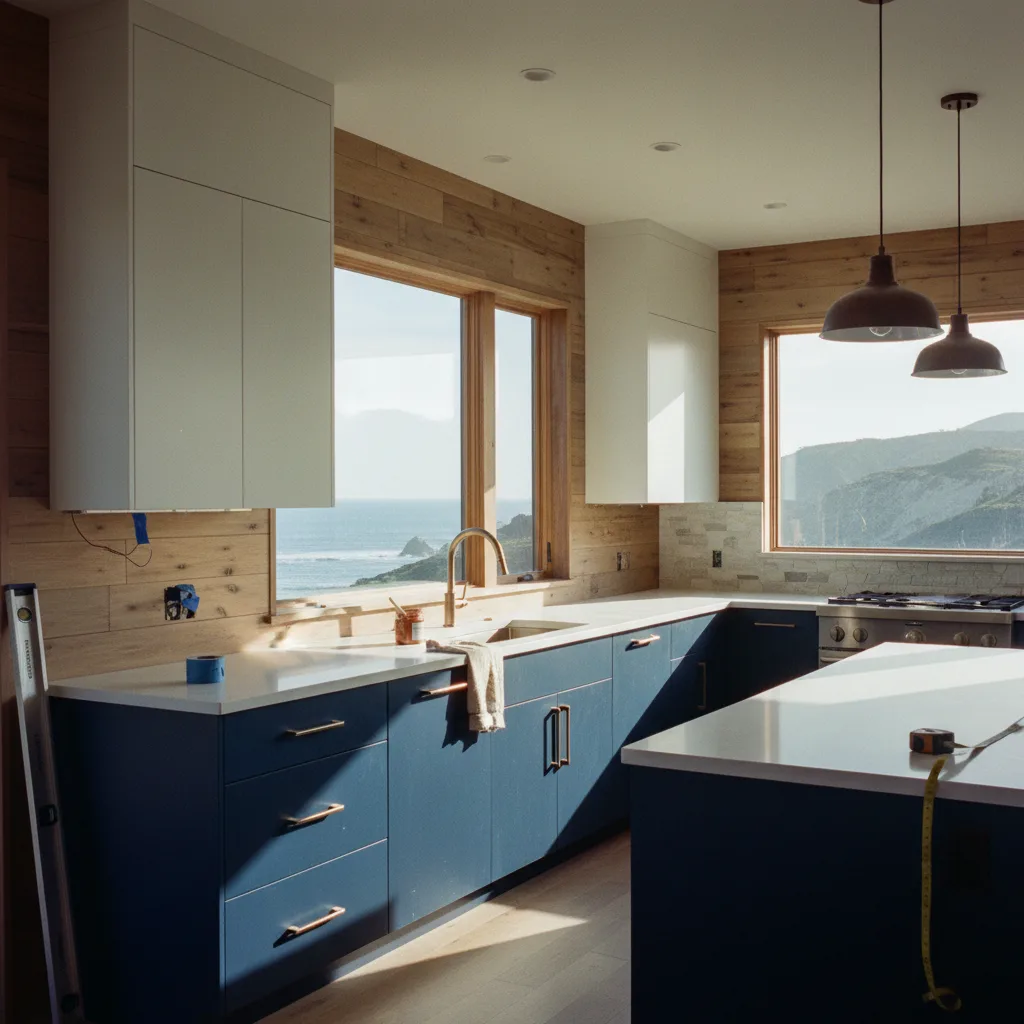
Planning a kitchen in Malibu? A full project typically runs $66,000 to $110,000 in 2026. Cosmetic refreshes start near $40,000, while premium custom work climbs well past $130,000. This is what your budget actually covers, what drives the price, and how to vet a contractor who knows Malibu permits.
The Honest 2026 Price for a Kitchen in Malibu
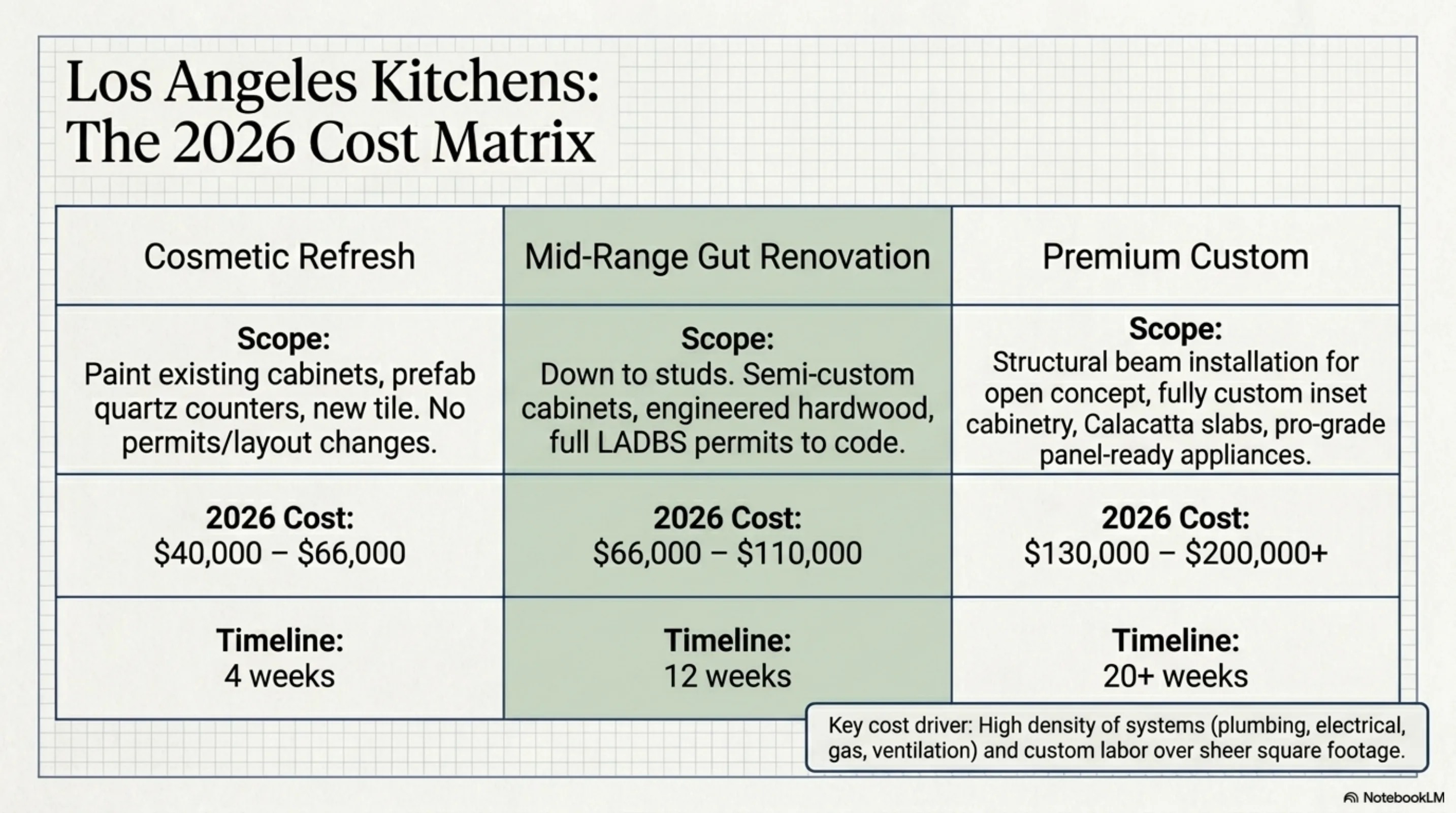
In the world of renovation, ambiguity is the enemy of a sound budget. National cost averages are a poor compass for a market as distinct as Malibu. Here, the convergence of coastal regulations, discerning aesthetic standards, and high-value real estate creates a unique pricing environment. Based on our analysis of contractor invoices and permit data, a professionally managed kitchen renovation in Malibu falls into a clear spectrum. The median project, a full gut renovation with mid-to-high-end finishes, consistently lands between $66,000 and $110,000.
For homeowners focused on surface-level improvements without altering the core layout, a cosmetic refresh can be achieved for $40,000 to $66,000. This tier involves thoughtful upgrades to countertops, backsplashes, cabinet fronts, and fixtures. At the other end, a premium, custom-designed kitchen often begins at $130,000 and can easily exceed $200,000. These projects involve structural changes, bespoke cabinetry, professional-grade appliances, and statement-making materials like book-matched marble slabs.
Key takeaway
The single largest driver of budget overruns is not the choice between quartz and quartzite; it's scope creep. Finalize every design detail, from cabinet hardware to outlet placement, before a single hammer is swung. Your contract should reflect this finalized scope, with a clear process for handling any changes.
What Drives Kitchen Costs in Malibu
See what a kitchen remodel actually costs in your Malibu zip.
Take 4 questions →Understanding the anatomy of a Malibu kitchen bid is the first step toward controlling your budget. Costs are not arbitrary; they are a direct reflection of three core components: specialized labor, the quality and sourcing of materials, and the complexities of local governance.
Labor and Logistics
Malibu's geographic position and challenging topography directly influence labor costs. Contractors who serve this area command a premium due to travel time and the logistical hurdles of moving materials and crews along the Pacific Coast Highway or through winding canyon roads. According to the California Department of Industrial Relations, prevailing wages for skilled trades in Los Angeles County are among the highest in the nation. This isn't just for the general contractor; it includes the licensed electricians, plumbers, and specialized artisans required for a high-quality finish. A project on a tight, hillside lot may also require additional labor for manual material handling, further adding to the bottom line.
Materials and Finishes
This is where design intent meets the budget. While a basic ceramic subway tile might cost a few dollars per square foot, a hand-glazed zellige tile can be ten times that amount before installation. The difference between pre-fabricated cabinets and a custom, rift-cut white oak vanity with grain-matched fronts can be tens of thousands of dollars. In Malibu, the expectation for quality is high. Homeowners and designers often specify materials that require expert fabrication and installation, such as a waterfall island made from a single, honed Calacatta slab or integrated appliances from brands like Miele or Gaggenau that demand precise paneling and utility placement.
Permits and Engineering
Never underestimate the administrative costs. A simple cosmetic refresh might not require a permit, but the moment you move a gas line, alter a load-bearing wall, or change the location of plumbing fixtures, you enter the world of permits and inspections. In Malibu, this involves the City of Malibu Planning Department and, for many properties, the California Coastal Commission. Structural changes will necessitate plans stamped by a licensed engineer, adding several thousand dollars in "soft costs" before construction even begins. These non-negotiable expenses ensure your project is safe, up to code, and properly documented for future resale.
Malibu Kitchen by Tier: 3 Real Project Examples
To make these numbers tangible, let's look at three distinct project scopes we've tracked in Malibu this year. These examples illustrate how budget, timeline, and design ambition are interconnected. They represent a cosmetic refresh, a full mid-range renovation, and a premium custom build.
| Tier | Scope of Work | Cost Range | Timeline |
|---|---|---|---|
| Cosmetic Refresh | Keep existing layout. Refinish or reface cabinets, new quartz countertops, tile backsplash, new sink and faucet, updated lighting fixtures, fresh paint. No plumbing or electrical relocation. | $40,000 - $66,000 | 4 - 7 Weeks |
| Mid-Range Gut Renovation | Full demolition. New semi-custom cabinetry, new appliance suite, quartzite or high-grade quartz countertops, potentially a new island. Minor layout changes, updating plumbing and electrical within existing walls. | $66,000 - $110,000 | 8 - 14 Weeks |
| Premium Custom Build | Full demolition, often including removing walls or relocating windows. Fully custom cabinetry, professional-grade appliances (e.g., Sub-Zero, Wolf), natural stone slab countertops and backsplash, custom range hood. Significant electrical and plumbing work. | $130,000 - $200,000+ | 16 - 24+ Weeks |
Did you know
Long-lead items are the primary driver of timeline extensions. Custom cabinetry can take eight to sixteen weeks from final measurements to delivery. High-end European appliances can have similar lead times. A savvy contractor will order these items the moment the design is finalized, often before demolition begins.
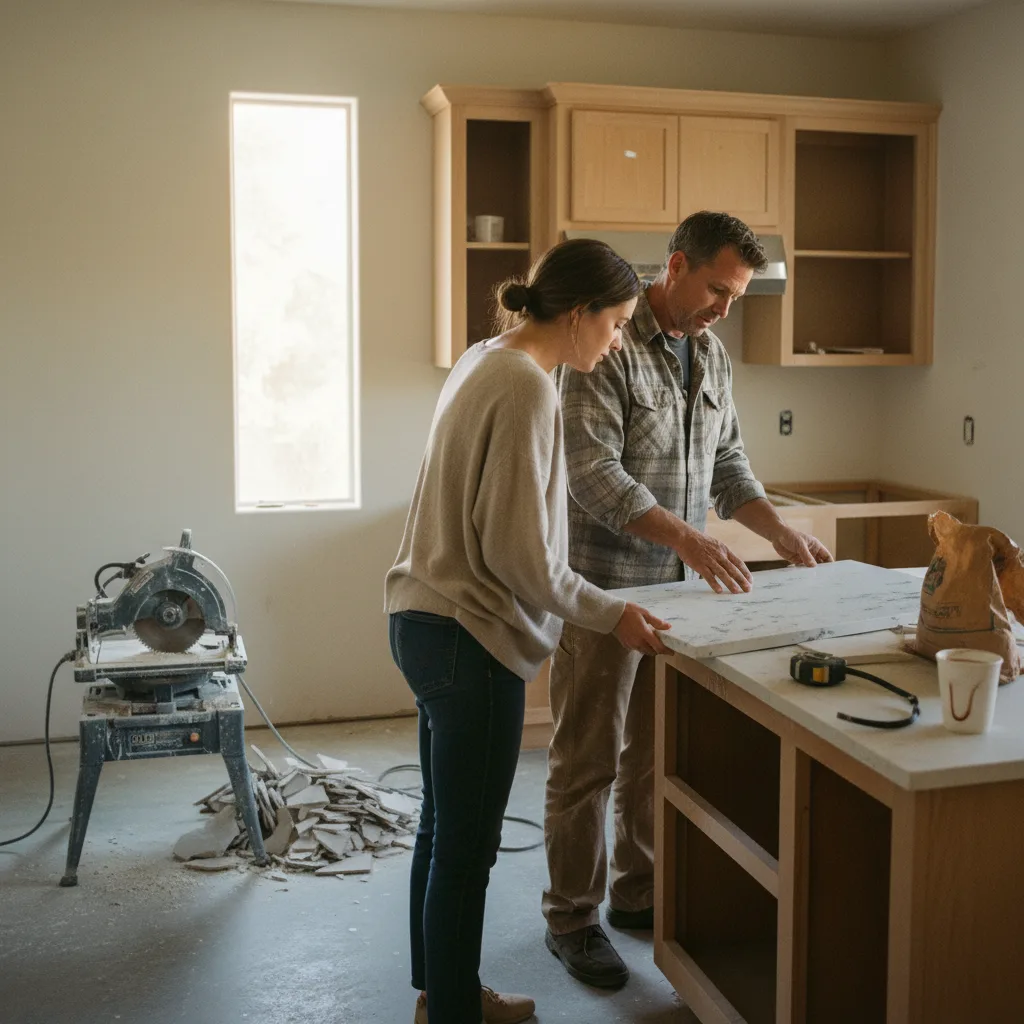
Permits and Local Code in Malibu
Navigating the permitting process in Malibu requires a contractor with specific local experience. It's not just about meeting the California Residential Code (CRC); it's about understanding the city's unique requirements and, crucially, the oversight of the California Coastal Commission (CCC) for any property within the designated Coastal Zone.
City of Malibu vs. The Coastal Commission
For a kitchen remodel, a permit from the City of Malibu Building Safety Division is typically required if you are altering structural elements, moving walls, or re-configuring plumbing, electrical, or gas lines. The city's plan checkers will review your drawings for compliance with Title 24 energy codes, which mandate things like high-efficacy lighting, and CALGreen building standards.
However, if your home is west of the Pacific Coast Highway or in another designated area, your project may also require review by the CCC. A seemingly internal kitchen remodel can trigger a Coastal Development Permit (CDP) if it is part of a larger project or involves any exterior modifications, no matter how minor. This adds another layer of review and can significantly extend the pre-construction timeline. An experienced local architect or contractor will know precisely when and how to engage with the CCC to avoid costly delays.
The best contractors in Malibu don't just build; they manage the complex dance between city hall and the Coastal Commission.
The Malibu Neighborhoods Where Kitchen Costs Diverge
While Malibu is a single city, its neighborhoods present different challenges and opportunities for a kitchen renovation. The cost and complexity of a project can vary significantly between a sprawling estate in Point Dume and a classic beach house on Carbon Beach.
Point Dume Estates
Homes in Point Dume often sit on larger lots, which simplifies material staging and parking for construction crews, potentially reducing logistical costs. However, many of these are classic mid-century or ranch-style homes. A kitchen renovation here often involves more than just aesthetics; it requires bringing ancient electrical panels and galvanized plumbing up to modern code. The goal is frequently to create a large, open-concept kitchen that flows into living spaces, which means structural work, engineering, and the associated permits are almost a given. The design brief often calls for a sophisticated but relaxed feel, with materials like cerused oak cabinetry and durable soapstone countertops.
Carbon Beach Waterfront
On "Billionaire's Beach," the constraints are entirely different. Lots are narrow and access is tight, meaning material deliveries must be meticulously scheduled. The primary design driver is the view, but the primary material consideration is the harsh marine environment. I recently walked a project on Carbon Beach where the architect specified marine-grade 316L stainless steel for all exterior-facing hardware, including window cranks and door handles adjacent to the kitchen's nano wall. Inside, finishes must be resistant to salt air corrosion. This means high-performance window coatings, durable cabinet finishes, and avoiding materials like unsealed marble that can be etched by the salty air. The cost per square foot here is amplified by the need for specialized, resilient materials and precision logistics.
In my last walkthrough in the Big Rock neighborhood, the challenge was purely logistical. The winding, narrow road meant a standard delivery truck couldn't make it to the property. The contractor had to budget for smaller trucks and extra labor to shuttle materials up the hillside, a cost that was invisible on paper but critical to the project's success. This is the kind of hyper-local knowledge you are paying for with a seasoned Malibu contractor.
Timeline: Realistic Week-by-Week Expectations
A successful renovation runs on a well-managed schedule. While every project is unique, a full mid-range kitchen remodel in Malibu generally follows a predictable pattern once permits are secured. Rushing this process is the surest path to costly mistakes.
- Weeks 1-4: Planning and Design. This is the most critical phase. You'll work with a designer or architect to finalize the layout, select all materials, and create detailed drawings for permitting and construction.
- Weeks 5-10: Permitting and Procurement. Your contractor submits plans to the City of Malibu. While waiting for approval, they will order long-lead items like custom cabinets, windows, and appliances.
- Week 11: Demolition and Site Prep. The old kitchen is carefully removed. The site is prepared for new construction, including dust barriers and floor protection. This is when surprises, like hidden plumbing issues or termite damage, are often discovered.
- Weeks 12-13: Rough-Ins and Framing. If the layout is changing, new walls are framed. Plumbers and electricians run new lines for the sink, dishwasher, outlets, and lighting. This work is inspected by the city before any walls are closed up.
- Weeks 14-15: Drywall, Flooring, and Cabinetry. Walls are closed, taped, and textured. The new flooring is installed, followed by the installation of the new cabinets. This is when the new space begins to take shape.
- Week 16: Countertop Templating and Fabrication. Once cabinets are in, the countertop fabricator creates a precise template. Fabrication typically takes seven to ten days.
- Week 17: Countertops, Backsplash, and Fixtures. The new countertops are installed, followed by the tile backsplash. The sink, faucet, and garbage disposal are connected.
- Weeks 18-19: Appliances, Lighting, and Finals. Appliances are installed and connected. Light fixtures, outlets, and switches are installed. The final coat of paint is applied. A final inspection is scheduled with the city.
- Week 20: Punch List. You and your contractor walk through the finished kitchen and create a "punch list" of any small items needing adjustment, from a sticky drawer to a paint touch-up.
How to Vet a Malibu Contractor
Choosing the right general contractor is the single most important decision you will make. In a high-stakes market like Malibu, a thorough vetting process is not optional. Look for a builder whose portfolio, communication style, and business practices align with the demands of your project.
Key Questions to Ask Potential Contractors
Go beyond asking for a price. A great partner will be able to answer these questions with confidence and detail.
- Can you show me three completed kitchens in Malibu or the surrounding coastal areas from the last 18 months?
- Who will be my primary point of contact, and who will be the on-site project manager?
- How do you handle project scheduling and communication with clients? Do you use a project management app?
- Have you ever worked on a project that required a Coastal Development Permit from the CCC? Please describe the experience.
- Can you provide a sample change order so I can understand your process and pricing structure?
- What percentage of your work comes from architect referrals versus homeowner-direct inquiries? (A high number of architect referrals is a strong signal of quality).
Red Flags to Watch For
Equally important is knowing what to avoid. The following are clear warning signs that a contractor may not be the right fit for a high-value Malibu renovation.
- An unusually low bid. This often indicates that the scope is not fully understood or that the contractor plans to make up the difference with expensive change orders.
- Vague or non-itemized estimates. A professional bid will break down costs for labor, materials, and permits.
- Pressure to sign a contract immediately or start work without a permit.
- A lack of a digital footprint or a portfolio that doesn't include work similar in style and scale to your own.
- Hesitation to provide their license number (CSLB #), insurance certificates, or references.
Pro tip
Always verify a contractor's license on the California Contractors State License Board (CSLB) website. Check for their B-General Building classification, ensure it's active, and see if there are any public complaints or disciplinary actions listed.
Renology Take
As an editor, I see hundreds of kitchen projects a year. The pattern that consistently separates the successful Malibu renovations from the stressful ones is the homeowner's early investment in planning. The most common mistake is rushing into demolition with an incomplete design and an allowance-based budget. This approach treats critical decisions, like the specific countertop slab or the exact model of the refrigerator, as afterthoughts. In reality, these choices have cascading effects on everything from electrical placement to cabinet dimensions. The smoothest projects are those where the homeowner and designer have front-loaded all decisions, producing a set of drawings so detailed that the contractor’s job becomes one of pure execution, not interpretation. In a market this complex, meticulous planning is not a luxury; it's the most effective form of risk management.
Sources & Methodology
These cost ranges are reconstructed from publicly available labor and permit data, the latest Remodeling Magazine cost-vs-value report, and Renology's own Project of the Day network, a rolling sample of real homeowner invoices we collect from Malibu-area contractors. Last refreshed April 2026.
- National Association of Home Builders (NAHB) Remodeling Market Index, Q1 2026
- California Department of Industrial Relations, Los Angeles County Prevailing Wage Data, 2026
- City of Malibu Building Safety Division Permit Data, 2026
- California Coastal Commission, Public Permit Records
- Remodeling Magazine, 2026 Cost vs. Value Report
- Renology Project of the Day Network, aggregated 2026 contractor invoices in Malibu
- California Contractors State License Board (CSLB)
Methodology
How Renology estimates kitchen costs in Malibu.
Renology treats this page as a planning benchmark for Malibu, California, not a final quote. We compare published local guide data, contractor scope patterns, permit-sensitive work, climate or site constraints, and finish-level assumptions.
Cost range
$66,000-110,000
Timeline
6-14 weeks
Source type
Editorial dataset
Local factor: Mediterranean (Köppen Csa): 14 inches annual rain, hot dry summers, mild winters. UV intensity is high year-round.
Use these numbers to shape a scope and spot missing line items. Confirm permits, structural work, electrical, plumbing, gas, waterproofing, drainage, and code-sensitive details with the local building department and a licensed professional.
Compare against the full Renology Cost IndexMalibu · pre-screened
Get 3 Malibu renovation bids in 48 hours.
Our editors already vetted Malibu contractors. Answer 4 questions and we send 3 written bids inside 48 hours, with the real price for your scope, not their inflated first-call number.
- Free, no commission
- Pre-screened locally
- Bids inside 48 hours
Takes about 60 seconds. We'll text you when bids arrive.