Building an Accessory Dwelling Unit (ADU) in Sacramento costs between $180,000 and $450,000 in 2026. The city's median project cost for a detached, 600-square-foot unit is $275,000. Costs can start lower, from $95,000 to $150,000, for simpler garage conversions or interior renovations, but this does not represent a typical new-build project.
In a Nutshell
- Total Cost Range: $180,000 to $450,000 for a new detached ADU. Garage conversions range from $95,000 to $150,000.
- Mid-Range Project Cost: A median 600 sq. ft. detached unit costs approximately $275,000, or $460 per square foot.
- Typical Timeline: Six to nine months for design and permitting, followed by six to ten months for construction. The total duration from initial design to tenant move-in is twelve to nineteen months.
- Biggest Surprise Cost: Utility connection fees. Tapping into city water, sewer, and electrical grids can cost between $8,000 and $25,000, a figure often presented late in the bidding process.
What does an ADU actually cost in Sacramento?
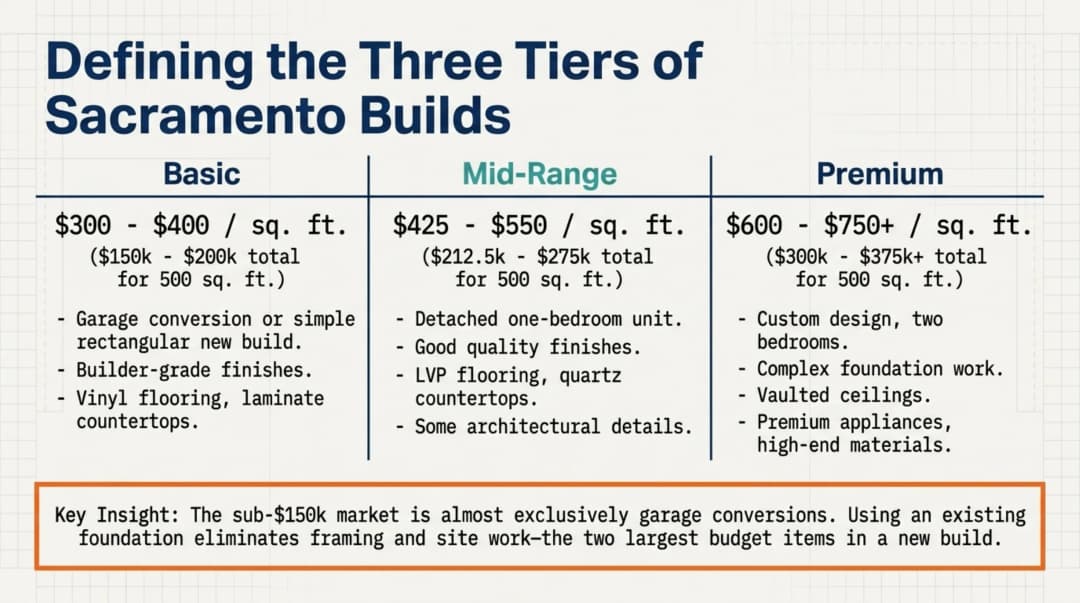
The total cost of an ADU in Sacramento is a function of size, type (detached, attached, conversion), site conditions, and finish quality. Below are three tiers of project costs homeowners can expect in 2026. These figures include design, permits, labor, and materials but exclude landscaping and high-end appliances, which can add another ten to fifteen percent.
| Project Tier | Cost / Sq. Ft. | Total Cost (500 sq. ft. unit) | Common Scope |
|---|---|---|---|
| Basic | $300, $400 | $150,000, $200,000 | Garage conversion or simple rectangular new build. Builder-grade finishes, vinyl flooring, laminate countertops. |
| Mid-Range | $425, $550 | $212,500, $275,000 | Detached unit with one bedroom. Good quality finishes, LVP flooring, quartz countertops, some architectural details. |
| Premium | $600, $750+ | $300,000, $375,000+ | Custom design, two bedrooms, high-end materials, vaulted ceilings, premium appliances, complex foundation work. |
A typical mid-range ADU project budget in Sacramento allocates funds across several categories. While every project is unique, the distribution provides a clear picture of where the money goes. Note that soft costs like design and permits make up a significant portion before construction begins.
- Design & Permits: 12%
- Site Prep & Foundation: 15%
- Framing & Roofing: 18%
- Exterior Finishes (siding, windows): 10%
- Major Systems (HVAC, electrical, plumbing): 15%
- Interior Finishes (drywall, paint, flooring): 15%
- Cabinetry & Countertops: 8%
- Fixtures & Appliances: 7%
The bottom of the cost range, specifically projects under $150,000, almost always refers to a garage conversion. These projects use an existing foundation and structure, which eliminates a substantial portion of site work and framing costs, two of the largest budget items in a new build.
Why is an ADU more expensive in Sacramento than the Central Valley?
While Sacramento is more affordable than the Bay Area, its construction costs are notably higher than in other parts of the Central Valley like Fresno or Bakersfield. Three primary factors drive this price differential: labor rates, material supply chains, and regulatory complexities combined with neighborhood-specific premiums.
First, skilled labor is more expensive. According to the California Department of Industrial Relations prevailing wage data for Sacramento County, hourly rates for residential construction trades are significantly higher than in surrounding rural counties. In 2026, a journeyman carpenter commands $65, $85 per hour, an electrician $75, $100, and a plumber $80, $110. These rates are a direct reflection of the higher cost of living and strong demand for qualified tradespeople, fueled by both public and private construction projects throughout the metro area.

Second, material costs are elevated due to supply chain logistics and regional demand. Sacramento sits at a logistical crossroads, but its proximity to the high-cost Bay Area market means it often competes for the same pool of materials, from lumber to engineered products. Suppliers price their goods based on this broader regional demand, pushing costs above what is seen further south in the valley. Fuel and transportation surcharges for deliveries also contribute to the final price tag on everything from concrete to cabinetry.
Finally, regulatory requirements and neighborhood premiums add another layer of cost. Building in established, desirable neighborhoods like East Sacramento or Land Park often comes with a premium from contractors who are accustomed to higher-end projects and more discerning clients., Sacramento has specific municipal challenges. The city’s solid tree ordinance can require expensive arborist reports and specialized foundation designs to protect root systems. California's Title 24 energy code also mandates stringent efficiency standards, requiring more expensive insulation, windows, and HVAC systems than may be required in other jurisdictions with less rigorous enforcement.
What do real Sacramento homeowners spend in 2026?
Three modeled project scenarios for 2026, built from the Renology Cost Index and typical local scopes. These are illustrative estimates, not completed client projects:
Project 1: A 450 sq. ft. Detached ADU in Tahoe Park
- Total Cost: $215,000
- Cost per Square Foot: $478
- Scope: This project involved a new-build, one-bedroom, one-bathroom detached unit on a level lot with good access. The homeowner chose mid-range finishes, including LVP flooring, quartz countertops from a local supplier, and standard appliance packages. The design was a simple rectangle to minimize complex framing and roofing costs. The foundation was a standard slab-on-grade, as soil tests came back without major issues. The largest unforeseen cost was a $4,500 electrical panel upgrade for the main house to support the new unit's load.
Project 2: A 400 sq. ft. Garage Conversion in Curtis Park
- Total Cost: $130,000
- Cost per Square Foot: $325
- Scope: This project converted a two-car detached garage into a studio apartment. The primary cost savings came from using the existing foundation and structure. However, the budget included significant work to bring the structure up to code: reinforcing the foundation, adding new shear walls for seismic stability, and running all new plumbing and electrical lines, including a sewer trench to the main line. The homeowner opted for a ductless mini-split for HVAC and selected finishes on par with the basic tier to manage costs. About $12,000 of the budget was allocated to architectural plans and structural engineering to ensure the conversion was safe and fully permitted.
Project 3: A 750 sq. ft. Attached Two-Story ADU in East Sacramento
- Total Cost: $385,000
- Cost per Square Foot: $513
- Scope: This complex project added a two-story ADU to the rear of an existing historic home. The scope included a small kitchen and living area on the ground floor and a bedroom and bathroom upstairs. The high cost was driven by several factors: the complexity of tying into the existing structure's foundation and roofline, the need to match historic exterior siding and trim, and premium interior finishes. The project also triggered a requirement for fire sprinklers in both the new ADU and parts of the main house, adding nearly $15,000 to the cost. The lot was narrow, which complicated material delivery and staging, increasing labor hours.
Where does the money actually go? The top 8 hidden costs
Contractor bids typically focus on the direct costs of construction, often referred to as "hard costs." However, a significant portion of an ADU budget, sometimes as much as 25%, is consumed by "soft costs" and other line items that are frequently omitted from initial quotes. Homeowners should budget for these expenses separately to avoid financial surprises.
- Architectural and Engineering Plans ($12,000, $22,000): A full set of plans for a custom ADU includes architectural drawings, structural engineering calculations, and potentially a Title 24 energy report. Pre-approved plans can reduce this but offer less flexibility.
- Permit and Impact Fees ($7,000, $18,000): This includes plan check fees, building permit fees, and potentially school or park impact fees, although many are waived for ADUs under 750 sq. ft. in California. Always verify current fee structures with the Sacramento Community Development Department.
- Utility Connection Fees ($8,000, $25,000): This is the cost to connect the new ADU to water, sewer, gas, and electricity. The price varies dramatically based on the distance from the main lines and the capacity of existing infrastructure. A new sewer lateral or transformer can drive this cost to the high end of the range.
- Soil and Geotechnical Reports ($2,500, $5,000): In Sacramento, where expansive clay soil is common, a soil report is often required by the city or your structural engineer. This report dictates the type of foundation needed to prevent future cracking and shifting.
- Main Electrical Panel Upgrade ($3,000, $6,000): Most older homes lack the electrical capacity to support an all-electric ADU. Upgrading the main service panel from 100 amps to 200 amps is a common and necessary expense.
- Landscaping and Hardscaping ($5,000, $15,000): The contractor's bid usually ends at the ADU's foundation. It does not include replacing the lawn, adding a walkway, building a patio, or installing fencing for privacy.
- Fire Sprinkler System ($5,000, $12,000): If your ADU is attached to your primary residence or if the primary residence has sprinklers, you will likely be required to install them in the ADU. This involves specialized plumbing and equipment.
- Arborist Report and Tree Protection ($1,500, $4,000): If your project is near a protected tree, the city will require a certified arborist's report and a tree protection plan, which adds costs for consultation and special fencing during construction.
What stops a Sacramento ADU from running over budget?
3 Sacramento ADU builders, editor-screened. 4 questions.
See my 3 matchesBudget overruns on ADU projects are common, but they are not inevitable. They typically stem from three main sources: an incomplete scope of work, unforeseen site conditions, and homeowner-driven changes during construction. Proactive planning is the only effective mitigation.
First, an ill-defined scope of work is the leading cause of cost increases. A low-ball bid from a contractor often relies on vague specifications. When the homeowner later requests specific items they assumed were included, like a particular type of window or extra outlets, these are treated as change orders with significant markups. A detailed scope, specifying every material from the foundation mix to the doorknobs, is essential to secure a fixed-price contract.
Second, unforeseen site conditions can derail a budget. In Sacramento, this often relates to expansive clay soil requiring a more solid and expensive foundation, or discovering old, undocumented plumbing lines during trenching. While these cannot always be predicted, a thorough site investigation, including soil testing, can identify many potential issues before construction starts. The National Association of Home Builders recommends a ten to fifteen percent contingency on renovations in homes over thirty years old. For a new-build ADU, a contingency fund of at least ten percent is prudent for these exact situations.
Third, homeowner changes mid-project are the most controllable but often most expensive cause of overruns. Deciding to move a wall, upgrade tile, or change the kitchen layout after construction has begun creates a cascade of costs. It involves not just the new materials but also deconstruction, re-ordering, and labor delays that ripple through the project schedule. Locking in all design and material decisions before breaking ground is the most effective way to protect your budget.
Securing Permits for a Sacramento ADU
The permitting process is a critical phase that can influence both the timeline and budget of your ADU project. In Sacramento, the primary authority for permits is the Sacramento Community Development Department. Navigating their requirements demands careful preparation and a complete set of documents. The typical process involves submitting architectural plans, structural engineering calculations, energy compliance forms (Title 24), and sometimes a site survey or soil report.
The city offers a streamlined process for ADUs, adhering to state laws that mandate quicker review times. As of 2026, California law requires municipalities to approve or deny an ADU permit application within sixty days of submission. However, this clock only starts once the application is deemed complete. An incomplete submission can lead to weeks or months of back-and-forth corrections, known as plan check comments. Hiring an experienced architect or a design-build firm familiar with Sacramento's specific codes and submission portal is critical for a smooth process.
For a detailed breakdown of the required forms, inspection schedules, and strategies for accelerating your application, see our comprehensive guide: The Sacramento ADU Permit Playbook 2026. Understanding these steps can prevent costly delays and ensure your project starts on the right foot.
What should your Sacramento ADU contractor include in the quote?
A detailed, line-item quote is a hallmark of a professional contractor and your best tool for comparing bids accurately. A vague proposal is a red flag. Your quote from an adu contractor in Sacramento should be a comprehensive document that breaks down the project into clear phases and material allowances. Insist that any bid includes the following fourteen items at a minimum:
- Detailed Scope of Work: A narrative description of the entire project, from site prep to final cleaning.
- Site Preparation: Costs for demolition, grading, excavation, and utility trenching.
- Foundation: Type of foundation (e.g., slab-on-grade, post-tensioned), concrete yardage, and rebar specifications.
- Framing: All labor and material costs for walls, floors, and roof structure.
- Exterior Finishes: Siding, roofing, windows, and exterior doors, with specific brands and models listed.
- Plumbing: All rough-in and finish plumbing, including fixtures and water heater type.
- Electrical: All rough-in and finish electrical, including the main panel, outlets, switches, and light fixtures.
- HVAC System: The specific type and size of the heating and cooling system (e.g., ductless mini-split).
- Insulation: Type and R-value for walls, ceiling, and floors, meeting Title 24 requirements.
- Interior Finishes: Drywall, paint (number of coats), flooring, trim, and interior doors.
- Cabinetry and Countertops: A specific allowance or the exact product selection for kitchen and bath.
- Project Management Fees: The contractor's overhead and profit, usually listed as a percentage.
- Payment Schedule: A clear breakdown of payment amounts tied to specific project milestones.
- Warranty Information: Details on the warranty for both labor and materials.
Information Gain: Navigating Sacramento's Tree Canopy and Foundation Challenges
National ADU cost estimators fail to account for two significant and expensive local factors in Sacramento: its expansive clay soil and its cherished urban tree canopy. Ignoring these can add tens of thousands of dollars to a project or halt it entirely.
Sacramento Valley's geology is dominated by expansive clay soil. This type of soil swells dramatically when it absorbs water and shrinks as it dries, exerting immense pressure on foundations. A standard slab-on-grade foundation, common in many parts of the country, is often insufficient here and can lead to severe cracking and structural failure within years. A geotechnical report ($2,500, $5,000) is the first step to understanding the specific conditions on your property. Based on its findings, a structural engineer will likely specify a more solid foundation system. This could be a post-tensioned slab, which uses a grid of steel cables to hold the concrete in compression, or a raised foundation with drilled concrete piers that anchor the structure deep into more stable soil layers. These engineered solutions add $15,000 to $30,000 to the foundation cost compared to a simple slab but are non-negotiable for long-term stability.
Second, Sacramento's identity as the "City of Trees" is codified in a strict tree ordinance. The city's Urban Forestry division protects trees based on their size and species. If your proposed ADU is located within the dripline of a "protected tree," you will face significant hurdles. You must hire a certified arborist to create a tree protection plan ($1,500, $4,000), which may require project redesigns to move the foundation farther from the root zone. Construction requires establishing a fenced Tree Protection Zone (TPZ), and foundation work may need to be done with hand tools or specialized equipment to avoid root damage. In some cases, the presence of a large heritage oak or elm can dictate the only possible location for an ADU or make the project infeasible. This is a critical due-diligence item that should be investigated before spending money on design.
ADU Financing and Resale Value in Sacramento
The financial case for an ADU in Sacramento rests on two pillars: the cost to build versus the long-term value it generates, either through rental income or increased property value. Understanding both is key to making a sound decision.
For financing, homeowners typically use one of four methods: a cash-out refinance on their primary mortgage, a Home Equity Line of Credit (HELOC), a construction loan, or cash savings. A cash-out refinance or HELOC are often the most straightforward, as they use existing home equity. Construction loans are another option, where a lender disburses funds in stages as the project hits milestones, but they involve more paperwork and higher interest rates. Exploring financing with a local credit union can often yield favorable terms, as they are familiar with the regional real estate market.
From a resale perspective, the return on cost is strong. While Remodeling Magazine's Cost vs. Value report does not track ADUs specifically, comparable projects like major kitchen remodels in the Pacific region recoup over 86% of their cost. An ADU, being a functional, income-generating dwelling, typically performs even better. A 2021 study by the National Association of Realtors found that properties with an ADU can see a value increase of 20% to 35%. For a median Sacramento home, a $275,000 ADU could add $150,000 to $250,000 in value at sale, making it a nearly break-even proposition before accounting for rental income.
The primary value, however, is the income stream. As of 2026, a new one-bedroom ADU in a desirable Sacramento neighborhood rents for $1,800 to $2,400 per month. A $275,000 ADU financed over thirty years might have a monthly payment of $1,500. The positive cash flow makes the project self-sustaining and builds equity over time.
Finding the Right ADU Contractor in Sacramento
Selecting the right builder is the single most important decision you will make for your ADU project. A qualified, experienced contractor can work through the complexities of local regulations, manage subcontractors effectively, and deliver a high-quality product on time and on budget. An unqualified one can lead to costly delays, poor workmanship, and legal disputes.
First, verify credentials. Any contractor you consider must have a valid California State License Board (CSLB) license. You can check the license status, bond, and workers' compensation insurance history online. Look for a General Contractor (B-license) with specific, demonstrable experience building ADUs in the Sacramento area. Ask to see a portfolio of at least three completed ADU projects and speak with the homeowners about their experience.
Second, look for a specialist. An ADU is not a simple shed; it's a small house with all the complex systems of a larger one. A contractor who specializes in ADUs will be more familiar with the unique challenges, such as utility connections, compact space design, and the specific requirements of the Sacramento Community Development Department. They will have established relationships with architects, engineers, and subcontractors who also specialize in this type of construction, creating a more efficient process.
Finally, evaluate their business practices. A professional contractor provides a detailed, itemized bid, a clear payment schedule tied to milestones, and a formal contract that includes a warranty. Be wary of contractors who demand large upfront payments, provide vague quotes, or pressure you to sign a contract immediately. Thorough vetting is your best protection against a negative outcome.
Sources & Methodology
See the Renology Methodology for how sources are reviewed, ranges are normalized, and planning-data limits are handled.
Cost ranges in this guide draw on the following named industry sources, public agency datasets, and Renology editorial research.
- California Department of Industrial Relations, Sacramento County Prevailing Wage Data (2026)
- Remodeling Magazine, 2025 Cost vs. Value Report (Pacific Region) (2025)
- City of Sacramento Community Development Department, Permit Fee Schedule (2026)
- National Association of Home Builders (NAHB), Housing Market Index (Q1 2026)
- U.S. Census Bureau, Building Permits Survey (2025)
- Zillow Rental Market Trends, Sacramento CA (Q1 2026)
- California HCD, Accessory Dwelling Unit Handbook (2025)
- Renology Project of the Day (POTD) Network, Sacramento Metro Data (2024-2026)
- National Association of Realtors (NAR), "The Comeback of the In-Law Unit" Report (2021)
- City of Sacramento Urban Forestry, Tree Ordinance Guide (2025)
Renology Take
Homeowners consistently underestimate the proportion of an ADU budget consumed by soft costs and site work. The allure of a per-square-foot construction number is misleading because it omits the substantial expenses incurred before a single 2x4 is cut. Architectural plans, structural engineering, soil reports, city permits, and utility connection fees can easily account for 20 to 25 percent of the total project cost. For a $300,000 project, this means $60,000 to $75,000 is spent before breaking ground.
This front-loaded cost structure creates a common point of failure. Homeowners, anchored to an artificially low construction estimate, exhaust their initial budget on these prerequisites, leaving them with insufficient funds to complete the build as designed. The meta-pattern is a failure to budget for the project as a whole. A successful ADU project requires a comprehensive, all-in budget from day one, treating the pre-construction phase with the same financial diligence as the physical build itself.
Frequently Asked Questions
How much value does an ADU add to a property in Sacramento?
What are the biggest factors affecting ADU cost in Sacramento?
Can I build an ADU myself (DIY) to save money in Sacramento?
How long does it take to get ADU permits in Sacramento?
Are pre-fab or modular ADUs cheaper in Sacramento?
What are the typical monthly rental incomes for ADUs in Sacramento?
Do I have to pay impact fees for my Sacramento ADU?
What are the new 2026 state laws affecting ADUs in Sacramento?
Sacramento · pre-screened
Get 3 Sacramento ADU bids in 48 hours.
Our editors already vetted Sacramento ADU builders. Answer 4 questions and we send 3 written bids inside 48 hours, with the real price for your scope, not their inflated first-call number.
- Free, no commission
- Pre-screened locally
- Bids inside 48 hours
Takes about 60 seconds. We'll text you when bids arrive.
Sources
- California Department of Industrial Relations, Sacramento County Prevailing Wage Data
- Remodeling Magazine, 2025 Cost vs. Value Report (Pacific Region)
- City of Sacramento Community Development Department, Permit Fee Schedule
- National Association of Home Builders (NAHB), Housing Market Index
- U.S. Census Bureau, Building Permits Survey
- Zillow Rental Market Trends, Sacramento CA
- California HCD, Accessory Dwelling Unit Handbook
- Renology Project of the Day (POTD) Network, Sacramento Metro Data
- National Association of Realtors (NAR), "The Comeback of the In-Law Unit" Report
- City of Sacramento Urban Forestry, Tree Ordinance Guide