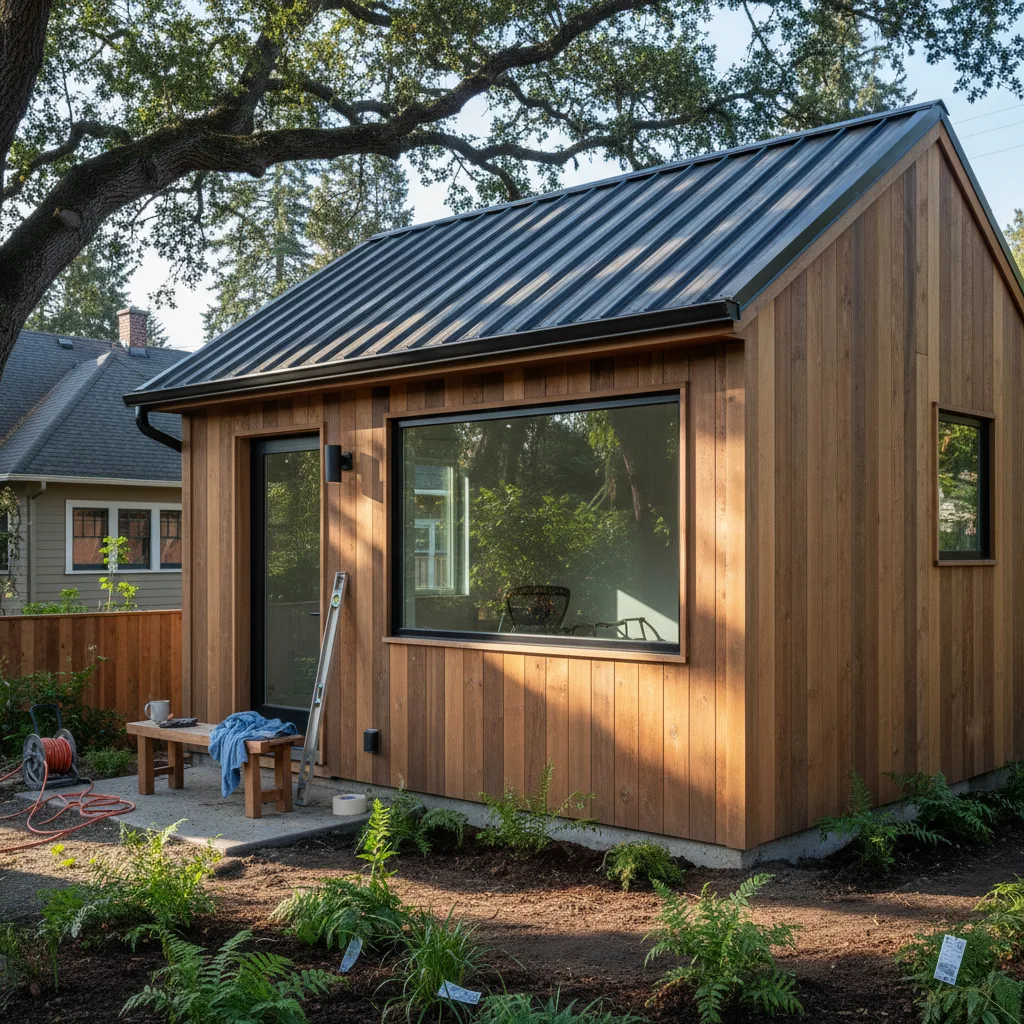
Planning an ADU or garage conversion in Oakland? A full project typically runs $235,000 to $415,000 in 2026. Cosmetic garage updates start near $140,000, while premium custom ADUs can climb past $500,000. Here is what your budget actually covers, what drives the price, and how to find a contractor who understands Oakland's unique building landscape.
The Honest 2026 Price for an ADU or Garage Conversion in Oakland
Let's get straight to the point. Adding a standalone Accessory Dwelling Unit (ADU) or converting your garage into living space in Oakland is a significant investment. Based on our analysis of contractor invoices and permit data, a standard, all-in project lands between $235,000 and $415,000. This range covers a new-construction ADU of about 500 to 800 square feet or a comprehensive garage conversion that includes new foundation work, plumbing, and electrical services.
Can you spend less? Yes. A simple cosmetic garage refresh, think new drywall, flooring, and an upgraded garage door without adding a bathroom or kitchen, can be done for $140,000 to $235,000. On the other end of the spectrum, a high-end, custom-designed ADU with premium finishes, complex architectural details, and extensive site work can easily exceed $500,000. The final number on your contract is a direct result of scope, site conditions, and material choices, not a vague per-square-foot estimate you found online.
Key takeaway
National cost estimators are often 15 to 30 percent too low for the Bay Area. They don't account for our high labor costs, seismic building codes, and the specific logistical challenges of building on Oakland's varied terrain. Use local data for your budget planning.
What Really Drives ADU and Garage Costs in Oakland
See what a ADU build actually costs in your Oakland zip.
Take 4 questions →The price tag isn't arbitrary. It’s a formula of labor, materials, and local compliance costs. Understanding these components helps you see where your money is going and where you might have flexibility.
Skilled Labor Costs
This is the largest single component of your budget, often accounting for 40 to 50 percent of the total cost. The Bay Area has some of the highest skilled labor rates in the country, a reflection of the high cost of living and strong demand. A quality general contractor is managing a team of specialized subcontractors: foundation crews, framers, electricians, plumbers, and roofers. Their expertise and coordination are what you're paying for. Attempting to manage these trades yourself to save money is a false economy for most homeowners and often leads to costly delays and mistakes.
Materials and Finishes
Material costs fluctuate with supply chain dynamics, but they consistently make up 30 to 40 percent of the project total. Your choices here have a massive impact on the final price.
- Structural Materials: Lumber, concrete for the foundation, seismic hardware, insulation, and roofing. These are largely non-negotiable and dictated by your plans and code requirements.
- Exterior Finishes: Siding options range from cost-effective fiber cement to pricier stucco or wood. Window and door packages can vary in price by thousands of dollars depending on material (vinyl, wood, aluminum) and energy efficiency ratings.
- Interior Finishes: This is where you have the most control over the budget. Flooring, tile, cabinetry, countertops, light fixtures, and appliances can range from builder-grade basics to high-end custom pieces. A standard appliance package might cost $5,000, while a luxury suite can run over $25,000.
Permits, Fees, and Site-Specific Requirements
The "soft costs" of a project can surprise homeowners. In Oakland, this bucket includes architectural and engineering plans, soil reports, and city permit fees. For an ADU, you can expect these to total $15,000 to $30,000 before any construction begins. Key factors include:
- Plan Check and Permit Fees: Calculated by the Oakland Planning & Building Department based on project valuation.
- Utility Connection Fees: Tapping into water, sewer, and electrical grids isn't free. These fees can be substantial, especially if your project requires a new service line or panel upgrade.
- Geotechnical and Structural Engineering: Almost always required for new foundations, especially on the sloped lots common in many parts of Oakland. A soil report and the corresponding foundation engineering can add $5,000 to $10,000.
- Seismic Retrofitting: California's building codes are strict for a reason. Your project will require specific hardware, shear walls, and foundation bolting to meet current earthquake safety standards.
Oakland ADU & Garage Projects by Tier: 3 Real Examples
To make the numbers tangible, let's look at three common project scopes we see in Oakland. These are composites based on real contractor bids from the Renology network. Your project will vary, but these provide a realistic baseline for what's possible at each budget level.
| Tier | Typical Scope | Cost Range (2026) | Timeline (Post-Permit) |
|---|---|---|---|
| Cosmetic Garage Update | Converting an existing, structurally sound garage. No new plumbing. Includes new insulation, drywall, flooring, lighting, and an upgraded garage door. Creates a finished office, gym, or studio space. | $140,000 - $235,000 | 12-16 weeks |
| Mid-Range ADU or Full Conversion | A full garage conversion with a new bathroom and kitchenette, or a new-construction, 500-800 sq. ft. detached ADU. Standard-grade finishes, pre-approved city plans or a simple custom design, and straightforward utility connections. | $235,000 - $415,000 | 32-56 weeks |
| Premium Custom ADU | A custom-designed 800-1,200 sq. ft. ADU with architect involvement. High-end finishes, custom cabinetry, vaulted ceilings, complex foundation work on a sloped lot, and premium window and door packages. | $500,000 - $745,000+ | 48-64 weeks |
Navigating Permits and Local Code in Oakland
Every significant construction project lives and dies by the permit process. In Oakland, your plans will be reviewed by the Oakland Planning & Building Department. While the state of California has passed laws to streamline ADU approval, the process is still detailed and requires professional oversight.
The Plan Check Process
Before you can break ground, your architect or designer will submit a full set of plans for review. The city's plan checkers will scrutinize them for compliance with a host of regulations. This isn't just a rubber stamp; it's a critical review to ensure the structure will be safe, accessible, and energy-efficient. Expect comments and revisions. A good design professional anticipates these and addresses them proactively, but a back-and-forth with the city is a normal part of the process and a key reason why the pre-construction phase can take several months.
Key Regulations to Know
Your contractor should be an expert in these, but it helps to know the language.
- California Building Code (CBC): This governs all structural aspects, including the stringent seismic requirements for foundations, framing, and connections that are mandatory in our earthquake-prone region.
- California Title 24: These are the state's energy efficiency standards. For your ADU, this means specific requirements for insulation, window U-factor and SHGC ratings, high-efficacy lighting, and potentially "cool roof" materials.
- Oakland's Local Ordinances: The city has its own rules regarding ADU size, height, setbacks from property lines, and aesthetic requirements that may apply in certain zoning districts. State law provides a baseline, but local rules still matter.
Pro tip
Ask your potential contractor if they have submitted ADU plans to the Oakland Planning & Building Department in the last 12 months. An experienced local builder will understand the nuances of the Oakland review process and have relationships with city staff, which can help resolve issues more efficiently.
How Oakland Neighborhoods Change the Math on Your Project
Oakland isn't a monolith. The geology, lot size, and age of housing stock vary dramatically from one neighborhood to the next, and this directly impacts the cost and complexity of an ADU or garage project. A flat lot in a newer development is a completely different animal from a hillside lot with a 100-year-old main house.
Rockridge and North Oakland
In neighborhoods like Rockridge, you're dealing with older homes on relatively small, flat lots. The primary challenges here are access and infrastructure.
- Lot Constraints: With smaller setbacks, fitting even a modest ADU can be a puzzle of zoning compliance. Construction access for excavation equipment and material delivery can be tight, driving up labor costs.
- Aging Infrastructure: The sewer lateral for a 1920s bungalow may not have the capacity to support a new dwelling unit. Tying into century-old plumbing and electrical systems often requires significant, and sometimes unexpected, upgrades to the main house's infrastructure to bring everything up to current code.
The Oakland Hills
Building in Montclair, Piedmont Pines, or other parts of the Oakland Hills introduces a completely different set of challenges, primarily related to topography and fire safety.
- Sloped Lots: A sloped lot means one thing: expensive foundation work. It requires a geotechnical report to analyze soil stability and extensive engineering for a stepped foundation, retaining walls, or even piers and grade beams. This can add $50,000 or more to a project compared to a flat-lot build.
- Fire Safety Codes: Much of the Hills is designated as a Wildland-Urban Interface (WUI) area. This triggers strict building code requirements for fire-resistant materials, including non-combustible siding, multi-pane tempered glass windows, and specific types of roofing and vents. These materials are more expensive and require specialized installation.
I was on a site walk in the Montclair hills last quarter for a proposed ADU. The homeowner had a budget based on a simple slab-on-grade foundation. But after the geotechnical engineer took soil borings, the report came back requiring a series of 15-foot-deep concrete piers to anchor the structure to stable bedrock. That single report changed the foundation cost from $40,000 to over $100,000. This is the reality of hillside construction; the ground beneath your feet dictates the first, and often most expensive, part of the budget.
Timeline: A Realistic Week-by-Week Look at an Oakland ADU Build
A contractor might tell you "32 to 56 weeks," but what does that actually look like? The total duration from your first call to moving in is often closer to a year. Here’s a more realistic breakdown of a standard ADU project timeline.
Phase 1: Pre-Construction (12-20 weeks)
- Weeks 1-4: Design and Contractor Selection. You'll finalize your layout, select a contractor, and sign a contract.
- Weeks 5-12: Plan Development and Engineering. Your architect or designer creates detailed construction documents. A structural engineer designs the foundation and framing.
- Weeks 12-20: Permit Submission and Review. The plans are submitted to the Oakland Planning & Building Department. This is often the most variable part of the timeline. A simple plan might get approved in six weeks; a complex one with required revisions could take four months or more.
Phase 2: Construction (20-36 weeks)
- Weeks 21-24: Site Prep and Foundation. Excavation, grading, utility trenching, and pouring the concrete foundation. This phase is heavily weather-dependent.
- Weeks 25-28: Framing and Roofing. The skeleton of your ADU goes up. Walls, floor joists, and roof trusses are installed, followed by sheathing and the roof itself.
- Weeks 29-34: Rough-Ins and Insulation. This is the "behind the walls" work. Plumbers, electricians, and HVAC technicians run all the necessary lines. After inspection, insulation is installed.
- Weeks 35-42: Exterior and Interior Finishes. Windows, doors, and siding are installed. Inside, drywall goes up, followed by painting, flooring, tile work, and cabinet installation.
- Weeks 43-46: Fixtures and Final Touches. Countertops are installed, and plumbers and electricians return to set the final fixtures: sinks, faucets, lights, and outlets.
- Week 47: Final Inspections and Occupancy. The city building inspector conducts a final review. Once you pass, you receive your Certificate of Occupancy.
Important
This timeline assumes no major delays from supply chain issues for items like custom windows or appliances, which can add weeks or even months to the schedule. A good contractor will order these long-lead items as soon as the plans are finalized.
How to Vet an Oakland ADU and Garage Contractor
Choosing the right general contractor is the single most important decision you will make. A great one will guide you through the process, while a bad one can turn your project into a financial and emotional nightmare.
The cheapest bid is often the most expensive one by the end of the project.
Key Questions to Ask
When you interview potential contractors, go beyond "how much" and "how long."
- "How many ADUs or garage conversions have you completed in Oakland in the last two years?" You want a specialist, not a generalist who does one ADU every few years.
- "Can I speak with your last three ADU clients?" Talk to them. Ask about communication, budget adherence, and how problems were handled.
- "Show me your license and proof of insurance." Verify their license on the California Contractors State License Board (CSLB) website. Ensure they have both General Liability and Workers' Compensation insurance.
- "Who is my day-to-day point of contact and project manager?" You need to know who is responsible for being on-site and answering your questions.
- "How do you handle change orders?" Changes are inevitable. A professional will have a clear, written process for pricing and approving any work that falls outside the original contract.
Red Flags in a Bid
A bid is a reflection of a contractor's professionalism. Watch out for these warning signs.
- Vague or Incomplete Scope of Work: If the bid says "Install new flooring" instead of specifying the exact make, model, and square footage, that's a red flag. A detailed, itemized bid prevents misunderstandings.
- Unusually Low Price: A bid that's significantly lower than others often means something has been left out, corners will be cut, or the contractor is financially unstable. They plan to make up the difference with expensive change orders.
- High-Pressure Sales Tactics: A good contractor is busy. They won't pressure you to sign a contract on the spot or offer a "special price" that's only good for today.
- Requesting a Large Upfront Deposit: California law limits deposits to 10% of the contract price or $1,000, whichever is less. A contractor asking for more is breaking the law and is a major red flag.
The Renology Take
As an editor who spends time on job sites, I see a recurring pattern homeowners miss when budgeting for an ADU or garage conversion. They focus almost exclusively on the structure itself: the cost of framing, the price of cabinets, the square footage. They consistently underestimate the cost of everything that happens before the first wall goes up. Site work is not an afterthought; it is a foundational cost. In Oakland, this means budgeting for the very real possibility of extensive grading, a complex engineered foundation for a hillside lot, or the five-figure surprise of replacing an old sewer line that can’t handle the new load. The most successful projects I see are the ones where the homeowner budgets a healthy 15 to 20 percent contingency fund specifically for these unknowns, especially the ones buried underground.
Sources & Methodology
These cost ranges are reconstructed from publicly available labor and permit data, the latest Remodeling Magazine cost-vs-value report, and Renology's own Project of the Day network, a rolling sample of real homeowner invoices we collect from Oakland-area contractors. Last refreshed April 2026.
- National Association of Home Builders (NAHB) Remodeling Market Index, Q1 2026
- California Department of Industrial Relations, Alameda County Prevailing Wage Data, 2026
- Oakland Planning & Building Department Permit Fee Schedule, 2026
- Remodeling Magazine, 2026 Cost vs. Value Report
- California Contractors State License Board (CSLB)
- California Building Standards Commission (Title 24)
- Renology Project of the Day Network, aggregated 2026 contractor invoices in Oakland
Methodology
How Renology estimates adu / garage conversion costs in Oakland.
Renology treats this page as a planning benchmark for Oakland, California, not a final quote. We compare published local guide data, contractor scope patterns, permit-sensitive work, climate or site constraints, and finish-level assumptions.
Cost range
$235,000-415,000
Timeline
32-56 weeks
Source type
Editorial dataset
Local factor: Mediterranean cool-marine: 22 inches annual rain, mild year-round with persistent fog, narrow temperature swings.
Use these numbers to shape a scope and spot missing line items. Confirm permits, structural work, electrical, plumbing, gas, waterproofing, drainage, and code-sensitive details with the local building department and a licensed professional.
Compare against the full Renology Cost IndexOakland · pre-screened
Get 3 Oakland ADU bids in 48 hours.
Our editors already vetted Oakland ADU builders. Answer 4 questions and we send 3 written bids inside 48 hours, with the real price for your scope, not their inflated first-call number.
- Free, no commission
- Pre-screened locally
- Bids inside 48 hours
Takes about 60 seconds. We'll text you when bids arrive.