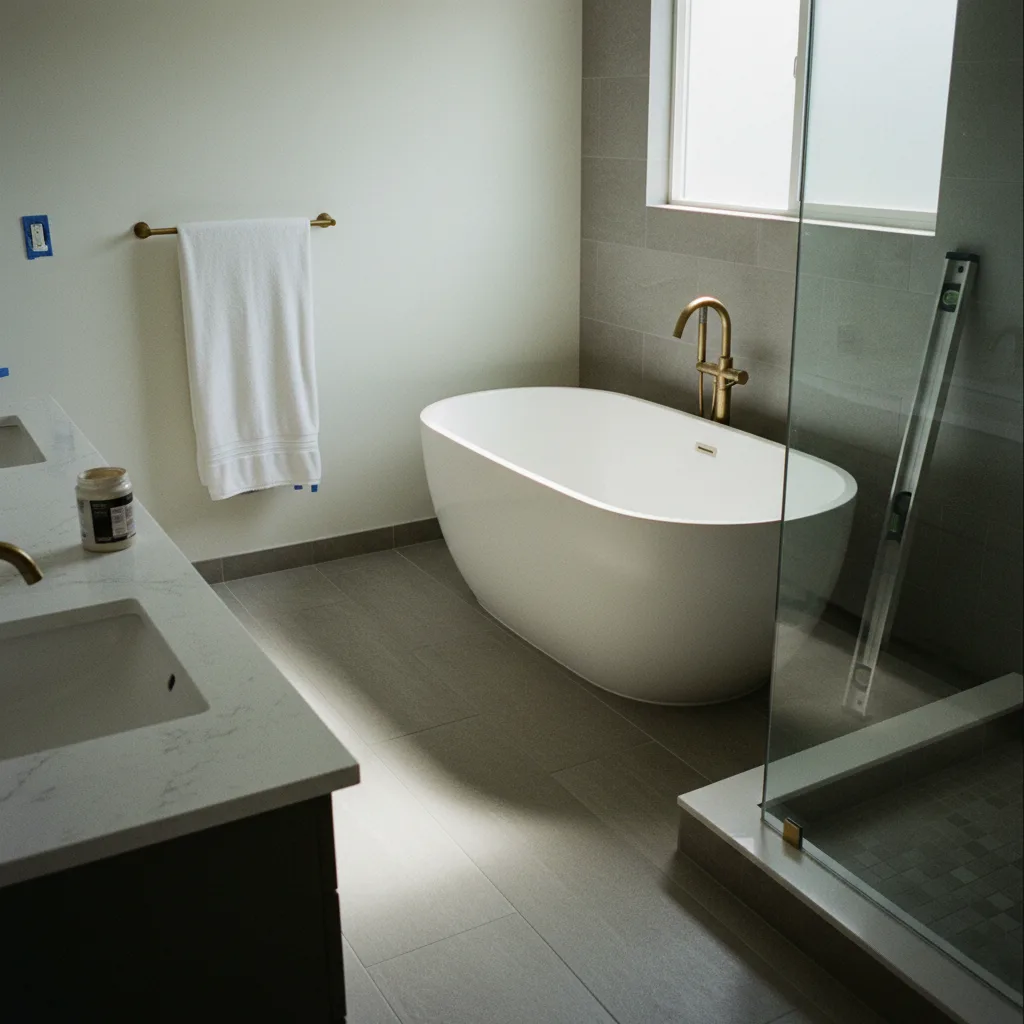
Planning a bathroom in Encino? A full project typically runs $36,000 to $60,000 in 2026. Cosmetic refreshes start near $22,000; premium custom work climbs past $72,000. This is what your budget actually covers, what drives the price up, and how to vet a contractor who knows Encino permits.
The Honest 2026 Price for a Bathroom in Encino
As the kitchens and baths editor at Renology, I review hundreds of project invoices from across Southern California. The data is clear: Encino is a premium market. The blend of high-value homes, skilled labor demand, and rigorous building codes sets a firm price floor. While national cost estimators might suggest lower figures, they often miss the nuance of the San Fernando Valley’s micro-economy. Here, a full gut renovation of a standard five-by-eight-foot bathroom rarely comes in below $35,000 once all is said and done.
The median price for a mid-range project, the most common type we see, hovers between $36,000 and $60,000. This range covers a comprehensive overhaul: new plumbing fixtures, a quality vanity, durable porcelain or ceramic tile, a new ventilation fan, and updated lighting. For projects that involve moving walls, re-routing significant plumbing, or specifying high-end materials like natural stone slabs and custom cabinetry, budgets quickly ascend into the $72,000 to $110,000+ premium tier. Understanding where your project fits is the first step toward a realistic budget and a successful outcome.
What Drives Bathroom Costs in Encino
See what a bathroom remodel actually costs in your Encino zip.
Take 4 questions →A bathroom renovation budget is a complex equation with four main variables: labor, materials, permits, and site-specific conditions. In Encino, each of these carries a significant weight, often more so than in other parts of the country.
Labor: The Price of Expertise
Skilled labor is the single largest component of an Encino bathroom budget, frequently accounting for 50 to 60 percent of the total cost. Los Angeles has some of the highest prevailing wages for trades in the nation. A licensed and insured general contractor is coordinating a team of specialists: a plumber, an electrician, a tile setter, a drywaller, and a painter. Each is a master of their craft, and their expertise is not a place to cut corners, especially when dealing with complex waterproofing and electrical work behind the walls. Expect to pay a premium for a contractor with a deep portfolio of successful projects in the immediate Encino area; they bring invaluable experience with local inspectors and building stock.
Materials and Fixtures: A Spectrum of Choice
Your material selections are the most direct way to control the budget. The difference between a pre-fabricated vanity from a big-box store and a custom-built, rift-sawn white oak piece can be thousands of dollars. The same applies to tile. A classic ceramic subway tile might cost $8 per square foot, while a Calacatta Gold marble slab for a shower wall can exceed $150 per square foot before fabrication and installation.
- Surfaces: Quartz countertops (like Caesarstone or Silestone) offer a durable, non-porous mid-range option at $80 to $120 per square foot installed. Natural stone, such as marble or quartzite, starts higher and requires more maintenance.
- Fixtures: Brands like Kohler, Moen, and Delta offer excellent mid-range options. Moving into designer lines such as Waterworks, Brizo, or Kallista can easily double or triple the cost of faucets, showerheads, and accessories.
- Lighting: A simple vanity light might be $200, but a set of designer sconces paired with recessed, high-efficacy LED lighting required by California's Title 24 code will be a more significant line item.
Permits and Administrative Overhead
Any project that alters plumbing, electrical, or structural elements requires a permit from the Los Angeles Department of Building and Safety (LADBS). The permit fees themselves are a relatively small part of the cost, usually a few hundred to a couple of thousand dollars. The real cost is in the administrative time: creating architectural plans, submitting them for review, responding to comments from the plan checker, and scheduling multiple inspections. This process adds weeks to the pre-construction timeline and requires a contractor who is methodical and communicative.
Key takeaway
The "all-in" cost of a permit isn't just the fee paid to the city. It includes the cost of architectural drawings, engineering if required, and the contractor's project management time to shepherd the plans through the system. This can add $2,500 to $5,000 to a project before a single hammer is swung.
Encino Bathroom by Tier: Three Real Project Examples
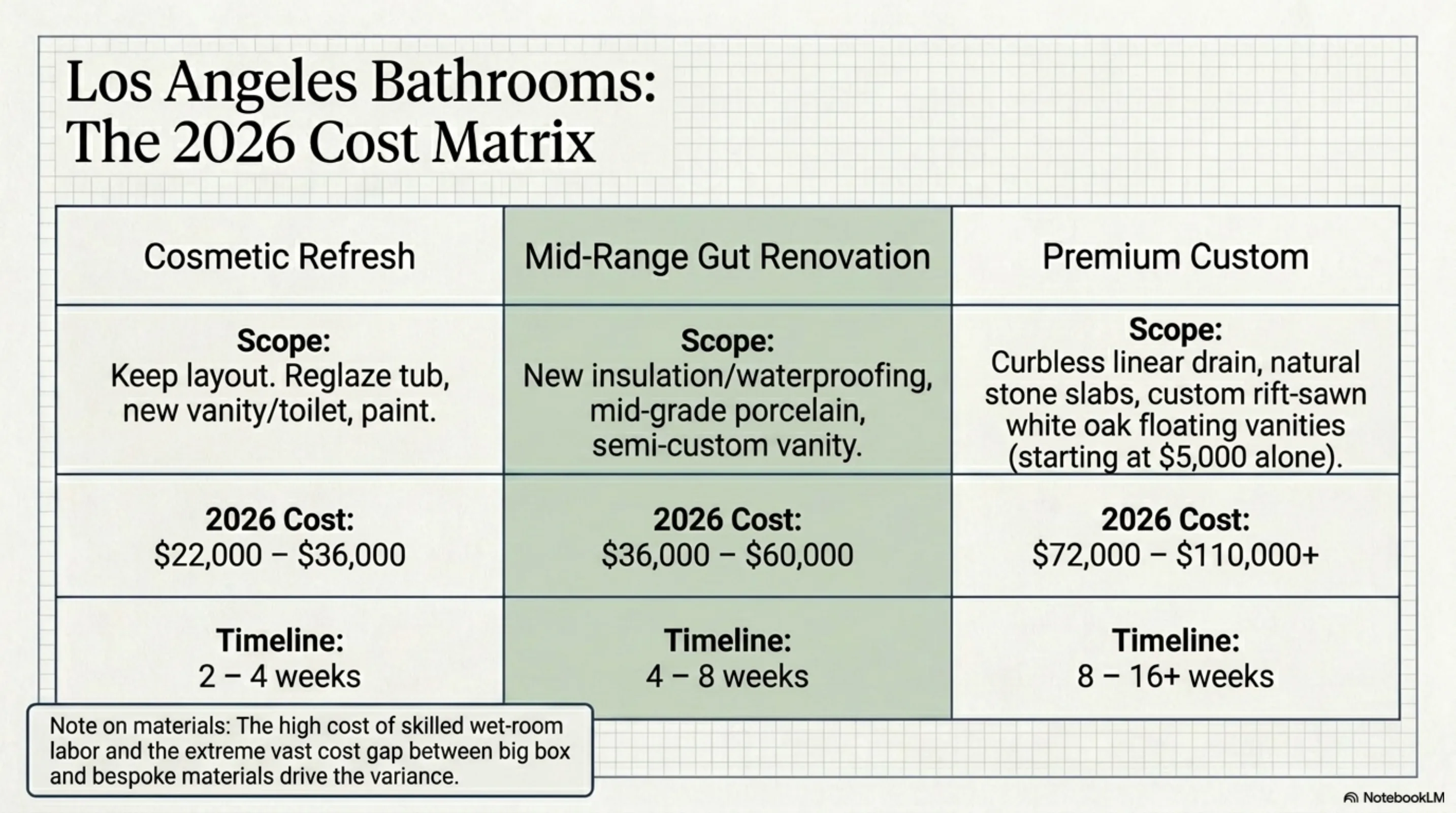
To make the numbers tangible, we've broken down three common project scopes we see in Encino. These are based on aggregated invoice data from the Renology network, showing what your budget truly buys in 2026.
| Tier | Typical Scope | Cost Range | Timeline |
|---|---|---|---|
| Cosmetic Refresh | Surface-level updates. Keep existing layout. New paint, new vanity/top, new light fixture, new faucet and shower trim. Refinish existing tub or shower tile. No plumbing or electrical moved. | $22,000 - $36,000 | 2-4 Weeks |
| Mid-Range Gut | Full demolition to studs. New plumbing and electrical in existing locations. New insulation and drywall. Full waterproofing system. New tile, tub/shower, toilet, vanity, and fixtures. New ventilation fan and lighting. | $36,000 - $60,000 | 4-8 Weeks |
| Premium Custom | Full gut with layout changes (e.g., moving a toilet or shower). May involve structural work. High-end materials like natural stone slabs, custom cabinetry, curbless shower with linear drain, steam shower, designer fixtures, smart home integration. | $72,000 - $110,000+ | 8-16+ Weeks |
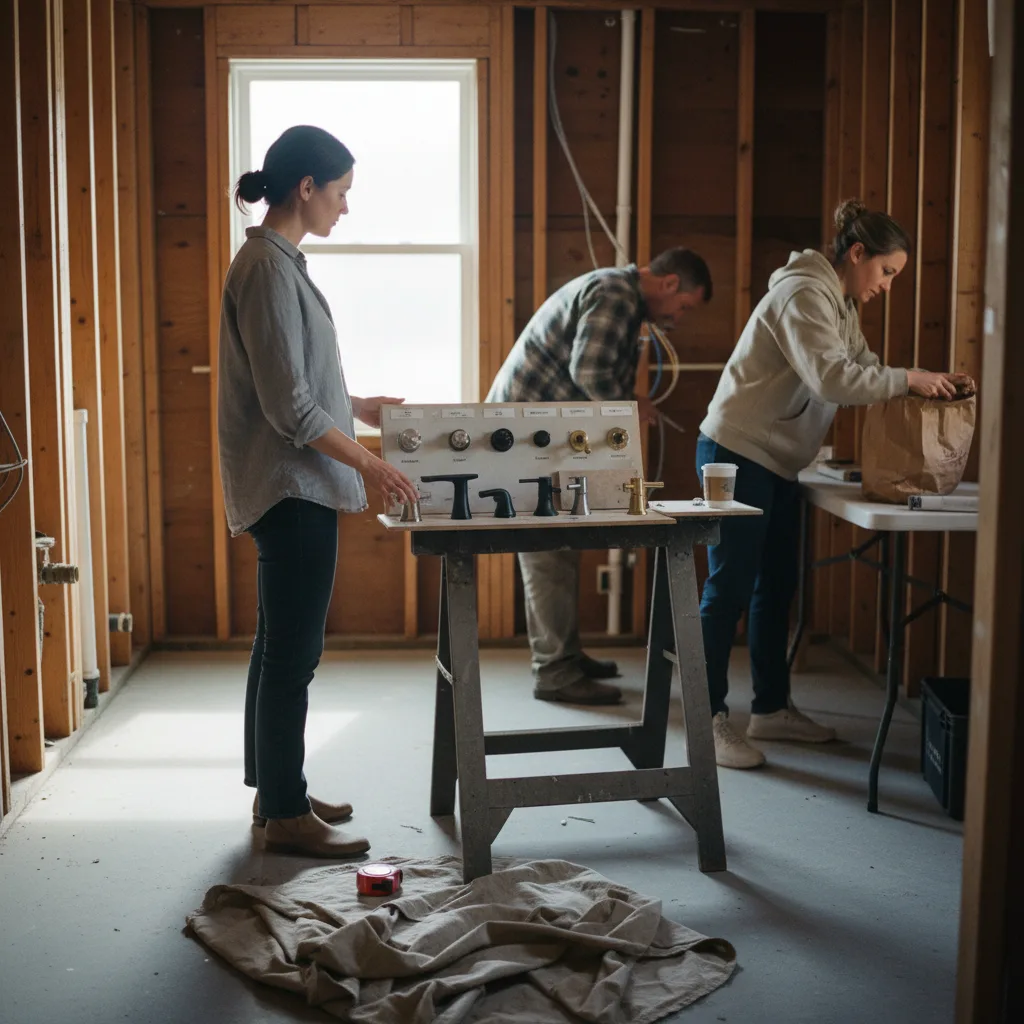
Permits and Local Code in Encino
Navigating the permitting process is a critical, and often underestimated, part of any significant bathroom remodel in Encino. As part of the City of Los Angeles, all work falls under the jurisdiction of the Los Angeles Department of Building and Safety (LADBS). Understanding their requirements is non-negotiable for a legal and safe renovation.
When a Permit is Required
A permit is triggered by more than you might think. While a simple "rip and replace" of a faucet or toilet doesn't require one, the moment you alter the systems behind the walls, you are in permit territory. This includes:
- Moving any plumbing supply or drain lines.
- Adding, moving, or altering any electrical circuit (e.g., adding a new outlet or changing the location of a vanity light).
- Relocating or removing any wall, even a non-load-bearing one.
- Installing a new window or altering the size of an existing one.
California Title 24 and CALGreen
Beyond basic safety codes, California mandates strict energy and environmental standards. For your bathroom, this primarily means adhering to Title 24 and CALGreen. Title 24 requires high-efficacy lighting, which means almost all new fixtures must be LED. It also requires that any new ventilation fan be high-efficiency and low-sones (quiet). CALGreen codes mandate the use of low-flow plumbing fixtures, including toilets, showerheads, and faucets, to conserve water. Your contractor must be fluent in these requirements and specify compliant products, as the LADBS inspector will verify them during the final inspection.
Editor's note
I've seen projects delayed for weeks because a homeowner bought a beautiful non-compliant light fixture online. Always confirm that your lighting and plumbing selections meet Title 24 and CALGreen standards with your contractor *before* purchasing.
The Encino Neighborhoods Where Bathroom Costs Diverge
Not all of Encino is built the same, and the character of your specific neighborhood can have a real impact on project complexity and cost. The sprawling ranch homes of the 1950s and 60s present different challenges than the larger custom homes built in later decades.
In my last walkthrough of a mid-century remodel in Amestoy Estates, the primary challenge was infrastructure. The home was beautiful, but the original galvanized plumbing and cloth-wire electrical systems were well past their service life. What started as a bathroom remodel expanded to include a significant plumbing re-pipe and electrical panel upgrade for the whole house. This is a common story in neighborhoods with older housing stock; the cost of bringing the "bones" of the house up to modern code can add 15 to 20 percent to the budget. The large lots are a benefit, providing ample space for staging materials and parking for trades, which can slightly reduce logistical costs compared to denser areas.
Contrast this with the hillside homes south of Ventura Boulevard. Here, the challenges are often related to access and foundation. I tracked three projects in this area last quarter, and two of them required extra engineering and specialized foundation work to support a new, heavier soaking tub or to re-route plumbing through a raised foundation. Getting materials to the site can be more difficult, and any work that requires soil excavation or exterior access comes at a premium. The architectural styles are often more custom, demanding a higher level of finish and more intricate tile work, pushing these projects naturally toward the premium tier.
Timeline: Realistic Week-by-Week Expectations
A smooth timeline is the result of meticulous planning. The active construction phase is just one part of the process. A typical mid-range Encino bathroom remodel follows a predictable sequence once your plans are approved and materials are on site.
A bathroom remodel is ninety percent infrastructure and ten percent aesthetics; the part you cannot see is what matters most.
- Weeks 1-2: Demolition and Rough-In. The first few days are for careful demolition and debris removal. This is immediately followed by the "rough-in" phase, where the plumber and electrician reposition pipes, drains, and wires in the open walls. This is often the moment of truth, where any pre-existing issues like mold or wood rot are discovered.
- Week 3: Inspections and Close-Up. The LADBS inspector will visit to approve the rough plumbing and electrical work. Once this inspection is passed (a critical milestone), the walls can be closed up with new insulation and moisture-resistant drywall.
- Weeks 4-5: Waterproofing and Tile. This is a meticulous, multi-day process. The shower area is waterproofed with a membrane system like Schluter-Kerdi or a liquid-applied product. Then, the tile setter begins their work, starting with the shower walls, then the floor. This cannot be rushed; proper curing time for mortar and grout is essential.
- Weeks 6-7: Finishes and Fixtures. The space starts to look like a bathroom again. The vanity, countertop, and toilet are installed. The plumber returns to set the faucets and shower trim (the "finish plumbing"). The electrician installs the vanity light, fan, and switches. The painter applies a final coat.
- Week 8: Final Details and Punch List. The final week is for installing the small but important details: mirrors, towel bars, and shower glass. You and your contractor will do a final walkthrough to create a "punch list" of any small adjustments needed. Once complete, you'll have a final inspection from the city.
How to Vet an Encino Contractor
Choosing the right general contractor is the most important decision you will make. A great contractor protects your investment, while a poor one can turn your dream project into a nightmare. A thorough vetting process is essential.
Key Questions to Ask Every Contractor
- Can you show me your California State License Board (CSLB) license and proof of general liability and workers' compensation insurance?
- How many bathroom remodels have you completed in Encino or adjacent neighborhoods in the last two years?
- Can I speak with two or three of your most recent clients?
- Who will be the dedicated project manager for my job, and how often will they communicate with me?
- How do you handle unforeseen conditions, like discovering mold or old plumbing? What does your change order process look like?
- What specific waterproofing system do you use in your showers, and why?
Pro tip
Ask to see a project currently in progress. This gives you a real-world look at their job site cleanliness, the quality of their team's work mid-stream, and how they protect the rest of the client's home from dust and disruption.
Red Flags to Watch For
- A Vague or Lump-Sum Bid: A professional bid is itemized, breaking down costs for demolition, plumbing, electrical, tile, etc. A single number is a sign of inexperience or a setup for future change orders.
- Pressure to Start Immediately: Good contractors are busy. A contractor who can start tomorrow may not have a lot of work for a reason.
- Requesting a Large Upfront Deposit: California law limits down payments to 10 percent of the contract price or $1,000, whichever is less. Anything more is illegal and a major red flag.
- Lack of a Professional Online Presence: In 2026, a contractor without a proper website showcasing their work and credentials is an anomaly. It suggests a lack of investment in their own business.
Renology Take
After analyzing hundreds of bathroom projects, the most consistent pattern I see is homeowners underestimating the importance of the systems they cannot see. It is easy to fall in love with a specific marble or a designer faucet, but the long-term success of your bathroom hinges on flawless waterproofing and powerful, properly vented mechanical ventilation. A shower pan that fails in year three due to improper installation will cost more to fix than the entire original tile budget. A fan that does not adequately remove moisture will lead to persistent mildew and peeling paint. When you review bids, pay close attention to the line items for these "unsexy" details. A contractor who specifies a premium, integrated waterproofing system and a high-CFM, low-sone fan is a professional who is building for the long haul. That is the investment that truly pays off.
Sources & Methodology
These cost ranges are reconstructed from publicly available labor and permit data, the latest Remodeling Magazine cost-vs-value report, and Renology's own Project of the Day network, a rolling sample of real homeowner invoices we collect from Encino-area contractors. Last refreshed April 2026.
- National Association of Home Builders (NAHB) Remodeling Market Index, Q1 2026
- California Department of Industrial Relations, Los Angeles County Prevailing Wage Data, 2026
- Los Angeles Department of Building and Safety (LADBS) Permit Data, 2026
- Remodeling Magazine, 2026 Cost vs. Value Report
- Renology Project of the Day Network, aggregated 2026 contractor invoices in Encino
- California Building Standards Commission (CBSC), Title 24 and CALGreen Codes
Methodology
How Renology estimates bathroom costs in Encino.
Renology treats this page as a planning benchmark for Encino, California, not a final quote. We compare published local guide data, contractor scope patterns, permit-sensitive work, climate or site constraints, and finish-level assumptions.
Cost range
$36,000-60,000
Timeline
3-8 weeks
Source type
Editorial dataset
Local factor: Mediterranean (Köppen Csa): 14 inches annual rain, hot dry summers, mild winters. UV intensity is high year-round.
Use these numbers to shape a scope and spot missing line items. Confirm permits, structural work, electrical, plumbing, gas, waterproofing, drainage, and code-sensitive details with the local building department and a licensed professional.
Compare against the full Renology Cost IndexEncino · pre-screened
Get 3 Encino renovation bids in 48 hours.
Our editors already vetted Encino contractors. Answer 4 questions and we send 3 written bids inside 48 hours, with the real price for your scope, not their inflated first-call number.
- Free, no commission
- Pre-screened locally
- Bids inside 48 hours
Takes about 60 seconds. We'll text you when bids arrive.