A full roof replacement in Orlando for a typical 2,000-square-foot home costs between $11,800 and $21,500 in 2026. The median expenditure lands near $15,600 for architectural asphalt shingles. Costs can start lower, from $7,500 to $9,800, for smaller townhomes or simple re-roofing projects without significant structural repairs, but this is not representative of a full tear-off and replacement for a single-family residence.
In a Nutshell: Orlando Roof Replacement
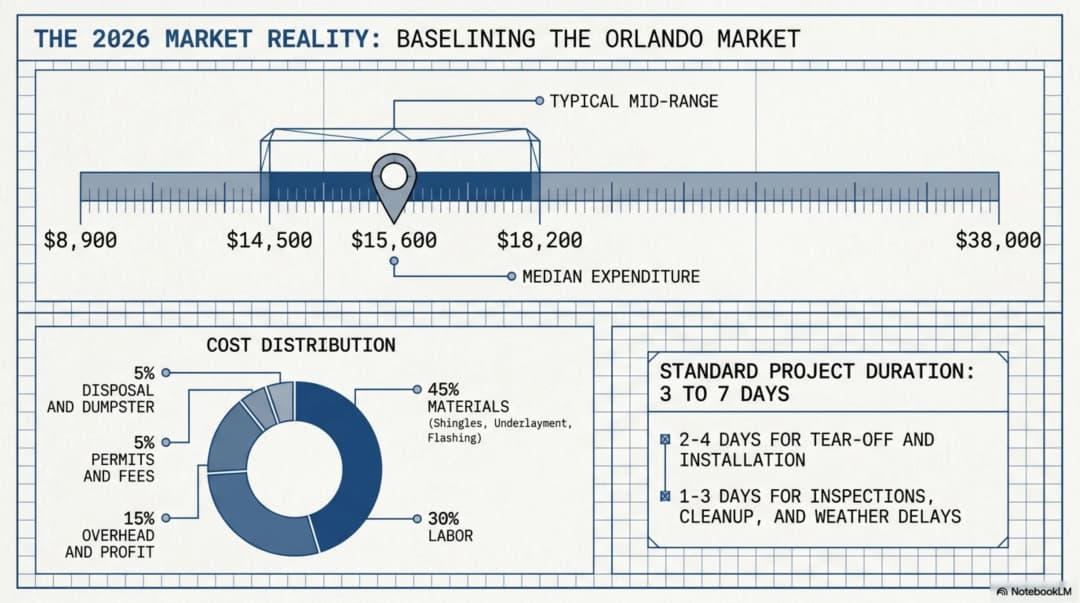
- Total Cost Range: $8,900 to $38,000. This wide range covers everything from basic 3-tab shingles on a small home to standing-seam metal or tile on a larger, more complex roof structure.
- Typical Mid-Range Project: $14,500 to $18,200. This is for a 2,200-square-foot roof using quality architectural asphalt shingles, including full tear-off, new underlayment, and required code upgrades.
- Project Timeline: Three to seven days. The tear-off and installation typically take two to four days, with another one to three days for inspections, cleanup, and potential weather delays.
- Biggest Surprise Line Item: Plywood decking replacement. Contractors often quote for zero to five sheets, but in Orlando's humid climate, it is common to find that 15% to 25% of the decking needs replacement due to moisture damage, adding $1,200 to $2,800 to the final bill.
What does a roof replacement actually cost in Orlando?
The total cost of an Orlando roofing project is determined by three primary factors: material choice, roof complexity (pitch, number of valleys, dormers), and the scope of work (tear-off vs. overlay). Below are cost tiers for a standard 2,100-square-foot roof on a single-story home in 2026.
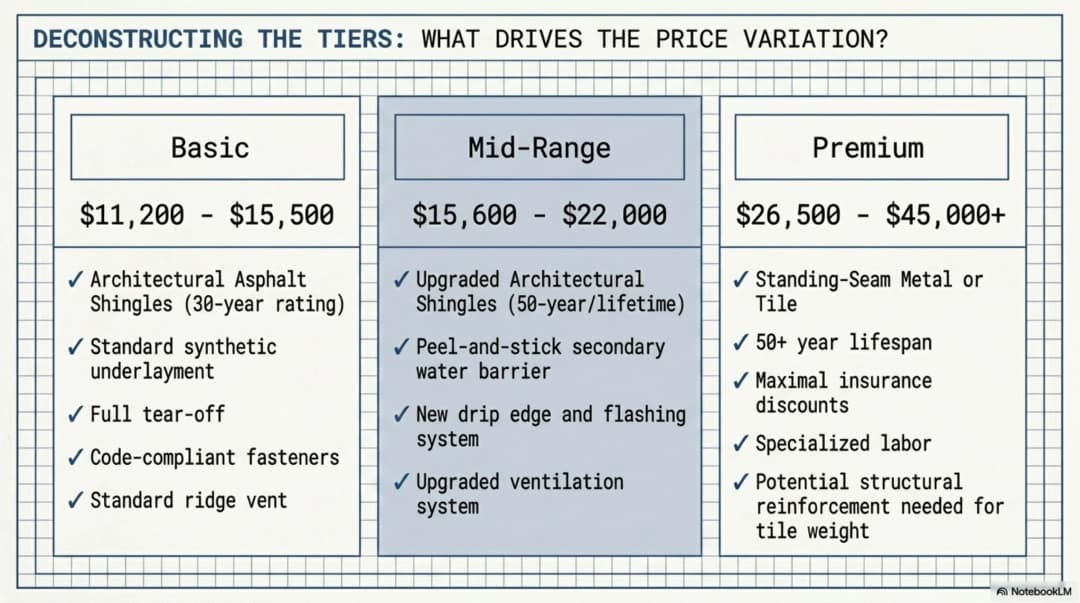
| Tier | Materials | Cost Range (2,100 sq ft) | Key Features |
|---|---|---|---|
| Basic | Architectural Asphalt Shingles | $11,200, $15,500 | 30-year rated shingles, synthetic underlayment, full tear-off, code-compliant fasteners, ridge vent. |
| Mid-Range | Upgraded Architectural Shingles | $15,600, $22,000 | 50-year or lifetime rated shingles, peel-and-stick secondary water barrier, new drip edge and flashing, improved ventilation. |
| Premium | Standing-Seam Metal or Tile | $26,500, $45,000+ | 50+ year material lifespan, significant insurance discounts, requires specialized labor, may need structural reinforcement for tile. |
A typical mid-range roofing project in Orlando has the following cost distribution, according to an analysis of contractor bids by Renology:
- Materials (Shingles, Underlayment, Flashing): 45%
- Labor: 30%
- Overhead and Profit: 15%
- Permits and Fees: 5%
- Disposal and Dumpster Fees: 5%
The bottom of the cost range, from $8,000 to $11,000, typically applies to smaller homes under 1,500 square feet, townhouses with shared rooflines, or projects on low-pitch roofs that do not require a full tear-off of the existing layer, a practice that is increasingly uncommon due to Florida Building Code requirements.
Why is roofing more expensive in Orlando than surrounding rural areas?
Roofing costs in the Orlando metro area are consistently 10% to 20% higher than in more rural parts of Central Florida. This premium is driven by a combination of higher labor rates, stringent building codes designed for hurricane resistance, and increased operational costs for contractors in affluent neighborhoods.
First, labor costs are a significant factor. According to the U.S. Bureau of Labor Statistics Occupational Employment and Wage Statistics for the Orlando-Kissimmee-Sanford, FL Metropolitan Statistical Area, the median hourly wage for roofers is $23.15, with experienced installers earning up to $31.50 per hour. This is substantially higher than wages in non-metropolitan areas of Florida, and these costs are passed directly to the homeowner. A reliable roofing contractor in Orlando must pay competitive wages to retain skilled crews qualified to meet local code requirements.
Second, the Florida Building Code (FBC) imposes some of the strictest roofing standards in the nation due to hurricane risk. These mandates increase both material and labor costs. For example, the FBC requires a secondary water barrier (typically a self-adhering modified bitumen or 'peel-and-stick' underlayment) across the entire roof deck in the High-Velocity Hurricane Zone, a standard often adopted in Central Florida for better protection. It also specifies nail type and spacing patterns for shingles to achieve higher wind uplift ratings, requiring more fasteners and more precise labor per square foot. These non-negotiable code requirements can add $1.50 to $2.50 per square foot compared to a roof installed in a state with less severe weather.
Finally, neighborhood-specific factors contribute to higher prices. In areas like Winter Park and Baldwin Park, homeowner association (HOA) regulations may dictate specific material types or colors, limiting choices and preventing the use of more economical options., contractors working in these areas often have higher overhead costs related to insurance, marketing, and logistics, which are factored into their pricing. The expectation for meticulous site management and cleanup in these communities also adds to the labor hours required for each project.
What do real Orlando homeowners spend in 2026?
To provide a clearer picture of real-world costs, here are three representative roofing projects from 2026, scoped similarly with architectural asphalt shingles. The scenarios below are modeled estimates built from the Renology Cost Index and typical local scopes, not completed client projects.
Project 1: College Park Bungalow
- Scope: Full tear-off and replacement on a 1,750 sq. ft. single-story home with a moderately pitched roof and two dormers.
- Materials: GAF Timberline HDZ Architectural Shingles, synthetic underlayment, new aluminum drip edge, and lead pipe boots.
- Surprises: Seven sheets of rotted plywood decking needed replacement around a chimney flashing that had previously failed.
- Total Cost: $13,850
Project 2: Lake Nona Two-Story
- Scope: Replacement of a 2,600 sq. ft. roof on a two-story home with a complex roofline, including multiple valleys and a steep pitch over the garage.
- Materials: CertainTeed Landmark PRO shingles, full peel-and-stick secondary water barrier for insurance discount, upgraded ridge ventilation system.
- Surprises: The original soffit vents were found to be insufficient, requiring the installation of six new vents to improve attic airflow and validate the shingle warranty.
- Total Cost: $19,200
Project 3: Windermere Ranch-Style Home
- Scope: A large 3,400 sq. ft. roof replacement on a sprawling single-story home. The project also included replacing three skylights.
- Materials: Owens Corning Duration Shingles with SureNail Technology for enhanced wind resistance. All new flashing kits for the new skylights.
- Surprises: The crew discovered improper flashing around the skylights had caused slow leaks, requiring minor truss repair costing an additional $950.
- Total Cost: $25,500 (including skylight replacement)
Information Gain: The True Cost of a Roof is Insurance, Not Shingles
Most homeowners in Orlando fixate on the initial quote, comparing the cost per square foot of different shingle brands. This is a critical error. The most significant variable in the long-term cost of a roof in Central Florida is not the material price but its impact on your annual homeowner's insurance premium. The financial calculus of a roofing decision extends for decades beyond the installation date.
Florida's insurance market heavily rewards wind mitigation. A roof that meets specific criteria can generate discounts of 20% to 45% on the hurricane portion of a homeowner's policy. According to data from the Florida Office of Insurance Regulation, the average annual premium in Orange County is approximately $3,800. A 30% discount translates to $1,140 in savings every year. Over 15 years, this amounts to $17,100 in saved premiums, a figure that can exceed the entire initial cost of the roof itself.
Achieving these discounts requires more than just new shingles. It requires a complete system specified by a Wind Mitigation Inspection form (OIR-B1-1802). Key factors include: a peel-and-stick secondary water barrier (SWR), proper roof deck attachment (nail size and spacing), and a roof geometry that is predominantly a hip roof. The cost to upgrade from a standard synthetic underlayment to a full peel-and-stick SWR is $1,200 to $2,500 on a typical home. While this adds 8-15% to the upfront cost, the payback period through insurance savings is often just one to two years. Conversely, choosing a cheaper roofer who cuts corners on underlayment or nailing patterns can cost a homeowner tens of thousands of dollars in lost insurance discounts over the life of the roof. The smart financial decision is to discuss the wind mitigation report with your roofing contractor orlando before selecting materials and locking in a scope of work.
Where does the money actually go? 8 line items contractors leave out
3 Orlando roofers, editor-screened. 4 questions.
See my 3 matchesThe initial quote from a roofing contractor often covers the basics but may omit or vaguely estimate crucial items that can inflate the final cost. Homeowners should budget for these potential additions, which are frequently necessary to complete the job correctly and to code.
- 1. Plywood Decking Replacement: Quotes typically include a per-sheet price ($85, $125) for replacing damaged decking but may only budget for a few sheets. Widespread, hidden moisture damage is common and can add $1,000, $3,000.
- 2. Fascia and Soffit Repair: Rotted wood along the roof's edge is often discovered only after the old shingles and drip edge are removed. Repairing sections of fascia board can cost $30, $50 per linear foot.
- 3. Upgraded Underlayment/Water Barrier: A basic quote may include standard felt or synthetic underlayment. Upgrading to a self-adhering 'peel-and-stick' membrane for superior water protection (and significant insurance discounts) costs an additional $0.75, $1.50 per square foot.
- 4. Ventilation Improvements: Bringing attic ventilation up to code to prevent heat and moisture buildup may require adding new soffit, ridge, or gable vents. This can range from $300 to $900.
- 5. Flashing Replacement: While some contractors reuse old flashing, best practice is to replace all of it, especially around chimneys, valleys, and walls. A full flashing package costs $500, $1,500.
- 6. Gutter System Issues: The tear-off process can sometimes damage older, brittle gutters. Budget for potential repairs or decide if a full replacement ($1,200, $3,500) is a better long-term choice.
- 7. Permit and Inspection Fees: While the base permit fee is usually included, any required re-inspections due to unforeseen issues or code violations found during the work will be an extra cost, typically $150, $400 per visit.
- 8. Unforeseen Structural Repairs: In rare cases, removing the old roof reveals damage to the underlying trusses or rafters from long-term leaks or termites. These repairs are structural and can add $1,500 to $5,000+.
What stops an Orlando roof replacement from running over budget?
Even with a detailed quote, roof replacement projects can exceed their initial budget. In Orlando, overages are most often caused by three specific issues related to the region's climate and housing stock.
First, the most frequent cause of budget increases is extensive, undiscovered wood rot in the roof deck. Central Florida's high humidity, combined with years of intense sun and heavy rain, degrades roofing materials and allows for slow, undetected water intrusion. A quote might include an allowance for replacing five sheets of plywood, but it's common to find 15 or 20 sheets that are delaminated or soft. At $100 per sheet installed, this alone can add $1,500 to the final invoice. A thorough attic inspection before the work starts can help identify potential problem areas, but the full extent of the damage is never known until the tear-off is complete.
Second, scope creep initiated by the homeowner is a common culprit. Once the roofing crew is on site, it seems convenient to address other exterior issues. Homeowners may decide to replace gutters, paint fascia boards, or add solar-powered attic fans. While these are valuable upgrades, they were not part of the original contract. Each change order adds material and labor costs, pushing the final price higher. It is more cost-effective to decide on these additions during the quoting phase and include them in the initial scope of work.
Third, an insufficient contingency fund leaves no room for these common surprises. Many homeowners budget for the exact amount of the quote. However, for homes in Florida, which are subject to harsh weather, a financial cushion is not optional. We use a ten to fifteen percent contingency as a planning assumption; for comparison, HUD's Standard 203(k) loan rules require a reserve of at least 10 percent on homes 30 years or older. For a $15,000 roofing project, this means having an additional $1,500 to $2,250 set aside specifically for unforeseen but necessary repairs like decking or fascia replacement.
Understanding Orlando's Roofing Permit Process
A building permit is mandatory for almost all roof replacement projects in Orlando and Orange County. Attempting to replace a roof without a permit can result in significant fines, work stoppage orders, and difficulty selling or insuring the home in the future. The permit ensures that the work is inspected by a city or county official to verify compliance with the Florida Building Code, particularly its stringent wind mitigation and waterproofing requirements. Your contractor is responsible for securing the permit, but the homeowner should verify that it has been issued before any work begins. For a detailed guide on the specific forms, inspection schedules, and fees, see our complete guide: Orlando Roofing Permit Playbook 2026. Understanding this process can help you avoid delays and ensure your new roof is safe and fully compliant.
What should your Orlando contractor include in the quote?
A detailed, line-item quote is the foundation of a successful roofing project. A vague or one-page estimate is a sign of an unprofessional contractor. Your official quote should be a multi-page document that explicitly details the following 14 items:
- Full Business Information: The contractor's full name, address, phone number, and state license number.
- Proof of Insurance: A copy of their general liability and worker's compensation insurance certificates.
- Scope of Work: A detailed description of the work, including 'full tear-off of all existing roofing layers down to the wood deck'.
- Material Specifications: The exact brand, type, and color of shingles, underlayment, and other major components (e.g., 'GAF Timberline HDZ in Charcoal').
- Decking Replacement Allowance: The price per sheet (typically 4x8 OSB or plywood) for any damaged decking that needs to be replaced.
- Underlayment Details: Specification of whether it's synthetic felt or a self-adhered (peel-and-stick) membrane.
- Flashing Plan: A statement that all existing flashing (around chimneys, walls, vents) will be replaced with new, appropriate materials.
- Ventilation Plan: Details on the type and amount of ventilation to be installed (e.g., 'Install new GAF Cobra ridge vent across all main ridges').
- Drip Edge and Starter Shingles: Confirmation that new, code-compliant metal drip edge and starter shingles will be installed on all eaves and rakes.
- Fastener Specification: Mention of the type and number of nails to be used per shingle to meet Florida's wind uplift requirements.
- Cleanup and Debris Removal: A clause stating that all project-related debris will be removed and the property will be magnetically swept for nails.
- Warranty Information: Separate details on the manufacturer's material warranty and the contractor's workmanship warranty.
- Payment Schedule: A clear breakdown of the payment schedule, including deposit amount, progress payments, and final payment upon completion and inspection.
- Project Timeline: An estimated start date and the projected duration of the project.
Sources & Methodology
See the Renology Methodology for how sources are reviewed, ranges are normalized, and planning-data limits are handled.
Cost ranges in this guide draw on the following named industry sources, public agency datasets, and Renology editorial research.
- U.S. Bureau of Labor Statistics, OEWS, Orlando-Kissimmee-Sanford, FL MSA (May 2024)
- Remodeling Magazine, 2025 Cost vs. Value Report, South Atlantic Region (2025)
- National Association of Home Builders (NAHB) Home Building Geography Index (Q1 2026)
- City of Orlando Permitting Services Division, Fee Schedule (2026)
- Florida Building Code, 8th Edition (2023)
- Florida Office of Insurance Regulation, Annual Report (2025)
- GAF Roofing, Pro-Contractor Cost Survey (2025)
- Metal Roofing Alliance, Florida Market Report (2025)
- CertainTeed, Building Products Cost Analysis (2026)
Renology Take
The central miscalculation Orlando homeowners make is treating a roof replacement as a simple commodity purchase. They shop for the lowest price on a specific shingle, assuming all installations are equal. This is incorrect and costly. In a hurricane-prone region governed by a complex building code, a roof is not a product; it is a meticulously engineered system. The value is not in the shingles themselves but in the integrity of the installation and the system's ability to mitigate wind and water damage.
The meta-pattern causing most budget issues and post-installation failures is a failure to invest in the components you cannot see: the underlayment, the flashing, the deck fastening, and the ventilation. A cheaper quote often saves money by using standard felt instead of a peel-and-stick water barrier, or by reusing old flashing. These shortcuts void manufacturer warranties and forfeit thousands of dollars in potential insurance discounts, making the 'cheaper' roof far more expensive over its lifespan. The focus should be on hiring a roofing contractor in Orlando who documents a complete, code-compliant system, not just the one who offers the lowest price per square.
How to time and finance an Orlando roof replacement
Timing affects price more than most homeowners expect. Orlando roofers are busiest from June through November, when summer storms and hurricane season drive emergency demand. Booking a planned replacement in late winter or early spring, roughly January through March, often lands better crew availability and 5 to 10 percent lower labor quotes than scheduling in the middle of storm season.
Insurance is the other lever. Many Florida carriers now require a roof under 15 years old, or a passing inspection, before they will renew a policy. If your roof is nearing that age, replacing it proactively can prevent a non-renewal and unlock wind mitigation credits that offset part of the cost across the next few premium cycles.
For financing, weigh three common paths before you sign:
- Cash or a HELOC, which carries the lowest total cost and the most negotiating leverage on price.
- Contractor financing, convenient but often priced at 8 to 15 percent APR over several years.
- An insurance claim, viable only when storm damage, not normal age and wear, is the documented cause.
Whichever you choose, confirm the full system scope, the underlayment and flashing spec, and the written workmanship warranty before money changes hands. The financing decision is far easier to reverse than a roof installed over reused flashing.
Frequently Asked Questions
How much does a metal roof cost in Orlando?
Do I need a permit for a roof replacement in Orlando?
How long does a roof replacement take in Orlando?
What is a wind mitigation inspection and how does it affect my roof cost?
What are the best roofing materials for the Orlando climate?
Can I put a new roof over my old one in Orlando?
How do I find a reputable roofing contractor in Orlando?
Will a new roof increase my home's value in Orlando?
Ready to find a pro?
Tell us what you are planning and where. A Renology advisor can help you explore contractor matching.
Find a Pro- Free for homeowners
- Licensed, vetted local contractors
- No obligation to hire
Sources
- U.S. Bureau of Labor Statistics, OEWS, Orlando-Kissimmee-Sanford, FL MSA
- Remodeling Magazine, 2025 Cost vs. Value Report, South Atlantic Region
- National Association of Home Builders (NAHB) Home Building Geography Index
- City of Orlando Permitting Services Division, Fee Schedule
- Florida Building Code, 8th Edition
- Florida Office of Insurance Regulation, Annual Report
- GAF Roofing, Pro-Contractor Cost Survey
- Metal Roofing Alliance, Florida Market Report
- CertainTeed, Building Products Cost Analysis
Follow Renology on Google
Choose Renology as a preferred source and our guides show up more often in your Google results, including Top Stories and AI Overviews.