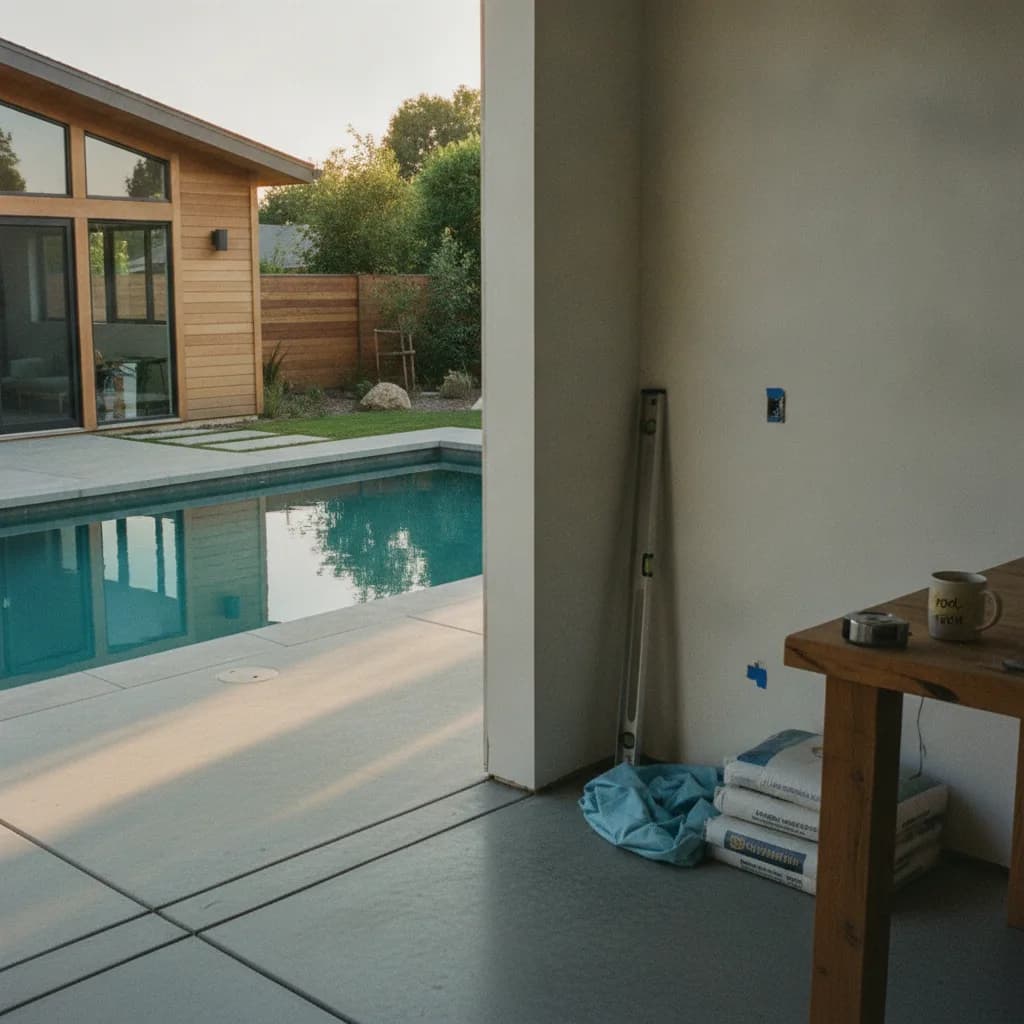
A new in-ground swimming pool in Sacramento costs between $75,000 and $180,000 in 2026, with the median homeowner spending $95,000 to $125,000 for a complete project. This range encompasses a standard gunite pool, essential equipment, and basic decking. While some projects can start lower, particularly for smaller spools or vinyl-liner pools with minimal site preparation, the majority of suburban installations land squarely in this bracket. Site access, soil conditions, and the extent of landscaping and hardscaping are the primary variables that dictate the final price for Sacramento pools.
In a Nutshell
- Total Project Cost Range: $75,000 to $180,000+. This covers everything from excavation to the final plaster coat and startup chemicals.
- Median Mid-Range Project: $95,000, $125,000. This typically buys a 15-by-30-foot gunite pool with paver decking, an energy-efficient pump, and LED lighting.
- Project Timeline: 12 to 20 weeks. This timeline spans from initial design and permit submission to the final inspection and handover.
- Biggest Surprise Cost: Electrical work. Upgrading a main service panel and trenching for a new subpanel frequently adds $4,500, $9,000, an expense rarely detailed in initial quotes.
What does a pool actually cost in Sacramento?
The final cost of a Sacramento pool is determined by size, materials, and features. We've broken down the typical price points into three tiers based on data from local contractors and recent projects. These figures represent the all-in cost, including labor, materials, equipment, and permits for a standard suburban lot.
| Tier | All-In Cost Range (2026) | Description |
|---|---|---|
| Basic | $75,000, $95,000 | A 12'x24' rectangular vinyl-liner or a small fiberglass shell. Includes minimal brushed concrete decking (3-foot perimeter), a single-speed pump (where permitted), a cartridge filter, and basic in-pool lighting. Site work is straightforward with good access. |
| Mid-Range | $95,000, $135,000 | The most common project: a 15'x30' freeform gunite pool. Includes a larger paver patio (500-700 sq. ft.), an energy-efficient variable-speed pump, color-changing LED lights, and a standard plaster or quartz finish. |
| Premium | $135,000, $200,000+ | A custom-designed 16'x35'+ gunite pool with an integrated spa. Features include a PebbleTec or PebbleSheen interior finish, full smart-device automation, a gas heater or heat pump, water features like waterfalls or deck jets, and extensive hardscaping with premium materials like travertine or stamped concrete. |
For a typical mid-range project totaling $115,000, the budget allocation is as follows:
- Excavation, Steel & Gunite Shell: 35% ($40,250)
- Decking & Coping: 20% ($23,000)
- Plumbing & Electrical: 15% ($17,250)
- Contractor Labor & Overhead: 15% ($17,250)
- Pool Equipment Package: 10% ($11,500)
- Interior Finish & Tile: 5% ($5,750)
Costs at the very bottom of the overall range, below $70,000, are generally reserved for above-ground pool packages or small pre-fabricated plunge pools (spools) on level lots with no access or utility complications. These are not representative of a typical in-ground pool construction project.
Why is a pool more expensive in Sacramento than in other regions?
While Sacramento may not have the coastal price pressures of Los Angeles or the Bay Area, pool construction costs are notably higher than in many other parts of the country. This premium is driven by a combination of labor rates, material logistics, and challenging local conditions. A project that costs $80,000 in a lower-cost state could easily command a $110,000 price tag here for the same scope of work. Understanding these factors helps homeowners set a realistic budget for a quality installation from a reputable pool contractor in Sacramento.
1. High-Skill Labor Rates
California's labor market is among the most expensive in the nation. According to the California Department of Industrial Relations prevailing wage data for Sacramento County, skilled construction trades command premium hourly rates. An experienced shotcrete nozzleman, a critical trade for gunite pools, can earn over $70 per hour. Licensed electricians and plumbers, essential for safe and compliant equipment installation, also have rates that are 20-30% higher than the national median. These costs, along with workers' compensation insurance and payroll taxes, are passed directly into the project's labor budget, which typically accounts for 15-25% of the total cost.

2. Expansive Clay Soil
Much of the Sacramento Valley is characterized by expansive clay soil. This type of soil swells significantly when it absorbs water and shrinks as it dries, exerting immense pressure on rigid structures like a concrete pool shell. To mitigate the risk of cracking and structural failure, pools built in these areas require more solid engineering. This often translates to a thicker shell, more steel rebar, and sometimes even the installation of engineered fill or piers. These geotechnical considerations can add $5,000 to $15,000 in excavation and structural costs compared to building on more stable, sandy loam soil. Homeowners in neighborhoods like Land Park and parts of Elk Grove are frequently required to obtain a soils report before a permit is issued.
3. Regulatory Compliance and Material Costs
California's stringent building and energy codes, particularly Title 24, impose requirements that increase upfront costs. Title 24 mandates the use of energy-efficient, variable-speed pool pumps and may require specific plumbing configurations or a solar heating system to offset gas heater usage. While these measures reduce long-term operating costs, they add $1,500 to $3,000 to the initial equipment package., as an inland hub, Sacramento experiences higher transportation costs for certain materials, like specialty tile or imported stone coping, compared to port cities. High regional demand for concrete and steel from a booming commercial and residential construction market also keeps prices for these fundamental pool components elevated.
What do real Sacramento homeowners spend in 2026?
The scenarios below are modeled estimates built from the Renology Cost Index and typical local scopes, not completed client projects.
Project 1: A $112,000 Geometric Pool in East Sacramento
- Scope: A 14-by-28-foot rectangular gunite pool designed for a classic bungalow backyard. The project involved navigating a tight lot, which required the use of smaller excavation equipment and more manual labor, increasing site preparation costs.
- Breakdown: The budget included $42,000 for the engineered gunite shell and excavation, $18,000 for a simple broom-finish concrete deck and precast concrete coping, and $16,000 for plumbing and a new electrical subpanel. The equipment set was a standard energy-efficient package costing $11,000.
- Key Detail: The homeowner opted for a saline chlorine generator ($2,500) and an automatic pool cover for safety and to reduce evaporation ($14,500), which comprised a significant portion of the feature budget. The remaining funds covered permits, tile, and the interior plaster finish.
Project 2: A $145,000 Freeform Pool with Spa in Folsom
- Scope: A larger, 16-by-32-foot freeform gunite pool with an attached 7-by-7-foot spa. The project was on a newer suburban lot with good access, but the design incorporated more premium materials and features.
- Breakdown: The core structure and excavation cost $55,000. The major cost driver was the hardscaping: $35,000 for an extensive travertine paver patio and matching bullnose coping. The equipment package was $22,000, including a gas heater for the spa, full automation controls via a smartphone app, and color-changing LED bubblers.
- Key Detail: The interior finish was upgraded from standard plaster to a PebbleSheen finish for enhanced durability and color, adding $9,000 to the cost. The remaining $24,000 covered plumbing, electrical, tile, and contractor overhead.
Project 3: A $98,000 Fiberglass Pool in Roseville
- Scope: A 12-by-26-foot pre-manufactured fiberglass shell installed in a family-friendly neighborhood. The primary goal was a faster installation timeline and lower long-term chemical maintenance.
- Breakdown: The fiberglass shell itself, including delivery, was the largest line item at $32,000. Excavation and setting the pool with backfill cost $20,000. The equipment package was $10,000. A 600-square-foot paver patio and coping accounted for another $20,000.
- Key Detail: While the installation was faster (completed in six weeks), the upfront cost of the shell is higher than the raw materials for a gunite pool of the same size. The remaining $16,000 covered the necessary electrical and plumbing work, permitting, a safety fence, and initial landscaping restoration.
Where does the money actually go? 8 costs contractors leave out
3 Sacramento pool builders, editor-screened. 4 questions.
See my 3 matchesThe initial quote from a pool contractor sacramento residents receive often focuses on the pool shell and basic equipment. However, a significant portion of the total budget is consumed by ancillary work required to make the pool functional, safe, and integrated into your backyard. Homeowners should budget for these items separately or ensure they are explicitly included in the contract.
- Electrical Subpanel and Trenching: $4,500, $9,000. A pool requires a dedicated electrical subpanel with multiple circuits for the pump, lighting, and other features. The cost includes the panel, breakers, labor, and trenching from the main house panel to the equipment pad.
- Code-Compliant Safety Fencing: $5,000, $12,000. California law requires an isolation fence with a self-closing, self-latching gate around the pool area. The cost varies widely based on material (mesh, aluminum, wood) and the perimeter length.
- Yard Drainage Systems: $3,000, $7,500. New, non-porous decking will alter your yard's drainage patterns. Installing French drains or channel drains to direct water away from the pool and your home's foundation is a critical but often overlooked expense.
- Landscaping and Irrigation Repair: $6,000, $20,000+. Heavy machinery will inevitably damage lawns, sprinkler systems, and existing plants. The cost to regrade the yard, lay new sod, replace sprinkler heads, and install new landscaping can be substantial.
- Utility Rerouting: $2,500, $8,000. If excavation uncovers sewer, gas, or electrical lines in the planned pool location, they must be moved by a licensed professional. This is an immediate and non-negotiable change order.
- Geotechnical and Soils Reports: $1,500, $4,000. In areas with known expansive soil or on hillside properties, the City of Sacramento may require a report from a geotechnical engineer to specify the pool's structural requirements.
- Increased Property Taxes: An ongoing cost. A pool can add $50,000 or more to your home's assessed value, resulting in a permanent increase in your annual property tax bill, potentially $600-$1,000 per year in Sacramento County.
- Higher Homeowners Insurance Premiums: $300, $600 per year. A pool is considered an "attractive nuisance," and your liability coverage will need to be increased. Most insurers recommend raising liability limits to at least $300,000-$500,000.
What no one else covers
The conversation around pool cost in Sacramento is almost entirely focused on the construction price. What is rarely discussed with the same financial rigor is the Total Cost of Ownership (TCO), the accumulation of all expenses over the pool's life. A $100,000 pool does not simply cost $100,000; its true cost includes a stream of mandatory expenses for energy, water, chemicals, and eventual repairs. A prospective owner should budget for an additional $2,500 to $5,000 per year in operating costs.
Energy is the largest variable. California's Title 24 Building Energy Efficiency Standards have made variable-speed pumps (VSPs) the default. According to the U.S. Department of Energy, VSPs can save between $400 and $1,100 annually in electricity costs compared to old single-speed models by running at lower speeds for longer periods. However, heating is the real budget-breaker. A natural gas heater can add $200 to $500 per month to a PG&E bill during the spring and fall. This is why Title 24 often encourages or requires a solar heating system ($5,000-$10,000 upfront) to offset fossil fuel consumption. Water is another significant factor. In Sacramento, a 15,000-gallon pool can lose over 2,500 gallons a month to evaporation in the summer. This, combined with backwashing and splash-out, can easily push a household into a higher, more expensive water rate tier, adding $300 to $700 to the annual water bill. Routine maintenance, including chemicals and professional service, adds another $1,800 to $3,000 per year. Finally, homeowners must plan for long-term capital expenditures. A plaster interior needs to be redone every 8 to 12 years at a cost of $8,000 to $15,000. A pump or filter may fail after a decade, costing $1,500 to $3,000 to replace. Factoring these TCO elements into the initial decision provides a far more accurate financial picture than the builder's quote alone.
What stops a Sacramento pool project from running over budget?
Even with a detailed contract, pool projects are susceptible to budget overruns. Understanding the common causes can help homeowners prepare financially and managerially. The most effective tool against budget creep is a combination of thorough planning and a dedicated contingency fund.
1. Unforeseen Site Conditions
What lies beneath the surface is the biggest unknown in any pool project. While a contractor can make educated guesses, it's impossible to be certain until excavation begins. Hitting a layer of hard rock can add thousands in equipment rental and labor for hammering. Discovering a high water table may require dewatering pumps and additional drainage solutions. The most common issue in the Sacramento area is encountering highly expansive clay soil that requires more extensive excavation and the import of engineered fill, a costly and time-consuming process not typically included in a standard bid.
2. Homeowner-Driven Scope Creep
The second most frequent cause of budget increases is changes made by the homeowner after the contract is signed. It is tempting to add features once construction is underway. Deciding to add an integrated spa mid-build, upgrading from standard concrete to a more expensive paver patio, or adding a waterfall feature will generate change orders. Each change order not only adds material and labor costs but can also disrupt the construction schedule, causing cascading delays and associated expenses. It is far more cost-effective to finalize all design decisions before breaking ground.
3. Permitting and Inspection Delays
The administrative side of the project can also lead to unexpected costs. If the initial plans submitted to the city are incomplete or incorrect, the resulting revisions and re-submissions can delay the start date by weeks. During construction, a failed inspection (for instance, on the rebar placement or electrical bonding) requires the contractor to halt work, correct the issue, and wait for a re-inspection. This downtime is costly for the contractor, and those costs are often passed on to the homeowner. For these reasons, the National Association of Home Builders recommends a ten to fifteen percent contingency on renovations in homes over thirty years old. For a new construction element like a pool, a 10% contingency is a prudent minimum.
Navigating the Sacramento Permitting Process
Securing the proper permits is a critical first step in any pool construction project. The process involves submitting detailed structural, electrical, and site plans for review to ensure compliance with state and local building codes, including safety and energy efficiency standards. Navigating the City of Sacramento's permitting process can be complex. For a detailed breakdown of the required plans, inspection schedules, and associated fees, see our complete guide: Sacramento Pools Permit Playbook 2026. A qualified pool contractor will typically handle this entire process on your behalf, but understanding the steps is essential for any homeowner.
What should your Sacramento contractor include in the quote?
A detailed, itemized quote is the foundation of a successful project. Vague proposals leave room for ambiguity and future disputes. Your contract should be a comprehensive document that specifies every component of the build. Insist that your contractor's proposal includes the following 14 items, at a minimum:
- A detailed scope of work with scaled drawings and dimensions.
- All costs associated with permit acquisition from the City of Sacramento.
- Excavation details, including soil type assumptions and cost for hauling/disposal.
- Structural specifications, including the amount and grade of steel rebar and the thickness and PSI rating of the gunite or shotcrete.
- A complete plumbing schematic showing pipe sizes, runs, and all included fixtures (skimmers, drains, returns).
- A full electrical plan, including the cost of a new subpanel, all conduit runs, bonding, and light fixtures.
- A specific list of all pool equipment (pump, filter, heater, cleaner, automation system) by make and model number or clear performance specifications.
- The type, thickness, and color of the interior finish (e.g., white plaster, quartz aggregate, or pebble finish).
- The material and square footage of the pool coping and the surrounding deck.
- Details on the waterline tile selection and installation.
- Procedures for site protection, cleanup, and restoration of any areas damaged during construction.
- A clear payment schedule tied to specific construction milestones.
- Comprehensive warranty information covering workmanship, materials, and equipment.
- An estimated project timeline with a start and completion date, accounting for potential weather or inspection delays.
Sources & Methodology
See the Renology Methodology for how sources are reviewed, ranges are normalized, and planning-data limits are handled.
Cost ranges in this guide draw on the following named industry sources, public agency datasets, and Renology editorial research.
- Remodeling Magazine: 2025 Cost vs. Value Report (Pacific Region) (2025)
- California Department of Industrial Relations, Sacramento County Prevailing Wage Determinations (2026)
- City of Sacramento, Building Permits Division, Fee Schedule (2026)
- National Association of Home Builders (NAHB), Construction Cost Survey (2025)
- Pool & Hot Tub Alliance (PHTA), Construction and ANSI Standards (2024)
- U.S. Department of Energy, Energy Saver Guide for Swimming Pools (2024)
- Pacific Gas and Electric (PG&E), Rate Schedules and Energy Efficiency Data (2026)
- Renology Project of the Day Network, Sacramento Metro Data (2024-2026)
- U.S. Geological Survey, California Expansive Soils Map (2023)
- Harvard Joint Center for Housing Studies (JCHS), 'Improving America's Housing' Report (2025)
Renology Take
The primary miscalculation homeowners make when budgeting for a pool in Sacramento is focusing too narrowly on the cost per square foot of the pool itself. This metric is misleading because it ignores the fact that nearly half the total project cost is allocated to elements *around* the pool. The decking, the code-required safety fencing, the new electrical subpanel, the drainage system, and the landscape restoration are not optional add-ons; they are fundamental, and often expensive, components of a complete and safe installation. A low-ball bid from a contractor often achieves its attractive price by minimizing or completely omitting these items from the quote, setting the homeowner up for a series of costly change orders and surprises. A successful project begins with a holistic budget that treats the pool and its surrounding environment as a single, integrated system. The value is not just in the water, but in the entire backyard transformation.
This article is from The Renology Magazine, the renovation magazine and contractor-advisory for homeowners in Southern California, San Diego, and Greater Seattle. Want more renovation breakdowns? Search "The Renology Magazine" on Google.
Frequently Asked Questions
How much does a pool add to the value of a Sacramento home?
What's the cost difference between gunite, fiberglass, and vinyl liner pools in Sacramento?
How long does it take to build a pool in Sacramento?
Are saltwater pools more expensive than chlorine pools in Sacramento?
Do I need a pool cover in Sacramento, and what does it cost?
How much should I budget for landscaping around a new pool?
What permits are required for a pool in Sacramento?
Can I build a pool on a small or sloped lot in Sacramento?
Sacramento · pre-screened
Get 3 Sacramento pool bids in 48 hours.
Our editors already vetted Sacramento pool builders. Answer 4 questions and we send 3 written bids inside 48 hours, with the real price for your scope, not their inflated first-call number.
- Free, no commission
- Pre-screened locally
- Bids inside 48 hours
Takes about 60 seconds. We'll text you when bids arrive.
Sources
- Remodeling Magazine: 2025 Cost vs. Value Report (Pacific Region)
- California Department of Industrial Relations, Sacramento County Prevailing Wage Determinations
- City of Sacramento, Building Permits Division, Fee Schedule
- National Association of Home Builders (NAHB), Construction Cost Survey
- Pool & Hot Tub Alliance (PHTA), Construction and ANSI Standards
- U.S. Department of Energy, Energy Saver Guide for Swimming Pools
- Pacific Gas and Electric (PG&E), Rate Schedules and Energy Efficiency Data
- Renology Project of the Day Network, Sacramento Metro Data
- U.S. Geological Survey, California Expansive Soils Map
- Harvard Joint Center for Housing Studies (JCHS), 'Improving America's Housing' Report