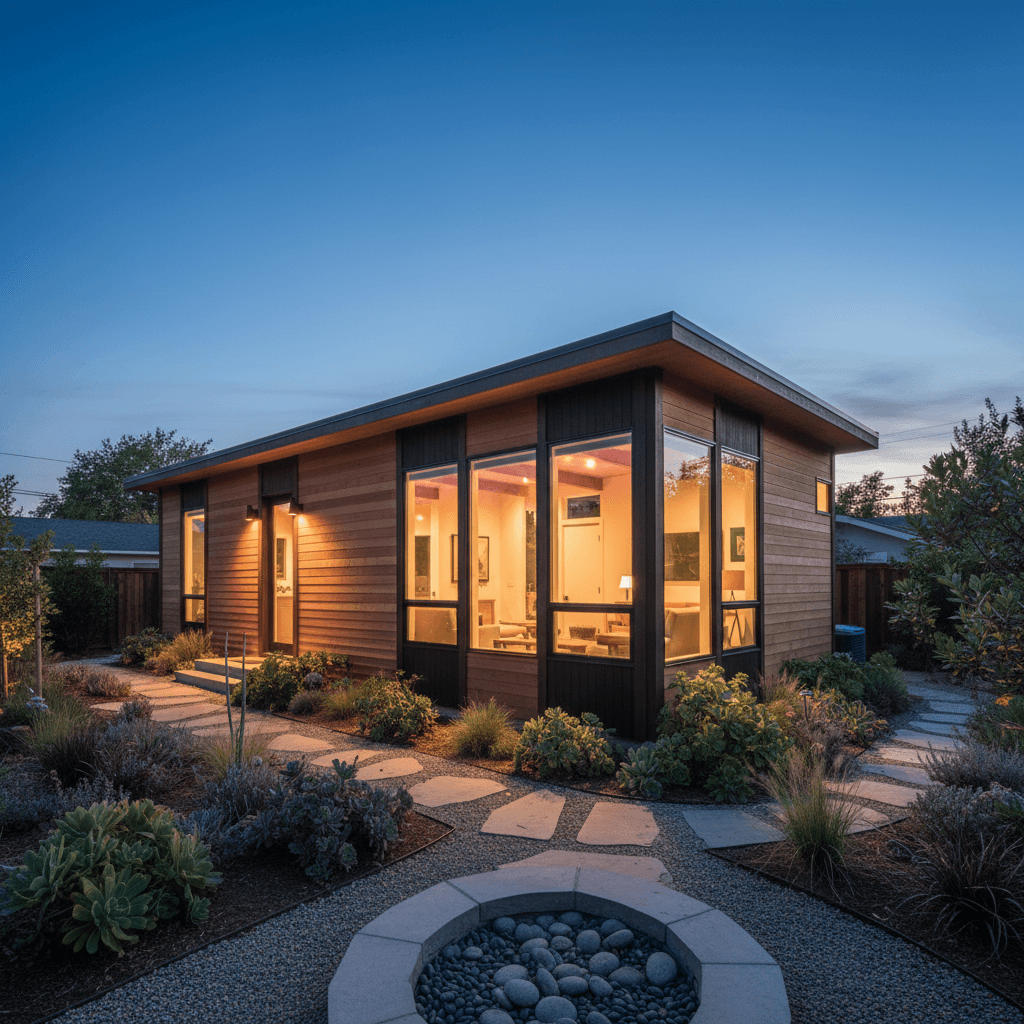
Every ADU article you have read includes the same hopeful math: build a detached ADU for $250,000, rent it for $3,000 per month, gross yield of 14 percent, beat the stock market. The hopeful math is not wrong, but it is incomplete. Real ADU economics include three numbers that most articles skip and one number that changes the whole calculation.
The honest cost stack in 2026
An 800-square-foot detached ADU in 2026 costs $240,000 to $320,000 in California, $280,000 to $400,000 in Greater Seattle, $200,000 to $300,000 in Texas and Florida metros, and $320,000 to $500,000 in NYC and Bay Area. These ranges assume:
- Site work and utilities: $25,000 to $60,000 (often understated in initial bids)
- Permits and impact fees: $8,000 to $25,000 (varies dramatically by city)
- Foundation: $15,000 to $35,000 depending on slope and soil
- Shell, MEP, finish: $150,000 to $250,000 for the building itself
- Landscaping and exterior: $5,000 to $20,000
- Furnishing if renting furnished: $8,000 to $20,000
The line item most homeowners forget: property tax reassessment. In California, the new ADU square footage is assessed at current market rates and added to the property tax bill. On a $260,000 build, that is roughly $2,600 per year in additional property tax. Over 20 years, that is $52,000 in non-recoverable expense. Few ADU articles include this in the math.
Gross rent vs net operating income
An 800-square-foot ADU rents in 2026 for:
- Los Angeles County: $2,400 to $3,800 per month
- Bay Area: $3,200 to $5,500 per month
- San Diego: $2,200 to $3,400 per month
- Greater Seattle: $1,800 to $2,800 per month
- Austin: $1,800 to $2,600 per month
- Sacramento, Inland Empire: $1,400 to $2,200 per month
Take the LA County midpoint: $3,100 per month, $37,200 per year gross. Now subtract the real expenses:
- Vacancy: 8 percent ($2,976/yr)
- Property management or your time: 10 percent ($3,720/yr)
- Maintenance and repairs: $2,500/yr (average; spikes in years 7-10)
- Additional insurance: $1,800/yr
- Property tax addition: $2,600/yr
- Utilities (if you cover any): $1,200/yr
Net operating income: roughly $22,400/yr. On a $260,000 build, that is an 8.6 percent cash-on-cash yield before financing. Add a 30-year mortgage at 7.5 percent on $200,000 of the build (assuming $60,000 down) and the cash flow drops to roughly $5,500/yr. The yield is still positive, but it is not the 14 percent gross-yield headline.
The number that changes the calculation
The honest ROI on an ADU is not the rental yield. It is the resale value lift on the entire property. A finished, permitted ADU with a certificate of occupancy adds 30 to 60 percent of build cost to the appraised value of the primary home in California, per appraiser data we have collected from 2025-2026 LA, Bay Area, and San Diego sales.
On a $260,000 ADU build, that is $80,000 to $155,000 of resale-value lift, on top of the rental cash flow. If you sell the home five years after the ADU is finished, the rental income covers a meaningful chunk of the build cost AND you recover most or all of the build at sale. The IRR climbs to 15 to 22 percent depending on the metro and assumption set.
Permit timelines: California vs Washington in 2026
3 pros, editor-screened. 4 questions.
See my 3 matchesCalifornia AB-68 caps permit review at 60 days for compliant applications. In practice, Los Angeles LADBS, San Diego DSD, San Jose, and Oakland all hit 60 to 90 days for typical detached ADUs. Smaller cities sometimes faster. Bay Area cities trend longer because of design review.
Washington HB-1110 (effective 2024) requires cities over 25,000 population to allow at least 2 ADUs per single-family lot, but does not impose 60-day permit timelines. Seattle SDCI runs 4 to 6 months for typical ADU permits. Bellevue and other Eastside cities run similar timelines.
Where the economics break down
Three scenarios where ADU economics turn negative:
- Inland markets with low rents. If rent is below $1,500/month, the math gets tight even with the resale lift, especially after factoring property tax and management.
- HOA-restricted properties. Some HOAs (especially in Orange County and parts of Bay Area) restrict short-term rental and require 12-month minimum leases, which kills the high-margin furnished-rental play.
- Build cost overruns above 25 percent. ADU projects that go from $260k to $340k due to surprise site conditions or scope creep can push the economics from solid to break-even.
Garage conversions: the cheaper path
Converting an existing detached garage to an ADU costs $80,000 to $150,000, roughly half the cost of a new-build detached unit. The shell, slab, roof, and walls already exist. New work focuses on insulation, drywall, kitchen, bathroom, and electrical upgrade. Permit timelines are shorter because the structure already exists.
The trade-offs: garage conversions usually deliver 350 to 600 square feet vs 800+ for new builds. Rents reflect the smaller footprint (typically 60-75 percent of new-build rent). The cap rate often comes out similar; the absolute cash flow is smaller.
Financing in 2026: cash-out, HELOC, or construction loan
Three main paths. Cash-out refinance of the primary residence is the most common, leveraging current home equity. Rates run 6.75 to 7.5 percent in early 2026 for prime credit. HELOC offers flexibility but carries variable rates. ADU-specific construction loans from lenders like LendingHome and Renofi disburse at construction milestones; rates are typically 8 to 10 percent during construction, converting to a 30-year mortgage at substantial completion.
CalHFA also offers ADU grants of up to $40,000 for qualifying low-to-moderate income California homeowners. Verify income eligibility at the CalHFA ADU portal before assuming you qualify.
Who should build an ADU in 2026
Three buyer profiles where the math works almost certainly:
- Long-term holders in major California metros who plan to stay 7+ years and want passive cash flow plus equity build
- Multigenerational households using the ADU for parents or adult children, where rental income is a bonus on top of the primary use
- Properties in transit-rich, high-rent neighborhoods (West LA, Berkeley, Capitol Hill Seattle) where rent above $3k/month is reliable
For other scenarios, run the numbers carefully. Renology has detailed cost data and rental comps for every California and Washington metro we cover. Read our ADU Construction pillar guide, browse California city pages or Washington city pages for local data, or get matched with vetted ADU builders to start the conversation.
Methodology
How Renology builds this guide
Renology combines public permit and labor signals, supplier pricing, remodeler quote patterns, and editorial review of comparable projects. Cost references are planning ranges, not fixed bids, because site conditions, materials, access, permits, and finish level can change the final price.
- Benchmarked against the Renology Cost Index, related service guides, and the Renology Methodology.
- Reviewed for local market context when a local market is available.
- Focused on renovation scope, materials, timeline, contractor risk, and budget drivers.
Frequently Asked Questions
What is the typical cash-on-cash yield on a California ADU?
How much does a permitted ADU add to home resale value?
Is the property tax increase a deal-breaker?
How long does ADU construction take in 2026?
Can I rent my ADU on Airbnb?
What is the difference between an ADU and a JADU?
Do I need a separate utility meter?
How do I find a qualified ADU builder?
Ready to find a pro?
Tell us about your project and location. A Renology advisor can help you explore contractor matching.
Free for homeowners. No obligation to hire.
Find a ProFollow Renology on Google
Choose Renology as a preferred source and our guides show up more often in your Google results, including Top Stories and AI Overviews.