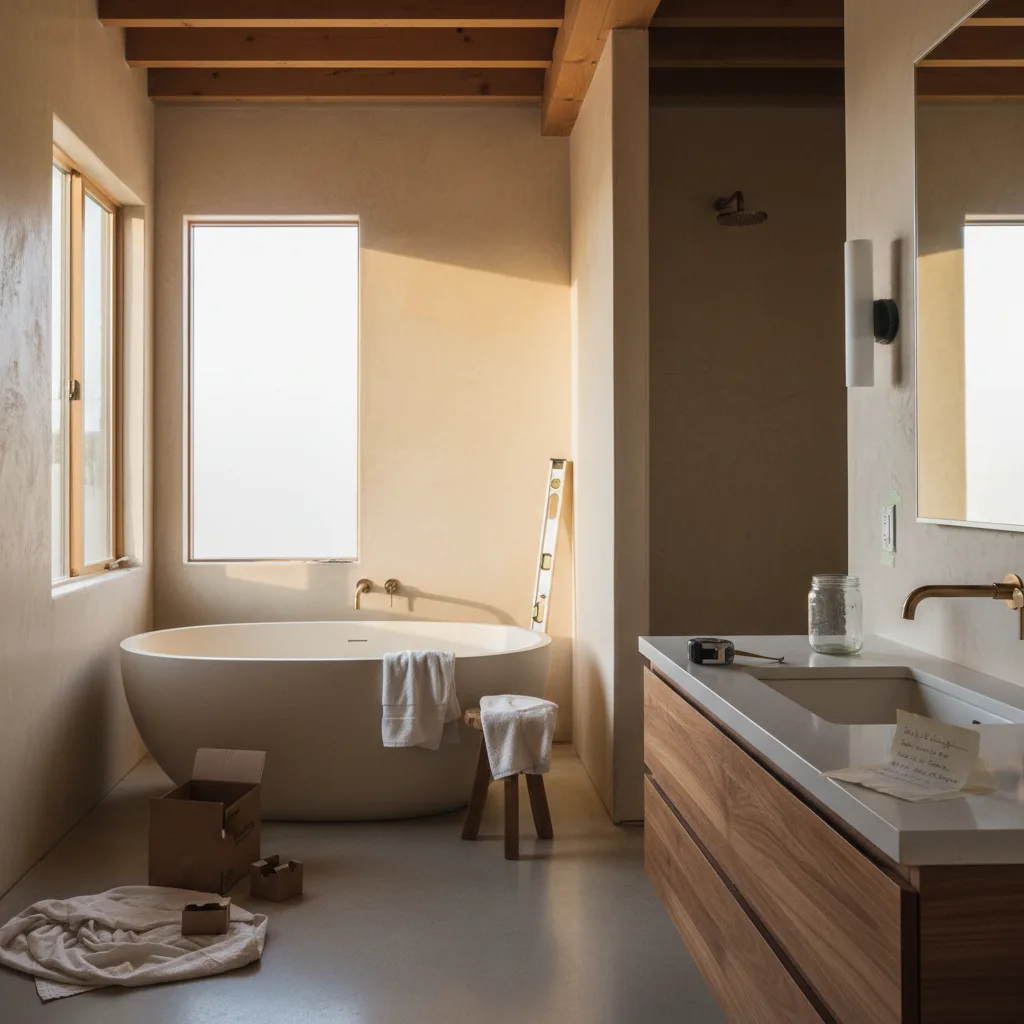
The bathroom idea worth keeping is the one that works on an ordinary morning. Warm wood, softer colors and a generous shower can look inviting, but storage, cleaning access and the layout matter long after the photograph. Use these eight ideas to build a brief, then test each against the room you actually have.
Wood-faced vanities: look inside as well as outside
A wood face can warm up a room without replacing every surface. Before ordering, open every drawer and check where the sink and plumbing interrupt storage. Ask how exposed edges and the area around the basin are finished, which cleaners are allowed and how a damaged door would be repaired or replaced. A pleasing grain pattern is only one part of the purchase.
Warm neutrals and greens: approve samples in your light
Try the tile, cabinet and wall samples together under daylight and the lighting planned for the room. A green that feels calm in a showroom may read differently beside warm stone or beneath a mirror light. Keep one approved set of samples and record product codes; similar names across suppliers do not ensure a match.
Large-format surfaces: fewer joints, more layout decisions
A broad tile or slab can simplify the visual pattern. Ask the installer to draw seams, corners, cutouts and the junction with the shower floor before ordering. Fewer visible joints does not mean no maintenance or no preparation. Compare fabrication, substrate preparation and waste as part of the installed scope. Our quartz and quartzite comparison explains why the selected material and care instructions matter.
A larger shower: test the daily route through the room
Mock up the door swing, entry, towel location and space to dry off. If removing a tub creates a better shower, check the household’s actual tub use first. An open wet-room look also needs a plan for spray, cleaning and the parts of the room that remain dry. A curbless entry is a design and construction decision, not a guarantee that the room suits every mobility need. See the tub-to-shower scope and cost guide before comparing enclosure prices.
Brushed or living finishes: choose your maintenance tolerance
Ask to see an aged sample if a finish is intended to change with use. Confirm what the maker considers normal patina and which changes count as a defect. Decide whether you want an evolving surface or a consistent appearance. Keep the exact finish code for taps, shower fittings and accessories so replacements can be identified later.
Layered lighting: test faces, mirrors and nighttime use
Separate the tasks: seeing your face, lighting the room and moving safely at night. Test the mirror and lights together for glare and shadows. Have the electrician confirm the selected fittings, controls and locations meet applicable requirements. An attractive fixture photograph does not establish suitability near water or compatibility with the proposed dimmer.
Storage designed around what you own
List the items that need a place: towels, cleaning supplies, spare toiletries and electrical grooming tools. Measure tall bottles and equipment rather than assuming all drawers are interchangeable. A floating vanity can make the floor feel more open, but ask whether the remaining storage is enough and whether wall preparation is included in the installation price.
Water-efficient fixtures and useful technology
For a showerhead, check the actual model’s specifications and performance information. EPA’s WaterSense label addresses water efficiency and performance; also confirm California and local requirements for the selected product. For digital controls or smart fixtures, ask about service access, replacement parts and manual operation before paying for features you may rarely use.
Take this comparison sheet to an LA bathroom showroom
| Ask to see | Record before paying |
|---|---|
| The exact finish and material | Product code, permitted cleaning products and variation between samples and orders. |
| A working fixture or comparable display | Controls, spray or light quality, access and suitability for the intended user. |
| The installation drawing | Rough-in requirements, dimensions and the installer’s approval of the selected product. |
| The complete price | Required valves, trim, drains, delivery and items sold separately. |
| The return and service terms | Special-order restrictions, damage checks and who handles a faulty component. |
For a smaller bathroom, choose the one or two changes that solve daily friction before adding a statement finish. Ask your contractor to price optional upgrades separately. The Los Angeles bathroom planning guide connects those decisions to bids and approvals without turning a trend list into a promise about your budget.
What the 2026 bathroom surveys actually measure
No public survey ranks bathroom trends for California or Los Angeles on their own. The two most cited 2026 sources are national, and they measure different things. The 2026 U.S. Houzz Bathroom Trends Study asked 1,619 U.S. homeowners on Houzz about bathroom projects they recently finished or plan to start. The NKBA report asks industry professionals what they expect to be popular. One shows what homeowners did. The other shows what designers predict. Treat both as national signals, not local adoption rates.
What renovating homeowners chose, according to Houzz
The top reason to renovate was disliking the look of the old bathroom, named by 47% of homeowners. A deteriorated bathroom came second at 35%, and being financially ready came third at 29%. Too little lighting and poor ventilation were each named by 7%.
Tubs are a big part of the story. A bathtub was removed in 26% of projects, and when one came out, 79% of homeowners used the space to enlarge the shower. Among homeowners adding or replacing a tub, 72% chose a soaking tub, up 10 percentage points from the prior year.
Vanities are getting wider. Models larger than 72 inches were chosen by 21% of homeowners who upgraded a vanity, ahead of 60-inch and 72-inch models. Built-in electrical outlets (32%) and hair tool organizers (19%) each rose by 7 percentage points. Most homeowners also brought in help: 89% hired at least one professional, and general contractors worked on 52% of projects.
| Project group | Reported spending |
|---|---|
| All bathroom upgrades | $15,000 median, up from $13,000 in 2024 |
| Major remodels (at least the shower upgraded) | $25,000 median |
| Top 10% of major remodels | $70,000 |
| Bathrooms of 100 square feet or more | $30,000 median |
These are national medians from a homeowner survey. They are not Los Angeles prices and not a quote for your room.
What designers expect, according to NKBA
The NKBA 2026 Bath Trends release publishes these shares of surveyed professionals:
- Color: 96% named neutrals the most popular bath colors, led by off-white (58%), light brown or tan (54%) and white (40%). Among greens, sage drew 64% and olive 43%.
- Style: transitional or timeless design led at 70%, followed by organic or natural at 65% and contemporary, modern or minimalist at 57%.
- Floors: 89% said homeowners want smaller grout lines or none, and 80% expect large format flooring to be the most popular over the next three years.
- Vanities: wood-faced vanities (62%) moved ahead of painted ones (53%).
- Faucet finishes: matte (54%), brushed (51%) and satin (46%) all beat polished (39%).
- Layout: 55% said a larger shower matters more than a bathtub, and 72% expect the overall bath footprint to grow.
- Lighting: 92% said task lighting should always be in the primary bath, and 80% are including nighttime-specific lighting.
- Technology and access: 51% expect smart toilets to rise in popularity. On aging in place, 32% called it a mainstream trend now and 48% said it is on its way.
Both surveys point the same way on the shower: more room for it, often at the expense of the tub. Neither one supports calling white or minimal bathrooms finished.
California water rules that shape fixture choices
California law defines some older fixtures as noncompliant. Under Civil Code section 1101.3, that means a toilet made to use more than 1.6 gallons per flush, a showerhead with a flow capacity above 2.5 gallons per minute, or an interior faucet that emits more than 2.2 gallons per minute.
A permitted remodel brings the rule into play. Civil Code section 1101.4 says that for alterations or improvements to a single-family home, the permit applicant must replace all noncompliant plumbing fixtures with water-conserving ones as a condition of final permit approval. The text says all noncompliant fixtures, so ask the contractor whether fixtures outside the bathroom are in the bid. Sellers of single-family homes must also disclose in writing whether the home has noncompliant fixtures.
New fixtures face their own limits. The California Energy Commission says state appliance regulations, combined with federal standards, set minimum efficiency levels for water use in plumbing equipment. Its page links to the Modernized Appliance Efficiency Database System (MAEDbS), which has an appliance quick search. Check the exact model number there before ordering from a showroom.
The WaterSense label is a separate, federal check. EPA says standard showerheads use 2.5 gallons per minute, while labeled showerheads must use no more than 2.0 and meet spray force and coverage criteria. Labeled bathroom sink faucets use a maximum of 1.5 gallons per minute, compared with a standard flow of 2.2. Use the label as a performance check and confirm the California listing separately.
Permits for a bathroom remodel in the City of Los Angeles
Start by confirming the property is inside the city. LADBS points owners to ZIMAS, and a property it cannot find may need another county department. Inside the city, LADBS lists remodeling bathrooms and adding or replacing plumbing fixtures among the small projects its Express Permit system allows. Homeowners applying for single-family e-permits may apply for building, mechanical, electrical and plumbing permits. A project that does not qualify goes through Plan Check.
The plumbing permit follows the pipes. LADBS plumbing permits are required for any installation or modification of drainage, waste and vent systems and potable water piping. If the plan moves a toilet, shower or sink, ask each bidder which permits the price includes.
Inspections run in stages. Regular inspections must be requested one day in advance before 2 PM and take place on weekdays from 7 AM to 3:30 PM. After the work passes every inspection, you request a final inspection. LADBS also notes that California construction contractors must be licensed by the CSLB. For local bids and scope, see the bathroom remodeling service page and the Los Angeles bathroom guide.
Sources and Methodology
Reviewed September 28, 2026. National survey findings are identified as such. Room-planning and showroom questions are editorial advice. Unsupported LA showroom sales figures and project-share claims have been removed; no local construction-cost range is inferred from this survey. See our editorial methodology.
Planning the work? Compare Los Angeles bathroom references and inclusions. No contact details needed.
Frequently Asked Questions
Are these the most popular bathroom trends in Los Angeles?
Which ideas work in a small bathroom?
What are the most popular bathroom remodeling trends in California right now?
What bathroom trends are designers predicting for 2026?
Do I have to replace old toilets and showerheads when I remodel a bathroom in California?
Do I need a permit to remodel a bathroom in Los Angeles?
Are bathtubs going out of style?
Ready to find a pro?
Tell us what you are planning and where. A Renology advisor can help you explore contractor matching.
Find a Pro- Free for homeowners
- Licensed, vetted local contractors
- No obligation to hire
Sources
- NKBA: 2026 Bath Trends release and methodology· accessed 2026-09-28
- EPA: WaterSense showerheads· accessed 2026-09-28
- Natural Stone Institute: care· accessed 2026-09-28
- Houzz Research: 2026 U.S. Houzz Bathroom Trends Study· accessed 2026-10-09
- California Civil Code section 1101.3 (noncompliant plumbing fixture definitions)· accessed 2026-10-09
- California Civil Code section 1101.4 (fixture replacement on permitted alterations)· accessed 2026-10-09
- California Energy Commission: Appliance Efficiency Regulations, Title 20· accessed 2026-10-09
- EPA: WaterSense bathroom faucets· accessed 2026-10-09
- LADBS: Homeowner Step-by-Step· accessed 2026-10-09
- LADBS: Plumbing Permits· accessed 2026-10-09