Planning a roof replacement in Malibu? A full project typically runs $17,000 to $26,000 in 2026. Cosmetic repairs start near $10,000, while premium custom work with high-performance materials can climb past $47,000. This is what your budget actually covers, what drives the price, and how to vet a contractor who understands Malibu's unique environmental and regulatory demands.
The Honest 2026 Price for Roofing in Malibu
Let's get straight to the point. The numbers you see on national cost calculators are often misleading for a market like Malibu. They don't account for the localized cost of skilled labor, the logistical challenges of coastal and canyon properties, or the stringent building codes designed to protect homes from fire and marine air. At Renology, we analyze real contractor invoices, and for 2026, the data points to a clear financial picture for a standard 2,000-square-foot home.
The median price range of $17,000 to $26,000 represents a full tear-off and replacement with quality architectural asphalt shingles. This is the most common project we see. However, the final cost is a direct function of three variables: the material you choose, the complexity of your roof's structure, and the condition of the underlying sheathing. A simple gable roof on a flat lot will always cost less than a complex roof with multiple valleys, dormers, and skylights on a steep hillside.
Key takeaway
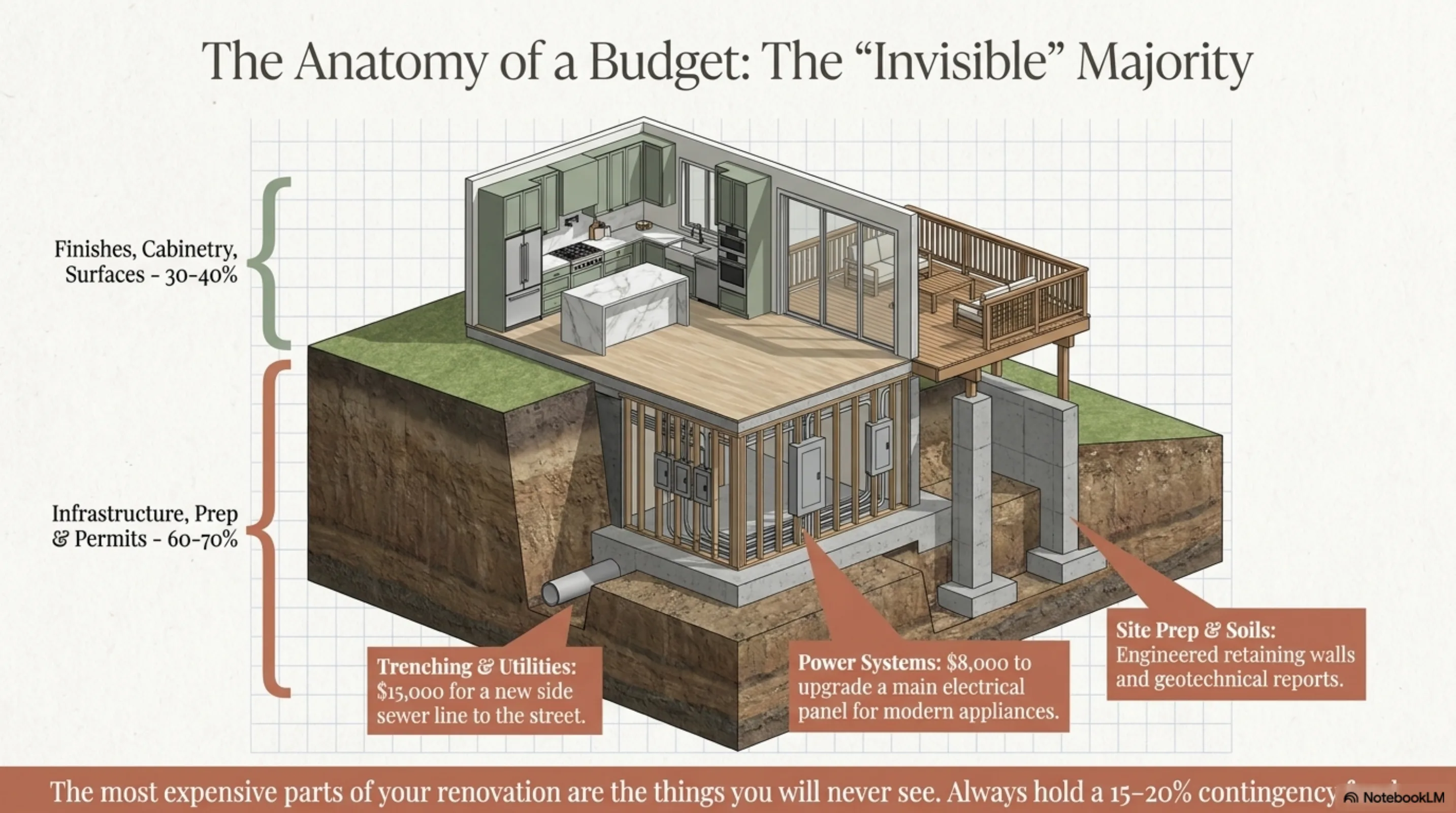
The single biggest factor that can inflate a roofing budget unexpectedly is the discovery of damaged or rotted decking after the old roof is removed. Always budget a ten to fifteen percent contingency fund to cover potential structural repairs that are impossible to see until the project is underway.
For homeowners looking at more resilient, long-lasting materials suited to the coastal climate, such as standing seam metal, clay tile, or slate, the investment increases substantially. These premium systems often require structural reinforcement and specialized labor, pushing costs well into the $31,000 to $47,000 range, and frequently higher for large, custom homes.
What Drives Roofing Costs in Malibu
See what a roofing project actually costs in your Malibu zip.
Take 4 questions →A roof is more than just the shingles you see from the street. It is a complete system of interlocking components, and each one contributes to the final price tag. Understanding these cost drivers is the first step in building a realistic budget and assessing contractor bids.
Materials: Beyond the Shingle
The primary material is the most obvious cost, but it is only part of the equation. In Malibu, material choices are dictated by aesthetics, budget, and, most importantly, performance against severe environmental stress.
- Asphalt Shingles: The market standard. Architectural or "dimensional" shingles offer good durability and a 30 to 50-year lifespan for a reasonable cost. In Malibu, look for products with enhanced UV-reflective granules to combat sun degradation and high wind ratings (110-130 mph).
- Clay or Concrete Tile: A classic choice for Mediterranean and Spanish-style architecture. Extremely durable and inherently fireproof (a critical feature in this region), but heavy. The cost includes not just the tiles but a potential engineering assessment to ensure your roof structure can support the weight.
- Standing Seam Metal: Increasingly popular for its modern aesthetic, exceptional longevity (50+ years), and superior resistance to wind and fire. The material itself is expensive, and installation requires specialized technicians, driving up labor costs.
- The Unseen System: Underneath the primary material lies a critical assembly: the wood decking (sheathing), a high-performance synthetic underlayment to block moisture, ice and water shield in valleys and eaves, and metal flashing around chimneys, vents, and skylights. Skimping on these components is a common mistake that leads to premature failure.
Labor and Logistics
Skilled labor is a premium in Southern California, and roofing is physically demanding, high-risk work. A professional crew's pricing reflects their insurance, training, and experience. In Malibu, labor costs are often higher due to logistical challenges. Narrow canyon roads, steep driveways, and limited staging areas for materials and debris dumpsters all add time and complexity, which translates to cost. A contractor who knows how to operate efficiently in these constrained environments is worth the investment.
Permits and Code Compliance
You cannot replace a roof in Malibu without a permit from the City of Malibu Planning Department. The permit fees themselves are a minor part of the budget, but the cost of meeting the code is not. California's building codes, particularly in designated Wildland-Urban Interface (WUI) zones, are some of the strictest in the country. This means your new roof must meet specific fire-resistance standards, typically requiring Class A-rated materials and specialized installation techniques for vents and eaves to resist ember intrusion. Compliance is not optional, and it adds to the material and labor costs.
Malibu Roofing by Tier: 3 Real Project Examples
To make the numbers tangible, here are three typical project scopes we see in the Malibu market. These are based on a standard 2,000-square-foot, single-story home to provide a clear comparison.
| Tier | Scope of Work | Cost Range (2026) | Typical Timeline |
|---|---|---|---|
| Cosmetic / Repair | Targeted repair of a leak, replacing a few dozen damaged shingles or tiles, sealing flashing around a chimney or vent. No full tear-off. Scope is limited to addressing a specific failure point. | $2,500 - $10,000 | 1-3 Days |
| Mid-Range / Full Replacement | Complete tear-off of old roofing down to the wood deck. Inspection and replacement of up to 10% of plywood sheathing. Installation of new synthetic underlayment, drip edge, and flashing. Installation of a Class A-rated architectural asphalt shingle system. | $17,000 - $26,000 | 1-2 Weeks |
| Premium / System Upgrade | Complete tear-off and inspection. Replacement of significant sheathing. Upgrading roof-to-wall connections for seismic and wind resistance. Installation of a premium system like standing seam metal or clay tile, including new high-performance underlayment, custom flashing, and improved attic ventilation. | $31,000 - $47,000+ | 2-4 Weeks |
Permits and Local Code in Malibu
Securing a permit for a reroof in Malibu is a non-negotiable step. The process is managed by the City of Malibu Planning Department, but for many properties, review from other agencies is also required. Understanding this landscape is key to a smooth project.
The City of Malibu Permit Process
For a straightforward reroofing project, the permit application will require a site plan, details of the existing and proposed roofing materials, and confirmation of compliance with current building codes. The city's primary concern is safety, particularly fire safety. Your contractor must demonstrate that the new roof assembly meets or exceeds the requirements of Chapter 7A of the California Building Code, which governs materials and construction methods in WUI fire hazard areas. This includes not just the Class A roofing material but also fire-resistant vents and proper eave construction.
Coastal Commission and Other Overlays
If your home is located within the Coastal Zone, which includes a significant portion of Malibu, your project may also require review by the California Coastal Commission. This is especially true if the roof replacement is part of a larger remodel or changes the structure's height or visual profile. The Commission's mandate is to protect coastal resources, and their review can add time and complexity to the approval process. A contractor experienced in Malibu will know precisely when a Coastal Development Permit (CDP) or exemption is needed and how to prepare the application correctly.
Did you know
Many Malibu properties are also subject to hillside development standards overseen by the Los Angeles County Department of Public Works. These regulations can affect site access, material storage, and erosion control measures during construction, all of which a qualified local contractor must manage.
The Malibu Neighborhoods Where Roofing Costs Diverge
Malibu is not a uniform market. The character, geography, and age of homes in different neighborhoods create distinct challenges that directly impact roofing costs. A quote for a home in Point Dume will look very different from one for a home in Big Rock, even if they are the same size.
Point Dume: Exposure and Scale
Homes in Point Dume are often on larger, more exposed lots. The primary environmental stress here is the direct, unimpeded assault of salt-laden marine air and high winds coming off the Pacific. Roofing systems must be specified for maximum corrosion resistance. This means using G90 galvanized or stainless steel flashing, corrosion-resistant fasteners, and roofing materials proven to withstand constant salt spray., the larger scale of homes in this area means larger roof surface areas, driving up the total volume of materials and labor required. Access is generally good, but the expectation for high-end finishes and meticulous site management adds a premium to the labor cost.
Big Rock: Access and Surprises
The Big Rock neighborhood presents a completely different set of challenges. The homes are often built on steep, terraced lots with narrow, winding roads. This makes getting materials to the site and debris away from it a major logistical hurdle. Cranes or specialized lifts may be needed just to load materials onto the roof, a significant line item on any bid. In my last walkthrough in Big Rock, I consulted on a project where the contractor had to build a temporary scaffold bridge from the street to the roofline just to create a safe pathway for his crew. Additionally, many homes in this area date back to the mid-20th century. A tear-off is more likely to reveal outdated structural framing or deteriorated decking that needs to be brought up to modern seismic and safety codes, turning a simple reroof into a more complex structural repair project.
Your roof is your home's first line of defense against sun, salt, and fire; it is the last place to cut corners in a place like Malibu.
Timeline: Realistic Week-by-Week Expectations
A common misconception is that a new roof goes on in a few days. While the active construction can be swift, the entire process, from initial consultation to final sign-off, is a multi-week endeavor. A well-managed project follows a predictable sequence.
Phase 1: Pre-Construction (2 to 6 Weeks)
This is the planning stage. It involves selecting your contractor, finalizing the material choices, signing the contract, and, most importantly, submitting the permit application. The City of Malibu's plan review can take several weeks, especially if other agency reviews are triggered. During this waiting period, your contractor will order long-lead materials and schedule the crew.
Phase 2: Active Construction (1 to 2 Weeks for Asphalt Shingle)
- Day 1-2: Site Prep and Tear-Off. Your property will be protected with tarps. The crew will arrive to remove the old roofing material down to the wood sheathing. A dumpster will be placed on-site.
- Day 3-4: Inspection and Repair. With the sheathing exposed, the crew (and often the city inspector) will assess the condition of the wood deck. Any damaged or rotted sections are replaced. This is the most common point for a change order if significant repairs are needed.
- Day 5-7: Underlayment and Flashing. The new weather barrier is installed. This includes the synthetic underlayment across the entire roof and specialized ice and water shield in vulnerable areas. New metal flashing is custom-fitted.
- Day 8-10: Final Installation and Cleanup. The new shingles, tiles, or metal panels are installed, along with ridge caps and ventilation. The site is thoroughly cleaned, and all debris is removed.
Phase 3: Inspections and Closeout (1 Week)
Once the work is complete, the contractor will schedule a final inspection with the city building inspector. Upon approval, you will receive the finalized permit, and you can make your final payment. Your contractor should provide you with all warranty documentation for both the materials and their workmanship.
How to Vet a Malibu Contractor
Choosing the right contractor is the single most important decision you will make. In a high-stakes market like Malibu, you need a professional with specific, verifiable experience in coastal, high-fire-risk environments. Go beyond a simple license check.
Important
A low bid is often a red flag. It can indicate an inexperienced contractor, the use of substandard materials, or an incomplete scope of work that will be supplemented later with expensive change orders. The best value is typically found in the detailed, transparent, mid-range bid from a reputable local company.
Questions to Ask Every Potential Contractor
- Can you provide addresses of three recent roofing projects you completed here in Malibu?
- What specific underlayment and flashing materials do you recommend for our coastal climate, and why?
- How do you handle site logistics and debris removal on a property with difficult access?
- Are you certified by the manufacturer of the roofing material you are proposing? (This is often required for the best warranties).
- How do you ensure compliance with Malibu's WUI fire codes?
- Can you provide a copy of your current California C-39 Roofing contractor's license, general liability insurance, and workers' compensation coverage?
Red Flags to Watch For
- Vague, one-page bids with no detail on materials or scope.
- High-pressure sales tactics or demands for a large upfront cash deposit (more than 10% or $1,000, whichever is less, is illegal in California).
- Inability to provide local references or proof of insurance.
- A lack of familiarity with the City of Malibu's permit process or WUI code requirements.
Renology Take
As the structural editor at Renology, I review project data from across the country. The recurring pattern I see in Malibu is homeowners focusing almost exclusively on the visible shingle or tile while under-budgeting for the critical system beneath it. The performance of your roof is not determined by the top layer alone. It is determined by the quality of the underlayment, the corrosion resistance of the flashing, and the integrity of the ventilation. These are the components that battle the daily thermal stress from intense sun and the corrosive attack of salt air. A cheap shingle on a perfectly installed, high-performance system will outperform a premium tile on a poorly executed base layer every time. Spend your money on the system, not just the surface. That is the key to a roof that will truly protect your investment for decades.
Sources & Methodology
These cost ranges are reconstructed from publicly available labor and permit data, the latest Remodeling Magazine cost-vs-value report, and Renology's own Project of the Day network, a rolling sample of real homeowner invoices we collect from Malibu-area contractors. Last refreshed April 2026.
- National Association of Home Builders (NAHB) Remodeling Market Index, Q1 2026
- California Department of Industrial Relations, Los Angeles County Prevailing Wage Data, 2026
- City of Malibu Planning Department Permit Data, 2026
- California Building Standards Commission, 2022 Title 24, Part 9 (Fire Code)
- Remodeling Magazine, 2026 Cost vs. Value Report
- Renology Project of the Day Network, aggregated 2026 contractor invoices in Malibu
- California Contractors State License Board (CSLB) Disciplinary Actions Report, 2025-2026
Methodology
How Renology estimates roofing costs in Malibu.
Renology treats this page as a planning benchmark for Malibu, California, not a final quote. We compare published local guide data, contractor scope patterns, permit-sensitive work, climate or site constraints, and finish-level assumptions.
Cost range
$17,000-26,000
Timeline
1-2 weeks
Source type
Editorial dataset
Local factor: Mediterranean (Köppen Csa): 14 inches annual rain, hot dry summers, mild winters. UV intensity is high year-round.
Use these numbers to shape a scope and spot missing line items. Confirm permits, structural work, electrical, plumbing, gas, waterproofing, drainage, and code-sensitive details with the local building department and a licensed professional.
Compare against the full Renology Cost IndexMalibu · pre-screened
Get 3 Malibu roof bids in 48 hours.
Our editors already vetted Malibu roofers. Answer 4 questions and we send 3 written bids inside 48 hours, with the real price for your scope, not their inflated first-call number.
- Free, no commission
- Pre-screened locally
- Bids inside 48 hours
Takes about 60 seconds. We'll text you when bids arrive.