01 / Scope & budget
What does an outdoor living project cost in Los Angeles?
Behind a lot of Los Angeles backyards is a slope, and the permit records show it. Of 1,877 outdoor permits issued for one- and two-family homes since September 2024, 1,231 were for retaining walls, 434 for patio covers and 198 for patios, hardscape and landscape work. The median declared value across all of them was $16,500, and half landed between $9,254 and $34,150.
$16,500
Those are the values applicants write on the form, and nearly seven in ten of them are round multiples of $5,000, which reads like an estimate rather than an invoice. Plenty of yard work never files a permit at all. Across the metro, households who worked on landscaping or sprinklers reported an average of $3,450 in the Census Bureau's 2023 survey, and those who built or replaced a porch, deck or patio an average of $10,250, a figure with a wide margin of error.
All the numbers and where they come from
| Figure | Value | What it measures |
|---|---|---|
| What the permit form says | $16,500 | Median declared value on 1,877 City of Los Angeles outdoor permits (retaining walls, patio covers, patios and hardscape) for one- and two-family homes, issued since September 2024. Half fall between $9,254 and $34,150; one in ten declared $61,800 or more. (City of Los Angeles building permits (LADBS), open data) |
| Patio cover | $10,000 | Median declared value on 434 City patio cover permits since September 2024. Half fall between $7,000 and $20,000. (City of Los Angeles building permits (LADBS), open data) |
| Retaining wall | $20,000 | Median declared value on 1,231 City retaining wall permits since September 2024, the most common outdoor permit. Half fall between $10,000 and $40,000. (City of Los Angeles building permits (LADBS), open data) |
| Landscaping, metro average | $3,450 | Average spent on landscaping or sprinkler projects in the Los Angeles-Long Beach-Anaheim metro in the 2023 survey (margin of error $1,194). (U.S. Census Bureau, American Housing Survey 2023, Table 16) |
| Porch, deck or patio, metro average | $10,250 | Average spent on porch, deck, patio or terrace projects in the Los Angeles-Long Beach-Anaheim metro in the 2023 survey. Wide margin of error ($5,028). (U.S. Census Bureau, American Housing Survey 2023, Table 16) |
| Cement mason wage | $30.67 an hour | Median cement mason and concrete finisher wage in the Los Angeles-Long Beach-Anaheim metro, May 2025. Landscaping workers earned a median $21.46. Contractors bill above wages. (U.S. Bureau of Labor Statistics, May 2025 wages, Los Angeles-Long Beach-Anaheim) |
A simple surface project, a covered living area and a kitchen with utility connections are different jobs. Decide which one you mean before you compare any price.
Make the guide yours
What is the main change you want outside?
Choose the closest option. We'll show what to clarify before comparing bids.
Your next conversation
Decide whether the structure is freestanding or attached and clarify its dimensions, footing, roof and electrical scope before requesting a price.
- What supports the structure?
- Who checks the permit path?
You can change the project details before sending anything.
What moves the price
Site preparation, drainage, paving or decking material, foundations, shade structures, lighting, gas, water and appliance choices change the work. Ask for a site plan and separately priced utility and finish allowances.
A backyard can look level while still needing careful drainage and access planning. A bid that names only “patio installation” may omit excavation, base preparation, water management or the route for new utilities. Those exclusions deserve a decision before work starts.
Planning a specific structure rather than the whole yard? Read the Los Angeles decks and pergolas guide.
A better order of decisions
- Map how people will move, sit and cook, then mark existing slopes, drainage and access to the work area.
- Choose surface and shade materials, set the utility locations and check whether the structure or new connections need review.
- Ask every builder to price the same drawing, drainage approach, materials and cleanup so omissions are visible before work starts.
What an outdoor living project budget buys in Los Angeles.
About $3,500
About what metro households averaged on landscaping and sprinkler work, $3,450. Planting, irrigation, lighting and small paths, with no structure and often no building permit.
About $10,000
Where the metro average for porch, deck and patio work ($10,250) meets the median declared on City patio cover permits ($10,000). A new patio or an attached cover over an existing one. LADBS publishes pre-approved standard plans for some patio covers, but the permit still depends on your site.
About $20,000
The median declared on City retaining wall permits, the most common outdoor permit in Los Angeles. When a yard is made level, the wall, its footing and where the water goes behind it take the first share of the money.
$60,000 and up
The top tenth of City outdoor permits declared $61,800 or more. Long or tall walls, a full outdoor room with utilities, and hillside access live here.
On a sloped lot, the bid starts with what holds the yard up.
A permit value is written on the form for the fee and usually rounded. The Census figures are what households said they spent, mostly on work that never needed a permit. A builder's bid carries excavation, base, drainage, the finish, any utility runs, and overhead and margin.
"Patio installation" can mean a slab poured on what is there, or excavation, a compacted base and a drain line to the street. Gas, water and power for a kitchen or a heater are often priced as allowances or left out. Cement masons in the metro earned a median $30.67 an hour in May 2025, and the builder's rate sits on top of that.
Bring the bid checklist to every contractor so the numbers describe the same job.
02 / Local rules
What needs checking before permits?
For City of LA properties, LADBS offers pre-approved standard plans for some patio covers, but permit eligibility depends on the actual structure and site. Electrical, plumbing and gas work should be checked separately.
Outdoor projects vary by jurisdiction and by whether a structure is attached, covered or equipped with utilities. Ask the contractor to identify the permitting agency for the property address and list the approvals in the bid.
Start with LADBS patio-cover standard plans. For unincorporated areas, check LA County Building and Safety; other cities have their own departments.
03 / Hiring well
A better way to compare bids
Use the same drawing and material list for every proposal. The surface area alone does not tell you whether site preparation and utility work are included.
Before the first call: Bring a sketch with measurements, photos after rain if drainage is a concern, preferred surface and shade materials, and the locations of existing power, water and gas.
- What excavation, base preparation and drainage are included?
- What are the exact dimensions and materials of the surface or cover?
- Who prices and performs electrical, gas or water connections?
- Which appliances, lighting and finishes are allowances?
- Who obtains permits and handles inspections and cleanup?
Check license status through the California Contractors State License Board. Renology's quote review tool can help identify missing line items before you choose.
04 / Next step
From a plan to the right contractor
Renology helps you clarify the project, connect with suitable contractors, and stay supported as the work moves forward. Here is what the next step looks like:
- 01
Tell us what you are planning
Share the project, timing, budget and ZIP code. You can change the details before submitting.
- 02
Talk through the scope
A Renology advisor can clarify the work and look for contractors who fit your project and area.
- 03
Compare with support
Use one clear scope and written bids to decide. Renology remains available as the project moves forward.
Free to start. No obligation to hire. You can change your project details before submitting. See how Renology vets contractors.
Which LADBS permit covers which part of the yard
An outdoor project in the City of Los Angeles often needs more than one permit, because LADBS splits the work by trade. The structure, the wiring and the pipes are each reviewed on their own.
| Part of the project | What LADBS says |
|---|---|
| Patio cover, shade structure or other new structure | Building permits are required for new construction, additions and alterations of a building or structure. |
| Retaining walls and fences | Plans go through building plan check before the permit is issued. |
| Outlets, lights, heaters, appliance circuits | An electrical permit is required for any electrical work. |
| Gas line to a grill, fire pit or heater | A plumbing permit covers fuel gas piping. Systems with more than 10 outlets need plan check first. |
| Sink water lines and lawn sprinklers | A plumbing permit covers potable water piping and lawn sprinkler systems. |
Sources: LADBS pages on building permits, electrical permits and plumbing permits. Properties outside City limits answer to their own city or to the County.
Solid roof or lattice roof
The roof you pick for a patio cover can matter beyond shade. On LADBS plan check correction sheets, porches, patios and breezeways with a solid roof count toward a lot's Residential Floor Area, and ones with a lattice roof do not (LADBS correction sheet). On a house already close to its floor area limit, that can decide between an open lattice and a solid cover.
Where the water goes behind a wall
A low garden wall that LADBS lets you build without a permit still comes with rules. The department's bulletin for these small retaining walls requires concentrated drainage to be directed to the public street and does not allow drainage onto the neighbor's lot (LADBS retaining wall bulletin). It also says the wall and its subdrains must stay within your property.
Outdoor kitchens: gas, power and lighting
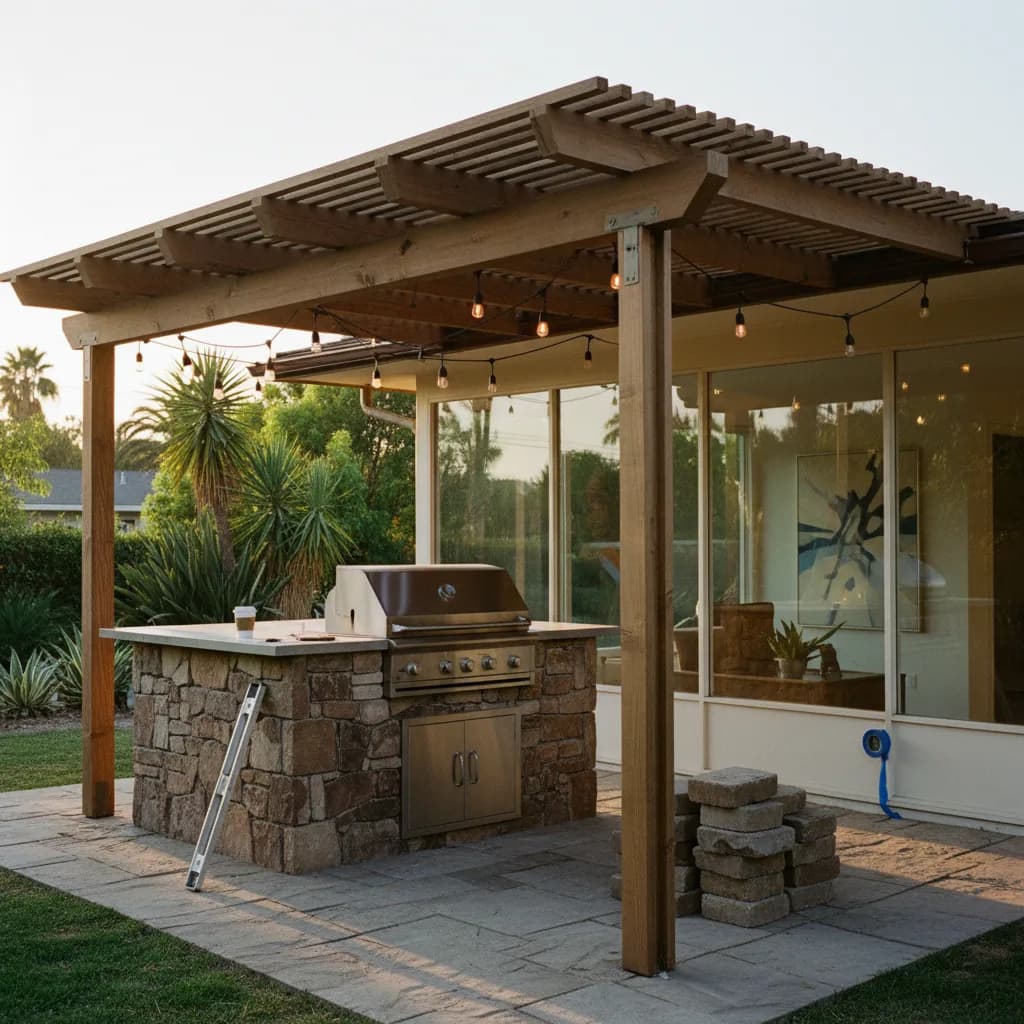
A built-in grill island is a small structure with a gas line and usually a circuit for lights, a refrigerator or an outlet. In the City that means a plumbing permit for the gas piping and an electrical permit for the power, on top of anything the structure itself needs. Ask the builder which trade pulls each permit and who schedules the inspections.
Lighting has a state rule too. Under the 2025 California Energy Code, outdoor lighting permanently mounted to the house or another building on the lot, including lighting for patios, must have a manual on and off switch plus automatic control: a photocell with a motion sensor, a photocell with a time switch, or an astronomical time clock (California Energy Commission, 2025 residential compliance manual, chapter 6). Any override must return to automatic within six hours. Low-voltage landscape lights staked in the yard are not covered by those requirements.
Swapping lawn for a water-wise yard: the LADWP rebate
If the plan includes taking out grass, LADWP and the Metropolitan Water District pay for it. The residential rebate is $5 per square foot, made up of $3 from LADWP and $2 from MWD, for projects from 250 to 5,000 square feet, so the most a household can receive is $25,000 (LADWP Turf Replacement Rebate). A 1,000 square foot lawn works out to $5,000.
The rules shape the design:
- Get pre-approval before removing any grass or starting the project.
- The new landscape needs California Friendly plants, mulch or another groundcover, a rain capture feature such as a rain garden or rain barrel, and drip irrigation.
- The project must be finished within six months of pre-approval.
- The converted area has to stay in compliance for five years.
LADWP points to October through March as the best planting time. LADWP also says rebate amounts can change and depend on availability when the application is approved, so check the page before counting on the money.
Watering days to design the irrigation around
The City is in Phase 2 of its water conservation ordinance. Addresses ending in an odd number water on Mondays, Wednesdays and Fridays, and even addresses on Sundays, Tuesdays and Thursdays (LADWP). All outdoor watering is prohibited from 9 a.m. to 4 p.m. (LADWP water conservation ordinance).
Sprinklers are limited to one cycle of up to 8 minutes per station per watering day on standard nozzles, or two 15-minute cycles on water-conserving nozzles. Runoff onto streets, driveways and gutters is not allowed, and neither is watering hard surfaces. A new planting plan that leans on drip lines and low-water plants fits inside those limits more easily than new lawn does.
Hillside lots in fire zones: brush clearance shapes the planting plan
If the house sits in a Very High Fire Hazard Severity Zone, the Fire Department requires year-round clearance of brush, weeds, grass and hazardous vegetation within 200 feet of any structure, and within 10 feet of a combustible fence or a driveway (LAFD brush clearance requirements). LAFD says these rules also apply to landscape vegetation, so they belong in the planting plan, not just the maintenance schedule.
- Grass is cut to 3 inches.
- Trees taller than 18 feet are trimmed so no foliage is within 6 feet of the ground.
- Foliage stays at least 10 feet from a chimney outlet, and branches keep 5 feet of vertical clearance above the roof.
- Chipped vegetation spread back on the lot can be no deeper than 3 inches within 30 feet of structures.
Crews doing the clearing cannot work on red flag days and must keep a fire extinguisher or a pressurized hose within 10 feet. For deck materials in fire zones, see our 2026 Los Angeles deck trends.
Adding a pool or spa
When a permit is issued for a new pool or spa, or for remodeling one, at a single-family home, California law requires at least two of seven drowning prevention features, such as an enclosure that separates the pool from the house, a certified safety pool cover, or exit alarms on doors and windows that open directly to the pool (California Health and Safety Code 115922). The building inspector checks them before final approval. For factory-built shells, see the prefab pools guide.
Licenses and payments for landscape work
Landscape construction has its own license. The C-27 Landscaping classification covers building and installing landscape systems and grading land for them (CSLB C-27 classification). State law exempts only jobs under $1,000 in total labor and materials that do not need a building permit (Business and Professions Code 7048). On a home improvement contract, the down payment cannot exceed $1,000 or 10 percent of the contract amount, whichever is less (Business and Professions Code 7159.5). For how Renology checks figures like these, see our methodology.
05 / Quick answers
Common questions
Does every patio need a permit?
Not every one. The City issued 434 patio cover permits and 1,231 retaining wall permits since September 2024, against 198 for patios and hardscape. Covers, walls and utilities are where permits come in.
How long does an outdoor project take?
Ask for separate dates for design, any permit and the build itself, and ask which phase can wait. Design, permitting, utility work and procurement can add time.
What should I draw before asking for prices?
Show the usable area, levels, shade, seating and utility locations. A simple site plan makes contractor exclusions and different approaches visible.
Is there a rebate for replacing my lawn in Los Angeles?
Yes. LADWP and the Metropolitan Water District pay residential customers $5 per square foot for 250 to 5,000 square feet of lawn, up to $25,000. You need pre-approval before removing any grass, and the new yard needs California Friendly plants, mulch, a rain capture feature and drip irrigation.
What days can I water my yard in Los Angeles?
Odd-numbered addresses water on Mondays, Wednesdays and Fridays, and even-numbered addresses on Sundays, Tuesdays and Thursdays. Outdoor watering is not allowed from 9 a.m. to 4 p.m. Hand watering with a self-closing nozzle is allowed any day outside those hours.
Do I need a permit for an outdoor kitchen in Los Angeles?
Usually more than one. In the City, LADBS requires a plumbing permit for fuel gas piping and an electrical permit for any electrical work, separate from any building permit for the structure.
How far do I have to clear brush around my house in Los Angeles?
In a Very High Fire Hazard Severity Zone, LAFD requires clearance of brush, weeds, grass and hazardous vegetation within 200 feet of any structure and within 10 feet of a combustible fence or driveway, with grass cut to 3 inches.
What safety features does a new pool need in California?
A new or remodeled pool or spa at a single-family home needs at least two of the seven drowning prevention features listed in Health and Safety Code 115922, checked by the building inspector before final approval.