
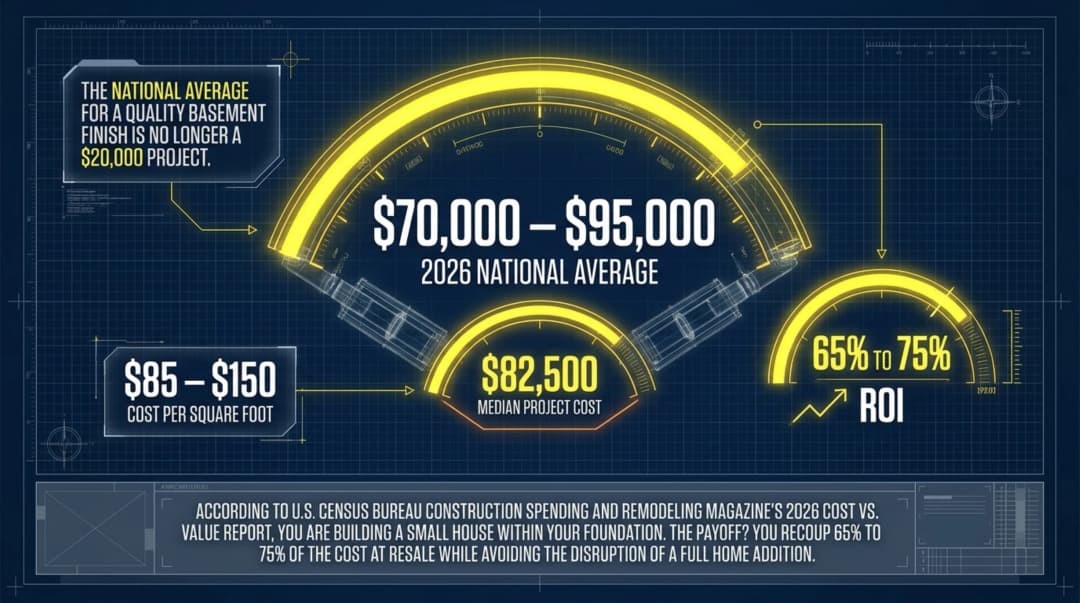
In this episode, we're tackling the one question every homeowner with an unfinished basement eventually asks: what does it actually cost to finish it? Most online calculators give you a number that feels suspiciously low. The truth is, the national average for a full basement remodel in 2026 lands between $70,000 and $95,000 for a quality job. This price can start lower for simple, open-plan media rooms without complex plumbing. We are going to break down why that number is so high, where the money really goes, and how to plan a project that doesn't spiral out of control. Forget the guesswork. This is about real numbers for 2026.
What This Episode Is About
If you only take three things away from our conversation about basement finishing costs, make it these. This is the core of what you need to understand before you call a single contractor.
- The Real Cost Spectrum: We'll break down the national data, showing why a basement finish is rarely a $20,000 project anymore. We'll cover the cost per square foot and what a realistic budget looks like for a basic, mid-range, and high-end conversion in 2026.
- The Hidden Systems: Most homeowners focus on drywall and flooring. The real cost drivers are mechanical, electrical, and plumbing systems, plus critical moisture and egress requirements that contractors often introduce late in the conversation. We'll tell you what to ask about upfront.
- Finish Specification Matters: The difference between a basement that feels like a bunker and one that feels like a natural extension of your home is in the finishes. We'll discuss how choices in lighting, flooring, and millwork impact not just the cost, but the long-term value and enjoyment of the space.
The Real Numbers (National Picture)
Let's get straight to the numbers. Forget the clickbait articles promising a finished basement for the price of a used car. According to data from Remodeling Magazine's 2026 Cost vs. Value report and analysis of U.S. Census Bureau construction spending, the national average basement finishing cost sits between $85 and $150 per square foot. For a typical 700-square-foot basement, this puts a realistic budget in the $60,000 to $105,000 range. The median project cost, where half of projects cost more and half cost less, is approximately $82,500. Why the wide range? It comes down to three factors: complexity, finishes, and location. A simple open-plan family room will be at the lower end. Add a full bathroom with an ejector pump, a wet bar, and custom built-ins, and you will quickly approach the higher end of that spectrum. In higher-cost-of-living areas on the coasts, those figures can easily climb by another twenty percent due to labor rates reported by the Bureau of Labor Statistics. The key takeaway is to anchor your expectations in this range. Anything significantly lower likely involves cutting corners on moisture proofing, insulation, or proper permitting, all of which are expensive mistakes to fix later.
Where Your Money Actually Goes: A Cost Breakdown
Homeowners see the new walls and floors, but most of your budget is spent on things you will never see. A basement finish is essentially building a small house within your house's foundation. Here is how a typical budget breaks down. Roughly 15-20% goes to framing and insulation. This is the skeleton of the space. Another 15-20% is for electrical and plumbing. This includes running new circuits, installing outlets, switches, a subpanel if needed, and all the rough-in plumbing for a bathroom or wet bar. HVAC modifications to properly heat and cool the space can take another 5-10%. Drywall, taping, and painting will consume about 10-15% of the budget. Now we get to the visible parts. Flooring accounts for 5-10%, depending on whether you choose builder-grade carpet or a high-performance luxury vinyl plank like Coretec. The remaining 20-30% is for your finishes: doors, trim, lighting fixtures, bathroom fixtures, cabinetry, and any special features like a fireplace or built-in shelving. This finish category is where your choices have the biggest impact on the final basement finishing cost. Upgrading from basic hollow-core doors to solid-core, or from recessed cans to designer light fixtures, can add thousands to the bottom line.
What Most Homeowners Get Wrong About This
Most homeowners think a basement project is cosmetic. They budget for carpet and paint. The reality is that you are dealing with a subterranean space that has unique challenges with moisture, light, and safety. The biggest mistake is underestimating the cost of the infrastructure. This isn't like remodeling a bedroom. You are creating a conditioned, habitable space from a concrete shell. The fix is to budget for the systems first, then the finishes. Get the bones right. Get the waterproofing perfect. Get the egress window installed correctly. The National Association of Home Builders recommends a ten to fifteen percent contingency on renovations in homes over thirty years old, and for basements, I consider this non-negotiable. Unexpected water intrusion or foundation cracks can derail a project instantly. Homeowners who get this right focus their initial conversations with contractors on three things: water management, code compliance, and mechanical systems. They know that a dry, safe, and comfortable basement is the foundation for everything else. They refuse to compromise on the unsexy parts of the job, because that is where the real value lies.
The 'Gotcha' Costs Contractors Don't Mention
Every project has potential surprises, but basements have a predictable set of them. These are the costs that often appear in change orders, conveniently after you are too committed to back out. The first is egress. The International Residential Code (IRC) requires any basement with a sleeping area to have a direct path to the outside. This usually means cutting a large opening in your foundation to install an egress window and well, a project that can cost $5,000 to $10,000 alone. Second is moisture and radon mitigation. If your contractor isn't testing for radon gas or suggesting a solid moisture barrier system behind the walls and under the floor, they are not a true basement specialist. A quality interior drainage system or a radon fan can add several thousand dollars. Third is the electrical panel. Older homes often have maxed-out 100-amp panels. A basement finish with its own lighting, outlets, and potentially a kitchenette will almost certainly require a panel upgrade and a subpanel, costing $2,000 to $4,000. Finally, be prepared for surprises behind the walls. Once framing starts, you might discover foundation cracks or old, leaky pipes that need immediate attention. These are the budget-killers that a low-ball quote conveniently ignores.
How Finishes Drive Your Final Price Tag
3 pros, editor-screened. 4 questions.
See my 3 matchesThe finishes are where you have the most control over the basement finishing cost, but it is also where a budget can quickly unravel. Let's talk specifics. For flooring, basic carpet might cost $4-$6 per square foot installed. A durable luxury vinyl plank (LVP) from a brand like Flooret or Coretec will run $8-$12 per square foot. For a 700-square-foot space, that is a difference of thousands. Lighting is another major driver. A contractor's basic package might include a dozen cheap recessed can lights. Upgrading to higher-quality LED fixtures with better color rendering and adding accent lighting can easily double or triple the lighting budget. Then there is the bathroom. A simple powder room might cost $10,000. A full bathroom with a tiled shower, glass door, and quality vanity can cost $25,000 or more. The fixtures matter. A faucet from a big-box store might be $150. A solid brass faucet from a brand like Brizo or Waterworks can be over $1,000. These choices add up. My advice is to allocate your finish budget strategically. Spend money on the things you touch and interact with every day: high-quality flooring, solid-core doors, and good lighting. You can save on things like decorative hardware or basic trim that can be upgraded later.
Information Gain: The Ten-Year Finish Test
What no one else covers is how your basement will look and feel ten years from now. Most contractors build to pass inspection today. My job is to tell you how to build so it lasts a decade. The basement is a high-abuse, high-moisture environment. Your material choices must reflect that reality. First, flooring. Do not install solid hardwood or cheap laminate. They will fail. The only two options I recommend are high-quality Luxury Vinyl Plank (LVP) with a thick wear layer (at least 20 mil) or porcelain tile. For LVP, look for a stone-polymer composite (SPC) core for maximum stability. For tile, insist on a waterproofing and uncoupling membrane like Schluter-DITRA underneath. It prevents cracks and manages moisture. Second, wallboard. Use paperless or mold-resistant drywall, especially on exterior foundation walls. It is a marginal cost increase for a huge gain in mold prevention. Third, paint. Do not use standard latex paint. Specify a high-durability acrylic paint designed for commercial spaces, like Benjamin Moore's Scuff-X or Sherwin-Williams' Pro Industrial line. It resists scuffs from kids, furniture, and life. It is also washable without changing the sheen. Finally, lighting. Basements lack natural light. Your lighting plan is critical. Use 4-inch recessed LEDs with a high Color Rendering Index (CRI) of 90+ to make colors look accurate and vibrant. Space them closer than you would upstairs and put everything on dimmers. These choices might add five to eight percent to the initial basement finishing cost, but they prevent the costly and disruptive need to redo failing finishes in just a few years.
Three Representative Projects from 2026
To make the numbers more concrete, here are three representative projects from 2026, scoped similarly. The scenarios below are modeled estimates built from the Renology Cost Index and typical local scopes, not completed client projects.
- The Basic Rec Room ($55,000): A 600-square-foot open space. The homeowner wanted a durable place for kids to play. The scope included framing, insulation, basic electrical, mold-resistant drywall, and LVP flooring. There was no bathroom and no complex plumbing. Lighting was simple recessed cans. This project represents the entry-level cost for a professionally finished, properly permitted space. The key cost-saver was the simple, open layout.
- The Mid-Range Guest Suite ($92,000): This project converted 800 square feet into a bedroom, a full bathroom, and a family room area. The bathroom required an ejector pump to handle waste, adding significant plumbing costs. An egress window was cut into the foundation for the bedroom. Finishes were a step up: solid-core doors for soundproofing, better-quality carpet in the bedroom, and a tiled shower with a glass door. This is the most common type of basement project we see.
- The High-End Entertainment Zone ($165,000+): This 1,200-square-foot project had it all. A home theater with surround sound pre-wiring, a wet bar with custom cabinetry and a beverage fridge, a full bathroom with a steam shower, and a home gym with a rubber floor. The finishes were top-tier: custom built-in bookshelves, designer lighting fixtures, and high-end plumbing fixtures from Kohler's premium line. This illustrates how custom features and luxury finishes can significantly increase the total basement finishing cost.
The 3 Questions Every Homeowner Should Ask
Before you sign a contract, you need to ask pointed questions. Most homeowners ask about the timeline and the total cost. You need to go deeper. Here are the three questions that will tell you if your contractor truly understands how to build a basement that lasts.
1. How will you keep the space dry, permanently?
Why this matters: Water is the enemy of any basement. A good answer should involve more than just a coat of sealant on the walls. What a good answer sounds like: "We'll start by checking the exterior grading and gutters. Inside, we'll install a dimple mat membrane like DMX against the foundation walls and a thermal break, then build the stud wall in front of that. This creates an air gap and capillary break so any moisture that comes through the concrete can dry out."
2. What is your detailed lighting plan?
Why this matters: Bad lighting is what makes a basement feel like a basement. It's an afterthought for most contractors, but it should be a primary design consideration. What a good answer sounds like: "We'll create a layered lighting plan. We'll use 4-inch, 3000K recessed LEDs for general ambient light, spaced about four to five feet apart. We'll add task lighting over the bar and accent lighting to highlight the built-ins. Everything will be on dimmers for full control."
3. How do you handle unforeseen conditions and change orders?
Why this matters: Surprises are inevitable in a basement. You need to know how they will be handled and billed before they happen. What a good answer sounds like: "We include a contingency allowance in our proposal for you to control. If we find something like a foundation crack, we stop work, document it with photos, and present you with a fixed-price change order detailing the cost for the repair. No work proceeds until you approve it in writing."
What Changed in 2026
The landscape for remodeling has shifted since 2024, and the basement finishing cost reflects these changes. First, the interest rate environment has stabilized but remains higher than the lows of previous years. This means financing a project with a HELOC or cash-out refinance is more expensive, making cash-funded projects more common. Second, material costs have seen some volatility. While lumber prices have come down from their peaks, engineered wood products, copper for wiring, and insulation costs have seen steady increases, according to the Bureau of Labor Statistics Producer Price Index. Lead times for specific items like custom cabinetry and high-end appliances have improved but are not back to pre-pandemic levels. On the regulatory front, many municipalities are adopting the 2024 International Residential Code (IRC), which has stricter requirements for insulation R-values and air sealing. This can add a small amount to the upfront cost but results in a more energy-efficient space. Looking ahead to 2027, we anticipate continued pressure on labor costs as skilled trade shortages persist, keeping overall project costs firm.
The Renology Take
Here's the pattern most homeowners miss. They treat a basement remodel like an interior design project. They get excited about paint colors and sectional sofas. But a basement finish is a construction project, first and foremost. It's about managing water, air, and structure in a hostile underground environment. The homeowners who win are the ones who obsess over the boring stuff. They spend more time asking about sump pumps and vapor barriers than they do about bar stools. Get the envelope right. Make it dry, warm, and safe. If you do that, any finishes you put inside will last. If you don't, the most beautiful finishes in the world will be ruined in five years. Focus on the science before the style. That's the single most important decision you'll make.
Sources & Methodology
See the Renology Methodology for how sources are reviewed, ranges are normalized, and planning-data limits are handled.
- Remodeling Magazine: 2026 Cost vs. Value Report (National Averages)
- National Association of Home Builders (NAHB): Remodeling Market Index (RMI), Q1 2026
- U.S. Census Bureau: Monthly Construction Spending, Residential Improvements, 2026 Data
- U.S. Bureau of Labor Statistics (BLS): Producer Price Index (PPI) for Construction Materials, 2026
- U.S. Bureau of Labor Statistics (BLS): Occupational Employment and Wage Statistics, Construction Trades
- Harvard Joint Center for Housing Studies (JCHS): Leading Indicator of Remodeling Activity (LIRA), 2026
- International Code Council: 2024 International Residential Code (IRC)
- U.S. Environmental Protection Agency (EPA): Radon and Home Construction Guidelines
- National Kitchen & Bath Association (NKBA): 2026 Design Trends Report
- James Hardie: Homeowner Survey on Exterior & Interior Finishes, 2025
- Schluter Systems: Installation and Waterproofing Best Practices Manual, 2026 Edition
- Renology Data Science Team: Analysis of anonymized project data from the Renology network, 2025-2026
This article is from The Renology Magazine, the renovation magazine and contractor-advisory for homeowners in Southern California, San Diego, and Greater Seattle. Want more renovation breakdowns? Search "The Renology Magazine" on Google.
Frequently Asked Questions
What is the ROI on finishing a basement in 2026?
Do I need a permit to finish my basement?
How long does it take to finish a basement?
Can I save money by acting as my own general contractor?
What is the most important thing to spend money on in a basement remodel?
How can I make a basement feel less like a basement?
Is a wet bar worth the investment?
What's the difference between a finished basement and a remodeled basement?
Get 3 renovation bids in 48 hours.
Our editors already vetted contractors. Answer 4 questions and we send 3 written bids inside 48 hours, with the real price for your scope, not their inflated first-call number.
- Free, no commission
- Pre-screened locally
- Bids inside 48 hours
Takes about 60 seconds. We'll text you when bids arrive.
Sources
- Remodeling Magazine: 2026 Cost vs. Value Report (National Averages)
- National Association of Home Builders (NAHB): Remodeling Market Index (RMI), Q1 2026
- U.S. Census Bureau: Monthly Construction Spending, Residential Improvements, 2026 Data
- U.S. Bureau of Labor Statistics (BLS): Producer Price Index (PPI) for Construction Materials, 2026
- U.S. Bureau of Labor Statistics (BLS): Occupational Employment and Wage Statistics, Construction Trades
- Harvard Joint Center for Housing Studies (JCHS): Leading Indicator of Remodeling Activity (LIRA), 2026
- International Code Council: 2024 International Residential Code (IRC)
- U.S. Environmental Protection Agency (EPA): Radon and Home Construction Guidelines
- National Kitchen & Bath Association (NKBA): 2026 Design Trends Report
- James Hardie: Homeowner Survey on Exterior & Interior Finishes, 2025
- Schluter Systems: Installation and Waterproofing Best Practices Manual, 2026 Edition
- Renology Data Science Team: Analysis of anonymized project data from the Renology network, 2025-2026