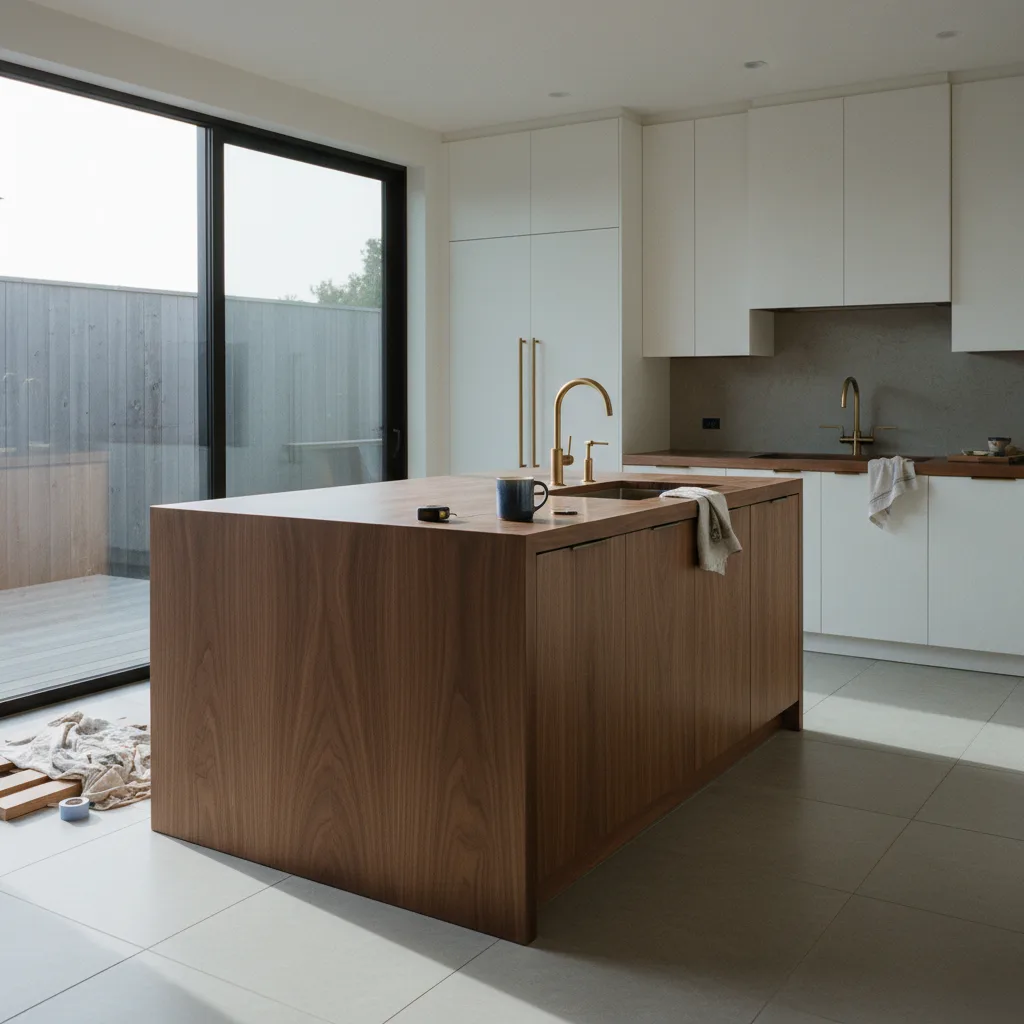
Planning a kitchen in Santa Monica? A full project typically runs $66,000 to $110,000 in 2026. Cosmetic refreshes start near $40,000; premium custom work climbs past $130,000. This is what your budget actually covers, what drives the price up, and how to vet a contractor who knows Santa Monica permits.
The Honest 2026 Price for a Kitchen in Santa Monica
In the world of home renovation, budget transparency is the ultimate luxury. Here at Renology, we analyze real project invoices to provide a clear picture of what it truly costs to create a beautiful, functional kitchen in Santa Monica. For 2026, the data points to a clear range: a comprehensive, mid-range kitchen renovation will command a budget between $66,000 and $110,000. This figure represents the sweet spot for most homeowners, covering a full gut renovation with quality materials and professional installation.
Of course, this is a market of nuance. A cosmetic refresh, focused on surfaces and fixtures without altering the layout, can be achieved for a more modest $40,000 to $66,000. This might involve professionally refinishing existing cabinetry, installing new quartz countertops, a classic tile backsplash, and updating appliances within their existing locations. On the other end of the spectrum, a premium, custom project often starts at $130,000 and can easily exceed $200,000. These are the projects of design magazines, involving structural changes, bespoke cabinetry, professional-grade appliances, and statement-making materials like a honed Calacatta slab for the island and backsplash.
Key takeaway
The "all-in" cost is more than just materials and labor. A realistic Santa Monica budget must account for design fees (5-15%), city permit fees (which can run into the thousands), and a contingency fund of 10-15%. This contingency is not a sign of poor planning; it is a professional standard for addressing the inevitable surprises found within the walls of older homes, like outdated knob-and-tube wiring or un-vented plumbing.
What Drives Kitchen Costs in Santa Monica
See what a kitchen remodel actually costs in your Santa Monica zip.
Take 4 questions →Understanding the line items in a contractor's bid is the first step toward a successful project. In a high-value market like Santa Monica, costs are driven by a distinct set of factors that go far beyond the national averages. Labor, material specification, and the complexities of local regulations each play a significant role in shaping the final number.
Labor: The Santa Monica Premium
Skilled labor is the single largest component of a kitchen budget, often accounting for 40-50% of the total cost. Santa Monica attracts top-tier talent, from general contractors to specialized subcontractors, and their expertise comes at a premium. The demand for licensed, insured, and reliable tradespeople is exceptionally high. You are not just paying for a carpenter; you are paying for a finish carpenter who can scribe custom cabinetry perfectly to an uneven wall, a tile setter who understands the intricacies of laying handmade Zellige tile, and a plumber who can work through the city’s specific code requirements. This level of craftsmanship is what separates a good result from a great one.
Materials and Finishes: From Stock to Statement
This is where the design vision truly comes to life, and where the budget can fluctuate most dramatically. The difference between a $60,000 kitchen and a $160,000 one often lies in the material choices.
- Cabinetry: The foundation of any kitchen. Stock or semi-custom cabinets from a big-box store are the most budget-friendly. A step up is high-quality semi-custom from a dedicated cabinet maker. The premium tier involves fully custom, site-built cabinetry, perhaps a rift-cut white oak vanity with integrated finger pulls or classic beaded-inset doors with a factory-sprayed finish.
- Countertops: Engineered quartz is the durable, popular choice for mid-range projects. Natural stones like granite and marble introduce more variation and cost. The highest end involves sourcing specific slabs, like a dramatic Calacatta Viola with deep purple veining, which requires careful selection and expert fabrication, especially if you plan to book-match the pattern across a waterfall island.
- Appliances: A standard suite of stainless-steel appliances might cost $8,000 to $15,000. A professional-grade package from brands like Wolf, Sub-Zero, or Miele can easily run from $30,000 to $50,000 or more, especially when including features like steam ovens and integrated coffee systems.
- Fixtures and Lighting: Faucets, cabinet hardware, and lighting are the jewelry of the kitchen. While seemingly small, these choices add up. A faucet can range from $300 to $3,000. A well-designed lighting plan, crucial for both function and ambiance, will include recessed cans, under-cabinet task lighting, and decorative pendants, all of which must comply with California's strict Title 24 energy code.
Soft Costs: The Invisible Structure
Often overlooked by first-time renovators, soft costs are essential for a smooth, legal, and well-executed project. These include fees for an architect or designer to draw up plans, a structural engineer if you are removing a load-bearing wall, and the permit application fees paid to the City of Santa Monica. In a city with rigorous building standards, investing in detailed plans from the outset is the best way to prevent costly delays and change orders down the line.
Santa Monica Kitchen by Tier: 3 Real Project Examples
To make these numbers tangible, we have broken down three typical project scopes we see in the Santa Monica market. These examples, based on aggregated 2026 data from the Renology network, illustrate what you can expect at each investment level.
Editor's note
These timelines reflect the active construction phase. Always add four to ten weeks to your total project timeline for the design, material selection, and permitting phases that happen before a single hammer is swung.
| Tier | Scope | Cost Range | Timeline |
|---|---|---|---|
| Cosmetic Refresh | Working within the existing layout. Refinish or reface cabinets, new quartz countertops, new tile backsplash, new sink and faucet, new light fixtures, paint. Appliances replaced in same locations. No plumbing or electrical relocation. | $40,000 - $66,000 | 4 - 7 weeks |
| Mid-Range Full Renovation | Full gut demolition. New semi-custom cabinetry, new layout (e.g., adding an island), new stone or high-end quartz countertops, full-height backsplash, new appliance suite, new flooring, updated electrical and plumbing to code, comprehensive lighting plan. | $66,000 - $110,000 | 8 - 14 weeks |
| Premium Custom Gut | Full gut demolition with structural changes (e.g., removing walls to create an open concept). Fully custom cabinetry, premium natural stone slabs (e.g., marble, quartzite), professional-grade appliances (e.g., Sub-Zero, La Cornue), custom range hood, high-end plumbing fixtures, potentially moving windows or doors. Architect and/or interior designer involvement is standard. | $130,000 - $200,000+ | 12 - 20+ weeks |

Permits and Local Code in Santa Monica
Renovating in Santa Monica means working closely with the City of Santa Monica Planning and Community Development Department. Any project that involves moving electrical outlets, altering plumbing lines, or changing structural elements requires a building permit. This is not a step to be skipped; working without a permit can result in stop-work orders, fines, and significant difficulty when you eventually sell your home.
The Permitting Process
Your contractor or architect will submit a full set of plans for review. For a kitchen, this typically includes a floor plan, electrical plan, plumbing plan, and mechanical plan if you are adding or moving a range hood vent. The city’s plan checkers will review these documents for compliance with the California Building Code (CBC), California Residential Code (CRC), and local Santa Monica ordinances. The initial review process can take anywhere from two to eight weeks, depending on the complexity of your project and the department's current workload.
Key Codes to Know
Beyond the basic structural and safety codes, two California-specific regulations heavily influence kitchen design:
- Title 24: California’s energy code is one of the strictest in the nation. In the kitchen, this dictates lighting choices. At least 50% of the wattage must come from high-efficacy sources, which essentially means LED fixtures. All lighting must be controlled by dimmers or vacancy sensors.
- CALGreen: The California Green Building Standards Code requires the use of low-VOC (volatile organic compound) paints, adhesives, and sealants. It also sets standards for plumbing fixture flow rates and construction waste diversion, mandating that a significant percentage of demolition debris be recycled.
Pro tip
If your home is located in the Coastal Zone (generally west of Lincoln Blvd, but check the city's official map), your project may also require review and a Coastal Development Permit (CDP) from the city, adding another layer of review and specific requirements designed to protect coastal resources.
The Santa Monica Neighborhoods Where Kitchen Costs Diverge
While the city is geographically small, the character and housing stock of its neighborhoods can create meaningful differences in project costs. A kitchen renovation is not a one-size-fits-all proposition, and local context matters immensely.
In my last walkthrough in Santa Monica, I visited two projects that perfectly illustrate this point. The first was a charming 1940s Spanish-style home in Sunset Park. The second was a larger, more contemporary residence North of Montana. While both were mid-range renovations in terms of finish quality, their budgets and challenges were worlds apart.
Sunset Park and Ocean Park
The homes in neighborhoods like Sunset Park and Ocean Park are often smaller, post-war bungalows built between the 1920s and 1950s. While full of character, this vintage presents specific challenges. The kitchens are typically smaller, and opening them up often requires significant structural work to remove load-bearing plaster walls. More importantly, the infrastructure is old. A renovation here almost always requires a full electrical upgrade to replace old wiring and a new, larger panel to support modern appliances. Plumbing often needs to be completely replaced to meet current code. These infrastructure upgrades can add $10,000 to $20,000 to a project before a single cabinet is installed. Site access can also be tighter, making material delivery and debris removal more complex.
North of Montana
This neighborhood is characterized by larger lots and more substantial homes, many of which have been built or significantly renovated in the last 20-30 years. Here, the challenge is less about aging infrastructure and more about scale and expectation. Kitchens are larger, often part of a great room, and the expected level of finish is higher. A project here is more likely to fall into the premium tier, with a professional-grade appliance package, a large island with seating, and custom cabinetry as the baseline expectation. While site access is easier, the sheer volume of materials and the scale of the work drive the budget upward. Homeowner association (HOA) rules or design review boards can also add another layer of approvals and aesthetic constraints to the process.
Timeline: Realistic Week-by-Week Expectations
A successful renovation runs on a clear and realistic schedule. While every project is unique, the overall phasing is consistent. The total duration from your first call to a designer to the final toast in your new kitchen is typically four to six months. The construction itself is often the shortest phase.
The fastest way to slow down a project is to rush the planning phase.
- Phase 1: Design & Sourcing (4-8 weeks): This is the most critical phase. You will work with a designer or architect to finalize your layout. You will also select every single material: cabinets, countertops, tile, flooring, appliances, lighting, and hardware. Long-lead items, like custom cabinetry (8-14 weeks) and certain high-end appliances (6-12 weeks), must be ordered now to avoid delays later.
- Phase 2: Permitting (4-8 weeks): Once the design is finalized, your contractor submits the plans to the City of Santa Monica. This period is often a waiting game, though your contractor can use the time to finalize subcontractor schedules.
- Phase 3: Construction (6-14 weeks):
- Week 1: Demolition & Site Prep. The old kitchen is removed, and the space is prepped. This is when surprises, like hidden water damage or structural issues, are most likely to be discovered.
- Weeks 2-4: Rough-ins. The bones of the new kitchen are put in place. This includes framing new walls, and running new electrical wiring, plumbing supply and drain lines, and HVAC ducting. This work is then inspected by the city.
- Weeks 5-7: Drywall & Flooring. After the rough-in inspections pass, the walls are closed up with drywall, which is then taped, mudded, and primed. Flooring is typically installed at this stage.
- Weeks 8-10: Cabinetry & Countertops. The new cabinets are installed. A fabricator will then visit the site to create a precise template for your countertops, which are typically installed 7-10 days later.
- Weeks 11-12: Finishes. The final details come together. The backsplash is installed, appliances are set in place, and the electrician and plumber return to install fixtures (faucets, lighting, outlets, switches).
- Week 13-14: Punch List & Final Inspection. You and your contractor will walk through the kitchen and create a "punch list" of any final items that need adjustment. After these are complete, the city performs a final inspection to officially close the permit.
How to Vet a Santa Monica Contractor
Choosing the right general contractor is the most important decision you will make. In a competitive market like Santa Monica, it is essential to do your due diligence. A great contractor is a partner who communicates clearly, respects your home, and delivers high-quality work.
Questions to Ask Beyond the Basics
Once you have confirmed they are licensed with the California Contractors State License Board (CSLB) and fully insured, dig deeper with these questions:
- How many projects does a single project manager oversee at one time? (A dedicated or low-ratio manager is a sign of quality.)
- Can you provide me with contact information for your last three clients?
- What is your preferred method of communication (email, text, app) and how often can I expect updates?
- Can I see a sample of your project schedule and a change order form?
- Who will be on-site every day? Will it be a lead carpenter or a project manager?
- Do you have established relationships with architects and designers who work in Santa Monica?
Red Flags to Watch For
Be wary of contractors who exhibit any of these behaviors:
- Vague Bids: A professional bid is highly detailed, with line items for each phase and material allowance clearly specified. A one-page quote is a major red flag.
- High-Pressure Sales Tactics: A good contractor will never pressure you to sign a contract on the spot. They understand this is a major decision.
- Requests for Large Upfront Payments: California law limits the down payment a contractor can request to 10% of the contract price or $1,000, whichever is less. Anything more is illegal.
- Lack of a Local Portfolio: A contractor who primarily works in the Valley may not be familiar with the specific logistics and inspection processes in Santa Monica. Look for a track record of successful projects in your immediate area.
Renology Take
As an editor, I review hundreds of kitchen projects a year. The most successful renovations I see in Santa Monica share one common trait: a deep investment in the planning phase. The meta-pattern homeowners often miss is that the physical construction is the final, almost pre-determined act in a much longer play. The real work happens in the first eight weeks of design, material selection, and meticulous vetting of your build team. Rushing this critical "soft" phase to get to demolition faster is the single biggest mistake you can make. It inevitably leads to change orders, budget overruns, and a compromised design. In a market this sophisticated, patience and preparation are not just virtues, they are the essential ingredients for a beautiful, lasting, and financially sound investment in your home.
Sources & Methodology
These cost ranges are reconstructed from publicly available labor and permit data, the latest Remodeling Magazine cost-vs-value report, and Renology's own Project of the Day network, a rolling sample of real homeowner invoices we collect from Santa Monica-area contractors. Last refreshed April 2026.
- National Association of Home Builders (NAHB) Remodeling Market Index, Q1 2026
- California Department of Industrial Relations, Los Angeles County Prevailing Wage Data, 2026
- City of Santa Monica Planning and Community Development Department Permit Data, 2026
- Remodeling Magazine, 2026 Cost vs. Value Report
- Renology Project of the Day Network, aggregated 2026 contractor invoices in Santa Monica
- California Contractors State License Board (CSLB)
- California Building Standards Commission (Title 24 & CALGreen)
Methodology
How Renology estimates kitchen costs in Santa Monica.
Renology treats this page as a planning benchmark for Santa Monica, California, not a final quote. We compare published local guide data, contractor scope patterns, permit-sensitive work, climate or site constraints, and finish-level assumptions.
Cost range
$66,000-110,000
Timeline
6-14 weeks
Source type
Editorial dataset
Local factor: Mediterranean (Köppen Csa): 14 inches annual rain, hot dry summers, mild winters. UV intensity is high year-round.
Use these numbers to shape a scope and spot missing line items. Confirm permits, structural work, electrical, plumbing, gas, waterproofing, drainage, and code-sensitive details with the local building department and a licensed professional.
Compare against the full Renology Cost IndexSanta Monica · pre-screened
Get 3 Santa Monica renovation bids in 48 hours.
Our editors already vetted Santa Monica contractors. Answer 4 questions and we send 3 written bids inside 48 hours, with the real price for your scope, not their inflated first-call number.
- Free, no commission
- Pre-screened locally
- Bids inside 48 hours
Takes about 60 seconds. We'll text you when bids arrive.