Planning a kitchen in Pasadena? A full renovation typically runs $66,000 to $110,000 in 2026. Cosmetic refreshes start near $40,000, while premium custom work with structural changes can easily climb past $130,000. Here is what your budget actually covers, what drives the price up, and how to vet a contractor who knows Pasadena permits.
The Honest 2026 Price for a Kitchen in Pasadena
As the kitchens editor at Renology, I review hundreds of project invoices each year. The single most common point of confusion for homeowners is the gap between national cost averages and the reality of renovating in a high-demand market like Pasadena. The numbers you see on home improvement shows or national websites often fail to account for the specific pressures of the Los Angeles metro area: the cost of skilled labor, the complexity of permitting, and the unique challenges of working with the city's diverse and often historic housing stock.
For 2026, a comprehensive, mid-range kitchen renovation in Pasadena lands squarely between $66,000 and $110,000. This range covers a full gut renovation in a typical 150 to 200-square-foot kitchen, including new semi-custom cabinetry, quality countertops like quartz or quartzite, a reliable appliance package, new flooring, and all the requisite electrical and plumbing work performed by licensed trades.
If your budget is tighter, a cosmetic refresh can deliver a significant aesthetic upgrade for $40,000 to $66,000. This approach preserves the existing layout, focusing on surface-level changes like painting cabinets, installing a new backsplash, and replacing countertops and fixtures. At the other end of the spectrum, a premium or luxury renovation starts at $130,000 and can extend well beyond $200,000. These projects involve structural modifications, fully custom cabinetry, professional-grade appliances, and high-end materials like natural stone slabs and designer lighting.
What Drives Kitchen Costs in Pasadena
See what a kitchen remodel actually costs in your Pasadena zip.
Take 4 questions →Understanding the anatomy of a bid is the first step toward a successful renovation. Costs are not arbitrary; they are a direct reflection of scope, material quality, and local economic factors. In Pasadena, the primary cost drivers fall into three main categories.
Labor and Professional Services
In the Los Angeles basin, skilled labor is a premium commodity. Roughly 50 to 60 percent of your total project cost will be allocated to labor and professional services. This includes not just the general contractor's management fee but also the specialized work of licensed electricians, plumbers, and tile setters. The quality of this craftsmanship is what separates a durable, beautiful kitchen from one that shows its flaws within a few years. An experienced contractor who knows Pasadena's building codes and inspectors is an invaluable asset, and their expertise is priced into the project cost.
Materials and Finishes
This is where your design vision comes to life, and it is also the area with the widest cost variability. The difference between stock laminate cabinets from a big-box store and a custom-built, rift-cut white oak vanity is immense, both in price and in quality. Your choices in countertops, appliances, flooring, and lighting will significantly influence the final invoice.
- Cabinetry: Stock cabinets can cost as little as $150 per linear foot, while semi-custom options range from $400 to $800, and fully custom work can exceed $1,200 per linear foot.
- Countertops: A basic laminate or tile countertop might cost $30 per square foot installed, whereas a quality quartz runs $80 to $120, and a premium material like a honed Calacatta Gold marble slab can easily top $200 per square foot.
- Appliances: A reliable suite of appliances from a brand like Bosch or KitchenAid can be sourced for $8,000 to $15,000. A professional-grade package with brands like Sub-Zero, Wolf, or Miele will start at $25,000 and go up from there.
Permits and Structural Changes
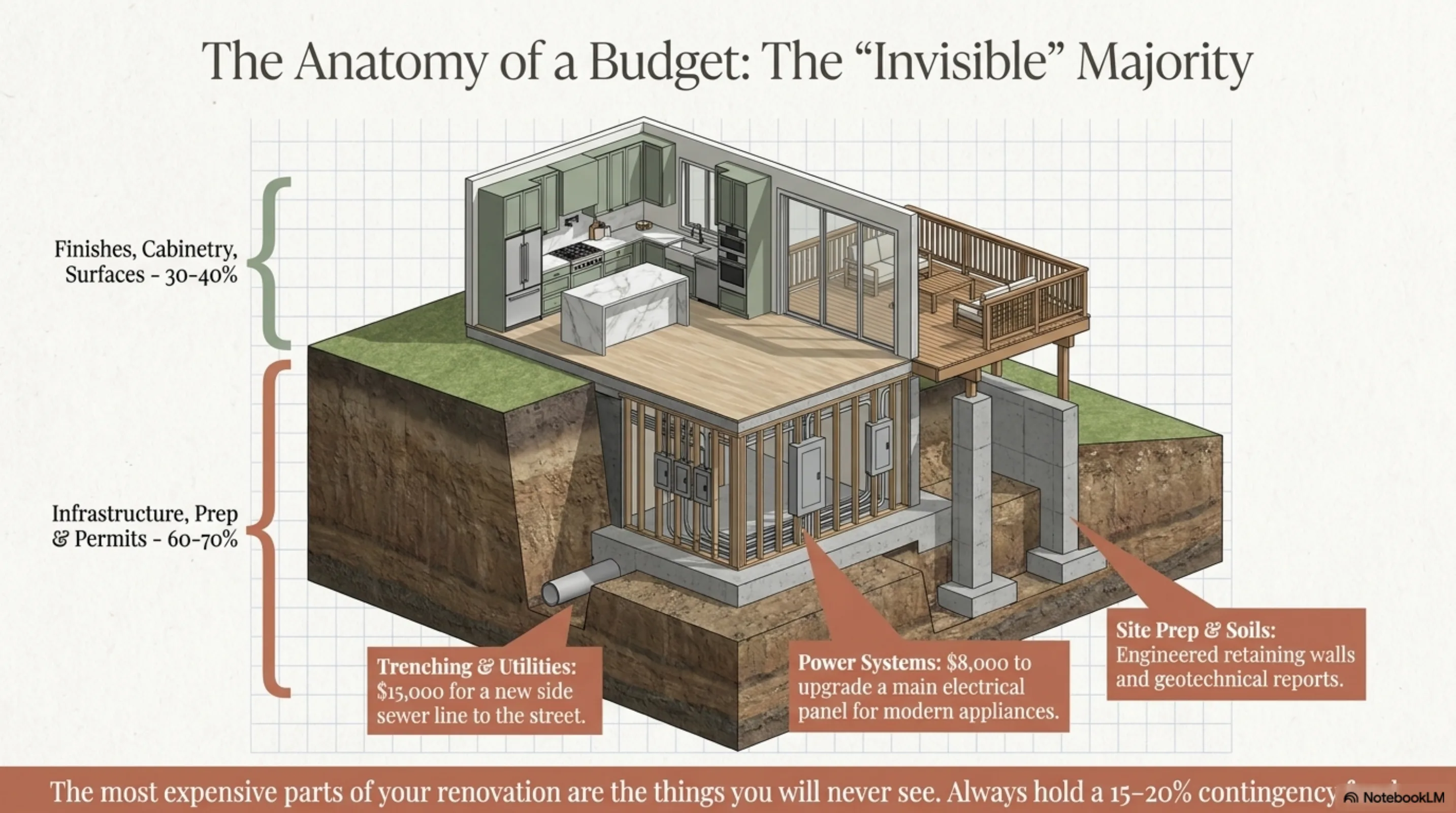
Any project that alters the structure of your home or moves plumbing, electrical, or gas lines will require a permit from the Pasadena Planning & Community Development Department. The permit fees themselves are a minor part of the cost, typically a few thousand dollars. The real expense comes from the work required to meet current building codes. Many of Pasadena's charming older homes have outdated electrical panels or cast-iron plumbing that must be brought up to modern standards once walls are opened. Removing a load-bearing wall to create an open-concept kitchen, for instance, requires architectural plans, engineering calculations, and the installation of a substantial support beam, adding thousands to the project cost.
Pro tip
Always budget a 15 to 20 percent contingency fund. In older Pasadena homes, it is not a question of *if* you will find something unexpected behind the walls, like outdated knob-and-tube wiring or an unvented plumbing stack, but *when*. A healthy contingency turns a potential crisis into a manageable line item.
Pasadena Kitchen by Tier: 3 Real Project Examples
To make these numbers more concrete, let's examine three distinct project tiers. We have compiled these scopes and costs from recent projects completed by contractors in the Renology network. These examples illustrate what you can realistically achieve at different budget levels in Pasadena.
| Tier | Scope of Work | Cost Range | Timeline |
|---|---|---|---|
| Cosmetic Refresh | Keep existing layout. Refinish or reface cabinets, new quartz countertops, install new tile backsplash, replace sink and faucet, new light fixtures, fresh paint. No permits typically required. | $40,000 to $66,000 | 3 to 5 Weeks |
| Mid-Range Renovation | Full gut of existing kitchen. New semi-custom cabinets, new layout (e.g., adding an island), mid-grade appliance package, quartzite or quartz countertops, new hardwood or LVP flooring, updated plumbing and electrical within existing locations. Permits required. | $66,000 to $110,000 | 6 to 12 Weeks |
| Premium Custom | Full gut with structural changes (e.g., removing walls). Fully custom cabinetry, professional-grade appliances (Sub-Zero, Wolf), natural stone slab countertops and backsplash, designer lighting, new windows, relocating plumbing and electrical. Architectural and design services included. | $130,000 to $200,000+ | 12, 20+ Weeks |
Permits and Local Code in Pasadena
Working with the city is a non-negotiable part of any significant kitchen renovation. Your contractor should handle the entire permitting process, but understanding the landscape is crucial for setting realistic expectations for your timeline and budget. Pasadena has its own specific requirements that build upon state-level mandates.
The Pasadena Planning & Community Development Department
This is the agency that will review your plans and issue your building permit. Your contractor or architect will submit a full set of drawings detailing every aspect of the proposed work, from electrical layouts to plumbing schematics. A simple kitchen remodel without structural changes might get through plan check in four to six weeks. However, if your home is in a historic district or involves complex engineering, expect a longer review period.
California Building and Energy Codes
All work must comply with the California Residential Code (CRC) for safety and structural integrity. Additionally, two key state-level codes impact kitchen projects:
- Title 24: This is California's energy efficiency code. For kitchens, it mandates high-efficacy lighting (almost always LED), requires that new appliances meet certain efficiency standards, and may have requirements for ventilation hoods.
- CALGreen: The California Green Building Standards Code requires builders to use low-VOC paints and finishes, install water-conserving fixtures, and divert a certain percentage of construction waste from landfills through recycling.
Did you know
If your Pasadena home is designated as a historic landmark or located within a historic district like Bungalow Heaven, your exterior-facing changes (like a new window or vent) may require additional review and approval from the Historic Preservation Commission to ensure they are architecturally appropriate.
The Pasadena Neighborhoods Where Kitchen Costs Diverge
Not all Pasadena renovations are created equal. The character, age, and regulations of a specific neighborhood can have a real impact on your project's complexity and cost. A kitchen remodel in a 1920s Craftsman bungalow presents a different set of challenges than one in a 1960s ranch home.
In my last walkthrough in Bungalow Heaven, I saw a perfect example of this. The homeowner wanted to add a small island, but the home's narrow footprint and original lath-and-plaster walls made the electrical and plumbing rerouting extremely delicate., the project was subject to the neighborhood's Historic Preservation Overlay Zone, which meant any changes visible from the outside, even a simple kitchen vent, required careful consideration and approval. This adds design constraints and time to the project compared to a more straightforward renovation elsewhere.
Contrast this with a project in San Rafael or Linda Vista, where homes are often larger, sit on more expansive lots, and may have been built in the mid-20th century. Here, the challenges are different. The scope might be bigger, involving the removal of multiple walls to create a large great room. While historic review is less of a factor, these homes might have outdated 100-amp electrical panels that need a full service upgrade to support a modern kitchen with an induction cooktop and double ovens, a significant added cost.
The best contractors do not just build kitchens; they understand the specific DNA of the homes in the neighborhoods they serve.
Timeline: Realistic Week-by-Week Expectations
A common source of frustration for homeowners is a timeline that stretches beyond the initial estimate. While unforeseen issues can cause delays, a professional contractor should be able to provide a clear, week-by-week schedule for the construction phase. Remember, this clock starts *after* all design decisions are finalized, materials are ordered, and permits are in hand.
A typical 10-week mid-range renovation schedule looks something like this:
- Week 1: Site preparation and demolition. Your old kitchen is carefully dismantled and hauled away.
- Week 2-3: Rough-ins and framing. This is the "behind the walls" work. Plumbers and electricians run new lines for your sink, dishwasher, refrigerator, and lighting. If you are moving walls, new framing is built. This phase concludes with the first major inspection.
- Week 4: Drywall and flooring. Walls are closed up, taped, and mudded. New subflooring is installed if needed, followed by the finished flooring, whether it is hardwood, tile, or luxury vinyl plank.
- Week 5-6: Cabinet installation. This is a milestone moment when the space starts to feel like a kitchen again. Cabinets are meticulously set, leveled, and secured.
- Week 7: Countertop templating and fabrication. The countertop company creates a precise digital or physical template of your installed cabinets. Fabrication typically takes one to two weeks.
- Week 8: Countertop and backsplash installation. The new countertops are installed, followed by the tile backsplash.
- Week 9: Final trades. The plumber returns to install the sink, faucet, and dishwasher. The electrician installs switches, outlets, and all light fixtures. Appliances are delivered and installed.
- Week 10: Finishing touches and final inspection. Door hardware is installed, final paint touch-ups are completed, and the contractor walks you through the finished space for a final punch list. After the final inspection is passed, your kitchen is officially complete.
Important
The single biggest cause of schedule delays is long-lead-time materials. Custom cabinets can take eight to 12 weeks to arrive, and high-end appliances are frequently backordered. Order these items as early as possible, even before demolition begins.
How to Vet a Pasadena Contractor
Choosing the right general contractor is the most important decision you will make. A great contractor acts as your project manager, quality controller, and trusted advisor. A poor one can turn your dream project into a nightmare of delays and budget overruns.
The Essentials: License and Insurance
Before you even discuss your project, verify these two non-negotiables. A contractor working on a project over $500 in California must have a valid license from the Contractors State License Board (CSLB). You can verify a license number instantly on the CSLB website. Ask for a certificate of insurance showing at least $1 million in general liability coverage and proof of workers' compensation insurance. Do not skip this step; it protects you from liability if an accident occurs on your property.
Questions to Ask Every Candidate
Go beyond just asking for a price. A detailed conversation can reveal a lot about a contractor's process and professionalism.
- How many kitchen projects have you completed in Pasadena in the last two years?
- Can I speak with your three most recent kitchen clients?
- How do you handle communication and project updates? Do you use a project management app?
- What is your process for handling change orders?
- Who will be the dedicated project manager on my job site every day?
- What parts of the job will be done by your in-house crew versus subcontractors?
Red Flags to Watch For
- An exceptionally low bid: This often means the contractor has missed something in the scope or is using subpar materials or uninsured labor. The cost difference will likely reappear later in the form of change orders.
- A demand for a large upfront deposit: California law limits down payments to 10 percent of the contract price or $1,000, whichever is less.
- Vague or lump-sum contracts: A professional bid will be itemized, breaking down the costs for demolition, labor, materials, and finishes.
- High-pressure sales tactics: A good contractor will give you the time and information you need to make a considered decision.
Renology Take
After analyzing thousands of kitchen projects, the most critical pattern I have observed is not about material choices or appliance brands. It is the profound impact of the pre-construction phase. Homeowners are often eager to start demolition, but the projects that finish on time, on budget, and with the fewest regrets are those that invest heavily in planning. A detailed architectural plan, a complete schedule of finishes, and a contract with a locked-in scope are not bureaucratic hurdles; they are the foundation of a successful renovation. Underinvesting in design and planning is the single most common mistake, leading directly to the scope creep and change orders that destroy budgets and timelines. Spend more time planning than you think you need. Your future self will thank you.
Sources & Methodology
These cost ranges are reconstructed from publicly available labor and permit data, the latest Remodeling Magazine cost-vs-value report, and Renology's own Project of the Day network, a rolling sample of real homeowner invoices we collect from Pasadena-area contractors. Last refreshed April 2026.
- National Association of Home Builders (NAHB) Remodeling Market Index, Q1 2026
- California Department of Industrial Relations, Los Angeles County Prevailing Wage Data, 2026
- Pasadena Planning & Community Development Department Permit Data, 2026
- Remodeling Magazine, 2026 Cost vs. Value Report
- Renology Project of the Day Network, aggregated 2026 contractor invoices in Pasadena
- California Contractors State License Board (CSLB)
- California Building Standards Commission (Title 24 and CALGreen)
Methodology
How Renology estimates kitchen costs in Pasadena.
Renology treats this page as a planning benchmark for Pasadena, California, not a final quote. We compare published local guide data, contractor scope patterns, permit-sensitive work, climate or site constraints, and finish-level assumptions.
Cost range
$66,000-110,000
Timeline
6-14 weeks
Source type
Editorial dataset
Local factor: Mediterranean (Köppen Csa): 14 inches annual rain, hot dry summers, mild winters. UV intensity is high year-round.
Use these numbers to shape a scope and spot missing line items. Confirm permits, structural work, electrical, plumbing, gas, waterproofing, drainage, and code-sensitive details with the local building department and a licensed professional.
Compare against the full Renology Cost IndexPasadena · pre-screened
Get 3 Pasadena renovation bids in 48 hours.
Our editors already vetted Pasadena contractors. Answer 4 questions and we send 3 written bids inside 48 hours, with the real price for your scope, not their inflated first-call number.
- Free, no commission
- Pre-screened locally
- Bids inside 48 hours
Takes about 60 seconds. We'll text you when bids arrive.