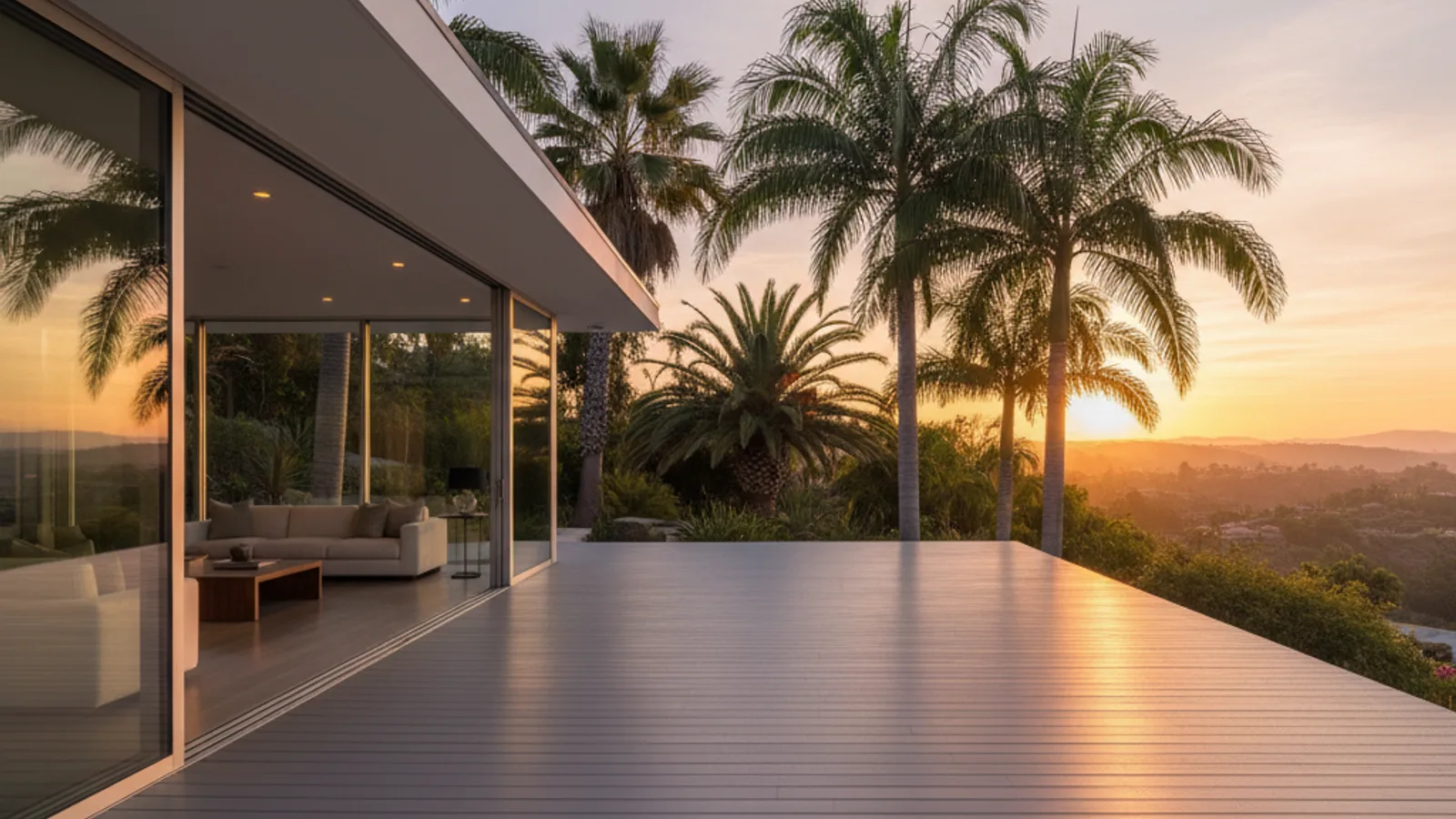
Every SoCal homeowner who has lived through a wood deck the long way knows the same quiet sentence: "It looked fine at year three, and it was falling apart by year six."
What the last few years have made clear is that the era of the wood deck in Los Angeles and Orange County is closing. Not because design taste changed, but because the engineering changed. A small group of contractors has stopped quoting redwood as the default and started quoting steel substructure under advanced polymer composite. They call it different things. The result is the same. The deck outlives the house.
This piece is about why that shift happened, what the new standard actually looks like under the boards, and how to tell whether the contractor you are about to hire understands any of it.
The investment you made for $30,000 to $60,000 should outlast your car. In SoCal, on wood, it rarely does.
Three SoCal deck specialists. Editor-screened.
Skip the cold-call gauntlet. Answer four short questions and we introduce you to up to three Los Angeles and Orange County contractors who build in advanced PVC and steel substructure, not redwood and hope.
★ Get matched with a vetted SoCal deck specialist →Why SoCal is the worst climate on earth for a wood deck
The honest answer is the combination, not any single factor. Three forces work on the boards at once, and they compound.
The first is ultraviolet load. Two hundred and eighty days of direct sun degrade the lignin, the natural polymer that binds wood fibers together. Within six to eight months an untreated redwood or cedar surface begins to grey and splinter. The damage is not cosmetic. It opens the grain to moisture and pests.
The second is the moisture cycle. Arid daytime heat expands the boards. Coastal fog at night contracts them. Repeated long enough, that cycle opens hairline fractures that, during the atmospheric-river winters of 2024 and 2025, became highways for water into the joist cavity. The rot that follows is silent because it is internal. The surface still looks like a deck.
The third is termites. The Western Drywood and the Formosan Subterranean thrive across the LA basin and OC canyons. A wood deck reads to them as substrate. They can compromise a structural joist in months and leave the surface boards untouched until the day someone steps through them.
The number worth remembering
Regional building inspectors and structural engineers who specialize in elevated exterior elements report that over 70% of wood decks built in LA and OC need major structural repair or full replacement within five to seven years. That is not a marketing figure. It is what shows up in SB721 and SB326 inspection reports across multi-family stock, and increasingly in single-family inspections that homeowners commission before listing.
The Balcony Bill, and what it really means for single-family homes
After the Berkeley balcony collapse, California passed Senate Bill 721 for multi-family buildings and Senate Bill 326 for HOA-managed properties. Both require periodic structural inspection of "exterior elevated elements" above six feet, performed by a licensed professional, with any identified hazards remediated within 120 days.
SB721 and SB326 do not legally bind a single-family home. What they did do is set a new "standard of care" for what a safe deck looks like. Inspectors apply that standard whether they are walking a 12-unit building in West LA or a private hillside deck in Pacific Palisades. The findings are consistent enough to name them.

The ledger board, where the deck attaches to the house, is the most common failure point. Behind the stucco, water has been trapped against the framing for years. Flashing, installed wrong nine times out of ten, has been quietly routing rain into the floor joists of the house itself. Galvanized joist hangers in coastal communities, from Manhattan Beach to Laguna, are corroding through. A deck that looks fine from the top can be holding on through a small number of intact fasteners.
The 2026 standard, and why it ends the conversation
The shift among the small group of contractors doing this right is not a material swap. It is a system change. Three elements, used together, produce a deck that meets WUI fire code, ignores termites, eliminates the refinish cycle, and carries a structural warranty north of fifty years.
What a 2026 SoCal Deck Specialist Actually Does
Steel substructure, not wood frame
The weakest link in any deck is the framing underneath. Steel joists end the rot conversation entirely and carry a 50-year structural life, not 7.
Class A WUI-compliant surface
Advanced PVC boards carry a Class A flame spread rating under ASTM E84, equivalent to concrete or steel. Embers from a distant fire do not ignite the deck.
Hidden fasteners and a dry-deck system
No exposed screws. No splinters. On second-story decks, an engineered drainage layer turns the space underneath into usable dry storage instead of a wet shadow.
Each of these on its own is an upgrade. Used together, they shift the entire risk profile of the deck. The boards do not rot because they are not wood. The frame does not rot because it is not wood. The surface does not ignite because it is engineered to a Class A flame spread rating. And the surface does not become unbearably hot in August, because the new generation of advanced PVC uses solar-reflective pigments that hold the surface roughly 25 to 30 degrees Fahrenheit cooler than first-generation composite.
Get a fixed-price quote from a SoCal deck specialist who builds this way.
★ Get matched →The money math, honestly
3 Los Angeles pros, editor-screened. 4 questions.
See my 3 matchesThe objection that runs through every kitchen-table conversation about this is price. Advanced PVC over steel costs more on day one than redwood over pressure-treated framing. That part is true. What is also true is that the comparison everyone makes, day-one price against day-one price, is the wrong comparison.
The right comparison is ten years of ownership. Redwood demands refinishing every two years at $1,500 to $2,500 per service in the LA labor market. By year five, roughly 10% of boards have been replaced. Termite treatment runs $400 a year. Advanced PVC over steel has none of that.
The math is unambiguous. The premium build is roughly $6,700 to $9,700 cheaper across a decade, and the deck looks new in year ten instead of looking ready for the landfill.
Why this matters, and why a handyman cannot do it
The reason this method is not yet universal is that it requires real engineering. Santa Ana winds put uplift pressure on elevated decks that most general contractors do not size hardware for. Hidden-fastener clip systems demand a specific install sequence; rush it and the boards cup. Steel substructure changes the load path; the connection details to the house have to be calculated, not improvised. Dry-deck drainage on a second-story deck requires precise slope and gutter geometry.
A discount Yelp contractor will not do any of this. A specialist will do all of it, on every project, because their warranty depends on it. The difference between the two does not show up until year three, by which point it is your problem.
The bottom line
A SoCal deck is one of the most photographed, most used parts of the house. It is also one of the most punished. The era of the redwood deck is closing here, not because design taste moved on, but because the climate, the fire code, and the pest population finally made wood untenable as a structural choice.
If you are starting a project in LA or OC in the next twelve months, the single most useful question you can ask any contractor on a first call is this: "Will you quote me on steel substructure with a Class A advanced PVC surface and hidden fasteners, with a 50-year structural warranty?"
How they answer will tell you everything.
And if you would rather skip the calling around, we already know which contractors answer that question with a yes, and we are happy to introduce you.
The Renology Take
If your deck rots in five years, the spec was written wrong.
We pre-vet LA and OC deck specialists for steel substructure, Class A WUI surface, and hidden-fastener finish before we will introduce them to a homeowner. Four short questions. Three matches. One business day.
★ Get matched with vetted SoCal deck specialists →No obligation. No contractor calls you directly. We screen, you choose.
Methodology
How Renology builds this guide
Renology combines public permit and labor signals, supplier pricing, remodeler quote patterns, and editorial review of comparable projects. Cost references are planning ranges, not fixed bids, because site conditions, materials, access, permits, and finish level can change the final price.
- Benchmarked against the Renology Cost Index, related service guides, and the Renology Methodology.
- Reviewed for Los Angeles market context when a local market is available.
- Focused on renovation scope, materials, timeline, contractor risk, and budget drivers.
Frequently Asked Questions
How fast do wood decks really fail in Southern California?
What does SB721 / SB326 actually require?
Is composite decking really safer in wildfire zones?
Won't synthetic decking get unbearably hot in summer?
What does a real cost comparison look like over 10 years?
Do I need permits for a deck replacement in LA or OC?
Ready to find a pro?
Tell us about your project and location. A Renology advisor can help you explore contractor matching.
Free for homeowners. No obligation to hire.
Find a ProFollow Renology on Google
Choose Renology as a preferred source and our guides show up more often in your Google results, including Top Stories and AI Overviews.