
In this episode, we are tackling the single most asked question in residential design: how long does a kitchen remodel *really* take? The honest answer for a major, gut renovation in 2026 is typically seven to twelve months from your first call with a designer to the final punch list. And according to the National Kitchen & Bath Association, nearly half of all projects face delays. We'll break down why that timeline is longer than you think, what changed this year, and how to plan for a process that respects your time, your budget, and your sanity. Timelines can start lower, of course, for a simple cosmetic refresh in a smaller condo kitchen, which might take only three to four months.
What This Episode Is About
If you take three things from our conversation today, let them be these:
- First, the 'construction' phase is only one-third of the total timeline. The majority of the months are spent in planning and procurement, where the most important decisions are made.
- Second, custom elements, especially cabinetry and specialty appliances, dictate your schedule. Their lead times are the long poles in the tent, and you must plan around them from day one.
- Third, your project's manager, whether it's a general contractor or a design-build firm, is more of a logistics expert than a builder. Their real value is in sequencing the dozens of dependencies that can derail a project.
A major kitchen remodel in the U.S. typically takes seven to twelve months from initial design consultation to project completion. This timeline includes two to four months for planning and design, one to three months for permitting and procurement of materials like custom cabinets, and three to five months for the active construction phase.
The Real Numbers (National Picture)
Let's ground this conversation in the data. When we look at national averages for 2026, the timeline for a kitchen remodel breaks down into distinct tiers of complexity and investment. It's crucial to understand where your project fits. The perception of a six-week TV makeover is just that: a television fantasy. The reality involves supply chains, labor schedules, and municipal permits.
Based on data from the National Kitchen & Bath Association (NKBA) and our analysis of project data, here is a realistic breakdown of what homeowners across the country can expect:
- Cosmetic Refresh (Minor Remodel): 3 to 5 Months. This scope involves no changes to the layout. Think new cabinet fronts, countertops, backsplash, paint, and appliances in the same location. The national median cost is $28,000 to $45,000. The timeline is shorter because it requires fewer trades and often avoids a lengthy permitting process.
- Full Remodel (Major, No Structural Changes): 7 to 12 Months. This is the most common project type. It involves a full gut of the existing kitchen, new cabinets, new appliances, and potentially relocating plumbing and electrical within the existing footprint. The national median cost is $75,000 to $150,000. The extended timeline accounts for design, custom cabinet lead times, and a full construction sequence.
- Full Remodel with Structural Changes (Major, Expansion): 10 to 18+ Months. This involves removing walls, expanding the kitchen's footprint, or adding windows. The complexity skyrockets, requiring architects, engineers, and a more rigorous permitting and inspection schedule. The national median cost often exceeds $150,000. Planning alone can take six months before a hammer ever swings.
These timelines represent the full journey, from the day you hire a professional to the day you can use your new kitchen. The biggest variable remains the planning and procurement phases, which are almost entirely within your control to manage effectively.
What Most Homeowners Get Wrong About This
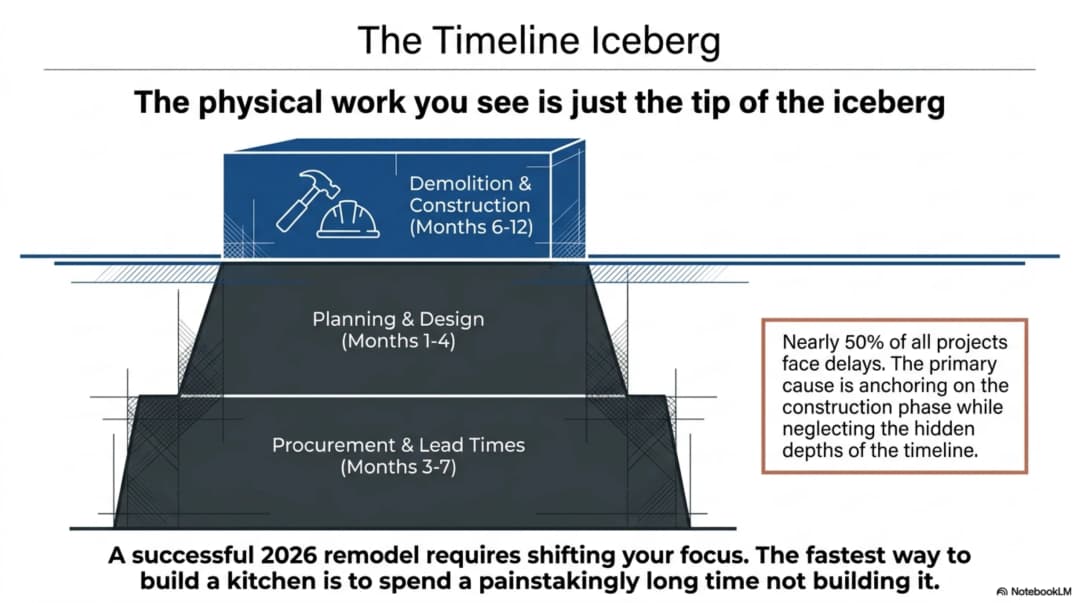
The single biggest misconception about how long a kitchen remodel takes is anchoring on the construction phase. Homeowners watch a demolition crew arrive and mentally start a stopwatch that runs for eight to twelve weeks. This is a recipe for frustration. The reality is that the physical work you see is just the tip of the iceberg. The vast, unseen bulk of the project timeline happens long before the dust flies.
Think of your project in three parts. If the total duration is nine months, the breakdown is often: months one through four for design and planning, months three through seven for procurement and waiting on materials, and only then, months six through nine for demolition and construction. The phases overlap. You're ordering cabinets while finalizing lighting plans. You're waiting for a permit while your custom appliances are being fabricated.
Why does this happen? Three reasons. First, good design takes time. Rushing the layout, the lighting plan, or the material palette leads to expensive changes later. Second, the supply chain is complex. Your rift-cut white oak cabinets don't exist yet; they have to be custom-built, a process that takes ten to sixteen weeks. Third, labor is scheduled. Your contractor is lining up a dozen different subcontractors, from plumbers to tile setters, and their availability is a complex logistical puzzle. The construction phase is the final act of a very long play.
Phase 1: Planning & Design (Months 1-4)
This is where your kitchen is truly built. The planning and design phase is the most critical period, and it's where you have the most influence over the final outcome and the smoothness of the process. Rushing here will guarantee delays and budget overruns later. This phase typically consumes the first two to four months of your total project timeline.
It begins with assembling your team, whether that’s an architect, an interior designer, a design-build firm, or a contractor. You’ll spend weeks in conversation, defining the scope, your goals, and your budget. This is where we perfect the work triangle, ensure adequate landing zones next to the cooktop and refrigerator, and detail the prep zones. We talk about workflow, not just aesthetics. We ask questions like, where will you chop vegetables versus where will the kids make their toast? A good design solves these functional puzzles first.
Next comes material selection. This is a deep, detailed process. We aren't just choosing a countertop; we are choosing between honed Calacatta Monet marble and a specific slab of leathered quartzite, then visiting the stone yard to tag the exact one. We're not just picking a cabinet style; we're deciding between inset and full overlay, a painted finish or a natural wood like white oak, and then selecting the exact hardware from a brand like Rejuvenation or Armac Martin. Every single item, from the grout color to the lumen output of the under-cabinet lighting, must be specified and documented before a single purchase order is sent. This meticulous planning prevents costly on-the-fly decisions during the chaos of construction.
Phase 2: Procurement & Lead Times (Months 3-7)
Once your design is finalized and every material is specified, the procurement phase begins. This period often overlaps with the end of design and the start of construction, but it is its own distinct, and often frustratingly long, part of the journey. This is the great waiting game of remodeling. The timeline here is dictated not by your contractor, but by global supply chains, manufacturing capacity, and artisan backlogs.
The longest lead-time item is almost always cabinetry. Fully custom cabinets from a reputable workshop can have lead times of 12 to 20 weeks. Semi-custom cabinets might be closer to 8 to 12 weeks. This single item determines the start date for your construction. You cannot begin demolition until you have a confirmed delivery date for the cabinets, as the entire project sequence flows from their arrival. We recommend homeowners look at options from trusted makers like Plain & Fancy or a local custom shop to get realistic lead times upfront. Another key item is appliances. While the worst of the post-2021 backlogs have eased, high-end or specialty appliances, particularly integrated refrigeration columns from brands like Sub-Zero or specific induction ranges from Miele, can still take three to six months to arrive. Windows and custom doors also have significant lead times, often 10 to 16 weeks.
This is why we order everything, down to the last piece of unlacquered brass hardware and the specific 2700K LED light fixtures, before demolition is even scheduled. Having all materials on-site before the work begins is the professional standard. It's the only way to prevent the costly scenario where a team of installers is standing around, unable to work, because a single critical component is delayed.
Phase 3: Construction & Installation (Months 6-12)
3 pros, editor-screened. 4 questions.
See my 3 matchesThis is the phase everyone thinks of when they ask, 'how long does a kitchen remodel take?' It's the loud, dusty, and disruptive part of the process, but if the preceding phases were done correctly, it should be the most predictable. For a major remodel, expect the active construction to last three to five months. This timeline can be shorter for cosmetic jobs and longer for projects involving structural changes.
The sequence is a carefully orchestrated dance of trades. It typically begins with demolition and hazardous material abatement if necessary. Then comes the 'roughs': framing any new walls, and roughing in the plumbing, electrical, and HVAC systems. This is followed by the first of many inspections from your local building department. After the roughs are approved, the space is closed up with insulation and drywall. The drywall finishing, which involves taping, mudding, and sanding, can take a week or more to get a perfect, smooth finish.
Next, the space starts to look like a kitchen again. The new flooring goes in, followed by the much-anticipated cabinet installation. This is a precision job that can take several days. Countertop templating happens only after the base cabinets are perfectly set, and then there's another one-to-three-week wait for the stone fabrication and installation. Once the countertops are in, the backsplash tile can be set. The final steps include installing appliances, plumbing fixtures like sinks and faucets, and lighting fixtures. The last week is dedicated to the 'punch list', a detailed walk-through with your contractor to identify and correct any small imperfections before the final payment is made. It's a marathon, not a sprint.
What Changed in 2026
The remodeling landscape is in constant flux, and 2026 has its own unique set of conditions that affect project timelines. Homeowners planning a kitchen renovation this year need to be aware of a few key shifts compared to the post-pandemic boom years. First, while interest rates have moderated slightly from their 2024 peaks, the cost of financing remains a significant factor, leading homeowners to be more deliberate and cautious in the planning phase. This adds time to the front end of projects as people secure funds and vet budgets more carefully.
Second, the Inflation Reduction Act (IRA) tax credits are now a mainstream part of the conversation. The credits for high-efficiency electrical upgrades are prompting more homeowners to switch from gas to induction cooktops. This is a positive change for performance and sustainability, but it can add weeks to a timeline. It often requires a dedicated new circuit and sometimes a full electrical panel upgrade, bringing in electricians for a much heavier lift than a simple appliance swap. You can learn more about the benefits of induction cooking on our blog.
On the materials side, supply chains have stabilized for many standard items, but the demand for skilled labor remains incredibly high. This is the primary bottleneck in most major U.S. metros. There is a shortage of experienced project managers, finish carpenters, and tile setters. This means good contractors are booked further out, sometimes six to nine months in advance. The era of getting three bids and starting a project next month is over for the foreseeable future. Planning ahead is no longer a suggestion; it's a requirement.
Information Gain: The Hidden Timeline Killers
Beyond the obvious factors like cabinet lead times, several less-visible issues can quietly sabotage your kitchen remodel timeline. These are the details that often don't appear on a contractor's initial schedule but can add weeks or even months of delay. The first is the Homeowners Association (HOA) architectural review board. If you live in a condo or a planned community, your project likely needs their approval before you can even apply for a city permit. This process can be slow and bureaucratic, involving specific submission deadlines, committee meetings, and subjective feedback on materials. We've seen HOAs take three months to approve a plan, completely stalling the project's start.
Another major hidden delay is coordinating with utility companies. Need to move a gas line for your new range location? That's not your contractor's job; it's the gas company's. They operate on their own schedule, and it can take six to ten weeks to get them on site. Similarly, a significant electrical panel upgrade may require coordination with your electric utility provider. These external dependencies are outside your contractor's control.
Then there's what we call the 'one missing part' syndrome. Your entire project can grind to a halt because of a single backordered item. Perhaps the special-order pendant lights are delayed, which means the electrician can't finish their work, which means the final electrical inspection can't happen, which means the project can't be closed out. A well-managed project mitigates this by ordering everything far in advance, but unexpected discontinuations or shipping damage can still occur. Finally, never underestimate the friction of scheduling municipal inspections. In busy jurisdictions, you may have to wait one to two weeks for an available inspector at each critical stage: framing, plumbing, electrical, and final. A failed inspection means correcting the issue and getting back in the queue, adding more unplanned downtime.
The 3 Questions Every Homeowner Should Ask Their Contractor
Choosing the right contractor is the most important decision you'll make, and their process management is more important than their portfolio. Before you sign a contract, ask these three questions to understand how they manage the most critical variable: your time.
1. 'How do you handle procurement and lead-time management?'
Why this matters: This question reveals if they are proactive or reactive. A great contractor will have a dedicated process for ordering, tracking, and warehousing all your materials before the project begins. What a good answer sounds like: 'We finalize and order all long-lead items like cabinets, appliances, and windows before scheduling demolition. We have a project coordinator who tracks every item and we store everything at our secure facility to ensure it's on-site and verified before your kitchen is taken out of commission.' Find out more in our guide to hiring professionals.
2. 'What is your process for communicating schedule updates and potential delays?'
Why this matters: Communication is everything. You need to know their system for keeping you informed. What a good answer sounds like: 'We use a project management app where you can see the daily schedule, progress photos, and any updates. We also hold a weekly on-site meeting to discuss progress, address any issues, and review the look-ahead schedule for the next two weeks. If a delay occurs, we notify you immediately with an explanation and a proposed solution.'
3. 'Can you walk me through your change order process and how it impacts the timeline?'
Why this matters: Change orders are a primary source of delays and budget increases. A clear, formal process is a sign of a professional operation. What a good answer sounds like: 'Any change you request will be documented in a formal change order. It will clearly state the cost and the impact on the schedule, which you must approve in writing before any work proceeds. This ensures there are no surprises and that we all agree on how the change affects the completion date.'
Budgeting for Time: Overruns and Contingency Planning
Your budget and your timeline are two sides of the same coin. A financial shock, like an unexpected structural issue, will inevitably cause a schedule delay as you and your team pause to find a solution. This is why proactive financial planning, including a solid contingency fund, is a critical part of timeline management. The National Association of Home Builders recommends a ten to fifteen percent contingency on renovations in homes over thirty years old. For a $100,000 kitchen, that means having an extra $10,000 to $15,000 in accessible funds set aside specifically for unforeseen problems.
These problems are common. When we open up walls, we might discover outdated knob-and-tube wiring that needs to be replaced to meet modern code. We could find hidden water damage or that a wall presumed to be non-load-bearing is, in fact, structural. Your contingency fund is the tool that allows your contractor to address these issues immediately without having to halt the project for weeks while you secure additional financing.
Properly managing the permit process is also essential. Delays in permit issuance or failed inspections can stop a project in its tracks. Ensure your contractor is experienced with your local building department and has a clear plan for managing the submission and inspection schedule. For more information, you can review our general guide, the National Permit Playbook for 2026, which outlines the typical steps involved. A well-managed budget and a proactive approach to permitting are your best defenses against the most common sources of project delays.
Three Representative Projects from 2026
To make these timelines more concrete, here are three representative projects from 2026, scoped similarly, reconstructed from Renology's Project of the Day network and used here in aggregate form. These show how scope and location type influence the answer to 'how long does a kitchen remodel take?'.
1. The Coastal Condo Refresh. This project involved a 1,200-square-foot condo in a high-rise building in a dense urban area like Miami or San Diego. The scope was cosmetic: keeping the layout, but replacing builder-grade finishes with semi-custom cabinet fronts, quartz countertops, a new backsplash, and panel-ready appliances. The total timeline was four months. The design phase was quick (one month), but two months were lost to a slow HOA approval process and strict building rules about construction hours and elevator use. The actual construction was completed in just five weeks.
2. The Midwest Suburban Gut. This was a 2,500-square-foot home from the 1980s in a suburb of a city like Chicago or Minneapolis. The project was a full gut remodel, removing a non-load-bearing wall between the kitchen and dining room to create an open-concept space. The timeline was eleven months. Planning and design took four months, including selecting all new custom cabinets and materials. Cabinet lead time was sixteen weeks. Construction, which included significant electrical and plumbing rerouting, took a full four months from demolition to final punch list.
3. The Sun Belt High-End New Build. This project was part of a larger custom home build in a growing metro like Austin or Phoenix. The kitchen itself was a high-end, bespoke design featuring two islands, a full suite of professional-grade appliances, and custom metalwork. While part of a new build, the kitchen-specific timeline was fourteen months. The design alone, coordinating with the architect and a specialty kitchen designer, took six months. Sourcing unique materials, like a specific marble from an overseas quarry and appliances from European manufacturers, added another six months of lead time. The installation itself was a complex, three-month process involving multiple teams of specialized artisans.
The Renology Take
After analyzing hundreds of kitchen projects, the meta-pattern is clear: The answer to 'how long does a kitchen remodel take?' has very little to do with construction speed. It is almost entirely a function of planning, communication, and project management. The most successful projects, those that finish on time and on budget, are not the ones with the fastest crews. They are the ones with the most thorough and disciplined design and procurement phases.
Homeowners should shift their focus from the back end of the project (the build) to the front end (the planning). Your most important work is done in the first three months, sitting at a table with your designer, making decisions. Every choice you finalize then is a week of delay you prevent later. The modern kitchen remodel is a logistics challenge. Treat it as such. Hire a professional for their project management skills as much as for their design eye, and you will have a process that feels controlled, predictable, and ultimately, successful.
Sources & Methodology
See the Renology Methodology for how sources are reviewed, ranges are normalized, and planning-data limits are handled.
- National Kitchen & Bath Association (NKBA) 2026 Market Outlook
- U.S. Census Bureau, Monthly Construction Spending Survey, 2026
- Bureau of Labor Statistics (BLS), Occupational Employment and Wage Statistics, 2025-2026 Data
- Bureau of Labor Statistics (BLS), Producer Price Index (PPI) for Construction Materials, 2026
- Remodeling Magazine, 2025 Cost vs. Value Report
- Harvard Joint Center for Housing Studies (JCHS), Leading Indicator of Remodeling Activity (LIRA), 2026
- National Association of Home Builders (NAHB), Remodeling Market Index (RMI), 2026
- U.S. Department of Energy, Inflation Reduction Act Home Energy Rebate Programs Guidance
- Renology internal data from the Project of the Day network, 2025-2026
This article is from The Renology Magazine, the renovation magazine and contractor-advisory for homeowners in Southern California, San Diego, and Greater Seattle. Want more renovation breakdowns? Search "The Renology Magazine" on Google.
Frequently Asked Questions
Can I live in my house during a kitchen remodel?
How can I speed up my kitchen remodel timeline?
What is the longest lead-time item in a kitchen remodel?
Does remodeling an old house take longer?
How much does a change order add to the timeline?
What's the difference between a design-build firm and a general contractor for my timeline?
How does the permitting process affect the timeline?
Why are appliance lead times still so long in 2026?
Get 3 renovation bids in 48 hours.
Our editors already vetted contractors. Answer 4 questions and we send 3 written bids inside 48 hours, with the real price for your scope, not their inflated first-call number.
- Free, no commission
- Pre-screened locally
- Bids inside 48 hours
Takes about 60 seconds. We'll text you when bids arrive.
Sources
- National Kitchen & Bath Association (NKBA) 2026 Market Outlook
- U.S. Census Bureau, Monthly Construction Spending Survey
- Bureau of Labor Statistics (BLS), Occupational Employment and Wage Statistics
- Bureau of Labor Statistics (BLS), Producer Price Index (PPI) for Construction Materials
- Remodeling Magazine, 2025 Cost vs. Value Report
- Harvard Joint Center for Housing Studies (JCHS), Leading Indicator of Remodeling Activity (LIRA)
- National Association of Home Builders (NAHB), Remodeling Market Index (RMI)
- U.S. Department of Energy, Inflation Reduction Act Home Energy Rebate Programs Guidance
- Renology internal data from the Project of the Day network