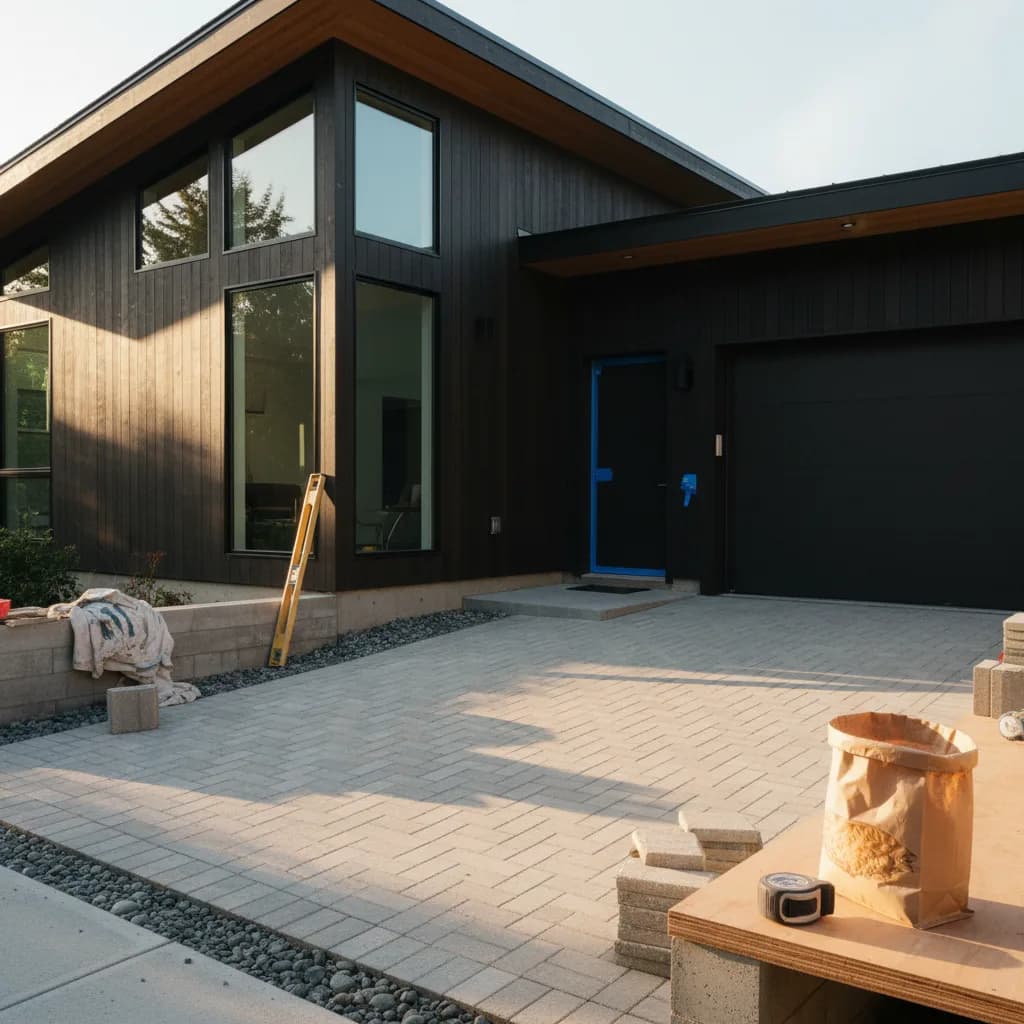
A new driveway in Seattle costs between $12,000 and $25,000 for a standard 600-square-foot project in 2026, with a median cost of $17,500 for brushed concrete. High-end projects with permeable pavers, heated systems, or complex drainage can run well past $25,000. Costs can start lower for simple asphalt resurfacing or a small townhouse pad, but most single-family home replacements land squarely in the mid-range. These figures account for materials, labor, and basic site preparation for a typical Seattle driveway.
In a Nutshell
- Typical Cost Range: $12,000 to $25,000 for a standard single-family replacement.
- Mid-Range Project Cost: $12,000, $18,000 for a 600-square-foot brushed or stamped concrete driveway.
- Project Timeline: Two to four days for demolition and installation, followed by a seven-day curing period for light foot traffic and up to twenty-eight days before parking vehicles.
- Biggest Surprise Line Item: Earthwork and drainage. Seattle's hilly terrain and heavy rainfall often require extensive grading and engineered drainage systems, costing from $2,000 to $5,000+.
What does a driveway actually cost in Seattle?
The cost of a Seattle driveway is determined by size, material, and site conditions. A basic asphalt installation represents the lower end, while permeable pavers with integrated heating systems define the premium tier. Below are three representative cost tiers for a typical driveway project in 2026.
| Tier | Scope of Work | Cost Range |
|---|---|---|
| Basic | 400, 500 sq. ft. asphalt replacement or simple broom-finish concrete. Minimal grading required. | $7,500, $11,000 |
| Mid-Range | 600 sq. ft. standard or colored concrete with a stamped pattern. Includes demolition of old driveway and moderate grading. | $12,000, $18,000 |
| Premium | 800+ sq. ft. interlocking or permeable pavers, extensive site excavation, heated system, and custom drainage. | $25,000, $45,000+ |
For a mid-range, $17,500 concrete driveway project, the costs break down as follows:
- Materials (concrete, rebar, gravel base): 35%
- Labor: 30%
- Site Preparation (demolition, excavation, grading): 20%
- Permits & Fees: 5%
- Finishes (stamping, coloring, sealing): 5%
- Contractor Overhead & Profit: 5%
The bottom-of-range case, around $7,500, typically applies to a simple asphalt overlay on an existing, stable base or a small parking pad for a townhome, not a full demolition and replacement for a single-family home.
Why is it more expensive in Seattle than surrounding regions?
Three primary factors contribute to the higher cost of Seattle driveways compared to national figures: labor rates, logistical challenges, and stringent environmental regulations.
1. High Labor Costs
The Puget Sound region has some of the highest construction labor costs in the country. According to Washington State L&I contractor licensing and labor rate data, prevailing wages for cement masons and operating engineers in King County are significantly above the national median. A reputable driveway contractor Seattle residents hire must pay these rates to retain skilled, licensed, and insured crews, which directly translates to higher project costs. A project requiring ten labor-days can see labor costs exceed $6,000 before accounting for overhead.

2. Site & Access Complexity
Seattle's topography is a major cost driver. Many properties in neighborhoods like Queen Anne and Magnolia are situated on steep slopes, requiring retaining walls, extensive excavation, and complex grading to ensure proper drainage and stability. This earthwork can add $3,000 to $10,000 to a project., dense urban layouts in areas like Capitol Hill can restrict access for heavy machinery like concrete trucks and excavators, leading to higher labor costs for manual work and specialized equipment rentals.
3. Stormwater Management Regulations
Seattle's commitment to managing stormwater runoff imposes strict requirements on new impervious surfaces. The city often mandates or encourages the use of permeable pavers or other green stormwater infrastructure (GSI) to reduce the burden on the public drainage system. These materials and their specialized installation methods cost 50-100% more than standard concrete. Even for traditional concrete driveways, contractors must install effective drainage solutions like channel drains or French drains to direct water away from structures and prevent erosion, adding another layer of cost and complexity dictated by city code.
What do real Seattle homeowners spend in 2026?
Three modeled project scenarios for 2026, built from the Renology Cost Index and typical local scopes. These are illustrative estimates, not completed client projects:
1. Ballard Craftsman: $14,200
The project involved removing a cracked 550-square-foot asphalt driveway and replacing it with standard 4000 PSI brushed concrete. The site was relatively flat, but several large tree roots had to be removed and the sub-grade re-compacted. The cost included demolition, haul-away, forming, pouring, and a basic sealant application.
2. West Seattle Mid-Century: $19,800
This 700-square-foot project replaced a failing concrete driveway on a moderate slope. The scope included a new, wider curb cut and apron, which required a separate Street Use permit from the Seattle Department of Transportation (SDOT). The final installation was colored concrete with a light broom finish and a channel drain system tied into the property's downspouts to manage water flow.
3. Laurelhurst Waterfront: $41,500
A 900-square-foot permeable paver driveway was installed to replace an old, undersized concrete slab. The high cost was driven by the extensive excavation required (18 inches deep) to create the multi-layered gravel sub-base for the permeable system. The project also included low-voltage lighting integrated into the paver border and a complex drainage system to handle runoff from the steep property.
Where does the money actually go?
3 Seattle driveway contractors, editor-screened. 4 questions.
See my 3 matchesA contractor's initial quote often focuses on the price per square foot for the primary material. However, several other line items constitute a significant portion of the final cost for Seattle driveways. Homeowners should ensure these are explicitly covered in the bid.
- Demolition and Haul-Away: $1,500, $3,500. The cost to break up and legally dispose of old concrete or asphalt.
- Excavation and Grading: $2,000, $6,000. This is especially costly on Seattle's hillsides, ensuring the correct slope for drainage.
- Sub-Base Preparation: $1,000, $2,500. This includes laying and compacting four to six inches of crushed gravel, a critical step for longevity in a wet climate.
- Permits: $800, $2,200. This can include a construction permit from the Seattle Department of Construction & Inspections (SDCI) and a Street Use permit from SDOT if the apron or curb is altered.
- Drainage Systems: $2,000, $5,000. For channel drains, French drains, or dry wells necessary to comply with local stormwater codes.
- Reinforcement: $1.75, $3.50 per sq. ft. Steel rebar or wire mesh is essential to prevent cracking from soil movement and freeze-thaw cycles.
- Curb Cut & Apron: $3,000, $7,000. The portion of the driveway on public property requires a separate permit and must be built to city specifications, often at a higher cost.
What stops a Seattle driveway from running over budget?
Driveway projects can exceed their initial budget for three main reasons: unforeseen site conditions, scope changes, and inadequate planning for drainage.
First, discovering poor soil quality, a high water table, or a web of old utility lines during excavation can halt work and require costly solutions like soil amendment or rerouting pipes. Second, scope creep is common. A homeowner might decide to add a matching walkway, a new retaining wall, or landscape lighting mid-project, which were not part of the original bid. Third, underestimating drainage needs is a frequent and expensive mistake. What appeared to be a simple slope might channel water directly toward the home's foundation, necessitating a last-minute, costly drainage system.
The National Association of Home Builders recommends a ten to fifteen percent contingency on renovations in homes over thirty years old. For driveway projects on sloped or complex Seattle lots, a similar contingency is prudent.
Navigating the Permit Process
Nearly all driveway replacement projects in Seattle require a permit, and work impacting the sidewalk or street requires another. Understanding the permit process is critical to avoiding delays and fines. You can find a detailed breakdown in our Seattle driveways permit playbook for 2026, which covers SDCI and SDOT requirements.
What should your Seattle contractor include in the quote?
A detailed quote is the best tool to prevent misunderstandings and unexpected costs. A bid for a driveway cost in Seattle should be a statement of work, not just a single number. Ensure your contractor provides a written quote that itemizes the following:
- Responsibility for acquiring all necessary SDCI and SDOT permits.
- Detailed scope of demolition and disposal methods for the existing surface.
- Specific excavation depth and grading plan, including final slope percentage.
- Type and compacted depth of the gravel sub-base (e.g., "6 inches of compacted 5/8-inch minus gravel").
- Reinforcement specifications (e.g., "#3 rebar on a 24-inch grid").
- Concrete strength (e.g., "4000 PSI minimum") and thickness (e.g., "4-inch slab").
- Layout and depth of control joints to manage cracking.
- Description of the final finish (e.g., "medium broom finish" or specific stamp pattern).
- Details on any coloring agents or hardeners to be used.
- Curing method and application of a specified sealant product.
- Complete site cleanup plan, including protection of adjacent landscaping.
- A clear payment schedule tied to project milestones.
- Written warranty covering both materials and workmanship for a specific period.
Renology Take
The most common point of failure in Seattle driveway projects is a mismatch between homeowner expectations and the realities of site work. Many people focus on the cost per square foot of the visible surface, the concrete or pavers, while the most critical and expensive components are buried underground. In the Pacific Northwest, a driveway's lifespan is determined almost entirely by its sub-base and drainage. A low bid often signals a contractor is skimping on excavation depth, sub-base compaction, or reinforcement. This saves money upfront but virtually guarantees cracking and heaving within five to seven years due to Seattle's saturated soils and freeze-thaw cycles. A proper driveway is an engineered system; paying for the unseen foundation is the only way to protect the visible cost.
Sources & Methodology
Renology reviews public permit and labor signals, supplier pricing, remodeler quote patterns, comparable projects, the Renology Cost Index, and the Renology Methodology. Cost references are planning ranges for Seattle driveway projects, not fixed bids.
- Remodeling Magazine, 2025 Cost vs. Value Report (Seattle, WA data)
- Washington State Department of Labor & Industries (L&I), Prevailing Wage Data for King County, 2026
- Seattle Department of Construction & Inspections (SDCI), Fee Subtitle & Information Sheets, 2026
- Seattle Department of Transportation (SDOT), Street Use Permitting Costs, 2026
- National Association of Home Builders (NAHB), Construction Cost Survey, 2025
- Oldcastle APG, 2026 Belgard Contractor Pricing Survey
- Renology Project of the Day Network, Seattle Metro Data, 2025-2026
Frequently Asked Questions
How much does a concrete driveway cost per square foot in Seattle?
Do I need a permit for a new driveway in Seattle?
What is the best driveway material for Seattle's climate?
How can I save money on a new driveway?
How long does a new driveway last in the Pacific Northwest?
Seattle · pre-screened
Get 3 Seattle driveway bids in 48 hours.
Our editors already vetted Seattle driveway contractors. Answer 4 questions and we send 3 written bids inside 48 hours, with the real price for your scope, not their inflated first-call number.
- Free, no commission
- Pre-screened locally
- Bids inside 48 hours
Takes about 60 seconds. We'll text you when bids arrive.
Sources
- Remodeling Magazine, 2025 Cost vs. Value Report (Seattle, WA data)
- Washington State Department of Labor & Industries (L&I), Prevailing Wage Data for King County, 2026
- Seattle Department of Construction & Inspections (SDCI), Fee Subtitle & Information Sheets, 2026
- Seattle Department of Transportation (SDOT), Street Use Permitting Costs, 2026
- National Association of Home Builders (NAHB), Construction Cost Survey, 2025
- Oldcastle APG, 2026 Belgard Contractor Pricing Survey
- Renology Project of the Day Network, Seattle Metro Data, 2025-2026