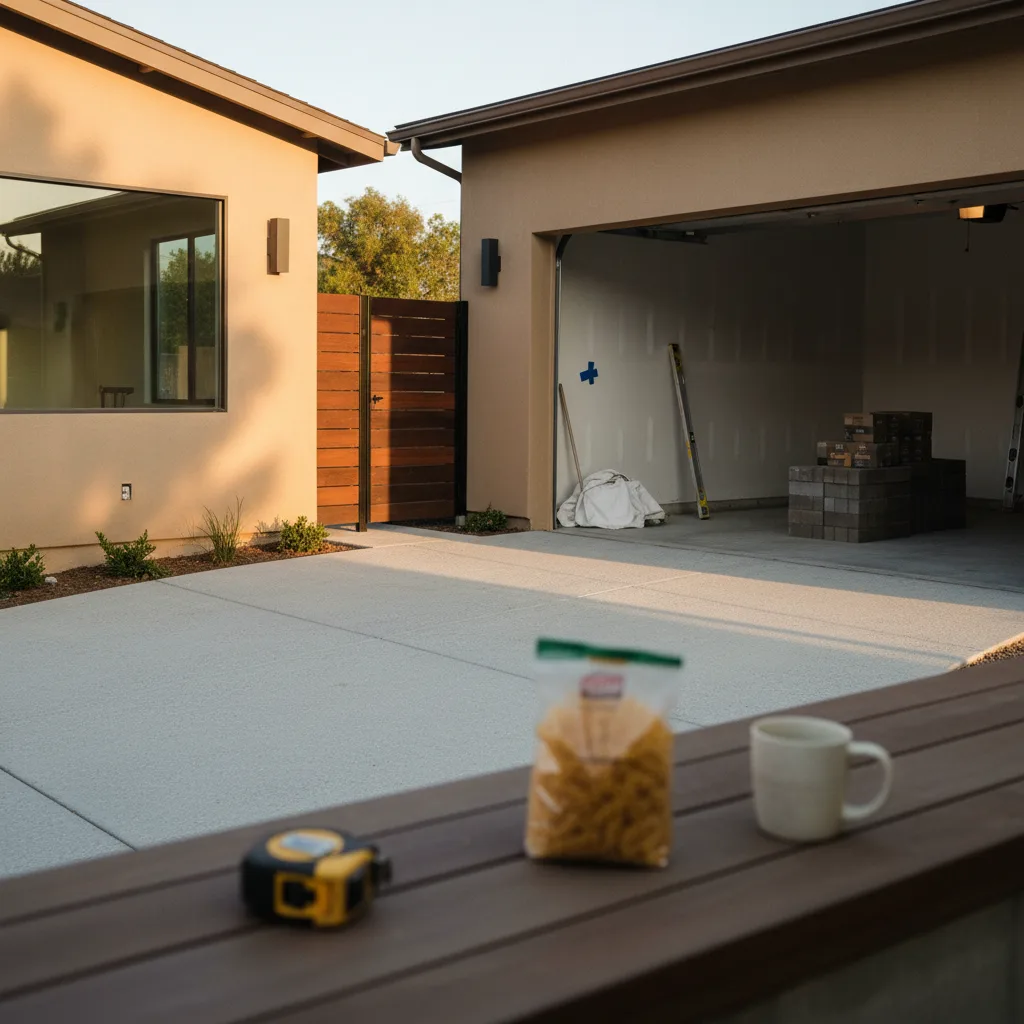
A new two-car driveway in San Diego, typically 400 to 600 square feet, costs between $13,000 and $28,000 to install in 2026. The median project cost lands at approximately $20,500 for a standard concrete installation with proper site preparation. Costs can start lower, in the $4,000 to $7,500 range, for simple resurfacing, small single-car pads, or asphalt installations with minimal grading. Conversely, high-end projects using premium interlocking pavers, extensive drainage, and significant earthwork can exceed $30,000.
In a Nutshell
- Total Cost Range: $4,000 (resurfacing) to $35,000+ (premium pavers with extensive site work).
- Median Mid-Range Project: $20,500 for a 500-square-foot reinforced concrete driveway replacement.
- Typical Timeline: Five to twelve working days, including demolition, curing, and cleanup.
- Biggest Surprise Line Item: Site preparation. Demolition of the old driveway and proper grading can account for $2,500 to $5,000 of the total cost.
What does a driveway actually cost in San Diego?
The total cost for a new San Diego driveway is determined by size, material choice, and existing site conditions. Below are three tiers of project costs for a typical 500-square-foot driveway, which is large enough for two cars.
| Tier | Typical Features | Cost Range (per sq. ft.) | Total Cost (500 sq. ft.) |
|---|---|---|---|
| Basic | Asphalt or standard 4-inch concrete slab with broom finish. Minimal grading. | $10, $18 | $5,000, $9,000 |
| Mid-Range | Reinforced concrete (rebar or mesh), colored or stamped finish, or standard pavers. Includes demolition and proper sub-base. | $18, $32 | $9,000, $16,000 |
| Premium | High-end interlocking pavers, permeable pavers, decorative concrete with borders, extensive grading, and drainage systems. | $30, $55+ | $15,000, $27,500+ |
For a mid-range, $20,500 concrete driveway project, the cost breakdown is typically:
- Materials (Concrete & Rebar): 35% ($7,175)
- Labor: 30% ($6,150)
- Site Prep & Demolition: 20% ($4,100)
- Permits & Fees: 5% ($1,025)
- Equipment Rental: 5% ($1,025)
- Contractor Overhead & Profit: 5% ($1,025)
The lowest costs in these ranges typically reflect asphalt resurfacing or a simple concrete pad on an already-level surface, not a full replacement, which is the most common project for single-family homes.
Why is a driveway more expensive in San Diego?
Installing a driveway in San Diego costs 10-20% more than the national median. Three primary factors contribute to this premium: labor rates, material and disposal logistics, and site-specific complexities tied to neighborhoods and local geology.
1. Labor Rates
Labor constitutes a significant portion of the budget. According to the California Department of Industrial Relations prevailing wage data for San Diego County, journey-level cement masons command hourly rates of $45 to $65, while equipment operators needed for excavation earn $55 to $75 per hour. These state-mandated rates for public works projects heavily influence private residential wages, which are 15-25% higher than in less regulated markets like Riverside or Imperial counties.

2. Material and Disposal Costs
San Diego's geographic location impacts material and disposal expenses. Aggregate and cement must be transported into the metro area, with fuel costs and regional carrier fees passed on to the consumer., disposal of demolished concrete and asphalt is a considerable expense. Tipping fees at facilities like the Miramar Landfill are among the highest in Southern California, adding several hundred dollars to the haul-away line item on a typical project.
3. Neighborhood Premiums and Soil Conditions
Contractor pricing varies by neighborhood. Projects in coastal communities like La Jolla or Coronado often carry a 10-20% premium due to stricter local ordinances, challenging site access for heavy equipment, and higher homeowner expectations for finish quality. San Diego's geology presents challenges. Inland areas such as Poway and Scripps Ranch are known for expansive clay soils, which require deeper excavation and a more solid, engineered sub-base to prevent the driveway from cracking and heaving over time. This necessary site work adds thousands to the project cost compared to areas with more stable, sandy soil.
What do real San Diego homeowners spend in 2026?
Three modeled project scenarios for 2026, built from the Renology Cost Index and typical local scopes. These are illustrative estimates, not completed client projects:
- University Heights Concrete Replacement: $11,900. This project involved removing and hauling away a cracked 480-square-foot concrete driveway. The scope included four inches of new Class II sub-base, #3 rebar reinforcement on an 18-inch grid, and a four-inch slab of 3,500 PSI concrete with a standard broom finish and control joints.
- Encinitas Paver Driveway Installation: $22,500. For a 650-square-foot area, this homeowner chose Belgard interlocking pavers. The higher cost reflects significant site work to regrade the area for proper drainage away from the home's foundation, the installation of a 10-foot channel drain tied into the property's drainage system, and the higher material cost of pavers.
- Bonita Asphalt Driveway: $9,800. The owner of this property opted for an asphalt replacement for their 700-square-foot driveway. The scope was simpler, requiring grinding of the existing damaged surface, application of a tack coat, and laying and compacting two inches of new hot-mix asphalt. The minimal grading required kept the cost down.
Where does the money actually go?
3 San Diego driveway contractors, editor-screened. 4 questions.
See my 3 matchesA contractor's initial quote may not itemize every cost. Homeowners should budget for these common expenses, which are often bundled into general line items like "site preparation" but represent real project costs.
- Demolition and Haul-Away: $1,500, $3,500. This covers breaking up the old driveway and the cost of labor and dump fees to dispose of the material.
- Grading and Site Preparation: $1,000, $4,000. Correcting the slope for drainage and preparing a stable foundation. This cost is higher in hilly areas or with poor soil.
- Sub-Base Material and Compaction: $800, $2,500. The cost of crushed rock (Class II base) and the labor to install and compact it to 95% density. This is non-negotiable for a long-lasting driveway.
- Drainage Solutions: $750, $2,000. Installing channel drains, French drains, or catch basins to manage water runoff, a critical component to protect your home's foundation.
- Permit Fees: $400, $900. The City of San Diego requires permits for new driveways or modifications to the curb cut. Fees cover plan review and inspections.
- Reinforcement: $500, $1,200. The cost for steel rebar or wire mesh inside a concrete slab, which provides tensile strength and prevents separation cracks.
- Root Barrier Installation: $600, $1,500. If large trees are near the driveway, a plastic barrier is installed underground to prevent roots from damaging the new surface.
What stops a San Diego driveway from running over budget?
Three issues commonly cause budget overruns on driveway projects. Understanding them allows for better planning and a more solid contingency fund.
1. Unforeseen Site Conditions. The most common cause of added cost is what lies beneath the old driveway. Poorly compacted soil, buried debris, or unexpected tree roots can require significant extra labor and materials for remediation. In some cases, shallow utility lines not on city maps must be relocated, causing delays and expense.
2. Scope Creep. It is easy to expand the project's scope once work begins. Adding a matching walkway, widening the entrance, or upgrading from a broom finish to a stamped pattern mid-project will increase both material and labor costs. These changes should be documented with a formal change order and a clear price adjustment.
3. Permit and Inspection Issues. If the contractor's plans are incomplete or do not meet city code, the permit can be delayed. A failed inspection, for instance on the sub-base compaction or rebar placement, requires rework and a follow-up inspection, adding labor costs and pushing back the timeline. The National Association of Home Builders recommends a ten to fifteen percent contingency on renovations in homes over thirty years old.
Understanding the specific requirements for curb cuts and encroachment permits is critical. You can find a detailed breakdown in our San Diego driveways permit playbook for 2026.
What should your San Diego contractor include in the quote?
A detailed quote is the best tool to prevent misunderstandings. A professional driveway contractor in San Diego should provide a bid that specifies the following fourteen points:
- Total square footage of the project.
- A specific line item for demolition and disposal of the existing surface.
- Details on excavation depth and the grading plan.
- Type and thickness of sub-base material (e.g., 4 inches of compacted Class II base).
- Type, thickness, and strength of the primary material (e.g., 4 inches of 4,000 PSI concrete).
- Reinforcement details (e.g., #3 rebar grid at 18-inch on-center spacing).
- A clear description of the drainage plan and materials (e.g., NDS channel drain model).
- Finish details (e.g., light broom finish, stamped pattern name, paver brand and color).
- Sealer type and number of coats to be applied.
- Confirmation of who is responsible for pulling permits and their associated costs.
- A project timeline with a firm start date and estimated completion date.
- A clear payment schedule tied to project milestones.
- Warranty information covering both materials and labor.
- Proof of general liability insurance and workers' compensation coverage.
Renology Take
Homeowners replacing a driveway often focus on the visible surface: the color of the pavers or the pattern of the stamped concrete. The most frequent and costly error, however, is underestimating the foundation. The long-term performance of a driveway is dictated entirely by the unseen elements of site preparation, specifically the sub-base and drainage. In San Diego County, where expansive clay soils are common, skimping on excavation depth and sub-base compaction is a direct path to failure. A $20,000 paver driveway installed on a poorly prepared $2,000 base can heave and crack within five years. A $13,000 concrete driveway on a properly engineered $5,000 base will perform for thirty. Scrutinize the quote for the details on grading, base material thickness, and compaction, not just the cost per square foot of the final material.
Sources & Methodology
Renology reviews public permit and labor signals, supplier pricing, remodeler quote patterns, comparable projects, the Renology Cost Index, and the Renology Methodology. Cost references are planning ranges for San Diego driveway projects, not fixed bids.
- Remodeling Magazine, 2025 Cost vs. Value Report (San Diego, CA data)
- City of San Diego Development Services Department, Permit Fee Schedule, 2026
- California Department of Industrial Relations, San Diego County Prevailing Wage Determinations, 2026
- National Association of Home Builders (NAHB), Home Building Geography Index, Q1 2026
- Concrete Network, "Concrete Driveway Cost Calculator," data for 92101 ZIP code, accessed 2026
- Interlocking Concrete Pavement Institute (ICPI), San Diego Regional Installation Cost Survey, 2025
- Renology Project of the Day Network, San Diego metro data, 2024-2026
Frequently Asked Questions
How much does a concrete driveway cost per square foot in San Diego?
Are paver driveways worth the extra cost in San Diego?
Do I need a permit for a new driveway in San Diego?
What is the best driveway material for San Diego's climate?
San Diego · pre-screened
Get 3 San Diego driveway bids in 48 hours.
Our editors already vetted San Diego driveway contractors. Answer 4 questions and we send 3 written bids inside 48 hours, with the real price for your scope, not their inflated first-call number.
- Free, no commission
- Pre-screened locally
- Bids inside 48 hours
Takes about 60 seconds. We'll text you when bids arrive.
Sources
- Remodeling Magazine, 2025 Cost vs. Value Report (San Diego, CA data)
- City of San Diego Development Services Department, Permit Fee Schedule
- California Department of Industrial Relations, San Diego County Prevailing Wage Determinations
- National Association of Home Builders (NAHB), Home Building Geography Index
- Concrete Network, "Concrete Driveway Cost Calculator," data for 92101 ZIP code
- Interlocking Concrete Pavement Institute (ICPI), San Diego Regional Installation Cost Survey
- Renology Project of the Day Network, San Diego metro data