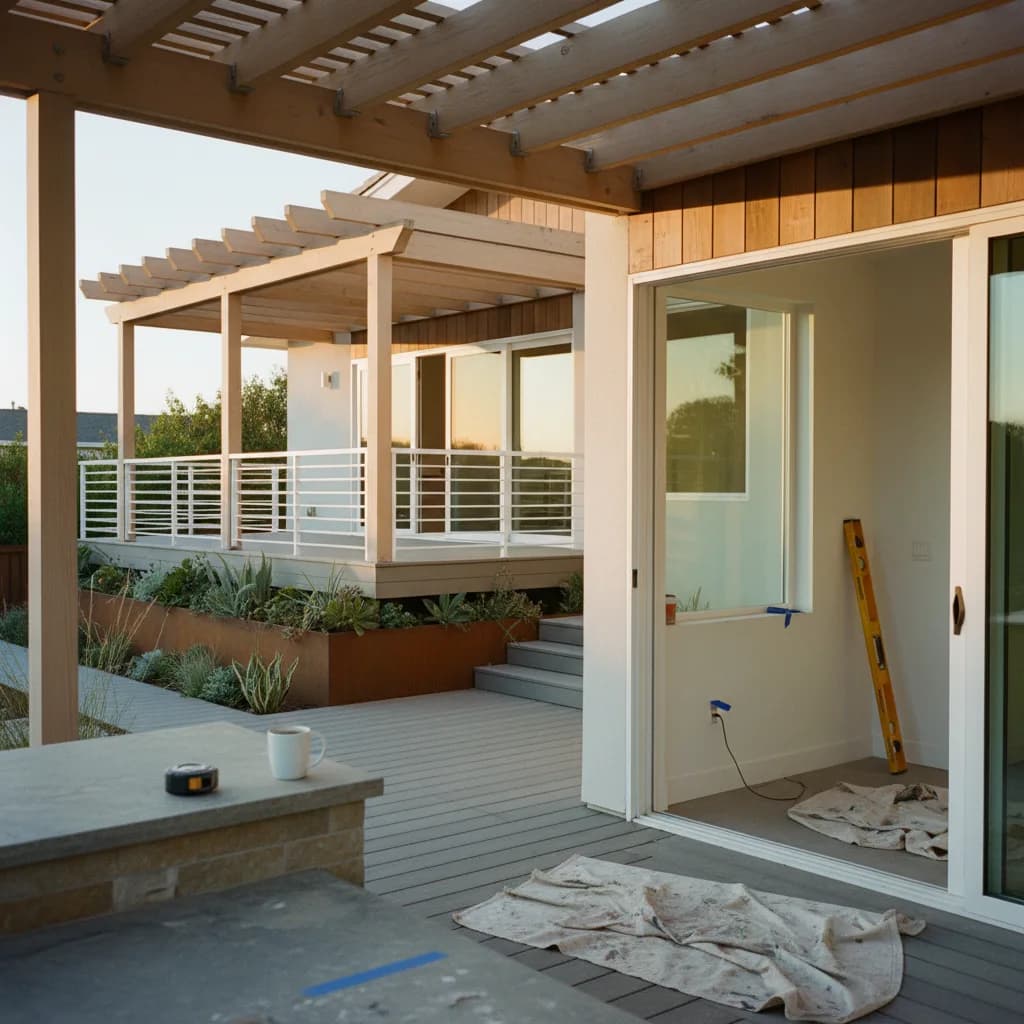
A new deck and pergola in San Diego costs between $16,000 and $38,000 for a typical project in 2026. The total expense is driven by size, materials, and site complexity. While projects can start lower, around $15,000 for a simple resurfacing or small ground-level platform, most homeowners with a standard 300 to 400-square-foot scope should anticipate costs near the middle of that range. This reflects San Diego's specific market pressures, including high labor rates and material requirements for coastal and wildfire-prone areas.
In a Nutshell
- Total Cost Range: $15,000 to $95,000+. A simple pressure-treated wood deck represents the floor, while a multi-level Ipe or high-end composite deck with a motorized pergola and outdoor kitchen hookups defines the ceiling.
- Mid-Range Project Cost: $16,000 to $38,000. This typically covers a 300-square-foot composite deck with a standard aluminum or cedar pergola, integrated LED lighting, and code-compliant railings.
- Typical Timeline: Four to eight weeks from permit issuance to final inspection. Design and permitting can add another six to twelve weeks to the pre-construction phase.
- Biggest Surprise Line Item: Geotechnical engineering and foundation work. San Diego's canyon landscape means many properties require specialized footings, which can add $5,000, $12,000 that is often not detailed in initial estimates.
What does a deck and pergola actually cost in San Diego?
Project costs in San Diego segment into three main tiers based on materials, size, and complexity. The following table outlines typical homeowner expenditures for 2026.
| Tier | Cost Range | Scope & Materials |
|---|---|---|
| Basic | $18,000, $28,000 | Under 250 sq. ft. deck; pressure-treated pine or cedar; simple design; standard wood railings; no pergola. |
| Mid-Range | $38,000, $55,000 | 300-400 sq. ft. deck; mid-grade composite (e.g., Trex Select); aluminum or cedar pergola; cable or composite railings; integrated lighting. |
| Premium | $70,000, $95,000+ | Over 500 sq. ft. deck; premium composite (e.g., TimberTech AZEK) or Ipe hardwood; custom design on a hillside; motorized louvered pergola; glass railings; utility hookups for outdoor kitchen. |
A mid-range $47,500 project budget typically breaks down as follows:
- Materials (Decking, Framing, Pergola): 45%
- Labor: 30%
- Foundation & Concrete Footings: 10%
- Permits & Engineering: 8%
- Electrical & Finishes: 7%
The lower end of the cost spectrum, around $15,000, typically represents a simple ground-level deck resurfacing or a small, basic structure under 150 square feet without complex footings or a pergola.
Why is it more expensive in San Diego than surrounding regions?
Three primary factors contribute to the higher cost of decks and pergolas in San Diego compared to inland areas like Riverside or Imperial County.
First and foremost are labor costs. The California Department of Industrial Relations prevailing wage data for San Diego County sets a high benchmark for skilled trades. A journey-level carpenter can command $55 to $75 per hour, and rates for licensed, insured, and bonded deck contractors are higher still. This is significantly more than in lower cost-of-living areas, directly impacting the 30% to 40% of a project's budget allocated to labor.

Second, material specifications are more stringent. Proximity to the coast necessitates the use of corrosion-resistant hardware, such as stainless steel fasteners and connectors, which can add $1,500 to $3,000 to a project compared to standard galvanized hardware., many San Diego communities are in Wildland-Urban Interface (WUI) zones, which mandate ignition-resistant materials like specific composites, hardwoods, or treated lumber, increasing material costs by 15% to 25%.
Finally, neighborhood premiums and challenging topography play a significant role. Contractors working in affluent coastal communities like La Jolla, Del Mar, and Coronado often have higher overhead and insurance costs, which are passed on to the client. San Diego's ubiquitous canyons and hillsides frequently require costly geotechnical reports and engineered foundations, a stark contrast to the flat, easy-to-build lots common in other parts of Southern California.
What do real San Diego homeowners spend in 2026?
Three modeled project scenarios for 2026, built from the Renology Cost Index and typical local scopes. These are illustrative estimates, not completed client projects:
- North Park Craftsman ($31,500): A 250-square-foot, single-level cedar deck was added to the back of a classic Craftsman home. The project included a simple, open-rafter cedar pergola, a new staircase to the yard, and picture-frame border detailing. The level lot required standard concrete pier footings, keeping foundation costs minimal. The total cost reflects the use of wood, which requires more long-term maintenance but has a lower upfront material cost than composite.
- Carmel Valley Family Home ($52,000): This project involved replacing an old, deteriorating wood deck with a 400-square-foot composite deck using Trex Transcend materials. The scope included a modern black aluminum pergola, built-in perimeter lighting, and a sleek cable railing system to preserve views. The slightly sloped lot required deeper, engineered footings. The price reflects the higher cost and lower maintenance of composite materials, which are popular in family-oriented communities.
- La Jolla Coastal View ($98,000): For a home with canyon views, this project featured a 600-square-foot, multi-level Ipe hardwood deck built on an engineered steel frame. The structure was designed to cantilever over a slope, requiring extensive engineering and deep caisson foundations. A motorized louvered pergola provided adjustable shade, and the scope included running a gas line for a built-in fire pit and installing a tempered glass railing system. The high cost is a direct result of the premium materials, complex engineering, and challenging site access.
Where does the money actually go?
3 San Diego deck builders, editor-screened. 4 questions.
See my 3 matchesInitial quotes from a decks pergola contractor in San Diego often focus on labor and primary materials. However, several other substantial costs are frequently omitted until the project is underway. Homeowners should budget for these items separately.
- Geotechnical Soils Report: For any project on a slope or in an area with known soil instability, the city may require this report. Cost: $2,500, $5,000.
- Structural Engineering Plans: Any deck over 30 inches high, attached to the house, or on a hillside requires engineered plans for permitting. Cost: $3,000, $6,000.
- Demolition and Haul-Away: Removal of an existing concrete patio or old wood deck is rarely included in a price-per-square-foot estimate. Cost: $1,500, $4,000.
- Site Access and Grading: If your backyard is difficult to access, requiring manual transport of materials or special equipment, contractors will add fees. Minor grading can also add to the cost. Cost: $2,000, $7,000.
- Upgraded Stainless Steel Hardware: In coastal areas (within five miles of the ocean), stainless steel fasteners are critical to prevent corrosion and are often double the price of standard galvanized hardware. Cost: $1,000, $2,500.
- Utility Line Rerouting: Discovering a sewer line, gas pipe, or irrigation system where footings need to go requires expensive rerouting. Cost: $2,000, $6,000+.
- WUI-Compliant Materials: If your home is in a designated Wildland-Urban Interface zone, you must use specific ignition-resistant decking and materials, adding 15-25% to your total material budget.
What stops a San Diego deck project from running over budget?
Three main issues typically cause budget overruns on San Diego decks and pergolas. The first is unforeseen site conditions. Hitting caliche rock during excavation for footings or discovering unstable soil on a canyon rim can lead to costly change orders for specialized equipment or deeper, more solid foundations. Second is scope creep. Homeowners deciding to add built-in benches, a privacy screen, or an outdoor kitchen connection midway through the build can quickly inflate costs and extend timelines. Third are permitting delays and corrections. If the initial plans are rejected by the City of San Diego Development Services Department, the required revisions from the engineer or architect will incur additional fees and delay the start of construction, sometimes leading to price adjustments from the contractor. The National Association of Home Builders recommends a ten to fifteen percent contingency on renovations in homes over thirty years old.
What about San Diego deck and pergola permits?
Navigating the permitting process is a critical step that ensures your structure is safe and legal. In San Diego, a building permit is generally required for any deck more than 30 inches above grade, attached to the house, or serving an exit door. Understanding the local process is key; our guide to San Diego deck and pergola permits details the requirements from the Development Services Department, including plan submission, inspection schedules, and special considerations for coastal and high-fire-risk zones.
What should your San Diego contractor include in the quote?
A detailed, itemized quote is the best tool to prevent misunderstandings. A thorough proposal for San Diego decks pergolas should include the following fourteen points:
- All costs associated with permit application, management, and fees.
- The cost for structural engineering drawings and any required soil reports.
- A clear scope for demolition and disposal of any existing structures.
- Site preparation, including any necessary grading or excavation.
- Specifications for foundation footings (depth, diameter, concrete psi).
- Framing material type, grade, and spacing (e.g., pressure-treated No. 2 Douglas Fir at 16” on-center).
- Decking material brand, product line, and color (e.g., TimberTech AZEK Vintage Collection in 'Coastline').
- Pergola material, dimensions, and style (e.g., 12'x16' Western Red Cedar with 2x8 rafters).
- Hardware specifications (e.g., Simpson Strong-Tie ZMAX galvanized or 316 Stainless Steel).
- Railing system type, material, and height (e.g., 42” Fortress Fe26 Iron Railing).
- A detailed electrical scope, including the number of outlets and type of lighting fixtures.
- Finishing details, such as staining, sealing, or painting specifications.
- A line item for comprehensive site cleanup and debris removal.
- Clearly stated labor and material warranty terms.
Sources & Methodology
See the Renology Methodology for how sources are reviewed, ranges are normalized, and planning-data limits are handled.
Cost ranges in this guide draw on the following named industry sources, public agency datasets, and Renology editorial research.
- Remodeling Magazine: 2026 Cost vs. Value Report (San Diego, CA) (2026)
- California Department of Industrial Relations, San Diego County Prevailing Wage Determinations (2026)
- City of San Diego, Development Services Department, Permit Fee Schedule (2026)
- National Association of Home Builders (NAHB), Home Building Geography Index (Q1 2026)
- Dunn-Edwards 2026 Construction Cost Index, Southern California (2026)
- Renology Project of the Day Network, San Diego Metro Data (2025-2026)
Renology Take
The most common point of failure for San Diego deck and pergola projects is a fundamental misunderstanding of the site itself. Homeowners often budget based on square footage and material choice, using national cost averages. They fail to account for the two factors that define San Diego construction: topography and microclimates. A project on a level lot in Mira Mesa has a completely different engineering and cost profile than the same size deck on a sloped lot in Encinitas. A deck in coastal La Jolla requires different hardware and materials than one in inland Rancho Bernardo to withstand salt air or wildfire threats. The primary meta-pattern causing budget and timeline issues is treating a San Diego deck as a simple carpentry project when it is, more often than not, a complex site-specific engineering challenge. Successful projects begin with a thorough site assessment and geotechnical understanding, not with a decking sample.
Frequently Asked Questions
Is a wood or composite deck better for the San Diego climate?
Do I need a permit for a deck or pergola in San Diego?
How much value does a new deck add to a San Diego home?
What is a WUI zone and how does it affect my deck cost?
San Diego · pre-screened
Get 3 San Diego deck bids in 48 hours.
Our editors already vetted San Diego deck builders. Answer 4 questions and we send 3 written bids inside 48 hours, with the real price for your scope, not their inflated first-call number.
- Free, no commission
- Pre-screened locally
- Bids inside 48 hours
Takes about 60 seconds. We'll text you when bids arrive.
Sources
- Remodeling Magazine: 2026 Cost vs. Value Report (San Diego, CA)
- California Department of Industrial Relations, San Diego County Prevailing Wage Determinations
- City of San Diego, Development Services Department, Permit Fee Schedule
- National Association of Home Builders (NAHB), Home Building Geography Index
- Dunn-Edwards 2026 Construction Cost Index, Southern California
- Renology Project of the Day Network, San Diego Metro Data