
In this episode, we address the question every U.S. homeowner eventually asks: which home renovation ideas actually pay off? It's a question of value, not just cost. Many projects feel good, but few provide a meaningful return when you sell. The 2026 data shows a clear pattern. Exterior replacement projects, like a new garage door, can recoup more than 100% of their cost at resale, a rare financial outcome in home improvement. We will break down the top twelve projects that add measurable value, separating contractor estimates from the final check you write. Our goal is to equip you with the numbers to make informed decisions, not emotional ones.
What This Episode Is About
If you take three things from this episode, they should be these:
- Curb appeal is a financial metric. The projects with the highest cost recouped are almost all exterior replacements. They are less glamorous than a kitchen remodel but have a more direct impact on a home's market value according to national appraisal data.
- Recouping cost is not the same as profit. A project that recoups 85% of its cost is a high-performer. We'll show you how to calculate the true return and why even a 'loss' can be a strategic win for your quality of life and eventual sale price.
- National data provides a baseline, not a bid. We will ground our discussion in national median costs, but local labor rates, material supply chains, and permitting can swing your final cost by 30% or more. We'll explain the key variables for 2026.
The highest-value home renovation ideas for 2026 focus on exterior appeal and functional replacements. Based on national data, the top three projects for cost recouped are garage door replacement (over 100%), manufactured stone veneer application (90-95%), and steel entry door replacement (85-90%). These projects offer the most direct path to increasing resale value.
The Real Numbers (National Picture)
When analyzing home renovation ideas, we anchor our analysis in the most reliable national data available, primarily the annual Cost vs. Value Report from Remodeling Magazine. For 2026, the report synthesizes data from thousands of real estate professionals on the perceived value of specific remodeling projects at resale. The national median job cost for 20 popular midrange and upscale projects was $82,455, with a median of 67.8% of that cost recouped at sale. This percentage is a critical benchmark. It tells us that, on average, homeowners see a return of about two-thirds of their renovation spending in the form of increased home value.
The standout performers are consistently exterior projects. A garage door replacement has a median national cost of $4,310 and recoups a median of $4,420 at resale, a 102.6% return. Applying manufactured stone veneer to the lower third of a home's front facade costs a median of $11,280 and adds $10,575 in value, for a 93.7% recoup. These projects improve a home's first impression, which has an outsized impact on appraisal value and buyer interest. In contrast, major interior projects, like an upscale kitchen remodel, have a much lower percentage of cost recouped, often in the 45% to 55% range. The cost for such a project can range from $158,000 to $175,000, but it may only add $85,000 in resale value.
What Most Homeowners Get Wrong About This
The most common misconception we see as cost estimators is the belief that a renovation's cost directly translates into an equivalent increase in home value. Homeowners often undertake a $75,000 kitchen remodel assuming their home is now worth $75,000 more. This is almost never the case. The market, not your receipts, determines value. This belief persists because personal enjoyment and utility are conflated with market value. A new kitchen provides immense personal value, but a potential buyer may have different tastes or see it as a feature that will be dated in five years.
The reality is that very few projects return 100% or more of their cost. To correct this thinking, homeowners should reframe their perspective in three ways:
- Think in terms of "cost recouped," not "profit." The goal is to minimize the net cost of the improvement after accounting for the value it adds at resale.
- Separate personal value from market value. Be honest about whether you are making a change for your own enjoyment or for a future sale. Both are valid reasons, but they have different financial implications.
- Focus on replacements over remodels for value. Replacing a failing roof or old windows is less exciting than a new bathroom, but it resolves a clear deficiency a buyer would otherwise subtract from their offer.
Understanding this distinction is the first step toward making smarter renovation decisions. A project can be personally worthwhile without being a financially optimal one, and that's an acceptable outcome if you go in with clear eyes.
The 12 Home Renovation Ideas with the Highest Recoup Value
Here we break down the twelve projects with the best cost-value ratio based on national 2026 data. Note that costs are national medians; your local market will vary. We present a median cost, the value recouped at sale, and the resulting percentage of cost recouped. For more on budgeting, see our guide to renovation budgeting.
1. Garage Door Replacement
This project consistently tops the list. It has a massive impact on curb appeal for a relatively low cost. The project involves removing and disposing of the existing garage door and tracks and installing a new four-section steel door on new galvanized steel tracks.
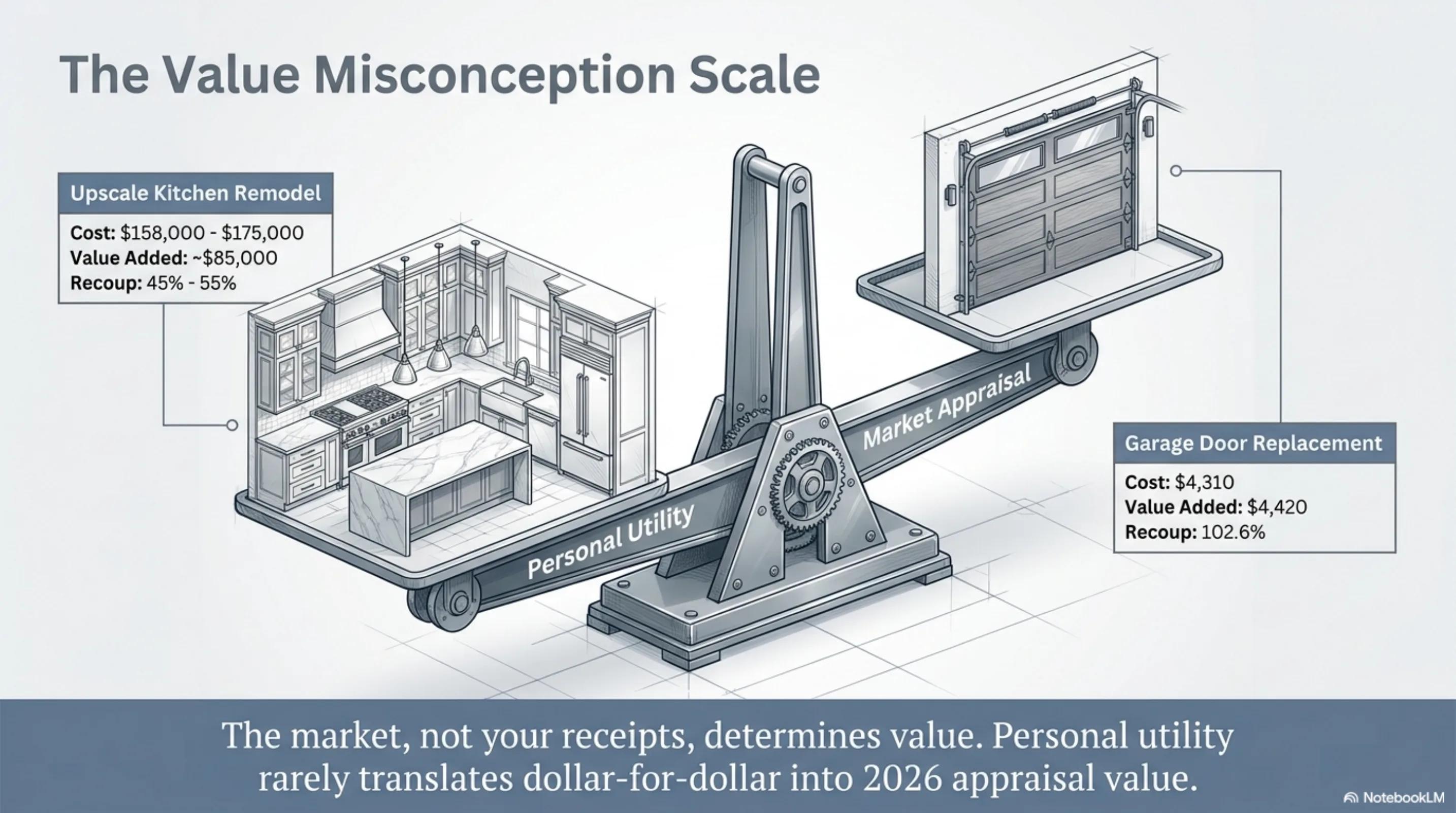
- Median Cost: $4,310 - $4,850
- Value Recouped: $4,420 - $4,910
- Cost Recouped: 102.6%
2. Manufactured Stone Veneer
Adding a stone accent to the bottom third of your home's street-facing facade provides a dramatic visual upgrade. This involves installing a mortar-based stone veneer product over a water-resistant barrier and metal lath.
- Median Cost: $11,280 - $12,150
- Value Recouped: $10,575 - $11,400
- Cost Recouped: 93.7%
3. Steel Entry Door Replacement
Another high-impact, low-cost curb appeal project. It involves removing an existing door and jambs and replacing it with a new 20-gauge steel door unit, including a new dual-pane, half-glass panel and new lockset.
- Median Cost: $2,355 - $2,710
- Value Recouped: $2,140 - $2,500
- Cost Recouped: 90.7%
4. Minor Kitchen Remodel (Midrange)
This is a cosmetic refresh, not a full gut. The scope includes refinishing cabinet fronts, replacing appliances with energy-efficient models, installing new laminate countertops, a new sink and faucet, and fresh paint and flooring.
- Median Cost: $28,280 - $32,500
- Value Recouped: $23,130 - $26,800
- Cost Recouped: 81.8%
5. Siding Replacement (Fiber-Cement)
Replacing old siding with durable fiber-cement siding is a major undertaking that pays off. This project includes replacing 1,250 square feet of existing siding with new, factory-primed and painted fiber-cement siding.
- Median Cost: $20,480 - $23,700
- Value Recouped: $16,420 - $19,100
- Cost Recouped: 80.2%
6. Window Replacement (Vinyl)
Replacing old, inefficient windows with new vinyl units improves aesthetics and energy performance. This project replaces ten existing 3x5-foot double-hung windows with insulated, low-E, simulated-divided-light vinyl windows.
- Median Cost: $21,450 - $24,800
- Value Recouped: $15,080 - $17,500
- Cost Recouped: 70.3%
7. Deck Addition (Wood)
Adding outdoor living space remains a popular and valuable improvement. This assumes a 16x20-foot deck with pressure-treated wood joists and decking, a built-in bench, a planter, and stairs.
- Median Cost: $17,530 - $20,200
- Value Recouped: $11,920 - $13,800
- Cost Recouped: 68.0%
8. Bathroom Remodel (Midrange)
Updating a dated bathroom is a homeowner priority. This project updates a 5x7-foot bathroom, replacing all fixtures, including a new porcelain-on-steel tub, ceramic tile surround, new single-lever temperature control, a new toilet, a solid-surface vanity, and ceramic tile flooring.
- Median Cost: $25,850 - $29,900
- Value Recouped: $16,980 - $19,600
- Cost Recouped: 65.7%
9. HVAC Conversion (Electrification)
Driven by IRA tax credits and a push for efficiency, replacing a fossil-fuel furnace with an electric heat pump is a forward-looking upgrade. It improves energy efficiency and can lower utility bills, a strong selling point.
- Median Cost: $18,200 - $24,500
- Value Recouped: $11,450 - $15,400 (not including tax credits)
- Cost Recouped: 62.9%
10. Attic Insulation (Fiberglass)
A purely functional upgrade that pays dividends in energy savings and comfort. The project involves air-sealing the attic floor and adding loose-fill fiberglass insulation to achieve an R-30 insulation value.
- Median Cost: $1,980 - $2,450
- Value Recouped: $1,220 - $1,500
- Cost Recouped: 61.7%
11. Roof Replacement (Asphalt Shingles)
A new roof is a critical maintenance item that reassures buyers. This project involves removing and disposing of the existing roof and installing 3,000 square feet of new fiberglass asphalt shingles with new underlayment and flashing.
- Median Cost: $32,100 - $37,500
- Value Recouped: $19,450 - $22,700
- Cost Recouped: 60.6%
12. Basement Remodel
Finishing a basement adds significant living space. This project finishes a 20x30-foot room and adds a 5x8-foot bathroom, including painted drywall, insulated walls, laminate flooring, and a small wet bar.
- Median Cost: $82,400 - $95,600
- Value Recouped: $49,100 - $57,000
- Cost Recouped: 59.6%
The 3 Questions Every Homeowner Should Ask
3 pros, editor-screened. 4 questions.
See my 3 matchesBefore signing a contract for any of these projects, pausing to ask three specific questions can prevent significant budget and timeline issues. These questions are designed to move beyond the topline estimate and uncover the hidden variables that drive real-world costs.
1. "What is explicitly excluded from this quote?"
Why this matters: Contractors' bids are structured to win the job. They often exclude items the homeowner assumes are included, such as final painting, debris hauling, or permit application fees. What a good answer sounds like: A good contractor will provide a detailed list of exclusions. "This quote does not include the cost of the permit itself, any required structural engineering reports, or the final interior paint touch-ups after our work is complete."
2. "What are the three most common unforeseen issues you find on projects like this?"
Why this matters: This question forces the contractor to draw on experience and identify likely risks. It helps you anticipate where your contingency fund might be needed. What a good answer sounds like: "For a bathroom this age, we often find hidden water damage behind the tile, outdated plumbing that isn't up to code, and sometimes electrical wiring that lacks a proper GFCI circuit. We won't know until we open the walls."
3. "How will change orders be priced and approved?"
Why this matters: Change orders are the primary source of budget overruns. You need a clear process before the project begins. What a good answer sounds like: "Any change you request will be documented in writing with a fixed price for labor and materials. Work will only proceed on that change after you have signed off on the document. There are no verbal agreements on changes." A clear process protects both you and the contractor. For more on this, see our guide on how to hire a contractor.
What Changed in 2026
The landscape for home renovations in 2026 is shaped by several key factors that differ from previous years. The interest rate environment is the most significant. With mortgage rates stabilizing in the 5.5% to 6.5% range, fewer homeowners are moving. This "lock-in" effect means more people are choosing to renovate their existing homes rather than buy a new one, increasing demand for qualified contractors.
Material costs and lead times have normalized since the supply chain disruptions of 2022-2024, but prices for energy-intensive materials like concrete and insulation remain elevated. The Bureau of Labor Statistics Producer Price Index for construction materials shows a 4% year-over-year increase, a more sustainable rate than the double-digit spikes of the recent past. However, skilled labor remains scarce, keeping labor costs high.
On the policy front, the Inflation Reduction Act (IRA) continues to offer substantial tax credits for energy-efficiency upgrades. The credits for heat pumps, insulation, and new windows, which were refreshed in 2025, are a direct financial incentive for homeowners to prioritize these specific projects. Looking ahead to 2027, we anticipate building codes in more states will begin to mandate higher levels of insulation and electrification-ready infrastructure, making these upgrades less of a choice and more of a requirement for major renovations.
Why Costs Vary: A Los Angeles Case Study
National median costs provide a useful starting point, but they can be misleading without understanding local market conditions. To illustrate, let's look at why a project in Los Angeles costs significantly more than the national median. The primary drivers are labor rates, regulatory complexity, and regional risks.
First, labor costs are substantially higher. According to the California Department of Industrial Relations prevailing wage data for Los Angeles County, a journeyman carpenter's total compensation package is between $75 and $95 per hour. This is 30-50% higher than in many other parts of the country. This premium reflects the high cost of living and strong demand for skilled tradespeople in the area.
Second, the permitting process in Los Angeles is notoriously complex and expensive. The Los Angeles Department of Building and Safety (LADBS) has stringent requirements, especially for structural changes or projects in hillside areas. In neighborhoods like Sherman Oaks or Mar Vista, even a simple deck addition might require a soils report or a structural engineer's stamp, adding thousands to the 'soft costs' of a project. Our permit playbook details these steps. Projects in historic zones like Highland Park face even more scrutiny.
Finally, regional risks like seismic activity add costs. California building codes mandate specific earthquake retrofitting measures, such as foundation bolting and shear wall paneling, that are not a factor in most of the country. These necessary safety upgrades add material and labor costs that are baked into every LA-area estimate.
Budgeting for a High-Value Renovation
A successful renovation is one that finishes on budget. The key is building a realistic budget from the start that accounts for both known costs and potential surprises. The quote from your contractor is the starting point, not the final number. A complete budget must include soft costs like design fees and permits, the cost of materials and fixtures you purchase yourself, and a contingency fund.
The National Association of Home Builders recommends a ten to fifteen percent contingency on renovations in homes over thirty years old. For a $50,000 project, this means setting aside an additional $5,000 to $7,500. This fund is not for upgrades; it is for addressing unforeseen issues like outdated wiring or hidden structural damage that are only discovered after demolition begins.
To illustrate how budgets can vary for similar projects, consider these scenarios. Three representative projects from 2026, scoped similarly, reconstructed from Renology's Project of the Day network and used here in aggregate form:
- A minor kitchen remodel in a suburban condo might cost $22,000. The scope is limited, permits are simpler, and access is easy. This is an example of how project costs can start lower than the national median.
- The same scope in a 1960s single-family home could be $31,000. The project may trigger code upgrades for plumbing and electrical, and there's a higher chance of finding unexpected issues.
- A similar cosmetic update in a high-end historic home could reach $45,000. This involves protecting existing structures, using higher-end materials to match the home's character, and more intensive labor.
These examples show why you must build a budget based on your specific property, not just a national median figure. A thorough plan and a healthy contingency are your best tools for financial control. For more detail, read our guide to kitchen remodel costs.
The Renology Take
In this episode, we've analyzed twelve home renovation ideas through the lens of cost versus value. The persistent pattern is clear: the market rewards functional, unglamorous, and visible improvements. A new garage door, solid siding, or a sound roof provide a quantifiable return because they address a buyer's primary concerns about a home's condition and maintenance needs. They reduce the perceived risk for a new owner.
In contrast, highly personalized interior remodels, while providing immense value to the current resident, are often seen by buyers as a matter of taste. Your dream kitchen may not be theirs. The single thing to remember is this: renovate for your own enjoyment and quality of life, but budget with the sober understanding that the market will only repay a fraction of the cost for most interior projects. The highest financial returns come from checking the boxes of basic maintenance and curb appeal.
Sources & Methodology
See the Renology Methodology for how sources are reviewed, ranges are normalized, and planning-data limits are handled.
- Remodeling Magazine: 2026 Cost vs. Value Report
- National Association of Home Builders (NAHB): Remodeling Market Index (RMI), Q1 2026
- U.S. Census Bureau: Monthly Construction Spending Report, March 2026
- U.S. Bureau of Labor Statistics (BLS): Producer Price Index (PPI) for Construction Materials, April 2026
- Harvard Joint Center for Housing Studies (JCHS): Leading Indicator of Remodeling Activity (LIRA), Q1 2026
- National Kitchen & Bath Association (NKBA): 2026 Design Trends Report
- Internal Revenue Service: Inflation Reduction Act of 2022, Home Energy Credits Guidance (Updated 2025)
- California Department of Industrial Relations: Prevailing Wage Determinations for Los Angeles County, 2026
- Renology Editorial Methodology: Analysis of project cost data from the Renology network of contractors, aggregated and anonymized.
Get 3 renovation bids in 48 hours.
Our editors already vetted contractors. Answer 4 questions and we send 3 written bids inside 48 hours, with the real price for your scope, not their inflated first-call number.
- Free, no commission
- Pre-screened locally
- Bids inside 48 hours
Takes about 60 seconds. We'll text you when bids arrive.