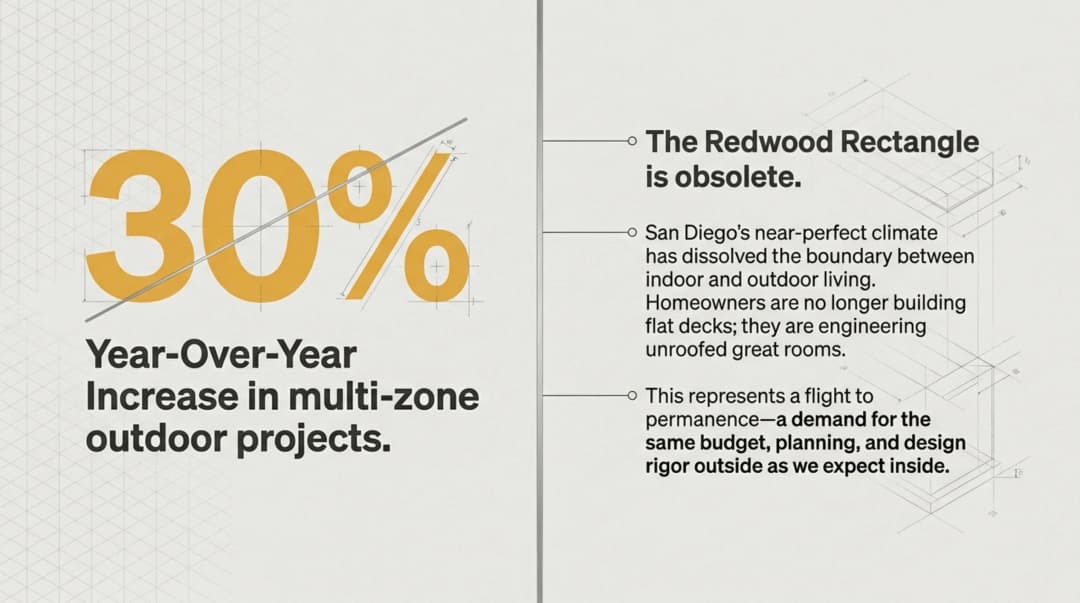
The simple backyard deck is a thing of the past. In its place, San Diego homeowners are commissioning fully realized outdoor rooms, with project scopes and budgets rivaling interior renovations. We're seeing a 30% year-over-year increase in projects that specify at least three distinct functional zones: cooking, dining, and lounging. This investment in functional, high-design outdoor space is the single biggest shift in how we build a decks pergola San Diego project in 2026, moving far beyond the redwood rectangles of the last decade.
In a Nutshell: The Deck as an Outdoor Great Room
- The Big Idea: Decks are no longer afterthoughts but fully integrated extensions of the home's living space, with the same level of design intentionality and material investment as a kitchen or great room.
- The Top Three Trends:
- Multi-Zone Layouts: Creating dedicated areas for grilling, dining, and conversation, often separated by level changes or architectural elements like pergolas.
- Architectural Metals: Powder-coated aluminum for pergolas and cable or glass for railings are replacing wood for their durability and clean lines.
- Low-Maintenance Surfaces: PVC and high-end composite decking are the default, with homeowners prioritizing long-term performance over the lower initial cost of wood.
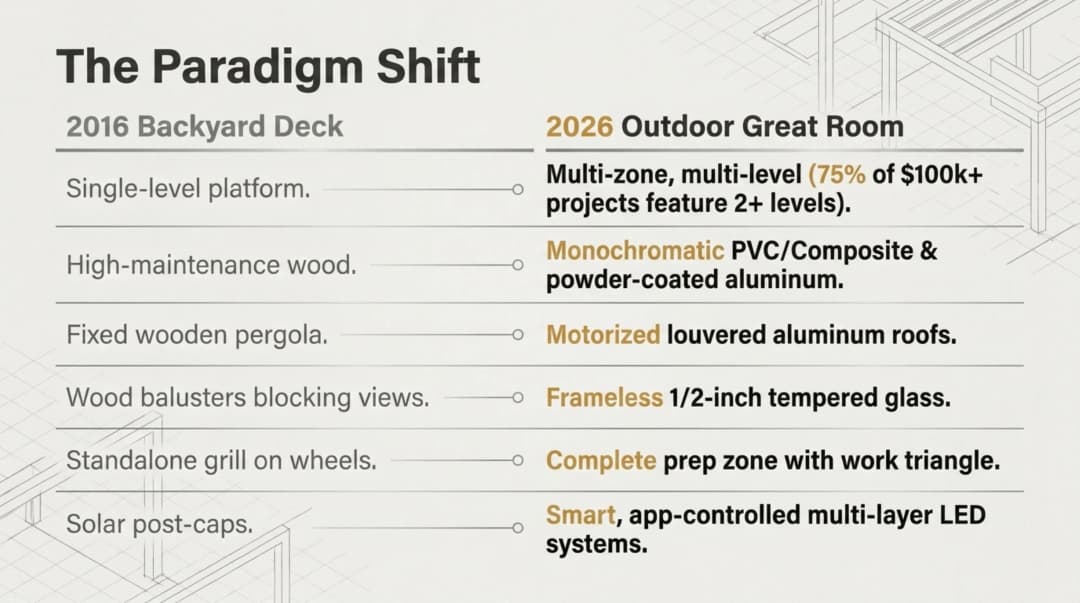
- What’s Being Replaced: Single-level redwood or pressure-treated pine decks; high-maintenance wooden pergolas; wood baluster railings; simple post-cap lighting.
- What's Next: Deeper integration of technology, including automated louvered pergola roofs, app-controlled lighting and heating, and outdoor-rated entertainment systems becoming standard inclusions rather than add-ons.
Trend 1: The Multi-Zone Deck is the New Standard
The concept of the work triangle, long a staple of interior kitchen design, has officially migrated outdoors. Homeowners are no longer content with a simple, flat platform for a grill and a table. The new standard, especially in design-forward neighborhoods from Bird Rock to Mission Hills, is a multi-zone layout that provides distinct, functional areas for different activities. This means creating a dedicated prep zone and cooking station, a separate dining area with its own ambiance, and a comfortable lounging space, often centered around a fire feature. We see designers achieving this separation through subtle changes in elevation, shifts in decking material or direction, and the strategic placement of pergolas to define a 'room' without walls. According to data from Renology's Project of the Day network, San Diego deck projects over $100,000 in 2025 were 75% more likely to feature at least two distinct levels compared to projects from 2022. This approach not only enhances usability but also dramatically increases the perceived square footage of a home's living area. The arc for this trend is clear: as outdoor living becomes more central to the Southern California lifestyle, these sophisticated layouts will become the expected baseline for any significant outdoor renovation.
Trend 2: Aluminum Pergolas Eclipse Wood
For decades, the wooden pergola was the default choice. No longer. Powder-coated aluminum is now the dominant material for high-end pergolas, and for good reason. In San Diego's coastal communities like Del Mar and Coronado, the salty marine layer is relentless, causing wood to warp, fade, and rot without constant, costly maintenance. Aluminum, particularly when finished in durable AAMA 2604 or 2605-compliant powder coats in colors like 'Monument Black' or 'Asteroid,' offers a compelling alternative. It's impervious to termites and rot, won't rust, and requires little more than an occasional rinse. Leading manufacturers like StruXure and Azenco are pushing the envelope with features like motorized louvered roofs that can be adjusted via remote control to provide full sun, partial shade, or a solid, rain-proof ceiling. Showrooms like San Diego's own Decks & Pergolas Co. report that aluminum systems now account for over 60% of their pergola sales, a complete inversion from just five years ago. This isn't just a coastal phenomenon; we're seeing these specified in inland projects in areas like Rancho Santa Fe, where homeowners value the clean, architectural lines and fire-resistant properties of metal construction.
Trend 3: Decking Goes Monochromatic and Low-Contrast
The minimalist decade may be over inside, but its principles of clean lines and material honesty are shaping the new outdoor aesthetic. The variegated, high-contrast look of tropical hardwoods like ipe and tigerwood is giving way to a more subdued, monochromatic palette. Homeowners and designers are choosing composite and PVC decking in solid, matte colors that read as a unified surface. Think Trex Transcend Lineage in 'Jasper' or Fiberon's Promenade collection in 'Shaded Cay', materials that offer subtle, wire-brushed textures without dramatic color streaks. This shift creates a quiet, architectural foundation that allows the surrounding landscape and the sky to be the stars of the show. This trend is particularly evident in the modern homes of North Park and South Park, where the deck is treated as a smooth extension of the interior flooring. By minimizing the visual noise of the deck surface itself, the focus shifts to the form of the space, the quality of the light, and the view beyond. This sophisticated, low-contrast look is here to stay, as it aligns perfectly with the move toward treating outdoor spaces with the same design rigor as interiors.
Trend 4: Glass Railings Frame the View
In a city defined by its canyons and coastline, the view is paramount. Traditional wood or composite railings, with their bulky posts and view-obstructing balusters, are being systematically replaced by glass. Specifically, half-inch tempered glass panels with minimal framing are becoming the standard for any project where a view is a key asset. We're seeing this everywhere from blufftop homes in Encinitas to canyon-side properties in Kensington. The preferred method involves mounting the glass panels with stainless steel standoffs or clamps directly to the deck fascia, creating a nearly invisible barrier that offers safety without compromising the vista. While more expensive upfront than other systems, the value preservation is undeniable. According to the 2026 Cost vs. Value report from Remodeling Magazine, projects that enhance outdoor views see one of the highest returns on investment in the Southern California market. The key is specifying the right hardware. In coastal zones, 316 marine-grade stainless steel is non-negotiable to prevent tea staining and corrosion from the salt air. The move toward glass is a permanent one; once a homeowner experiences an unobstructed view, there's no going back to a picket fence-style railing.
Trend 5: Integrated Smart Lighting Creates Ambiance
Outdoor lighting has evolved far beyond the basic solar-powered post cap. Today's high-end deck and pergola projects feature sophisticated, multi-layered lighting schemes designed with the same care as an interior plan. The goal is to create ambiance and define zones through light. This means low-voltage LED strip lighting recessed into stair risers for safety and drama, under-railing lights that cast a soft glow on the deck surface, and uplighting on nearby trees or architectural features. Warm color temperatures, typically around 2700K, are favored to create a welcoming, intimate atmosphere that mimics the glow of incandescent bulbs. The biggest change is the integration of smart controls. Systems from companies like Lutron and Control4 allow homeowners to dim lights, change scenes, and set schedules from their smartphones. Pergolas are a key part of this, with manufacturers offering integrated LED light channels within the louvers and support beams. This level of control allows a space to transition from bright and functional for cooking to soft and moody for after-dinner conversation with the press of a button. This is no longer a luxury upgrade; it's a fundamental component of modern outdoor design.
Trend 6: The Outdoor Kitchen Becomes a Full Prep Zone
3 San Diego deck builders, editor-screened. 4 questions.
See my 3 matchesThe standalone grill on wheels is being replaced by fully functional outdoor kitchens that rival their indoor counterparts. This is more than just a built-in grill; it’s a complete prep zone designed for serious cooking. We're applying interior kitchen design principles to the outdoors, creating a functional work triangle between the grill, an outdoor sink, and an under-counter refrigerator. A critical element is the inclusion of a proper landing zone, with at least 18-24 inches of uninterrupted counter space on either side of the grill for platters and tools. Material choices are paramount. For countertops, designers are specifying ultra-durable, UV-stable materials like Dekton or large-format porcelain slabs that won't fade or stain. For cabinetry, powder-coated stainless steel or marine-grade polymers like those from NatureKast provide waterproof, resilient storage. We're seeing these complete outdoor kitchens become centerpieces in family-oriented neighborhoods like Poway and Carmel Valley, where at-home entertaining is a core part of the lifestyle. This trend reflects the desire for a smooth indoor-outdoor experience where cooking and socializing can happen in the same beautiful, well-designed space.
Trend 7: Fire Features Are Now Architectural Focal Points
The portable fire pit has been retired. In its place are architectural fire features that serve as a deck's central gathering point and design anchor. The most popular form is the linear gas fire table, often integrated directly into the deck's structure or a built-in seating area. These features are typically finished in materials that complement the home's architecture, such as board-formed concrete, smooth-troweled stucco, or large steel plates with a natural rust patina. The convenience of a gas-powered feature, instant on/off with no smoke or embers, is a major driver of this trend. However, in a region with high wildfire risk, safety and compliance are critical. In San Diego, especially in areas bordering wildland-urban interface zones, there are strict regulations governing the placement and construction of any open flame. A key consideration is creating a 'defensible space' around the home. This means deck materials themselves must often be non-combustible or fire-resistant, and fire features must be installed with proper clearances from flammable structures and vegetation. Reputable decks pergola contractors in San Diego will be well-versed in these local codes and ensure the installation is not only beautiful but also safe and fully permitted. This trend elevates the fire feature from a simple accessory to a significant, integrated piece of architecture.
Trend 8: Low-Maintenance Materials Justify Their Premium
The conversation around decking materials has shifted from initial cost to total cost of ownership. While redwood and ipe have a natural beauty, the reality of maintaining them in the intense Southern California sun, which involves sanding and re-staining every 18-24 months, is a significant ongoing expense and hassle. This reality has cemented the dominance of premium composite and PVC decking. Brands like TimberTech AZEK (a PVC product) and Trex Transcend (a capped composite) offer 25 to 50-year fade and stain warranties, a guarantee that wood simply can't match. Homeowners in areas like Scripps Ranch and Rancho Bernardo are making a calculated investment, paying a premium upfront to buy back their weekends for the next two decades. The cost difference is significant, with premium composites often running two to three times the material cost of redwood. But when you factor in the $2,000-$4,000 cost of a professional deck refinishing every two years, the break-even point arrives surprisingly quickly, often within six to eight years. The visual quality has also improved dramatically. The latest generation of products features realistic wire-brushed finishes and subtle color blending that convincingly mimics the look of real wood, closing the final aesthetic gap and making the choice for low-maintenance a logical one for most homeowners.
What No One Else Covers: The Engineering of Hillside Decks
Most articles on deck trends focus on aesthetics, but in San Diego, the most critical element is often the one you can't see: the foundation. A significant portion of the city's desirable real estate is situated on canyons and slopes, making deck construction a complex geotechnical and structural engineering challenge. Building on what's known as an 'upslope' or 'downslope' lot requires more than just deeper footings. It starts with a soils report from a geotechnical engineer to assess the stability of the soil, identify the bedrock depth, and analyze the risk of landslides or soil creep. This report dictates the foundation design. For many hillside decks, standard concrete piers are insufficient. The solution is often drilled caissons, deep, reinforced concrete piles that extend 20, 30, or even 40 feet down to reach stable bedrock, bypassing the unstable topsoil. This is a highly specialized and expensive process., the deck's ledger board attachment, where it connects to the house, is a point of critical structural importance, especially in a seismic zone. California building codes have stringent requirements for bolting, flashing, and waterproofing this connection to prevent both structural failure and water intrusion that can lead to dry rot in the home's framing. These engineering requirements can add 30-50% to the total project cost compared to a deck built on flat ground. Homeowners often experience sticker shock when they see the cost of engineering and foundation work, but it's non-negotiable for safety and longevity. A qualified decks pergola contractor in San Diego will manage this process, coordinating between the architect, structural engineer, and geotechnical engineer to deliver a design that is not only beautiful but also fundamentally sound and built to withstand the unique geological pressures of the region.
How Much Do Decks and Pergolas Cost in San Diego in 2026?
A professionally designed and built deck and pergola is a significant investment, often comparable to a major interior remodel. For a full project involving demolition, new footings, framing, premium composite decking, a railing system, and a pergola, most San Diego homeowners should budget between $150 to $250 per square foot. A typical 400-square-foot project could therefore range from $60,000 to $100,000. This range can start lower, particularly for simpler resurfacing projects on existing frames or smaller, ground-level decks that don't require extensive engineering or permitting. However, for the multi-zone, feature-rich outdoor rooms currently in demand, the upper end of this range is more realistic. Projects involving hillside construction, extensive outdoor kitchens, motorized louvered pergolas, or complex lighting systems can easily exceed $300 per square foot. It's essential to get a detailed quote from a licensed contractor that breaks down the costs for materials, labor, permits, and engineering.
Three modeled project scenarios for 2026, built from the Renology Cost Index and typical local scopes. These are illustrative estimates, not completed client projects:
- $72,000 in Clairemont: A 350-square-foot ground-level deck replacing an old concrete patio. This project used Trex Transcend composite decking, a simple cable railing system, and a 12'x14' fixed-slat wood pergola. The price included demolition of the old patio, new concrete pier footings, and basic low-voltage lighting.
- $135,000 in La Jolla: A 500-square-foot, two-level deck with ocean views. This project featured premium TimberTech AZEK PVC decking, a frameless glass railing system to preserve the view, and a 16'x20' powder-coated aluminum pergola. The scope also included a small outdoor kitchen island with a built-in grill and stainless steel cabinetry.
- $220,000 in Rancho Santa Fe: A complex 600-square-foot hillside deck requiring significant engineering. The project involved drilled caisson foundations, structural steel framing, Ipe hardwood decking, a built-in linear gas fire pit, an extensive outdoor kitchen with a beverage center, and a large, motorized louvered aluminum pergola from StruXure with integrated lighting and heaters.
Why is a Deck More Expensive in San Diego?
Several factors contribute to the high cost of deck and pergola construction in San Diego. First, labor rates are among the highest in the nation. According to the California Department of Industrial Relations prevailing wage data for San Diego County, skilled carpenters and tradespeople command premium wages. This ensures quality workmanship but directly impacts the bottom line. Second, material costs are elevated by regional demand and supply chain logistics. Premium materials like composites, aluminum, and stainless steel hardware all carry a higher price tag in Southern California. Finally, the regulatory environment is complex and costly to work through. The City of San Diego's permitting process, especially for projects on hillsides or in coastal zones, can be lengthy and require extensive documentation, including structural engineering plans, geotechnical reports, and sometimes even coastal development permits, all of which add significant soft costs to the project before a single board is laid. The National Association of Home Builders recommends a ten to fifteen percent contingency on renovations in homes over thirty years old.
Finding a Decks Pergola Contractor in San Diego
Choosing the right contractor is the most critical decision you'll make. Look for a licensed, bonded, and insured contractor with a C-5 or B license from the California Contractors State License Board who specializes in outdoor structures. A specialist will have deep experience with local codes, hillside construction, and the best materials for the coastal climate. Ask for a portfolio of recent, local projects and speak with at least three references. A reputable contractor will provide a detailed, fixed-price contract that specifies all materials by brand and finish, outlines the payment schedule, and provides a clear timeline. They will also manage the entire permitting process on your behalf. For a detailed guide on what to expect, read our San Diego Decks & Pergolas Permit Playbook. A well-vetted, professional contractor is your best insurance against budget overruns and construction defects.
Sources & Methodology
See the Renology Methodology for how sources are reviewed, ranges are normalized, and planning-data limits are handled.
Cost ranges in this guide draw on the following named industry sources, public agency datasets, and Renology editorial research.
- Remodeling Magazine, Cost vs. Value Report (2026)
- Renology Project of the Day (POTD) Network Data (2023-2026)
- California Department of Industrial Relations, Prevailing Wage Data (San Diego County) (2026)
- National Association of Home Builders (NAHB), Housing Market Index (Q1 2026)
- City of San Diego Development Services Department, Building Permit Records (2025)
- Interviews with San Diego Decks & Pergolas Co. Showroom Staff (March 2026)
- Trex Company, LLC, Dealer Sales Data (2025)
- StruXure Outdoor, Architectural Specification Guides (2026)
- California Building Standards Code (Title 24) (2025)
Renology Take
The evolution of the San Diego deck is a direct response to the region's defining characteristic: its near-perfect climate. What we're seeing is the final dissolution of the boundary between indoor and outdoor living. Homeowners are no longer building decks; they are building unroofed great rooms. The investment in durable, high-design materials like powder-coated aluminum, architectural glass, and ultra-low-maintenance composites reflects a fundamental shift in perception. This isn't a secondary space; it's a primary living area, demanding the same budget, planning, and design rigor as a kitchen. The trend is a flight to permanence. By choosing materials that will endure for decades in the coastal sun and salt, San Diegans are making a long-term investment in a lifestyle that fully embraces the outdoors, effectively adding a priceless room to their home, one with a ceiling of blue sky.
This article is from The Renology Magazine, the renovation magazine and contractor-advisory for homeowners in Southern California, San Diego, and Greater Seattle. Want more renovation breakdowns? Search "The Renology Magazine" on Google.
Frequently Asked Questions
How much does a new deck and pergola cost in San Diego in 2026?
What are the best low-maintenance decking materials for the San Diego climate?
Do I need a permit for a deck or pergola in San Diego?
What's the difference between composite and PVC decking?
How long does it take to build a deck and pergola?
Can I build a deck on a sloped or hillside property in San Diego?
What is a 'defensible space' and how does it affect my deck design?
Is an aluminum pergola better than a wood one in coastal areas?
Ready to find a pro?
Tell us about your project and location. A Renology advisor can help you explore contractor matching.
Free for homeowners. No obligation to hire.
Find a ProSources
- Remodeling Magazine, Cost vs. Value Report
- Renology Project of the Day (POTD) Network Data
- California Department of Industrial Relations, Prevailing Wage Data (San Diego County)
- National Association of Home Builders (NAHB), Housing Market Index
- City of San Diego Development Services Department, Building Permit Records
- Interviews with San Diego Decks & Pergolas Co. Showroom Staff
- Trex Company, LLC, Dealer Sales Data
- StruXure Outdoor, Architectural Specification Guides
- California Building Standards Code (Title 24)
Follow Renology on Google
Choose Renology as a preferred source and our guides show up more often in your Google results, including Top Stories and AI Overviews.