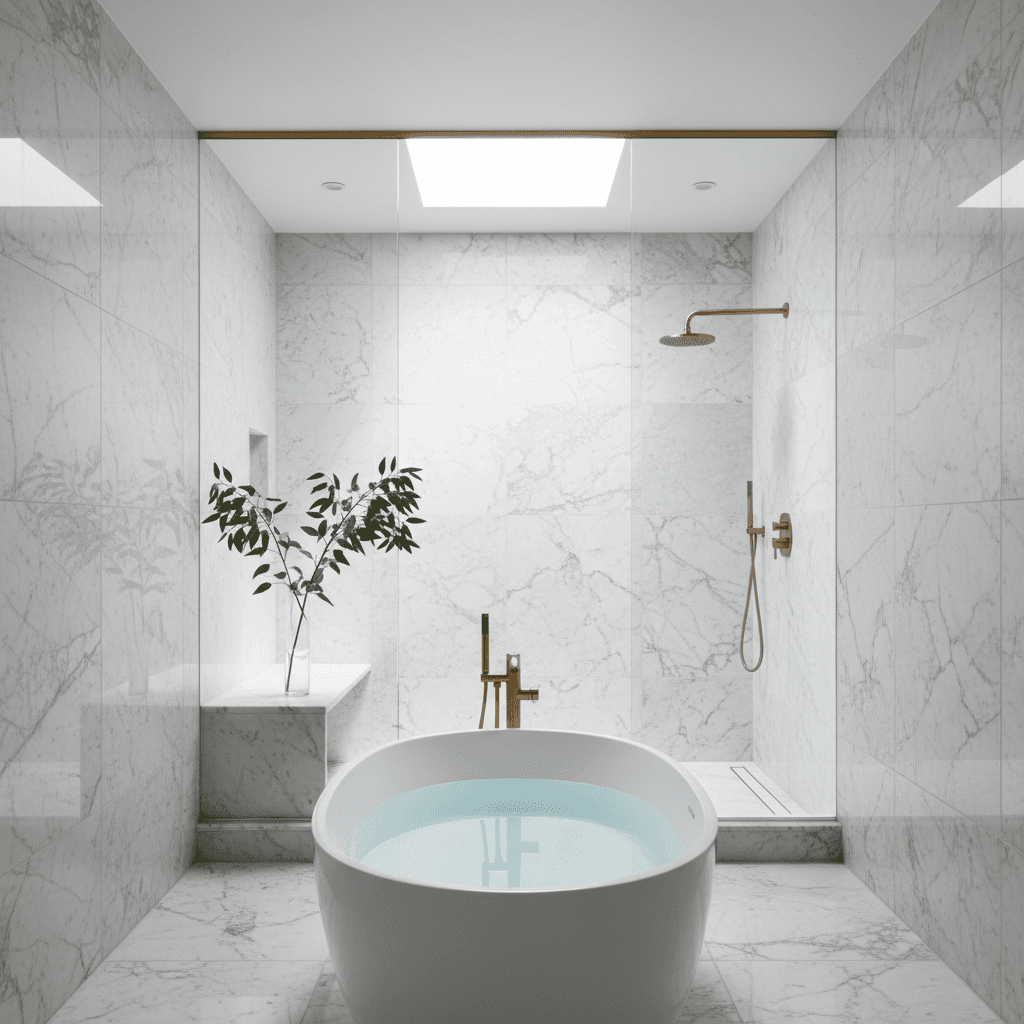
The European wet room (a bathroom where the shower flows directly into the room without a curb or enclosure) was a fringe concept in American bathrooms until about 2022. Most US bathrooms had separate shower stalls with curbs, separate tubs, and separate vanities, all in a tidy 9-by-12 grid.
Why the shift happened
Three factors converged.
Frameless glass got cheaper. A frameless glass partial wall (just enough to keep splashes contained without enclosing the shower) ran $2,500 to $4,500 in 2020. By 2026 the same install is $1,800 to $3,200. The cost ceiling that kept wet rooms exotic dropped meaningfully.
Waterproofing membranes became foolproof. Schluter Kerdi, RedGard, and Wedi Subliner are now standard kit for any tile contractor. The technical risk of wet rooms (water migrating into walls and floors over time) used to require specialist expertise. Today any competent tile setter can deliver a watertight wet room with off-the-shelf products.
The aesthetic became aspirational. Architectural Digest, Remodelista, and the Instagram interiors world saturated with wet-room photography from 2022-2024. Buyers walked into traditional bathroom remodels and said "but where is the wet room?" The expectation set, and the market followed.
What a wet room actually costs in 2026
A standard wet-room rebuild on a 7-by-10 footprint runs $20,000 to $50,000 above a comparable conventional bathroom remodel. The premium covers:
- Full waterproofing membrane on all walls and floor: $3,000 to $7,000
- Properly sloped floor for drainage: $1,500 to $3,500
- Linear drain channel: $800 to $2,500 installed
- Larger drain system: $400 to $1,200
- Frameless partial glass panel: $1,800 to $3,200
- Premium tile (because every surface is now tile): $5,000 to $15,000
- Larger ventilation and heated floor (because everything stays wet longer): $3,000 to $8,000
A complete wet-room primary bath in 2026 typically lands at $60,000 to $120,000, depending on tile, fixture, and tub selection. Above that range, the spend is mostly going to materials (book-matched marble, designer fixtures, custom millwork) rather than the wet-room build itself. See our Bathrooms pillar guide for full cost tiers and material recommendations.
The hidden upgrade: the floor
The single change that separates a great wet room from a mediocre one is the floor. Mosaic tile (1x1 or 2x2) gives slip resistance from the grout density and follows curves of slope without cutting. Large-format tile reads as more luxurious but offers less grip when wet.
Designer takes split: roughly 60 percent recommend mosaic tile for the shower zone and large format for the rest of the room (with a transition strip), 40 percent recommend large-format throughout for visual continuity. The mosaic-everywhere school is dying. The mixed approach reads more sophisticated.
Heated floors: from luxury to expected
3 pros, editor-screened. 4 questions.
See my 3 matchesHeated floors used to be a premium upgrade. In 2026 wet rooms, heated floors are expected. Wet floors stay wet longer than conventional bathrooms (no curb to contain splash, more tile surface area). Without heat, the room feels chilled even in summer. Most wet-room builds budget $2,500 to $5,000 for in-floor electric heating mat (Warmly Yours, Suntouch, Schluter Ditra-Heat).
Hydronic (water-based) radiant heating is the premium tier at $5,000 to $10,000 installed but pays back in lower operating cost on homes with existing hydronic systems.
Where wet rooms do not work
Three cases.
Tight footprints under 50 square feet. Wet rooms need open visual flow to read as luxurious. A cramped wet room reads worse than a well-designed conventional bathroom. Below 50 sqft, build a great traditional bathroom instead.
Family bathrooms with young children. The "everything is shower" aesthetic does not jive with toddler bath time, splash containment, and the mountain of bath toys. Reserve wet rooms for primary bathrooms or guest baths.
Homes that need to keep at least one tub for resale. If the wet room replaces your last tub, you may narrow your buyer pool. NAR data shows roughly 35 percent of buyers want at least one tub somewhere in the house. If your primary is the only full bath, keep the tub.
Aging-in-place benefits
Curbless wet rooms are accessibility gold. No threshold to step over makes them safe for current use and future-proofed for mobility changes. Premium wet rooms often spec a built-in bench, grab bars at the proper height (33 to 36 inches), and a handheld shower wand on a sliding bar. The "aging-in-place" framing is no longer just for retirees: many homeowners in their 40s and 50s build curbless wet rooms specifically because they plan to stay in the home long-term.
Climate considerations
In humid markets (Miami, coastal CA, Hawaii), wet rooms benefit from oversized exhaust fans (110+ CFM) on humidity-sensing switches. Without aggressive moisture management, mold becomes a 3-year problem.
In dry markets (Phoenix, inland LA, Las Vegas), wet rooms can run smaller exhaust (80 CFM) without issue. The room dries between uses naturally.
In cold markets (PNW above 1,500 ft, NYC, Boston), heated floors become non-optional. The cold-floor experience is jarring after a hot shower.
The verdict
If you are remodeling a primary bathroom above $50,000 in 2026, the wet room is the better default. The build cost premium pays back in resale value (premium baths return 60-70 percent at resale per NAR 2026 data), daily aesthetic, and adaptability for aging in place.
For market-specific cost data and matched bath designers, browse our Bathroom Remodels pillar guide, California city pages, Washington city pages, or get matched with vetted bath contractors.
Methodology
How Renology builds this guide
Renology combines public permit and labor signals, supplier pricing, remodeler quote patterns, and editorial review of comparable projects. Cost references are planning ranges, not fixed bids, because site conditions, materials, access, permits, and finish level can change the final price.
- Benchmarked against the Renology Cost Index, related service guides, and the Renology Methodology.
- Reviewed for local market context when a local market is available.
- Focused on renovation scope, materials, timeline, contractor risk, and budget drivers.
Frequently Asked Questions
Is a wet-room bathroom hard to keep clean?
Will a wet room hurt my resale value?
Do I need a higher-capacity exhaust fan for a wet room?
Can I convert my existing bathroom to a wet room?
What is the difference between a wet room and a curbless shower?
Will the toilet area get wet in a wet room?
How long does a wet-room bathroom remodel take?
Do wet rooms require special permits?
Ready to find a pro?
Tell us what you are planning and where. A Renology advisor can help you explore contractor matching.
Find a Pro- Free for homeowners
- Licensed, vetted local contractors
- No obligation to hire
Follow Renology on Google
Choose Renology as a preferred source and our guides show up more often in your Google results, including Top Stories and AI Overviews.