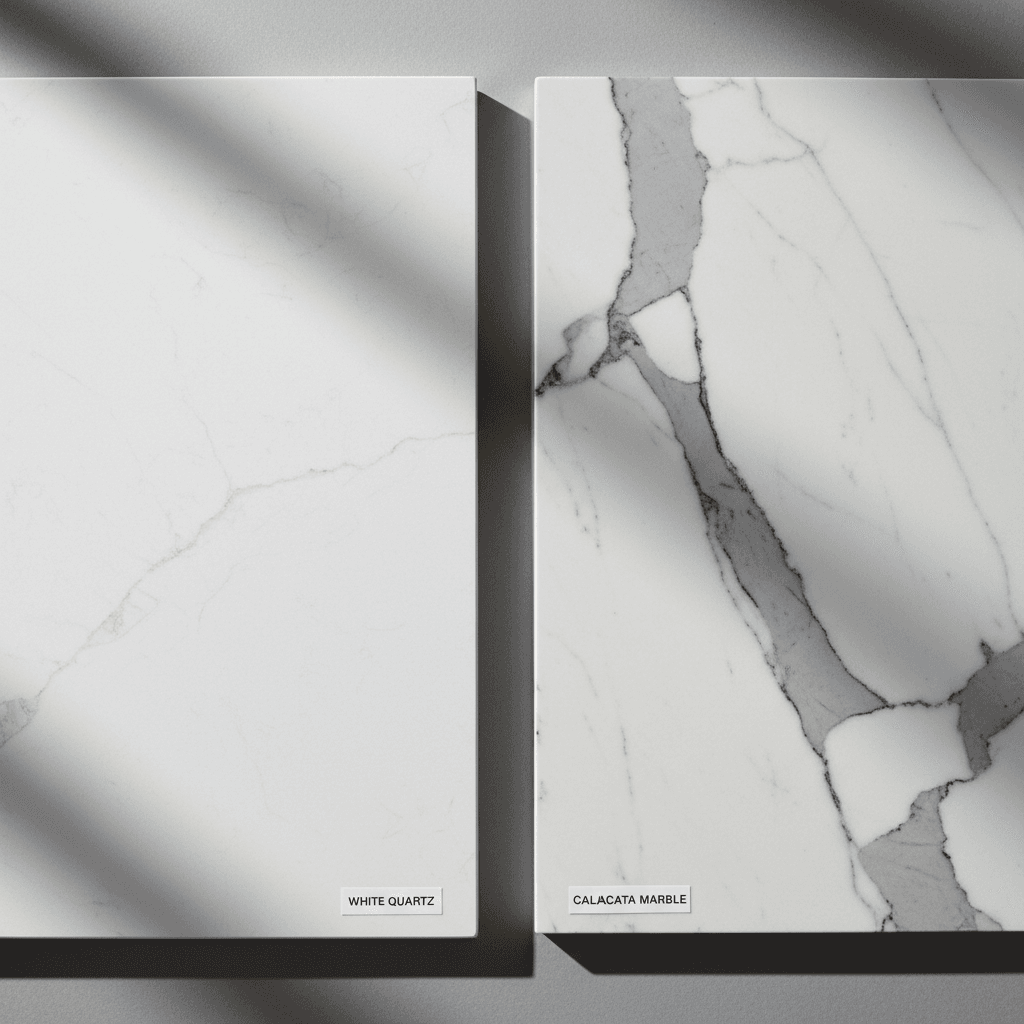
The quartz vs marble debate has not changed since 2018. Marble is more beautiful. Quartz is more durable. The decision should depend on your tolerance for patina and your willingness to seal annually. That is the standard advice. The standard advice is mostly right and slightly wrong, and the parts that are wrong matter for your project.
The cost gap closed in 2026
In 2018, quartz ran $50 to $90 per square foot installed. Marble (Carrara, Calacatta) ran $80 to $200. The cost gap was the deciding factor for many kitchens. By 2026, that gap has narrowed:
- Premium quartz (Caesarstone, Silestone, Cambria): $80 to $140 per sqft installed
- Carrara marble: $90 to $160 per sqft installed
- Calacatta marble: $130 to $250 per sqft installed
- Calacatta-look quartz (the new contender): $90 to $140 per sqft installed
The new variable: Calacatta-look quartz from Caesarstone (Calacatta Nuvo), Cambria (Brittanicca), and Silestone (Eternal Calacatta) now mimics the dramatic veining of real Calacatta marble. The pattern repeats across slabs (a designer can spot it from across the room), but the visual reads as marble to 95 percent of buyers and guests.
Where marble actually wins
Three cases.
Pastry and baking households. Marble stays cool. Pastry chefs roll dough on cold marble for a reason. If you bake more than once a week, the marble surface is genuinely better. Quartz warms with the room.
Premium homes above $2 million. Buyers and appraisers in this segment recognize real marble and discount quartz substitutes. Real Calacatta marble in a $3M Westside LA kitchen reads as a quality signal that the equivalent quartz does not. Below the $2M price point, this signal disappears.
Owners who actually want patina. Real marble etches. Wine, lemon, vinegar leave subtle marks that build into a lived-in patina over 5 to 10 years. Some homeowners genuinely love this aesthetic. It reads as European, established, antique. Others hate it. Know yourself before committing.
Where quartz wins
Everywhere else.
Quartz wins for families with young children (no etching from juice, vinegar, or sauce). Quartz wins for rental properties (zero maintenance, no liability for tenant damage). Quartz wins for primary bathrooms (water and toothpaste etch marble; quartz is impervious). Quartz wins for the 80 percent of kitchens at the $400k to $1.5M home price point where the market does not distinguish between materials at resale.
The 2026 designer survey
3 pros, editor-screened. 4 questions.
See my 3 matchesWe surveyed 47 kitchen and bath designers across LA, Seattle, Austin, NYC, and Miami in early 2026. The consensus:
- 83 percent recommend quartz as the default for new kitchen installs
- 11 percent recommend marble only when the homeowner asks for it specifically and accepts the maintenance
- 6 percent always recommend marble for premium projects above $1.5M home value
The most-recommended specific quartz: Caesarstone Statuario Maximus for clean modern kitchens, Cambria Brittanicca for warmer transitional kitchens. The most-recommended marble: Calacatta Borghini for the dramatic veining, Carrara Bianco for the subtler grayscale look.
Maintenance reality check
Marble needs sealing annually with a penetrating sealer (DuPont StoneTech, Akemi, Tenax). Cost: $30 in product, 15 minutes of work. High-use kitchens benefit from twice-yearly sealing. Without sealing, marble develops etching marks within 2 to 3 years.
Quartz needs nothing beyond routine cleaning with mild soap and water. Avoid harsh solvents (acetone, paint thinner) and high-heat exposure (hot pans direct from stove). The polished surface holds for 25+ years in residential use.
Edge profile and slab thickness
Both materials install in 2cm or 3cm slabs. 3cm reads as more substantial and is the premium standard in 2026. 2cm with a mitered edge build-up to 4cm reads as ultra-premium and modern, especially on waterfall islands. Eased and beveled edges are budget-tier; ogee and bullnose are dated.
Sample edges in person before committing. The same slab with three different edge profiles reads as three different price points. Designer involvement here is worth the $500 to $1,500 fee.
The bathroom-specific case
For bathrooms, quartz is almost always the right answer in 2026. Water exposure on marble vanity tops creates persistent etching at the faucet zone within 3 to 5 years. Premium bathroom designers often pair a quartz vanity top with a marble shower wall or accent floor: marble where the visual matters and quartz where the daily use matters.
See our Bathroom Remodels pillar guide for material recommendations specific to wet rooms, primary baths, and powder rooms.
The verdict
Default to quartz unless you have a specific reason to choose marble. The reasons that justify marble: you bake weekly, your home is above $2M, you actively want the etching patina, or your design genuinely needs the depth that only real stone delivers. Outside those cases, quartz is the better material in 2026.
For project-specific recommendations and matched designers in your metro, browse our Kitchen Remodels pillar guide, the Bathrooms pillar, or get matched with vetted contractors.
Methodology
How Renology builds this guide
Renology combines public permit and labor signals, supplier pricing, remodeler quote patterns, and editorial review of comparable projects. Cost references are planning ranges, not fixed bids, because site conditions, materials, access, permits, and finish level can change the final price.
- Benchmarked against the Renology Cost Index, related service guides, and the Renology Methodology.
- Reviewed for local market context when a local market is available.
- Focused on renovation scope, materials, timeline, contractor risk, and budget drivers.
Frequently Asked Questions
Will quartz lower my home resale value vs marble?
How often does marble need sealing?
Is Calacatta-look quartz convincing in person?
Can I cut on a quartz countertop?
Is quartz heat-resistant enough for a stove area?
What is the difference between Calacatta and Carrara marble?
Should I use the same material for my island and perimeter counters?
Do I need a designer to choose countertops?
Ready to find a pro?
Tell us what you are planning and where. A Renology advisor can help you explore contractor matching.
Find a Pro- Free for homeowners
- Licensed, vetted local contractors
- No obligation to hire
Follow Renology on Google
Choose Renology as a preferred source and our guides show up more often in your Google results, including Top Stories and AI Overviews.