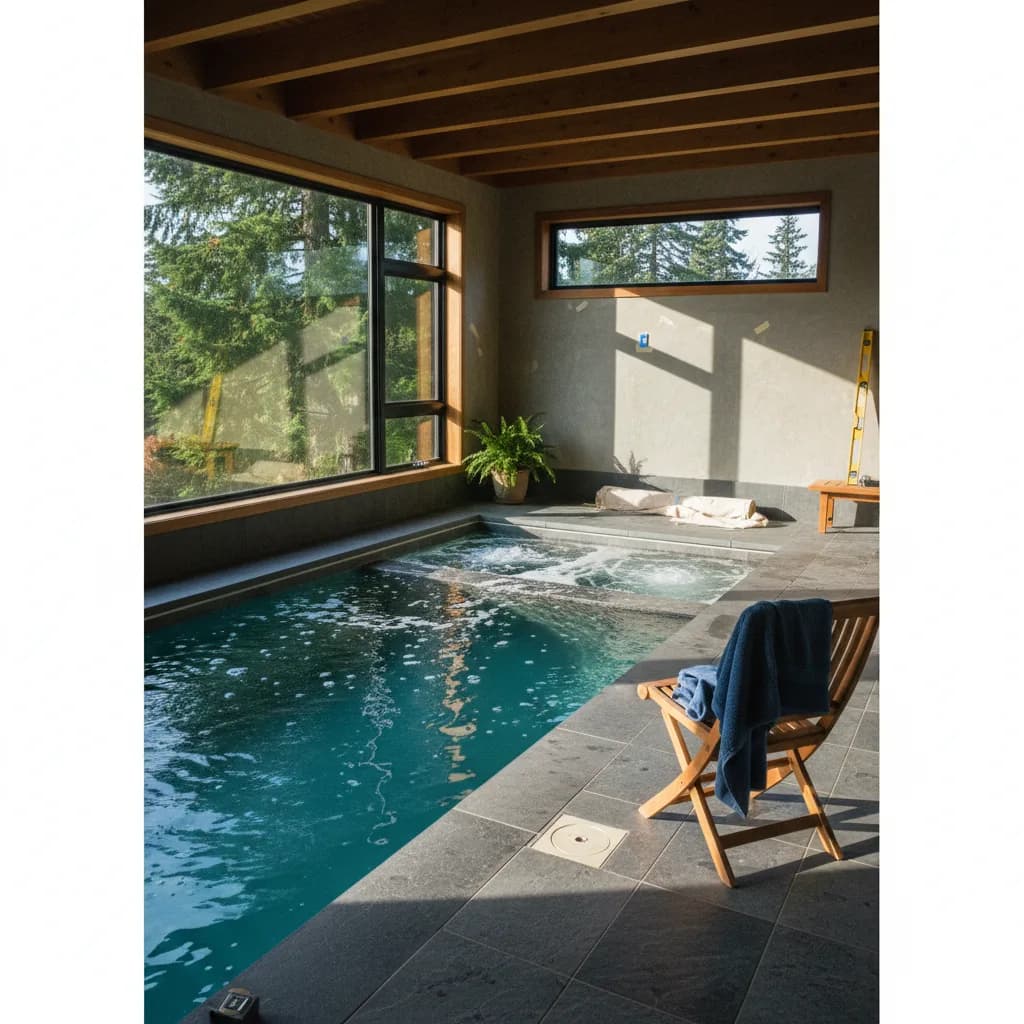
A professionally installed inground swimming pool in Portland, Oregon costs between $85,000 and $225,000 in 2026, with a median project price of approximately $145,000 for a mid-range gunite pool with standard decking. This cost can start lower, in the $50,000 to $75,000 range, for simpler projects like a fiberglass plunge pool or a semi-inground installation on a level lot. However, the majority of comprehensive backyard projects fall well within the six-figure range once excavation, decking, fencing, and equipment are accounted for.
In a Nutshell
- Total Cost Range (2026): $85,000 to $225,000+ for a fully installed inground pool.
- Mid-Range Project Cost: Approximately $145,000 for a 15x30 foot heated gunite pool with concrete decking and standard safety fencing.
- Project Timeline: Four to nine months from initial design to final inspection, heavily influenced by seasonal weather and permitting backlogs at the Portland Bureau of Development Services.
- Biggest Surprise Line Item: Site preparation and excavation. Hitting basalt rock or dealing with Portland's expansive clay soil can add $8,000 to $20,000 in unforeseen costs for specialized equipment and soil removal.
What does a pool actually cost in Portland?
The total cost of a Portland pool project is determined by its size, materials, and features. We have categorized projects into three common tiers based on an analysis of regional build data. These figures represent the full project cost, including labor, materials, equipment, and basic finishing.
| Tier | Cost Range (2026) | Typical Scope |
|---|---|---|
| Basic (Fiberglass/Vinyl) | $85,000, $115,000 | Small-to-medium prefabricated fiberglass shell or vinyl liner pool. Minimal concrete decking, basic pump and filter system, standard safety cover. |
| Mid-Range (Gunite) | $115,000, $180,000 | Custom-shaped 400-500 sq. ft. gunite pool with plaster finish. Broom-finish concrete or basic paver decking, energy-efficient equipment, gas heater, and automated controls. |
| Premium (Custom) | $180,000, $250,000+ | Large custom gunite pool with premium pebble or tile finish. Extensive travertine or stamped concrete decking, integrated spa, water features (waterfall, jets), high-end LED lighting, and automatic cover. |
For a typical mid-range $145,000 gunite pool project, the budget allocation is distributed as follows, according to Renology project data:
- Excavation, Steel & Gunite Shell: 35%
- Labor: 25%
- Decking & Coping: 15%
- Plumbing & Electrical: 10%
- Filtration & Heating Equipment: 10%
- Interior Finish (Plaster/Pebble): 5%
The bottom of the cost range typically represents a small fiberglass plunge pool on a flat, easily accessible lot with minimal landscaping, not a full-size family pool project.
Why is it more expensive to build a pool in Portland?
Building a pool in the Portland metro area presents a unique set of cost drivers compared to other regions. Three primary factors contribute to the higher price tag: specialized labor costs, challenging geological conditions, and logistical complexities.
First, skilled labor rates in the region are substantial. According to the Oregon Bureau of Labor and Industries, Portland metro occupational data for 2026 shows that prevailing wages for specialized trades like excavation equipment operators, electricians, and pipefitters are among the highest in the state. This is compounded by a persistent shortage of experienced pool construction crews, which allows top-tier pool contractors in Portland to command a premium for their services.

Second, Portland's geology creates significant construction hurdles. Many desirable neighborhoods, particularly in the West Hills, Lake Oswego, and West Linn, are characterized by steep slopes, dense basalt rock formations, and expansive clay soil. Excavating in these conditions often requires heavy-duty equipment like hydraulic hammers, which increases time, labor, and disposal costs. The high water table in flatter areas of the city can also necessitate dewatering systems and specialized waterproofing, adding thousands to the structural phase of the build.
Finally, the region's climate impacts the construction timeline and material choices. The short, intensive building season from late spring to early fall creates high demand for materials and crews., materials must be selected to withstand Portland's freeze-thaw cycles, which can damage improperly installed decking, tile, and plumbing lines over time. This requires higher-grade materials and more meticulous installation methods than in milder climates.
What do real Portland homeowners spend in 2026?
Three modeled project scenarios for 2026, built from the Renology Cost Index and typical local scopes. These are illustrative estimates, not completed client projects:
- A $138,000 Bethany Project: A family in the Bethany area installed a 14x28 foot rectangular fiberglass pool. The cost included the shell, installation, a gas heater, and a basic brushed concrete deck. The price was improved by $12,000 due to the need for a small retaining wall to manage a slight grade on the property. The project took five months from permit submission to completion.
- A $162,000 Lake Oswego Project: On a sloped lot in Lake Oswego, homeowners opted for a freeform gunite pool approximately 450 square feet in size. The project involved extensive excavation to carve into the hillside, costing an additional $18,000. The total included a salt chlorine generator, an automatic safety cover, and paver stone decking. Permitting and site work extended the timeline to just over seven months.
- A $195,000 West Linn Project: This project featured a 16x32 foot gunite pool with an integrated 7x7 foot spa. The primary cost drivers were the premium pebble interior finish, an automated control system managed by a smartphone, and extensive travertine decking. Electrical work was more complex, requiring a subpanel upgrade to support the dual equipment sets for the pool and spa, adding $4,500 to the budget. The build was completed in eight months.
Where does the money actually go?
3 Portland pool builders, editor-screened. 4 questions.
See my 3 matchesA pool contractor's initial quote often covers the pool shell and basic equipment but may omit other necessary expenses. Homeowners should budget for these items separately to get a true picture of the total project cost.
- Safety Fencing: Required by city and county code, a permanent, non-climbable fence with a self-latching gate costs between $8,000 and $15,000 for a typical yard.
- Electrical Service Upgrade: Pool equipment can require 60-100 amps. If your main panel is insufficient, a subpanel or full panel upgrade costs $2,500 to $5,000.
- Excess Soil Hauling & Disposal: A standard pool excavation can generate 10 to 15 truckloads of soil. The cost to haul and legally dispose of this material ranges from $3,000 to $7,000.
- Landscaping & Irrigation Repair: Construction will damage the surrounding lawn and sprinkler systems. Basic sod, plantings, and irrigation repair typically costs $5,000 to $12,000.
- Permitting Fees: Fees paid to the Portland Bureau of Development Services for building, electrical, and plumbing permits can range from $1,500 to $4,000.
- Automatic Pool Cover: A popular feature in the Northwest for safety, heat retention, and keeping out debris. An automated cover adds $12,000 to $22,000 to the project.
- Site Drainage: If the new decking affects yard drainage, installing French drains or other solutions may be necessary, costing $3,000 to $8,000.
- Initial Water Fill: Filling a pool with a garden hose can take days and be costly. A water delivery truck service costs $400 to $900.
What stops a Portland pool project from running over budget?
Three main issues commonly cause budget overruns on Portland pool projects: unforeseen site conditions, scope creep, and allowance underestimations.
First, what lies beneath the surface is the biggest unknown. As mentioned, hitting a significant basalt deposit or encountering a high water table during excavation can halt work and require costly solutions. While a soils report can mitigate this risk, it is not always performed for residential projects. We use a ten to fifteen percent contingency as a planning assumption; for comparison, HUD's Standard 203(k) loan rules require a reserve of at least 10 percent on homes 30 years or older. For pool projects, this contingency is critical for managing geological surprises on any property.
Second, scope creep is a frequent cause of budget inflation. This happens when homeowners make changes or additions after the contract is signed. Deciding to add a spa, upgrade from concrete to travertine decking, or install a waterfall midway through the project will generate change orders that add significant cost and can delay the schedule.
Third, vague allowances in the contract can be misleading. A contractor might include a $10,000 allowance for decking, but the paver style the homeowner ultimately selects costs $16,000. It is essential to specify exact materials, finishes, and models before signing the contract to ensure allowances accurately reflect the desired outcome.
What should your Portland contractor include in the quote?
A detailed, fixed-price quote is the foundation of a successful project. Before signing a contract with a pool contractor in Portland, ensure it clearly itemizes the following. A clear scope of work is also the first step in the permitting process, which you can learn more about in our guide to getting pool permits in Portland.
- Detailed pool dimensions, shape, and depth specifications.
- Excavation scope, including assumptions about soil conditions and cost for rock removal.
- Structural shell materials (e.g., rebar schedule, gunite thickness).
- Plumbing materials and schematic (pipe size, number of returns and skimmers).
- Electrical scope, including bonding, lighting, and subpanel installation if required.
- A specific list of all pool equipment by brand and model number (pump, filter, heater, sanitizer).
- Coping and decking material, square footage, and finish type.
- Interior surface material and color (e.g., white plaster, specific pebble finish brand).
- Inclusion of any water features, slides, or diving boards.
- Cost and type of temporary fencing during construction and permanent safety fencing.
- Responsibility for soil and construction debris removal.
- Cleanup, grading, and basic site restoration.
- Warranty information for both workmanship and equipment.
- A clear payment schedule tied to project milestones.
Heating costs in Pacific Northwest climate (8-month usable season)
Portland sits in the most heating-cost-sensitive pool climate in the lower 48: average overnight temperatures from late September through early May make an unheated pool unusable for two-thirds of the year. Three heating systems dominate Portland installs in 2026, with very different operating economics.
- Natural gas heater (most common): 400,000 BTU unit raises a 20,000-gallon pool from 60°F to 80°F in 18-24 hours. Operating cost: $4 to $9 per day during the 8-month swim season, depending on cover use and Portland NW Natural Gas rates. Annual heating cost: $700 to $1,800.
- Heat pump (electric): 140,000 BTU unit takes 48-72 hours to reach temperature, then maintains efficiently. Operating cost: $2.50 to $5.50 per day at PGE residential rates. Annual: $450 to $1,150. Best ROI but slow recovery if you let the pool cool.
- Solar heater (supplemental only): $3,500-$8,000 upfront, supplements either of the above. Extends the usable season 4-6 weeks per year. Not standalone-viable in Portland sky cover.
The single highest-leverage decision: a solid pool cover. An automatic safety cover ($9,000-$14,000 installed in 2026) reduces heating cost by 50 to 65 percent and prevents the daily 8-12°F overnight drop that triggers expensive reheats. Over a 10-year ownership, the cover usually pays back through heating savings alone.
Pool removal cost in Portland (the adjacent question sellers ask)
Many Portland homeowners researching pool installation are actually weighing pool REMOVAL on a property they are about to sell or have just purchased. The cost of pool removal in 2026 Portland metro:
- Partial removal (drain, demo top 18 inches, fill with structural soil): $4,500 to $9,500. Cheapest, but the property must be disclosed as having a "filled pool" forever, which deters some buyers.
- Full removal (complete demolition, haul-off, engineered fill, soil compaction certification): $11,000 to $22,000. Lot returns to fully developable status. Required for new construction on the footprint.
- Conversion to a deck or hardscape feature: $14,000 to $35,000. Concrete cap over partial demo, decked over for outdoor living. Avoids disclosure but adds resale appeal.
Portland Bureau of Development Services requires a demolition permit for either removal path and a soil compaction certification (typically Multnomah County geotech sign-off) before the lot can carry new construction. Stormwater retrofitting may be required if the pool footprint was draining to a separate system. Real estate data from Portland metro 2024-2026 shows full removal recovers roughly 65 to 80 percent of removal cost in faster sale time and price improvement; partial removal recovers 20 to 40 percent.
Sources & Methodology
See the Renology Methodology for how sources are reviewed, ranges are normalized, and planning-data limits are handled.
Cost ranges in this guide draw on the following named industry sources, public agency datasets, and Renology editorial research.
- Portland Bureau of Development Services, Permit Fee Schedule (2026)
- Remodeling Magazine, Cost vs. Value Report, Pacific Region (2026)
- Oregon Bureau of Labor and Industries, Portland Metro Occupational Data (2025-2026)
- National Association of Home Builders (NAHB), Construction Cost Survey (Q4 2025)
- Pool & Hot Tub Alliance (PHTA), Market Research & Statistics (2025)
Renology Take
The most common point of failure in budgeting for a Portland pool is not the cost of the pool itself, but the cost of the complete, functional, and compliant backyard environment. Homeowners fixate on the price of the water vessel, which contractors often emphasize in initial bids. However, the legally mandated safety fencing, the necessary restoration of the landscape, the required electrical upgrades, and the desirable decking often amount to an additional forty to sixty percent of the pool's cost. A $100,000 pool is, in reality, a $140,000 to $160,000 backyard project. Successful projects are those where the homeowner budgets for the total environment from day one, not just the hole in the ground.
Frequently Asked Questions
How much value does a pool add to a Portland home in 2026?
What are the annual maintenance costs for a pool in Portland?
When is the best time of year to start a pool project in Portland?
How long does it take to get a pool permit in Portland?
What type of pool is best for Portland's climate?
Ready to find a pro?
Tell us what you are planning and where. A Renology advisor can help you explore contractor matching.
Find a Pro- Free for homeowners
- Licensed, vetted local contractors
- No obligation to hire
Sources
- Portland Bureau of Development Services, Permit Fee Schedule
- Remodeling Magazine, Cost vs. Value Report, Pacific Region
- Oregon Bureau of Labor and Industries, Portland Metro Occupational Data
- National Association of Home Builders (NAHB), Construction Cost Survey
- Pool & Hot Tub Alliance (PHTA), Market Research & Statistics
Follow Renology on Google
Choose Renology as a preferred source and our guides show up more often in your Google results, including Top Stories and AI Overviews.