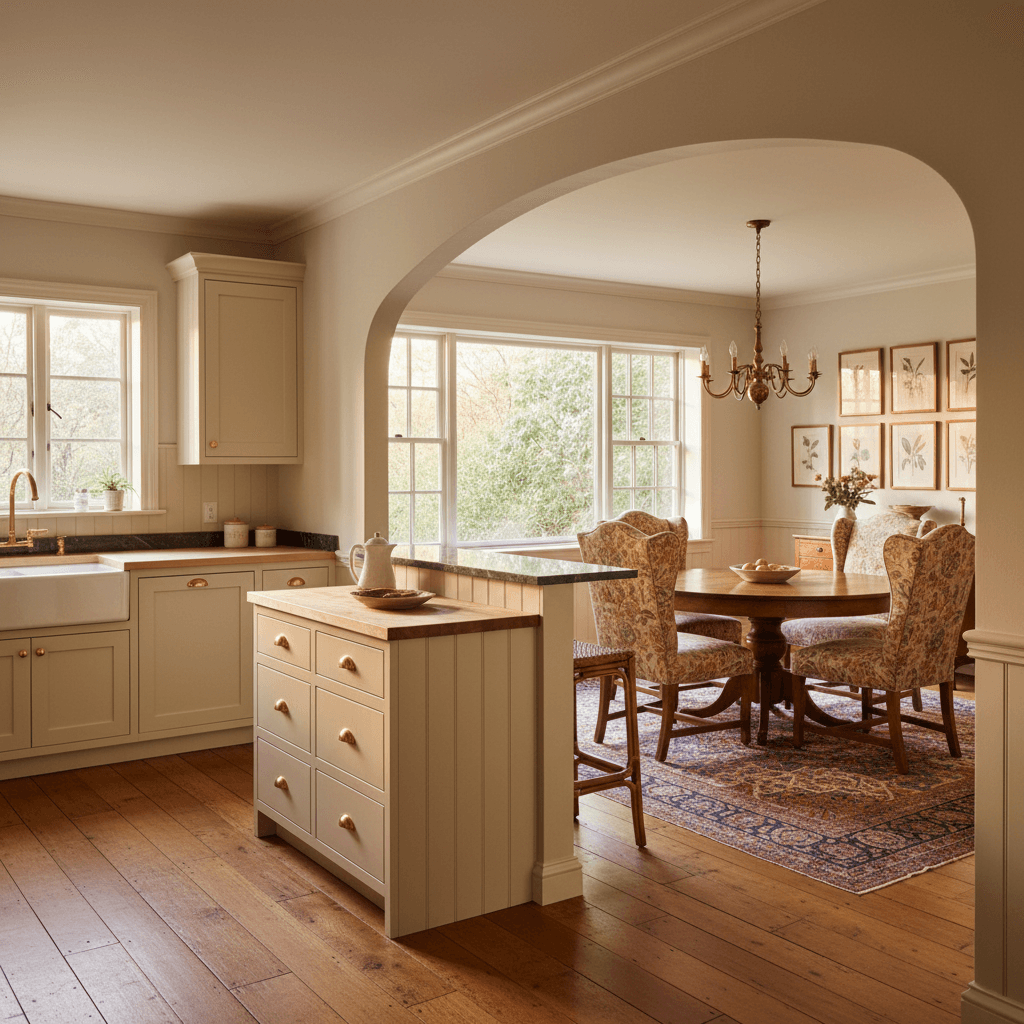
From 2000 to 2024, the answer to almost every kitchen renovation question was the same: tear down the wall to the dining room. Open up the floor plan. Create flow. The result was a generation of homes where the kitchen, dining room, and living room became one large multi-purpose space.
The four costs of open concept that nobody listed
The open-concept playbook sold these benefits: more entertaining space, easier supervision of children, bigger feel for small homes, more natural light flow. All real. But every benefit came with a cost that the playbook glossed over.
Cooking smell migration. Sear a steak in an open-concept kitchen and the smell is in the upholstery for three days. Closed kitchens contained the smell. Open kitchens spread it through the house. Premium kitchen ventilation (1,200+ CFM hoods with proper makeup air) helps but does not solve.
Acoustic chaos. Hard surfaces, big volumes, no walls to absorb sound. A single conversation, the dishwasher running, kids on tablets, and music playing all collide. Open concept is the worst-possible acoustic environment for households with multiple people doing different things in the same space.
Mess visibility. Closed kitchens hide dishes from the living room. Open kitchens broadcast every dirty pan and cluttered counter to every guest who walks into the space. Hosts feel the pressure to maintain showroom-clean kitchens, which is exhausting.
Heating and cooling inefficiency. Big volumes are harder to heat and cool. Open concept homes run 8 to 18 percent higher HVAC bills than the same square footage divided into rooms. With energy costs climbing, this matters more in 2026 than it did in 2010. See our heat pump article for HVAC rightsizing in open vs traditional layouts.
What designers are recommending instead
The new playbook is not "rebuild every wall." It is selective separation. Three patterns are dominant in 2026 premium remodels.
The arched cased opening. Replace a tear-down wall with a wide arched doorway between kitchen and dining. Visual flow remains. Smell, sound, and mess containment improve dramatically. The arch reads as architectural detail rather than an afterthought.
The pocket door. A 6-foot-wide pocket door can fully divide kitchen and living room when closed and disappear when open. Best of both worlds for households that want the option to host open or contain everyday cooking.
The half-wall with built-in shelving. A 42-inch tall half-wall with bookshelves or art display defines the kitchen from the living area visually without blocking sight lines. Acoustics improve modestly. Mess hides from seated dining height.
The retro influence
Designers are openly drawing inspiration from pre-1980 floor plans: kitchens with butler pantries, dining rooms with proper enclosure, living rooms with defined function. The 1970s ranch with awkward small rooms is not coming back. The 1920s Craftsman with thoughtfully separated rooms (each with purpose, doorway alignment, and natural light) is the reference.
The Architectural Digest portfolios that drove the open-concept trend in the 2000s are now driving the closed-and-curated trend in the 2020s. Where the homes used to feature single 1,200-square-foot great rooms, they now feature kitchens, dining rooms, libraries, and conservatories, each beautifully separated.
What this means for your remodel
If you are about to tear down a wall, ask first whether you should. The right answer depends on:
- How much you cook. Light cookers benefit from open concept. Heavy cookers should keep some separation.
- Household composition. Single occupants and couples who entertain often benefit from open. Families with multiple kids and competing activities benefit from selective separation.
- Existing acoustics. If your dining-to-living-to-kitchen space is already 25+ feet long with hard floors, opening it further creates an acoustic disaster.
- Resale time horizon. If you plan to sell in 3 years, the open-concept market still pays a small premium in most metros. If you plan to stay 7+ years, design for your own life.
The full demolition decision should never be made on aesthetic grounds alone. The structural, acoustic, and operational implications matter more than the photo-shoot moment.
The pantry comeback
3 pros, editor-screened. 4 questions.
See my 3 matchesOne specific manifestation of the closed-kitchen trend: the proper walk-in pantry is back. Premium 2026 kitchens increasingly feature 30 to 70 square feet of dedicated pantry space, often with a second sink, secondary refrigerator, microwave, and small appliance storage. The visible kitchen stays clean and minimal; the daily-use mess lives in the pantry.
Pantry square footage adds $200 to $450 per square foot to a kitchen budget but reads as ultra-premium and dramatically improves daily kitchen function. See our Kitchen Remodels pillar guide for pantry design considerations.
Cost of selective separation
Adding back a partial wall, pocket door, or arched cased opening costs:
- Half-wall with built-in shelving: $2,500 to $6,500 depending on length and millwork detail
- Cased arched opening: $3,000 to $9,000 (more if structural beam is required)
- Pocket door (single): $3,500 to $8,000 installed
- Pocket door (double-wide): $6,000 to $14,000 installed
- Walk-in pantry build-out: $15,000 to $40,000 depending on size and finishes
Climate and acoustic considerations
In hot climates (LA, Phoenix, Texas), open-concept HVAC inefficiency hurts more than in mild climates. The 8 to 18 percent additional energy cost translates to $400 to $1,200 per year on a 2,500 sqft home in LA. In cool climates like Seattle, the gap shrinks.
Acoustic improvement from rebuilding a half-wall is meaningful but partial. For homes with serious open-concept noise issues, layered solutions work better: rugs (best ROI), upholstered furniture (high impact), acoustic ceiling treatments (premium), then partial walls or doors.
Resale data: what buyers actually pay for
Mixed results in 2026 NAR and Zillow data. Open concept still commands a slight premium (3-5 percent) in most US markets at the $400k to $1M home price point. Above $1.5M, the premium reverses: traditional layouts with curated separation now command higher prices, especially in coastal CA and Northeast metros. The Westside LA market is the leading edge of this reversal.
What this means for your project
If you are buying or renovating in 2026, do not assume open-concept is the right answer. Ask the question. The honest answer for your specific household and home is increasingly "selective separation" rather than "tear it all down." For matched designers in your metro, browse our Kitchens pillar guide or get matched with vetted kitchen designers.
Methodology
How Renology builds this guide
Renology combines public permit and labor signals, supplier pricing, remodeler quote patterns, and editorial review of comparable projects. Cost references are planning ranges, not fixed bids, because site conditions, materials, access, permits, and finish level can change the final price.
- Benchmarked against the Renology Cost Index, related service guides, and the Renology Methodology.
- Reviewed for local market context when a local market is available.
- Focused on renovation scope, materials, timeline, contractor risk, and budget drivers.
Frequently Asked Questions
Should I close up my existing open-concept kitchen?
Will closing off my kitchen hurt resale?
How much does adding a wall back cost?
What is a butler pantry and is it worth it?
Can I add a pocket door to an existing open-concept kitchen?
How does open-concept affect HVAC efficiency?
Will a pocket door eliminate cooking smells?
Is the open-concept trend really over?
Ready to find a pro?
Tell us what you are planning and where. A Renology advisor can help you explore contractor matching.
Find a Pro- Free for homeowners
- Licensed, vetted local contractors
- No obligation to hire
Follow Renology on Google
Choose Renology as a preferred source and our guides show up more often in your Google results, including Top Stories and AI Overviews.