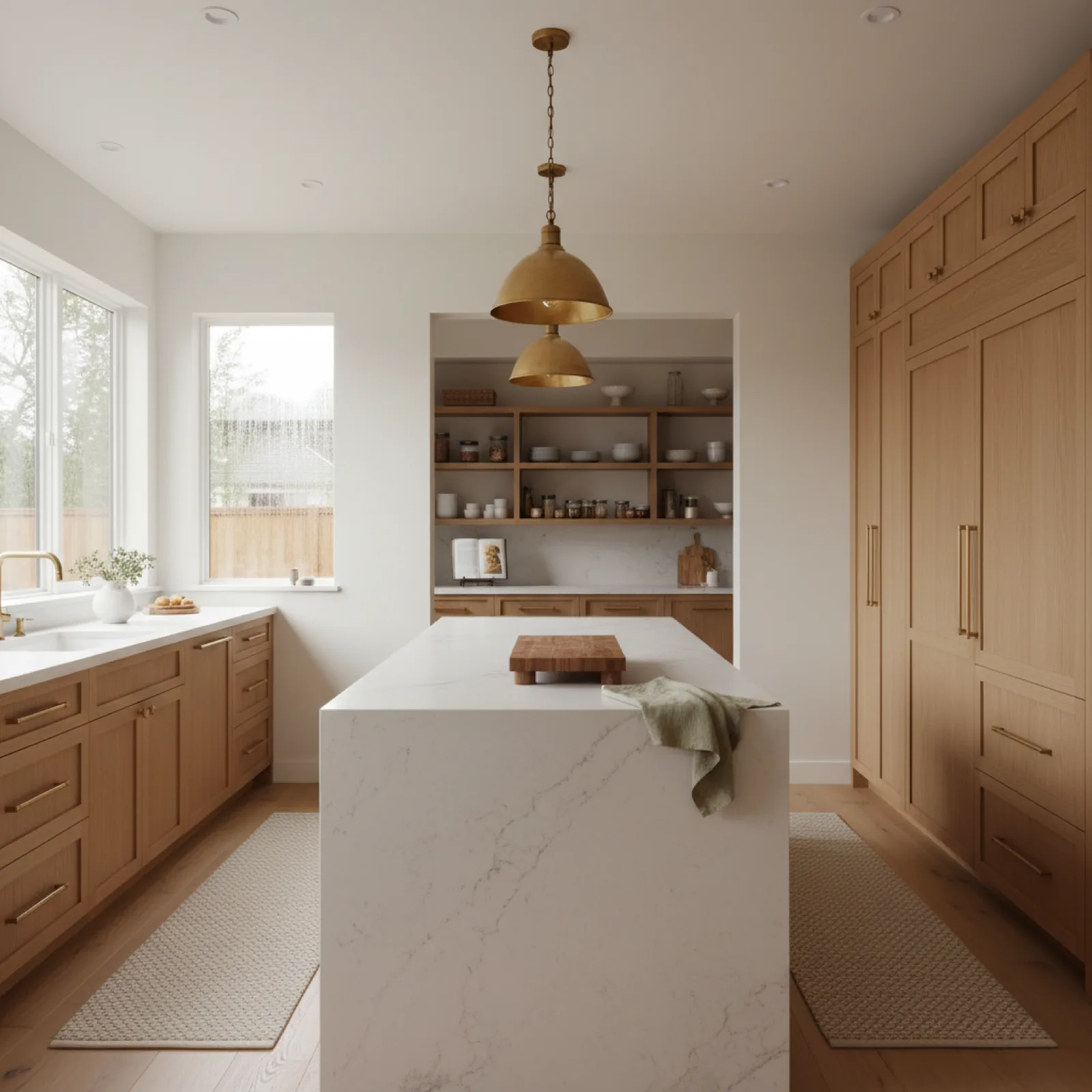
The eight kitchen design trends defining 2026 in Seattle share one thing: they are quieter than the trends they replaced. Warm woods over stark white. Walk-in pantries over open shelving. Induction over gas. Unlacquered brass over polished chrome. The minimalist decade is over. Seattle, partly because of its Pacific Northwest material palette, partly because of a climate that makes a kitchen feel like a warm center, is leaning into the shift harder than most metros.
In a Nutshell
- Umbrella theme: quiet luxury. Natural materials, integrated appliances, no shouty finishes.
- Biggest three: rift-cut white oak cabinetry, walk-in pantries, induction cooking.
- Being replaced: white shaker with black hardware, open shelving, gas ranges.
- Next arc: the trends below will dominate Seattle showrooms through 2027 and peak in 2028, then fracture into regional variants.
Rift-cut white oak is the new white
Rift-cut white oak is now the default cabinet specification on mid-range and premium Seattle kitchens. Ballard Cabinet Shop and two of the three largest Eastside kitchen showrooms reported rift-cut oak passing painted white on 2026 orders by early spring. The homeowner usually pairs it with a honed quartzite or a warm-toned quartz, never with high-gloss stone. Queen Anne and Madrona projects are leading; Bellevue and Kirkland are following within the same ninety days.
Walk-in pantries are back
A walk-in pantry, not a butler's pantry, not a prep pantry, a proper small room, is now on roughly half of new Seattle kitchen plans over 160 square feet in 2026. A Madison Park homeowner paid $147,000 for a kitchen this spring and the single room that made the project feel finished was the pantry: nine linear feet of rift-cut oak shelving, one library ladder on a track, warm integrated lighting. Her contractor told her three of his last five clients asked for the same thing. The pantry is coming for the floor plan, and open shelving, the signature look of the 2018, 2022 era, is the casualty.
Induction is the default on new Seattle kitchens
Induction has passed gas as the default range specification on permits pulled for Seattle kitchen remodels in 2026. Part of the reason is the city's push on building electrification; most of the reason is that the cooks who have tried induction rarely go back. Wolf, Miele, and Bosch induction ranges are outselling their gas equivalents two-to-one in Seattle showrooms. The holdout category is premium, a custom La Cornue or a bluestar still shows up in about a quarter of premium kitchens, always gas, often on a second cooktop.
Unlacquered brass is replacing polished chrome
Unlacquered brass, the version that patinas with use, not the factory-polished one, is the dominant 2026 hardware choice in Seattle. The patina is the point. Capitol Hill and Queen Anne homeowners are specifying it even on builder-grade cabinets because the finish evolves with the kitchen. Polished chrome, the signature finish of the 2016, 2022 era, is being specified on about one in six Seattle kitchens in 2026, down from one in two in 2022.

Panel-ready everything
3 Seattle kitchen remodelers, editor-screened. 4 questions.
See my 3 matchesIntegrated appliances behind cabinet panels, refrigerators, freezer drawers, dishwashers, and even the new panel-ready induction ranges, are the defining premium move of 2026. A Mercer Island project we documented this spring integrated every major appliance except the faucet; the kitchen read as millwork from the living room. This trend started in European kitchens a decade ago, landed in U.S. premium work around 2022, and is now the standard on new Seattle kitchens over $90,000.
The single quiet island
The maximalist island, waterfall stone, built-in wine fridge, microwave drawer, bar seating for six, is being replaced by a quieter island. A single slab, a single function, often just a prep surface with seating for two or three. Homeowners are trading island square footage for walk-in pantry square footage, and for the first time in a decade the average Seattle island is getting smaller year over year. Green Lake and Ravenna are where this shows up first; the Eastside is following.
Honed, not polished
Honed finishes on quartzite, marble, and high-end quartz are outpacing polished on Seattle 2026 kitchens for the first time since quartz became dominant. The honed finish forgives hard water marks, hides small nicks, and pairs visually with the warm wood trend. It also costs $4, $8 more per square foot on natural stone than polished, which is the only reason it hasn't taken over faster.
Statement range hoods in plaster or wood
The stainless steel chimney hood, the default specification for a decade, is being replaced by plaster-wrapped or wood-wrapped hoods that read as millwork. The hood becomes an architectural element, not an appliance. This one is particularly strong in Madrona and Madison Park, where the interior design community has pushed showrooms to stock plaster hood blanks in volume for the first time.
Soft, warm lighting replaces cool white
2700K is the new default color temperature on Seattle kitchens in 2026. Homeowners are specifying warm-dimming LED, the kind that shifts from 2700K down to 2200K as it dims, the way incandescent did, on every light fixture that will accept it. The cool 3000K and 3500K light that made white kitchens feel clinical is being specified on about one in five Seattle kitchens in 2026, mostly in rental units and ADUs.
Renology Take
The thread connecting all eight trends is the same: Seattle homeowners are asking their kitchens to feel like rooms, not like showrooms. The white-shaker-with-black-hardware era optimized for photography, the kitchen had to look sharp on Instagram. The rift-cut-oak-with-unlacquered-brass era optimizes for what happens after the homeowner lives in the kitchen for two years: the wood warms, the brass patinas, the plaster hood picks up a fingerprint, and the room earns its character. That is a more forgiving aesthetic, and in a city with Pacific Northwest winters and Pacific Northwest rain, it is the right one.
Sources & Methodology
Renology reviews public permit and labor signals, supplier pricing, remodeler quote patterns, comparable projects, the Renology Cost Index, and the Renology Methodology. Cost references are planning ranges for Seattle kitchen projects, not fixed bids.
- NKBA 2026 Kitchen Design Trends Report
- Ballard Cabinet Shop, 2026 Q1 order mix report
- Seattle Department of Construction and Inspections, 2026 residential kitchen permit data
- Wolf/Sub-Zero dealer network sell-through data, Pacific Northwest, 2026
- Remodeling Magazine, Pacific Northwest kitchen cost survey, March 2026
- Renology Project of the Day field interviews, January, April 2026
Frequently Asked Questions
Is white still in style for kitchens in 2026?
Is induction really better than gas?
Are walk-in pantries worth the square footage?
What hardware finish will still look right in five years?
Seattle · pre-screened
Get 3 Seattle kitchen bids in 48 hours.
Our editors already vetted Seattle kitchen remodelers. Answer 4 questions and we send 3 written bids inside 48 hours, with the real price for your scope, not their inflated first-call number.
- Free, no commission
- Pre-screened locally
- Bids inside 48 hours
Takes about 60 seconds. We'll text you when bids arrive.
Sources
- NKBA 2026 Kitchen Design Trends Report
- Ballard Cabinet Shop, 2026 Q1 order mix report
- Seattle Department of Construction and Inspections, residential kitchen permit data
- Wolf/Sub-Zero dealer network sell-through data, Pacific Northwest
- Remodeling Magazine, Pacific Northwest kitchen cost survey
- Renology Project of the Day field interviews