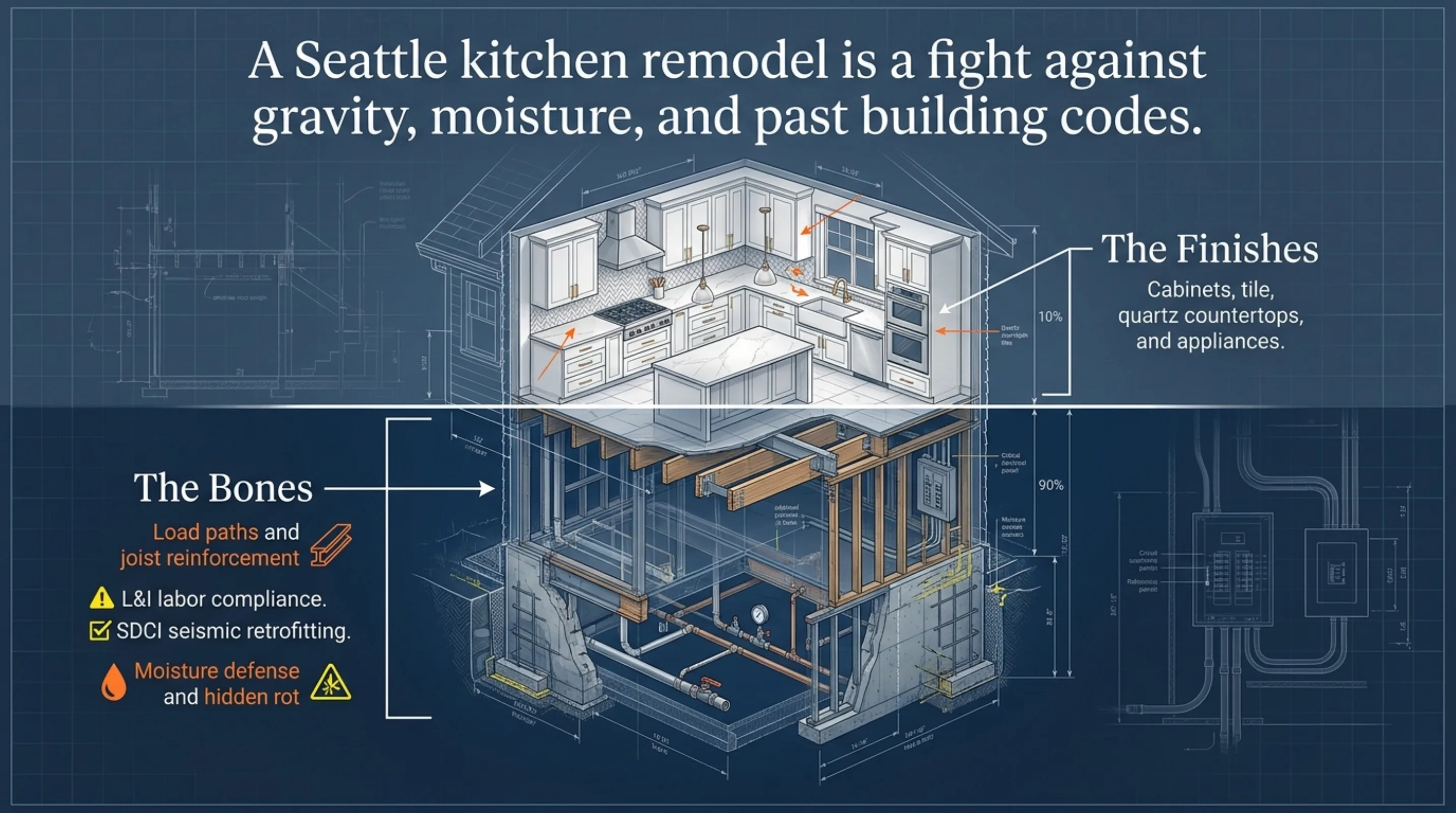
Hiring a kitchen contractor in Seattle isn't about finding the lowest bid. It's about finding a partner who understands the bones of your house. A Seattle kitchen remodel is a fight against gravity, moisture, and the ghosts of past building codes. The wrong contractor delivers a pretty-but-flawed space that fails inspection or, worse, fails under load. The right one builds a kitchen that will outlast the next big one. I’ve seen too many projects in West Seattle and Ballard where a slick countertop hides dangerously notched joists or un-vented plumbing. Your job is to find the crew that respects the load path as much as the backsplash. This guide is your playbook for vetting a kitchen contractor in Seattle who builds it right, the first time.
In a Nutshell
- Seattle kitchen remodels range from $45,000 for a basic refresh to over $200,000 for a high-end, custom project. The average gut remodel lands between $85,000 and $150,000.
- Always verify a contractor's license, bond, and insurance through the Washington State Department of Labor & Industries (L&I) website. No exceptions.
- Seattle's housing stock (pre-war Craftsman, mid-century boxes) presents unique challenges: seismic risks, outdated wiring, and galvanized plumbing. Budget for surprises.
- A solid contract specifies a detailed scope of work, a payment schedule tied to milestones, a clear change order process, and lien waiver procedures.
- The Seattle Department of Construction & Inspections (SDCI) will require permits for most kitchen work. Your contractor must know how to work through this process efficiently.
- Plan for a 10-15% contingency fund. It’s not a question of if you’ll use it, but when.
Understanding the Real Cost of a Seattle Kitchen Remodel
Let's talk numbers. The average cost for a full kitchen remodel in the Seattle area hovers between $85,000 and $150,000. This range covers a complete gut, new layout, semi-custom cabinets, solid-surface countertops, new appliances, and all the necessary electrical and plumbing rough-ins. The final number on your contract will depend on the size of your kitchen, the grade of materials, and the complexity of the structural changes. That said, a kitchen cost in Seattle can start lower. A cosmetic refresh in a downtown condo, keeping the existing layout and just replacing cabinets, counters, and appliances, might run you $45,000 to $65,000. These projects avoid the heavy costs of moving walls, plumbing, and electrical, which is where the budget really expands. On the other end, a high-end project in a Capitol Hill home with fully custom cabinetry, professional-grade appliances, structural beam installation, and luxury finishes can easily exceed $200,000. According to the 2026 Cost vs. Value Report from Remodeling Magazine, a major kitchen remodel in the Seattle metro is one of the best investments for recouping value at resale, but only if the work is done to code and built to last. Don't let a lowball bid tempt you into cutting corners that will cost you more in the long run.
Why Kitchens Cost More in Seattle
There are no two ways about it: building anything in Seattle is expensive. The primary driver is labor. Skilled tradespeople, from carpenters to electricians and plumbers, are in high demand. According to Washington State L&I contractor licensing and labor rate data for 2026, prevailing wages for journey-level trades in King County are among the highest in the nation. This isn't just a number on a spreadsheet; it's the cost of keeping experienced, licensed, and insured professionals on your job site. These are the people who know how to properly flash a new window or run a dedicated circuit that won't trip when you use the toaster and microwave. Beyond labor, material costs in the Pacific Northwest are influenced by our port-city logistics and high demand. Everything from lumber to drywall to specialized hardware has a regional premium attached. Finally, there's the regulatory environment. The Seattle Department of Construction & Inspections (SDCI) has solid building codes, especially regarding seismic safety and energy efficiency. Meeting these codes requires specific materials, techniques, and multiple inspections, all of which add to the project timeline and budget. A good kitchen contractor seattle will build these local costs into their initial bid, providing a realistic picture from the start.
Three Representative Seattle Kitchen Projects (2026)
Three modeled project scenarios for 2026, built from the Renology Cost Index and typical local scopes. These are illustrative estimates, not completed client projects:
1. The Condo Refresh in Belltown: $58,000. This project involved a 120-square-foot galley kitchen in a 2005-build condo. The layout was locked, so no walls moved. The scope included replacing all cabinets with high-quality semi-custom units, installing new quartz countertops, a new tile backsplash, and under-cabinet LED lighting. The appliance package was mid-range. All plumbing fixtures were replaced in their existing locations. Permitting was straightforward since no structural or major systems changes were made. The project took seven weeks from demolition to final punch list.
2. The Craftsman Gut in Ballard: $135,000. This was a full gut remodel of a 200-square-foot kitchen in a 1928 bungalow. A non-load-bearing wall was removed to create an open-concept space. This triggered a full permit review. The project required a complete electrical rewire to replace knob-and-tube remnants, and all galvanized supply lines were replaced with PEX. The floor joists needed reinforcement to support a new island. The scope included custom cabinets, granite countertops, a high-end appliance package, and new hardwood flooring to match the existing. This project took 16 weeks, including two weeks of delay for uncovering unexpected rot in the subfloor.
3. The High-End Remodel in Laurelhurst: $240,000. This extensive project in a 1980s home involved relocating the kitchen to a different part of the house for better views of Lake Washington. It required installing a 22-foot steel beam to open up the main floor. The 350-square-foot kitchen featured premium custom cabinetry, quartzite countertops, a professional-grade 48-inch range, and integrated column refrigeration. All new plumbing and electrical systems were run to the new location. The project also included new, larger windows and a NanaWall system opening to a new deck. The total timeline was seven months, reflecting the complex engineering, permitting, and long lead times for custom components.
The First Step: Vetting Your Kitchen Contractor
Before you talk about finishes or floorplans, you need to verify the basics. In Washington, any contractor performing this work must be registered, bonded, and insured. This is not optional. The Washington State Department of Labor & Industries (L&I) has a simple online tool to check a contractor's status. Look them up by name or UBI number. You want to see an "Active" status with no outstanding infractions. The bond protects you, the homeowner, if the contractor fails to complete the job or pay their suppliers or subcontractors. The insurance covers property damage or injuries that might occur on your job site. A contractor who can't provide current proof of a general liability policy and workers' compensation insurance is not a professional. Don't even consider them. This initial check takes five minutes and is the most important step you'll take. A legitimate kitchen contractor in Seattle will provide their L&I number upfront, often on their business card or website. If they hesitate or make excuses, walk away. This is the absolute floor for professionalism in the trades.
Beyond the License: What Really Matters in a Contractor
A valid license gets a contractor in the door. Their experience and reputation are what should get them the job. Start with their portfolio. Look for projects similar to yours in scope, style, and neighborhood. Are they experienced with older seattle kitchens, or do they only work on new construction? Ask for references, and actually call them. Don't just ask if they were happy; ask specific questions. How did the contractor handle problems? Was the job site kept clean and safe? Was the project manager responsive? How accurate was the initial budget and timeline? A contractor's past performance is the best predictor of future results. Also, pay close attention to communication style. During the initial meetings, are they listening to your goals, or are they pushing their own agenda? A good partner will explain the pros and cons of different approaches and respect your budget. They should be able to talk about load paths and permit requirements as easily as they talk about cabinet finishes. This combination of technical expertise and clear communication is the hallmark of a top-tier professional who can guide a complex kitchen project in Seattle to a successful conclusion.
Questions to Ask Every Potential Contractor
When you sit down with a potential contractor, you're conducting a job interview. Your questions should be designed to reveal their process, experience, and professionalism. Go beyond "How much will it cost?" Here are nine questions to get you started:
- Who will be my primary point of contact, and how often will we communicate? You need one person who is accountable and a clear schedule for updates (e.g., weekly meetings, daily texts).
- Can you detail your process for handling unforeseen conditions? Surprises are inevitable in older homes. A pro has a clear, documented change order process.
- How do you handle permitting with the Seattle DCI? Ask about their experience and relationship with local inspectors. Do they handle all the paperwork and schedule the inspections?
- What percentage of your work is kitchens, and can I see three recent, similar projects? You want a specialist, not a generalist who dabbles in kitchens.
- Are your subcontractors employees or independent? How long have you worked with them? A long-standing team indicates stability and quality control.
- What is your payment schedule? It should be tied to project milestones (e.g., completion of rough-in, cabinet installation), not arbitrary dates. A large upfront deposit is a red flag.
- What warranty do you offer on your workmanship? A reputable contractor will stand by their work for at least one year.
- How do you protect my home and manage dust during construction? Look for specific answers about dust barriers, floor protection, and daily cleanup protocols.
- What is not included in this bid? This is a crucial question. It forces clarity on potential exclusions like final painting, appliance costs, or unforeseen structural repairs.
Their answers will tell you more than their price tag. You're looking for detailed, confident responses that demonstrate a well-defined process.
Red Flags: When to Walk Away
3 Seattle kitchen remodelers, editor-screened. 4 questions.
See my 3 matchesVetting contractors is as much about spotting the bad fits as it is about finding the right one. Certain behaviors are clear signals of future problems. If you encounter any of these, end the conversation and move on. The biggest red flag is a demand for a large upfront payment. Washington state law has specific rules about down payments; anything more than 10-15% before work begins is suspect. It often means the contractor is using your money to finish their last job. Another major warning sign is an unusually low bid. If one estimate is dramatically lower than the others, it's not a bargain; it's a sign that they've missed something in the scope, are using substandard materials, or are uninsured. High-pressure tactics are also a bad sign. A contractor who pushes you to sign a contract immediately, offering a "special price" that's only good for today, is not to be trusted. A professional will give you time to review the bid and contract thoroughly. Finally, vagueness is a problem. If they can't provide a detailed, itemized bid, a clear timeline, or straight answers to your questions, it's a preview of the communication you'll get during the project. Trust your gut. A kitchen remodel is a long, intimate process. If you don't feel comfortable and respected from the very beginning, find someone else.
Information Gain: The Unseen Challenges of Seattle's Housing Stock
What most articles about seattle kitchens won't tell you is that your remodel is rarely just about the kitchen. It’s an excavation of your home's history, and in Seattle, that history is often complicated. The city's dominant housing styles, the 1910-1930s Craftsman bungalow and the 1950-1960s mid-century rambler, are full of specific, costly surprises that a good contractor anticipates. In a Craftsman, we often find knob-and-tube wiring remnants hidden in walls and ceilings. Even if it's not active, the presence of it means your electrical scope just expanded significantly for safety and code compliance. We also find undersized, over-spanned floor joists that were never meant to support a 600-pound quartz island. Sistering joists or adding a microlam beam becomes a non-negotiable structural upgrade. In mid-century homes, the enemy is often galvanized steel plumbing. These pipes are ticking time bombs, corroded from the inside out. The moment you touch them to move a sink line, they can fail, leading to a complete re-pipe of the kitchen supply lines. Both eras of homes present seismic vulnerabilities. Opening up a wall between the kitchen and dining room isn't just about drywall; it's about maintaining the lateral stability of the house. This often requires installing new shear walls or steel moment frames, an engineering and construction cost many homeowners don't budget for. A seasoned Seattle contractor knows to look for these patterns. They will probe the subfloor, inspect the electrical panel, and assess the framing before giving you a final number. The contractor who doesn't, who gives you a quick, low price, is the one who will hit you with a stack of change orders once the walls are open.
Deconstructing the Contract: Clauses You Must Have
The contract is your project's constitution. It is the single most important document you will sign. A handshake and a simple estimate are not enough. A proper construction agreement is detailed, specific, and protects both you and the contractor. Your contract must include a hyper-detailed scope of work. It should list not just "install cabinets," but the exact make, model, and finish of the cabinets. It should specify the model numbers for the sink, faucet, and all appliances. Every material should be defined. Ambiguity in the scope is the leading cause of disputes. The document must also contain a clear payment schedule tied to verifiable project milestones, not dates. For example: 10% on signing, 20% on completion of demolition and framing, 30% on successful rough-in inspections, 30% on cabinet and countertop installation, and the final 10% upon completion of the punch list. This structure keeps you in control. Insist on a formal change order process. Any deviation from the original scope, whether an addition or a subtraction, must be documented in a written change order that specifies the cost and time impact, and is signed by both you and the contractor before the new work begins. Finally, ensure the contract includes clauses for lien waivers, dispute resolution, and a clear warranty on workmanship. A contractor who provides a one-page "estimate" is not professional enough for your project. We walk through the five-stage version of that payment schedule, stage by stage, in a separate guide.
The Scope-Lock and Contingency Conversation
Before demolition begins, you need to have two critical conversations with your contractor: one about locking the scope and another about the contingency fund. The "scope-lock date" is the deadline by which all of your material and finish selections must be finalized. This includes everything from cabinet pulls to grout color. Making changes after this date creates a cascade of problems: it can delay material orders, throw off the subcontractor schedule, and increase costs. A professional contractor will establish this date early in the process and help you stick to it. This is also the time to formalize your project's contingency fund. The National Association of Home Builders recommends a ten to fifteen percent contingency on renovations in homes over thirty years old. For a $100,000 kitchen, this means having an extra $10,000 to $15,000 in accessible funds, completely separate from your primary project budget. This is not a slush fund for upgrades. It is a safety net for the inevitable surprises, like discovering dry rot behind the dishwasher or needing to upgrade the main electrical panel to support new appliances. Discussing this fund openly with your contractor establishes a realistic, team-based approach to problem-solving. A detailed plan for permitting is also part of this phase. Your contractor should explain the entire process, and you can learn more about the specifics in our guide: The Seattle Kitchens Permit Playbook for 2026.
Managing the Project: Your Role After Signing
Once the contract is signed and the work begins, your role shifts from evaluator to project partner. Your primary responsibility is to be a decisive and responsive communicator. When your contractor asks for a decision on tile layout or paint sheen, answer promptly. Delays in homeowner decisions are a common cause of schedule creep. You should also be available for scheduled site meetings. This is your opportunity to see the progress firsthand, ask questions, and address any concerns before they become bigger issues. Respect the communication channels you agreed upon. If your point of contact is the project manager, don't disrupt the workflow by giving conflicting instructions to the crew on site. Your other key role is managing the inspection card. This official document, posted on-site, is where the Seattle DCI inspector will sign off on each phase of the project: foundation (if applicable), framing, plumbing rough-in, mechanical, electrical, and final. Ensure the card is accessible and that your contractor is scheduling these inspections in the proper sequence. A failed inspection can halt all work on site, so staying on top of this process is crucial for keeping the project moving forward on its planned timeline for a kitchen seattle 2026 completion.
Passing Inspection with the Seattle DCI
The Seattle Department of Construction & Inspections (SDCI) ensures your project is safe and meets current building codes. For a kitchen remodel, you can expect at least three major inspections: framing, rough-in, and final. The framing inspection happens after demolition and any new walls are built, but before insulation or drywall. The inspector checks that any structural changes, like new beams or altered joists, are built according to the approved plans and engineering specifications. The rough-in inspection is a combined check of the new electrical wiring, plumbing supply and drain lines, and any mechanical (HVAC) ductwork inside the walls. This is a critical checkpoint. The inspector will verify proper wire gauges, GFCI protection, drain slopes, and vent locations. Common failure points include improper nailing plates to protect pipes in studs or electrical boxes that are overcrowded. Only after the rough-in passes can you insulate and close up the walls. The final inspection occurs when the project is 100% complete. The inspector will check everything from the installation of appliances and plumbing fixtures to the function of smoke detectors and exhaust fans. A good contractor knows the local codes inside and out and often has a working relationship with the inspectors, which can help anticipate issues and streamline the process. They build to pass, not just to look good.
The Final Walk-Through and Punch List
As the project nears completion, it's time for the final walk-through. This is a formal meeting with your contractor to identify any remaining small items that need to be corrected. This list of items is called the "punch list." It could include a misaligned cabinet door, a paint touch-up, or a faulty dimmer switch. Be thorough and methodical. Open every drawer and cabinet. Test every outlet and switch. Run the water in the sink and turn on the disposal. Look at the finishes from different angles and in different lighting conditions. Use blue painter's tape to mark any imperfections you find. A professional contractor will expect and welcome this process. They want you to be completely satisfied with the work. Once the punch list is agreed upon, the contractor will work to complete those items. Do not make your final payment until every single item on the punch list has been addressed to your satisfaction. At the time of final payment, you must also receive final lien waivers from the general contractor and all major subcontractors and suppliers. This is your proof that everyone has been paid, protecting you from future claims against your property. This final step is crucial for officially and cleanly closing out your remodel project.
Sources & Methodology
See the Renology Methodology for how sources are reviewed, ranges are normalized, and planning-data limits are handled.
Cost ranges in this guide draw on the following named industry sources, public agency datasets, and Renology editorial research.
- Washington State Department of Labor & Industries (L&I) (2026)
- Remodeling Magazine, Cost vs. Value Report (2026)
- Seattle Department of Construction & Inspections (SDCI), Permit Data (2025)
- National Association of Home Builders (NAHB), Remodeling Market Index (Q1 2026)
- U.S. Bureau of Labor Statistics, Occupational Employment Statistics, Seattle-Tacoma-Bellevue, WA (2025)
- National Kitchen & Bath Association (NKBA), Design Trends Report (2026)
- International Residential Code (IRC), Washington State Amendments (2024)
- Harvard Joint Center for Housing Studies (JCHS), LIRA Report (2026)
- AIA Contract Documents, A101 Owner-Contractor Agreement (2024)
- U.S. Census Bureau, Monthly Construction Spending Survey (2026)
Renology Take
The single biggest mistake Seattle homeowners make is underestimating the house itself. They fall in love with a design, focus on the cabinets and countertops, and budget for the visible things. But in a city of old, complex houses, the most expensive parts of a kitchen remodel are often the ones you will never see. It's the seismic retrofit required when you move a wall, the full electrical panel upgrade triggered by new appliances, or the new subfloor needed to fix a century of moisture damage. A great kitchen contractor in Seattle isn't just a project manager; they are a building diagnostician. Their real value is in their ability to read the bones of your house, anticipate these hidden challenges, and build a scope and budget that reflects reality. The best contractors price the project for what it will actually take to build it right, to code, and to last. The lowest bid often just reflects the most optimistic view, and optimism doesn't pass inspection.
This article is from The Renology Magazine, the renovation magazine and contractor-advisory for homeowners in Southern California, San Diego, and Greater Seattle. Want more renovation breakdowns? Search "The Renology Magazine" on Google.

Frequently Asked Questions
How long does a typical kitchen remodel take in Seattle?
Do I need a permit for my Seattle kitchen remodel?
What is the difference between a design-build firm and a general contractor?
How can I save money on my kitchen remodel cost in Seattle?
What are the most common 'surprises' found during a Seattle kitchen demo?
Should I move out of my house during the kitchen remodel?
How important is seismic retrofitting during a kitchen remodel?
What is a 'punch list' and how does it work?
Seattle · pre-screened
Get 3 Seattle kitchen bids in 48 hours.
Our editors already vetted Seattle kitchen remodelers. Answer 4 questions and we send 3 written bids inside 48 hours, with the real price for your scope, not their inflated first-call number.
- Free, no commission
- Pre-screened locally
- Bids inside 48 hours
Takes about 60 seconds. We'll text you when bids arrive.
Sources
- Washington State Department of Labor & Industries (L&I)
- Remodeling Magazine, Cost vs. Value Report
- Seattle Department of Construction & Inspections (SDCI), Permit Data
- National Association of Home Builders (NAHB), Remodeling Market Index
- U.S. Bureau of Labor Statistics, Occupational Employment Statistics, Seattle-Tacoma-Bellevue, WA
- National Kitchen & Bath Association (NKBA), Design Trends Report
- International Residential Code (IRC), Washington State Amendments
- Harvard Joint Center for Housing Studies (JCHS), LIRA Report
- AIA Contract Documents, A101 Owner-Contractor Agreement
- U.S. Census Bureau, Monthly Construction Spending Survey