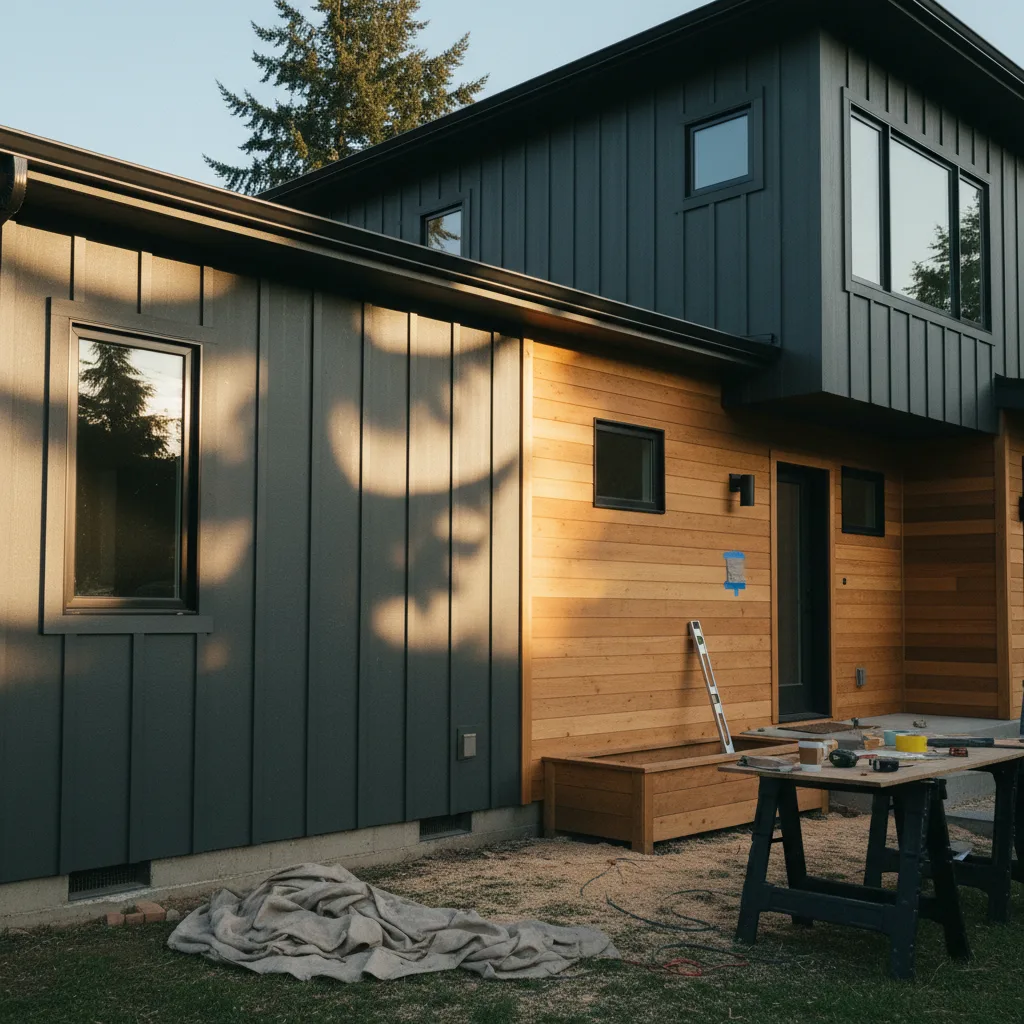
A full siding replacement in Portland takes between four and seven weeks, from tear-off to final touch-up paint. That timeline can start lower for a simple re-side on a small, modern home with no complications. But for a classic Laurelhurst Craftsman with layers of old paint and questionable sheathing, plan on the longer end of that range. The biggest single cause of delay isn't the weather, though that's a factor. It's what we find when we pull the old siding off. Dry rot is the ghost in the machine for any Pacific Northwest renovation, and you don't know the extent of it until you've committed to the demolition. A good plan accounts for this discovery phase from day one.
In a Nutshell
- Total Timeline: 4 to 7 weeks for a standard 1,800-2,500 sq. ft. home.
- Four Key Phases: Demolition & Repair, Weather Barrier & Prep, Siding Installation, and Trim & Paint.
- Biggest Delay Risk: Uncovering extensive dry rot or structural damage in the wall sheathing or framing after demolition. This can add one to three weeks and significant cost.
- Contingency Planning: Your budget needs a buffer. The National Association of Home Builders recommends a ten to fifteen percent contingency on renovations in homes over thirty years old. In Portland, I consider that a minimum.
Phase 1: Demolition, Repair, and Permits (Weeks 1, 2)
This is the discovery phase. Your crew arrives, sets up scaffolding and protection, and begins the tear-off. What's underneath that failing T1-11 or vinyl siding? This is where the project's true scope reveals itself. Any soft spots in the sheathing mean rot. Your siding contractor portland will probe for the extent of the water damage, which can range from a few square feet of new plywood to reframing entire wall sections. If your project involves changing window sizes or structural alteration, a permit from the Portland Bureau of Development Services (BDS) is required. For a simple like-for-like siding replacement, a permit often isn't needed, but it's the contractor's job to verify. The homeowner's job is to be ready for bad news. Finding rot isn't a contractor upsell; it's a structural necessity that must be fixed before any new siding goes on.
Phase 2: Weather Barrier and Window Prep (Week 3)
With the structure made sound, the focus shifts to creating a bulletproof water-resistive barrier (WRB). This is the most important part of any siding project in Portland. The siding is cosmetic armor; the WRB and flashing system is the waterproof skin underneath. The crew will wrap the entire house in a high-quality house wrap, taping every seam meticulously. Around windows and doors, they'll install new flashing, integrating it shingle-style with the WRB to direct water out, not in. On higher-end jobs, this includes a rainscreen system, creating an air gap behind the siding for drainage and drying. This is a critical inspection point. Before any siding covers this work, we get it checked. Any penetrations for vents, electrical boxes, or hose bibs are carefully sealed and flashed. If the electrical service drop is in the way, a temporary disconnect might be coordinated with Pacific Power.
Phase 3: Siding Installation (Weeks 4, 5)
Now the new cladding goes on. Whether it's fiber cement, cedar, or metal, installation is a systematic process. The crew lays out the courses, starting from the bottom and working their way up. Every board must be level, properly gapped, and fastened according to the manufacturer's nailing schedule. This is where craftsmanship shows. Improperly driven nails can void a material warranty and create entry points for water. The inspection card for the building envelope gets signed off here. Any exterior rough-ins, like mounting blocks for light fixtures or outlets, are installed in sequence with the siding. The goal is a clean, continuous installation that respects the underlying WRB. A nail in the wrong place is a future leak. The sound of nail guns is the sound of progress, but only if they're hitting the studs correctly.
Phase 4: Trim, Paint, and Final Cleanup (Weeks 6, 7)
3 Portland siding contractors, editor-screened. 4 questions.
See my 3 matchesThe job isn't finished when the last board is hung. This phase is about details. Corner trim, window and door casings, soffits, and fascia boards are installed. Every seam and nail hole is then caulked with a high-quality, paintable sealant. Then, the painters take over. A good paint job is more than aesthetic; it's the siding's first line of defense against Portland's nine months of drizzle. This phase is highly weather-dependent; you can't paint in the rain, and low temperatures affect how the paint cures. A couple of dry days are essential. Once painting is complete, the crew removes all scaffolding, does a final site cleanup, and hauls away the debris. The project concludes with a final walkthrough with you and the project manager to create a punch list of any remaining items. The job is done when you're satisfied, not just when the crew packs up.

Three Representative Projects from 2026
Three modeled project scenarios for 2026, built from the Renology Cost Index and typical local scopes. These are illustrative estimates, not completed client projects:
- Sellwood-Moreland Bungalow: A 1,900 sq. ft. 1920s Craftsman. The project involved a full tear-off of failing cedar lap siding, replacement of 20% of the wall sheathing due to dry rot, and installation of new James Hardie fiber cement siding. Total cost, including paint: $34,500. Total time: 6 weeks.
- Pearl District Townhouse: A 1,400 sq. ft. modern townhouse with failing composite panels. The scope was to replace the panels with a mix of new standing-seam metal siding and clear cedar accents. Minimal structural repair was needed. Total cost: $29,000. Total time: 5 weeks.
- Eastmoreland Tudor: A 2,800 sq. ft. 1930s home. This was a complex job requiring careful removal of old siding to preserve architectural details, significant structural repairs around dormers, and installation of new pre-primed cedar siding to meet neighborhood character standards. Total cost: $58,000. Total time: 9 weeks.
What Can Compress This Timeline
You can't control the weather or what's hiding in your walls, but you can control three things. The homeowner who saves a week or two does these things before signing the contract.
- Finalize Selections Early. Have your siding material, trim style, and paint colors chosen and documented before the work starts. The scope-lock date should be treated as final. Changing your mind mid-project adds delays for material orders and restocking.
- Prepare the Site. Clear a ten-foot perimeter around your house. Move the patio furniture, the grill, the planters, and the kids' toys. This saves the crew hours of non-productive work on day one.
- Be Financially Ready. Siding projects are paid in draws at key milestones. Have the funds ready. Nothing stops a job faster than a contractor waiting on a check to clear before they can order the next phase of materials.
What Blows It Up
Every project has risks. For Portland siding, these are the top three timeline killers.
- Extensive Rot and Pest Damage. This is the big one. If water has been getting behind your old siding for years, it can lead to rotted sheathing, studs, and even rim joists. This stops the siding job cold and turns it into a carpentry and structural repair project first.
- Lead Paint or Asbestos. If your house was built before 1978, the old paint is presumed to contain lead. If the siding itself is an older cement-asbestos shingle, special abatement procedures are required by law. This adds significant time and cost for containment and proper disposal.
- Weather Delays. You can't install siding or paint in heavy, wind-driven rain. A particularly wet spring or fall can add multiple non-work days to the schedule, pushing out the completion date.
The National Association of Home Builders recommends a ten to fifteen percent contingency on renovations in homes over thirty years old.
What Should Be in Your Contractor's Schedule
A professional contractor provides a schedule with real dates, not just a vague start and end. Your contract's scope of work should include a schedule with at least these milestones:
- Scope-lock date for all material and color selections
- Permit application and issue dates (if applicable)
- Material order lead times and confirmed delivery dates
- Project start date (scaffolding and demolition)
- Contingency window for structural repairs (e.g., 3-5 days allocated)
- Target date for passing the WRB/flashing inspection
- Siding installation start and completion dates
- Painting start date (weather permitting)
- Final walkthrough and punch list completion date
A detailed schedule is the mark of a pro. Get familiar with the process in our [permit playbook](/guides/portland-siding-permit-playbook-2026).
Renology Take
The sales brochure promises a beautiful new house in two weeks. That's the installation timeline on a perfect new build in a dry climate. The reality of a Portland siding replacement is different. The job isn't just installing new siding; it's excavating the sins of the past and rebuilding your home's defense against constant moisture. The siding cost in Portland is driven less by the material itself and more by the skilled labor required to fix what's underneath and install the new system correctly. The best siding contractor portland you can hire is one who prepares you for this reality. They price the job honestly and talk about the risk of dry rot in the first meeting. Don't trust the lowest bid if it ignores the biggest risk. Assume you'll find something unexpected under the old cladding. In Portland, you usually do.
Sources & Methodology
Renology reviews public permit and labor signals, supplier pricing, remodeler quote patterns, comparable projects, the Renology Cost Index, and the Renology Methodology. Cost references are planning ranges for Portland siding projects, not fixed bids.
- National Association of Home Builders (NAHB), Remodeling Market Index, Q1 2026
- Oregon Bureau of Labor and Industries, Portland Metro Prevailing Wage Rate Data, 2026
- Portland Bureau of Development Services (BDS), Residential Permitting Guidelines, 2026
- Remodeling Magazine, Cost vs. Value Report, Pacific Region, 2025-2026
- James Hardie Building Products, Best Practices Installation Guide, 2026
- Renology Project of the Day (POTD) Network, Portland Metro Data, 2025-2026
- U.S. Environmental Protection Agency (EPA), Lead Renovation, Repair and Painting (RRP) Rule
Portland · pre-screened
Get 3 Portland siding bids in 48 hours.
Our editors already vetted Portland siding contractors. Answer 4 questions and we send 3 written bids inside 48 hours, with the real price for your scope, not their inflated first-call number.
- Free, no commission
- Pre-screened locally
- Bids inside 48 hours
Takes about 60 seconds. We'll text you when bids arrive.