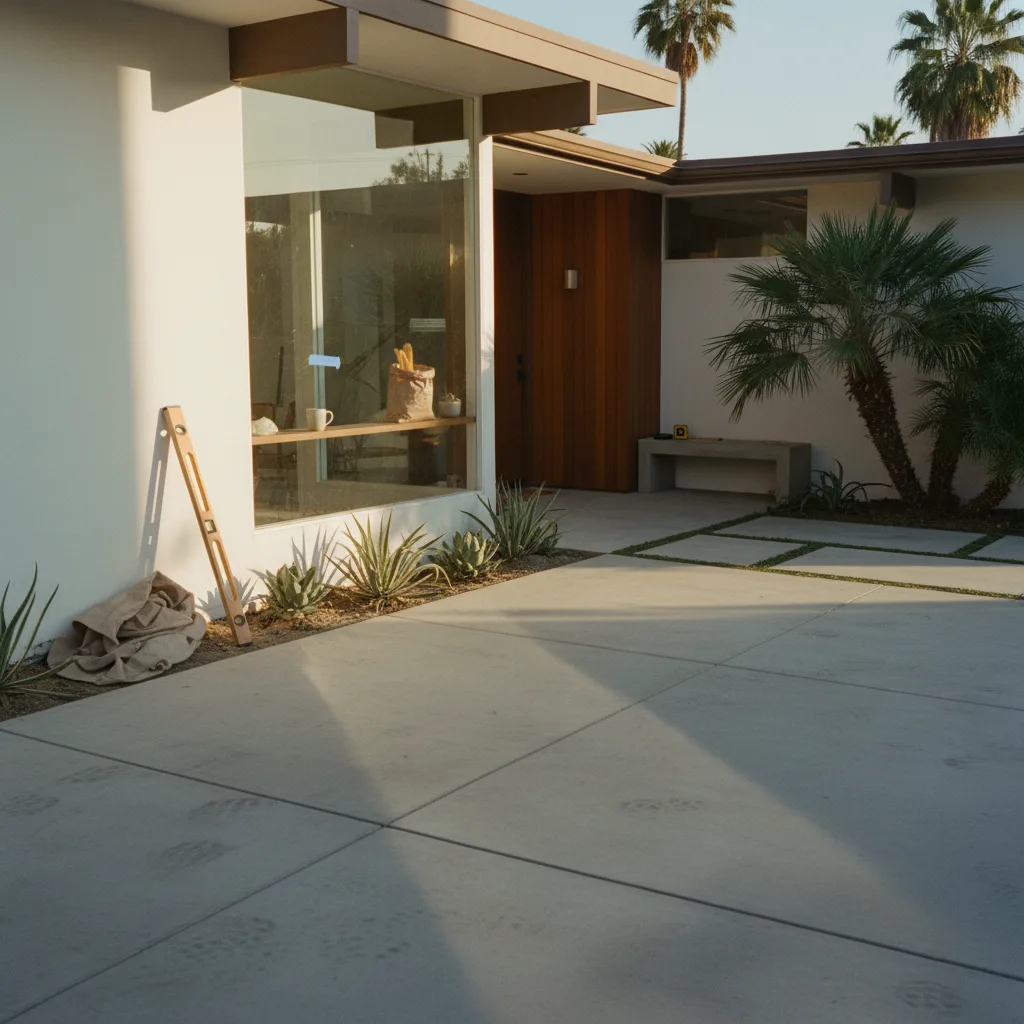
A new driveway in Los Angeles takes between three and six weeks from the day the contract is signed to the day you can park on it. The timeline can start lower, around two weeks, for a simple paver overlay on a solid base. But for a full tear-out and replacement, which is most of the work we see, plan on a month. The biggest single delay for Los Angeles driveways is getting the permit for a new curb cut or significant grading changes through the Los Angeles Department of Building and Safety (LADBS). We just finished a job in Mar Vista where the drainage plan review alone added ten days before we could even break ground. Plan for surprises.
In a Nutshell
- Total Timeline: 3, 6 weeks
- The Four Phases: Design & Permits; Demolition & Site Prep; Formwork & Pour; Curing & Final Inspection.
- Biggest Delay Risk: Unforeseen soil conditions, like expansive clay, or LADBS permit revisions for drainage and grading.
- Contingency Advice: The National Association of Home Builders recommends a ten to fifteen percent contingency. For a driveway, that covers surprise utility lines or needing an extra truck of engineered fill.
Phase 1: Design and Permits (Weeks 1, 2)
This phase is all paperwork. Nothing happens on site. First, you and your driveway contractor finalize the scope: material choice (concrete, asphalt, permeable pavers), dimensions, and crucially, the drainage plan. Los Angeles is serious about stormwater runoff. Your contractor will then draw up the plans and submit them to the Los Angeles Department of Building and Safety (LADBS). If you're altering the public right-of-way with a new curb cut or apron, you'll need a separate permit for that. The homeowner's job is to make decisions quickly and sign off. The contractor or their permit runner handles the submission. Common holdups include incomplete drawings or a drainage plan that doesn't meet city code. A good contractor knows the plan checkers and what they look for. A bad one learns on your dime. This is where a solid driveway contractor in Los Angeles earns their money.
Phase 2: Demolition and Site Prep (Weeks 2, 3)
Now the real work begins. A crew comes in to break up and haul away the old driveway. This is loud and dusty. Once the old surface is gone, the crew excavates the area to the required depth, typically eight to ten inches below the final grade. This is the most critical step. The subgrade must be properly graded for drainage and then compacted. In hillside neighborhoods like the Hollywood Hills, we often find expansive clay soil. This requires over-excavation and bringing in engineered fill to create a stable base. Before any digging, your contractor must call 811 to have public utilities marked. Hitting an unmarked LADWP water line is a costly mistake that floods your timeline and your budget. This phase ends when you have a perfectly graded, compacted soil base ready for the next step.
Phase 3: Formwork, Rebar, and Pour (Week 4)
This is where the driveway takes shape. The crew sets up wooden forms around the perimeter to hold the wet concrete. Then, they place a grid of rebar (steel reinforcement bars) inside the forms, holding it up on small chairs so it sits in the middle of the slab, not on the bottom. This rebar grid is what gives the concrete its tensile strength and prevents major cracking. Once the forms and steel are in place, an LADBS inspector must visit the site for a pre-pour inspection. They check rebar spacing, depth, and formwork. If you fail, the pour is delayed. Once the inspection card is signed, the concrete truck is scheduled. The pour itself is a fast, intense process of placing, screeding, and finishing the concrete. The finishers then cut control joints to encourage the concrete to crack in straight, predictable lines as it cures.
Phase 4: Curing and Final Inspection (Weeks 5, 6)
3 Los Angeles driveway contractors, editor-screened. 4 questions.
See my 3 matchesThe concrete is hard to the touch in hours, but it's not strong. Curing is a chemical process that takes time. You can typically walk on the new slab after two to three days. You should not drive on it for at least seven days, and even then, be gentle. Concrete doesn't reach its full design strength for 28 days. During the first week, it may need to be kept moist, especially in the dry LA heat, to ensure a proper cure. Rushing this step is the number one cause of surface flaking and future cracks. Once the initial cure is done and the site is cleaned up, the contractor schedules the final inspection with LADBS. The inspector verifies that the final grade is correct, the drainage works as designed, and the project matches the approved plans. A passed final closes out the permit. Your project is officially done.
Three Representative Projects from 2026
Three modeled project scenarios for 2026, built from the Renology Cost Index and typical local scopes. These are illustrative estimates, not completed client projects:
- Sherman Oaks: An 800 sq. ft. concrete driveway replacement. The project involved removing an old, cracked slab that was being destroyed by mature oak tree roots. Required a root barrier installation and a thicker, engineered subgrade. Total cost: $14,500. Total time: 4.5 weeks.
- Eagle Rock: A 600 sq. ft. new driveway using permeable pavers to comply with strict local stormwater management rules. Higher material cost and more labor-intensive base preparation. Total cost: $17,000. Total time: 5 weeks.
- Culver City: A 1,200 sq. ft. asphalt driveway replacement that required a new, wider curb cut and apron, triggering a more complex B-Permit from the Bureau of Engineering. Total cost: $19,500. Total time: 6 weeks.
What Can Compress This Timeline
The homeowner who saves two weeks does three things before the contract is signed. First, they make every single material decision upfront and scope-lock the project. No changes after the fact. Second, they hire a local driveway contractor who has a long track record with LADBS. An experienced pro knows how to draw plans that fly through review. Third, they prepare the site. This means clearing all vehicles, patio furniture, and personal items to provide wide, easy access for equipment and material delivery. Wasted time maneuvering a skid steer around a parked car is wasted money. These three actions remove the most common sources of homeowner-caused delays.
What Blows It Up
Three things can turn a four-week project into an eight-week headache. First, hitting something unexpected underground. Buried foundations from an old structure, abandoned septic tanks, or unmapped private utility lines can stop work for days while you figure out a plan. Second, discovering you have terrible soil. If the subgrade is soft or expansive, you'll need a soil engineer to specify a solution, which adds cost and weeks. Third, weather. You can't pour concrete in the rain, and a sudden heatwave can make curing a nightmare. The National Association of Home Builders recommends a ten to fifteen percent contingency on renovations in homes over thirty years old. For driveways, this wisdom applies to any property with unknown underground history.
What Should Be in Your Contractor's Schedule
Your contractor's proposal should include a detailed schedule. Don't sign a contract without one. It's your primary tool for tracking progress and holding them accountable. A professional schedule for Los Angeles driveways will have, at a minimum, these line items:
- Scope-lock and final design sign-off date
- Permit application submission to LADBS
- Permit approval date (target)
- Demolition and hauling start and end dates
- Excavation, grading, and compaction completion date
- Formwork and rebar installation completion date
- LADBS pre-pour inspection date
- Concrete pour date
- Curing period (no vehicle traffic) end date
- Final inspection and permit sign-off date
This level of detail is standard. For more on what to expect during the permitting phase, see our Los Angeles driveway permit playbook.
Renology Take
The marketing you see online for a driveway in Los Angeles promises a finished product in a week. That's for an unpermitted overlay. A real, permitted, tear-out and replacement is a small construction project. It takes a month or more. The cost of a driveway isn't in the concrete itself; it's in the labor for the demolition and preparation of the ground underneath. A driveway is only as good as its subgrade. If the base isn't properly graded and compacted, the slab above is guaranteed to fail. It will crack, it will heave, and in a few years, you'll be paying to do it all over again. The extra weeks spent on proper site prep are the best investment you can make. They buy you a driveway that lasts for decades, not just until the contractor's warranty expires.
Sources & Methodology
Renology reviews public permit and labor signals, supplier pricing, remodeler quote patterns, comparable projects, the Renology Cost Index, and the Renology Methodology. Cost references are planning ranges for Los Angeles driveway projects, not fixed bids.
- Los Angeles Department of Building and Safety (LADBS), Driveway Plan Check Corrections Sheet, 2025
- California Department of Industrial Relations, Prevailing Wage Data for Los Angeles County, 2026
- National Association of Home Builders (NAHB), Construction Cost Survey, 2025
- American Concrete Institute (ACI), ACI 330R-08: Guide for the Design and Construction of Concrete Parking Lots, 2024
- Remodeling Magazine, Cost vs. Value Report, 2026
- Renology Project of the Day (POTD) Network, Los Angeles Metro Data, 2024-2026
Frequently Asked Questions
How long does a driveway in Los Angeles really take?
Do I need a permit to replace my driveway in Los Angeles?
What's the longest single phase of a driveway project?
Can I fast-track the permits for a driveway in LA?
Los Angeles · pre-screened
Get 3 Los Angeles driveway bids in 48 hours.
Our editors already vetted Los Angeles driveway contractors. Answer 4 questions and we send 3 written bids inside 48 hours, with the real price for your scope, not their inflated first-call number.
- Free, no commission
- Pre-screened locally
- Bids inside 48 hours
Takes about 60 seconds. We'll text you when bids arrive.
Sources
- Los Angeles Department of Building and Safety (LADBS), Driveway Plan Check Corrections Sheet
- California Department of Industrial Relations, Prevailing Wage Data for Los Angeles County
- National Association of Home Builders (NAHB), Construction Cost Survey
- American Concrete Institute (ACI), ACI 330R-08: Guide for the Design and Construction of Concrete Parking Lots
- Remodeling Magazine, Cost vs. Value Report
- Renology Project of the Day (POTD) Network, Los Angeles Metro Data