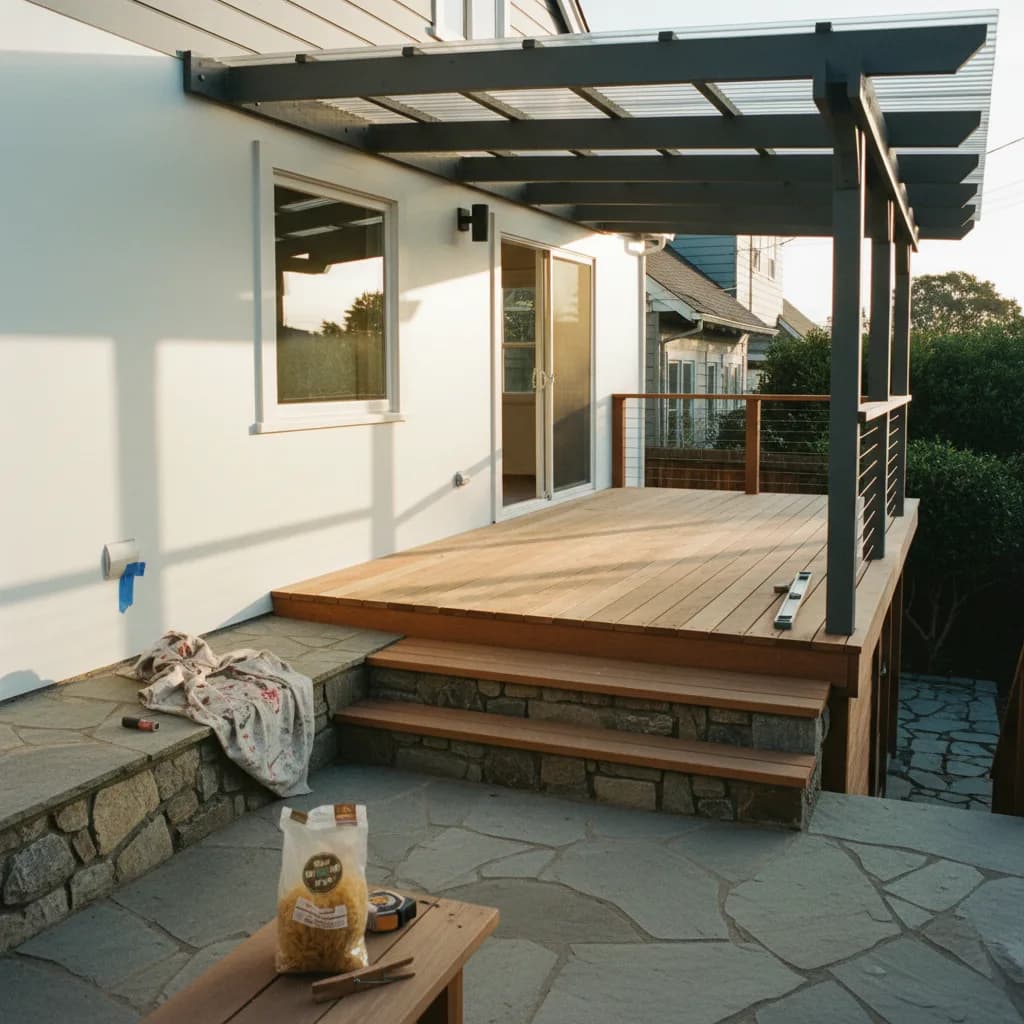
A new deck and pergola in San Francisco takes 12 to 20 weeks from the day you sign with a contractor to the day you pass final inspection. The timeline can start lower, around eight weeks, for a simple ground-level platform or a pre-engineered kit that doesn't trigger a full plan review. For most custom projects, especially on a hillside lot in a neighborhood like the Sunset, the single biggest delay is the plan review at the San Francisco Department of Building Inspection. They scrutinize every load path and connection for seismic safety. Don't let a contractor tell you they can start framing in two weeks. In this city, the paperwork is the project.
In a Nutshell
- Total Timeline: 12, 20 weeks
- Key Phases: Phase 1: Design and Permits (6, 8 weeks), Phase 2: Site Prep and Foundation (2, 3 weeks), Phase 3: Framing (3, 4 weeks), Phase 4: Finishes and Final (2, 3 weeks).
- Biggest Delay Risk: San Francisco Department of Building Inspection (SFDBI) plan review backlogs and requests for clarification, particularly for projects with complex structural engineering.
- Contingency Advice: Hold back ten to fifteen percent of your total budget for surprises. The National Association of Home Builders recommends this for a reason, especially on older homes where you might find rot behind the existing ledger board.
Phase 1: Design and Permits (weeks 1, 8)
This is where the project is won or lost. Nothing happens until the city says it can. Your architect or designer will create the plans, but in San Francisco, a structural engineer is the key player. They calculate the loads for our specific seismic zone and soil conditions. The plans must detail every connection, footing depth, and piece of hardware. The homeowner's job is to make decisions quickly and lock the scope. Once plans are submitted to the San Francisco Department of Building Inspection (SFDBI), changes cause major delays. A common holdup is a request for more detail on the ledger board attachment or flashing specifications, which sends the plans back to the engineer. A good decks pergola contractor in San Francisco will use a permit expediter who knows the SFDBI staff and process, but even they can't skip the queue.
Phase 2: Site Prep and Foundation (weeks 9, 11)
With an approved permit in hand, work can begin on site. This phase is about demolition and dirt. Any existing deck is torn out and hauled away. We look for dry rot or termite damage on the house framing where the old structure was attached; this is the first place surprises happen. Then, we excavate for the concrete footings. On a sloped San Francisco lot, this can mean significant digging. The holes are inspected for depth and placement before any concrete is poured. This is called the footing inspection, and you can't proceed without the inspector's signature on the card. We also coordinate with Pacific Gas and Electric (PG&E) to locate any underground gas or electrical lines before we dig. Site access is always a challenge in the city; all materials, from lumber to concrete, have to be moved through tight spaces without disturbing the neighbors.
Phase 3: Framing and Rough-In (weeks 12, 15)
This is when your deck starts to look like a deck. We begin by attaching the ledger board to the house. This is the most critical connection in the entire structure. It must be bolted into solid framing with waterproof flashing to prevent moisture intrusion. The rest of the frame, including joists and beams, is built out from there. The entire structure is squared and leveled. For a pergola, the posts are set and the main beams are installed. If your project includes electrical for lighting or outlets, or a gas line for a grill, the rough-in for those trades happens now, before the decking goes on. Once all the structural elements are in place, the city inspector comes out for the frame inspection. They check bolt patterns, joist spacing, and hardware against the approved plans. No decking can be installed until we have this signature.
Phase 4: Finishes and Final Inspection (weeks 16, 18)
3 San Francisco deck builders, editor-screened. 4 questions.
See my 3 matchesWith the framing approved, we move on to the visible surfaces. This phase is about craftsmanship. Deck boards, whether redwood, Ipe, or composite, are laid down and fastened. Stairs are built, and railings are installed. Railings have strict code requirements for height, spacing, and strength that are non-negotiable. The pergola rafters or slats are added, and any final trim pieces are attached. Electricians return to install light fixtures and outlets, and plumbers connect the gas grill. Everything is sanded, sealed, or painted as specified. The final step is scheduling the final inspection with SFDBI. The inspector walks the entire project, checking the railings, stairs, and overall construction against the plans. Once they sign off on the inspection card, the project is officially complete. This is the finish line.
Three Representative Projects from 2026
Three modeled project scenarios for 2026, built from the Renology Cost Index and typical local scopes. These are illustrative estimates, not completed client projects:

- Bernal Heights Hillside Deck: A 250 sq. ft. redwood deck on a steep slope requiring deep, engineered concrete piers. The project involved replacing a failing, unpermitted structure. Tight access for materials was a major factor. Total Cost: $48,000. Total Time: 19 weeks.
- Marina District Ipe Deck & Pergola: A 400 sq. ft. ground-level Ipe deck with a matching pergola. The decks pergola san francisco cost was driven by the premium hardwood and the use of stainless steel hardware to resist corrosion from the salt air. Total Cost: $65,000. Total Time: 16 weeks.
- Noe Valley Composite Deck with Views: A 350 sq. ft. multi-level composite deck with glass panel railings to preserve views. The project required significant structural work to ensure the load path was continuous to the foundation on a 1920s home. Total Cost: $72,000. Total Time: 20 weeks.
What Can Compress This Timeline
The homeowner who saves four weeks does three things before signing a contract. First, they have all their decisions made. They know the exact decking material, the railing style, and the lighting fixtures. This allows for a complete set of plans for submission, avoiding clarification requests from SFDBI. Second, they hire a design-build firm or a decks pergola contractor in San Francisco who has an in-house designer and permit expediter. This streamlines the entire front-end process. Third, they communicate clearly and are available to answer questions immediately. Waiting a day to respond to an RFI (Request for Information) from the field can mean a two-day delay by the time the crew remobilizes. Speed comes from decisiveness before the work starts, not from rushing the work itself.
What Blows It Up
Three things reliably derail a deck project timeline. The most common is discovering extensive dry rot in the home's rim joist or wall sheathing after removing the old ledger board. This stops all work and requires a structural repair, often needing a supplemental permit. Second is hitting unforeseen conditions during excavation, like a buried concrete slab or an old utility line that wasn't on any plans. This requires new engineering and city approval. Third, and specific to San Francisco, are neighbor disputes. A disagreement over property lines, construction noise, or blocked views can lead to complaints and stop-work orders from the city. The National Association of Home Builders recommends a ten to fifteen percent contingency on renovations in homes over thirty years old. In San Francisco, that's not advice; it's a requirement for survival.
What Should Be in Your Contractor's Schedule
A professional's schedule isn't a guess; it's a sequence of dependencies. Your contractor's project schedule must show more than just a start and end date. Look for a document, usually from software like Buildertrend or CoConstruct, that includes these specific line items:
- Scope-lock date for all owner selections
- Date for submission of plans to SFDBI
- Anticipated date for permit approval
- Lead-time and order date for long-lead items (e.g., Ipe decking, custom metal railings)
- Start date for demolition and excavation
- Scheduled date for footing inspection
- Scheduled date for framing inspection
- Milestone for completion of decking and railings
- Scheduled date for final inspection
- Project completion and final payment due
A detailed schedule shows your contractor has thought through the entire san francisco decks pergolas process. For more on navigating the city's requirements, see our permit playbook.
Renology Take
Contractor brochures for decks pergola san francisco 2026 might sell you a six-to-eight-week dream. That timeline only covers the physical build, and only if everything goes perfectly. The reality for any meaningful deck project in this city is a four-to-five-month journey. The part most homeowners underestimate is the sheer weight of the pre-construction phase. Design, engineering, and permitting in San Francisco easily consume half the total timeline. This isn't padding; it's the cost of building safely in a dense, seismically active city with a century of layered regulations. The best decks pergola contractor san francisco doesn't promise speed. They promise a clear process and a structure that will pass every inspection and stand for thirty years. That's the timeline that matters.
Sources & Methodology
Renology reviews public permit and labor signals, supplier pricing, remodeler quote patterns, comparable projects, the Renology Cost Index, and the Renology Methodology. Cost references are planning ranges for San Francisco deck projects, not fixed bids.
- National Association of Home Builders (NAHB), Remodeling Market Index, Q1 2026
- California Department of Industrial Relations, Prevailing Wage Data for San Francisco County, 2026
- San Francisco Department of Building Inspection (SFDBI), Permitting Data and Procedures, 2026
- American Wood Council, "Prescriptive Residential Wood Deck Construction Guide (DCA 6)", 2024
- Remodeling Magazine, "Cost vs. Value Report", 2025
- Simpson Strong-Tie, "Deck Connection and Fastening Guide", 2025
- Renology Project of the Day (POTD) Network, San Francisco Metro Data, 2024-2025
Frequently Asked Questions
How long does a deck and pergola build in San Francisco really take?
Can I live in the home during construction?
What's the longest single phase of a deck build?
Can I fast-track the permits in San Francisco?
What are the biggest cost drivers for decks and pergolas in SF?
Ready to find a pro?
Tell us about your project and location. A Renology advisor can help you explore contractor matching.
Free for homeowners. No obligation to hire.
Find a ProSources
- National Association of Home Builders (NAHB), Remodeling Market Index
- California Department of Industrial Relations, Prevailing Wage Data for San Francisco County
- San Francisco Department of Building Inspection (SFDBI), Permitting Data and Procedures
- American Wood Council, "Prescriptive Residential Wood Deck Construction Guide (DCA 6)"
- Remodeling Magazine, "Cost vs. Value Report"
- Simpson Strong-Tie, "Deck Connection and Fastening Guide"
- Renology Project of the Day (POTD) Network, San Francisco Metro Data
Follow Renology on Google
Choose Renology as a preferred source and our guides show up more often in your Google results, including Top Stories and AI Overviews.