In this episode, we're tackling the number one question every homeowner eventually asks: how does a bathroom remodel cost so much? We’re going to break down how a standard full bathroom renovation hits a national average of $25,000 in 2026. Forget the glossy magazine photos for a minute. We're talking about the real-world numbers, the hidden costs inside your walls, and why the labor to do it right is where the money goes. A typical full bathroom remodel now costs between $24,000 and $28,000 nationally, though this can start lower for a simple cosmetic refresh in a condo. This isn't just about picking tile. It’s about understanding the entire construction process, from demolition to final inspection.
What This Episode Is About
A full bathroom remodel in 2026 has a national average cost of $25,000 for a five-by-eight-foot space. Key cost drivers are labor, which can be 50-60% of the budget, plumbing and electrical work behind the walls, and the quality of fixtures and finishes. Costs vary based on project scope and regional labor rates.
If you take three things from this episode, make them these:
- The budget is in the walls, not on them. Most of your bathroom remodel cost is for things you'll never see again: plumbing, electrical, waterproofing, and proper ventilation. Skimping here is how you get a failed project in five years.
- Labor is your biggest line item. Materials get the attention, but skilled, licensed, and insured labor from a qualified general contractor and their subcontractors will account for more than half of your total project cost.
- A detailed scope of work is your only protection. A handshake deal is an invitation for disaster. A contract that specifies every single material, task, and timeline detail is what separates a professional job from a costly nightmare.
The Real Numbers (National Picture)
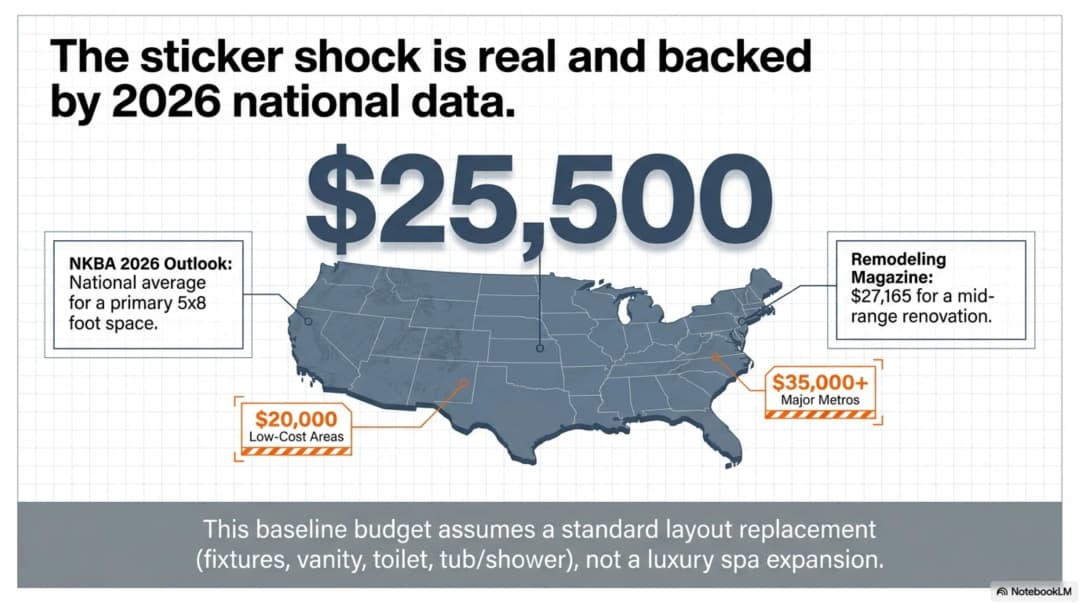
Let's get straight to the data. According to the National Kitchen & Bath Association (NKBA) 2026 Market Outlook, the national average for a full primary bathroom remodel is hovering right around $25,500. Remodeling Magazine's 2026 Cost vs. Value Report puts a mid-range bathroom renovation at a national average of $27,165. These are not numbers for luxury spa retreats. This is for a standard five-by-seven or five-by-eight-foot bathroom, the most common size in American homes. This scope includes replacing all fixtures, the vanity, the toilet, the flooring, and the tub with a new shower or tub-shower combo. The range is wide. In lower-cost-of-living areas, you might see this work come in closer to $20,000. In major metro areas with high labor costs, that same project can easily push $35,000 or more. The U.S. Census Bureau's data on residential improvements confirms this upward trend, showing a steady increase in spending per project over the last three years. The key takeaway is that the sticker shock is real, and it's backed by national data reflecting the true cost of materials and, most important, skilled labor.
Line by Line: How a Bathroom Remodel Hits $25,000
That $25,000 figure isn't arbitrary. It's the sum of many small, necessary parts. A project budget is a load path for your money, and every dollar has to be accounted for. Here’s a representative breakdown of a $25,000 bathroom remodel cost, based on industry averages. Your numbers will vary, but the percentages hold pretty steady.
- Design & Permits (3-5% | $750 - $1,250): This includes any design fees and the cost to pull a permit from your local building department. Never skip the permit. It triggers inspections that protect you.
- Demolition & Site Prep (4-6% | $1,000 - $1,500): Tearing out the old bathroom down to the studs. This includes a dumpster rental and disposal fees.
- Framing & Structural (5-7% | $1,250 - $1,750): Sistering a joist that's water damaged, reframing a wall for a niche, or adding blocking for a grab bar. Solid framing is non-negotiable.
- Plumbing Rough-In & Finish (15-20% | $3,750 - $5,000): This is a major expense. It covers moving supply and drain lines, installing a new shower valve in the wall, and setting the toilet, sink, and shower fixtures.
- Electrical Rough-In & Finish (8-10% | $2,000 - $2,500): Bringing wiring up to code. This means GFCI outlets, a dedicated circuit for a heater, a new exhaust fan, and new lighting.
- HVAC / Ventilation (3-5% | $750 - $1,250): Installing a new, properly sized and vented exhaust fan. A fan that just recirculates air into the attic is asking for mold.
- Insulation & Drywall (5-7% | $1,250 - $1,750): Insulation for sound and temperature, followed by moisture-resistant drywall, taping, and finishing.
- Waterproofing (3-5% | $750 - $1,250): This is a critical step. A multi-layer waterproofing system like Schluter-Kerdi or a liquid-applied membrane in the shower area is not optional. This is what prevents catastrophic leaks.
- Tile & Flooring (10-15% | $2,500 - $3,750): This includes the tile itself, backer board, thin-set, grout, and the skilled labor to install it perfectly.
- Fixtures (Tub, Toilet, Sink) (8-12% | $2,000 - $3,000): The items you see and touch. Quality here matters for longevity.
- Vanity & Countertop (5-8% | $1,250 - $2,000): A new cabinet and top, installed level and secure.
- Painting & Finish Work (3-5% | $750 - $1,250): Primer, two coats of quality paint, and trim work.
- Contractor Overhead & Profit (15-20%): This is part of every line item, not a separate fee. It covers the general contractor's project management, insurance, and business operations. It’s what you pay for a professional, coordinated job.
What Most Homeowners Get Wrong About This
The biggest mistake homeowners make is focusing on the finish materials. They spend weeks comparing tile that costs $8 per square foot versus $12 per square foot, thinking that's where the budget is won or lost. This is a fundamental misunderstanding of a bathroom remodel cost. The tile is just the skin. The real money, the real value, and the real risk are all located behind that tile. A project's success is determined by three things you can't see in the finished room: one, the plumbing rough-in; two, the electrical safety; and three, the waterproofing integrity. A licensed plumber replacing 50-year-old galvanized lines with copper costs thousands. A licensed electrician running new GFCI circuits costs thousands. A certified tile setter installing a multi-layer waterproofing system costs thousands. These are not places to hunt for bargains. A beautiful tile job over shoddy plumbing is just a prettier leak waiting to happen. The cost is for the skilled labor required to build a functional, safe, and durable wet room that won't destroy your subfloor in ten years.
The 3 Questions Every Homeowner Should Ask
When you're vetting a contractor, you need to ask questions that reveal their process, not just their price. Forget asking for a discount. Instead, ask these three things. The answers will tell you everything you need to know about who you're hiring.
- "Can you walk me through your standard waterproofing process for a shower?"
Why this matters: This is the single most critical technical detail in a bathroom. A failure here is catastrophic. A vague answer is a huge red flag.
What a good answer sounds like: They should name a specific system, like Schluter-Kerdi, Laticrete Hydro Ban, or RedGard. They should talk about flood testing the shower pan before tiling, ensuring proper slope to the drain, and how they treat seams and corners. - "How do you handle change orders, both for unforeseen conditions and homeowner requests?"
Why this matters: Surprises happen. You need a contractor with a clear, fair process for documenting changes and their costs.
What a good answer sounds like: "We use a written change order form. If we find something unexpected, like rotten subfloor, we stop work, document it with photos, and present you with a fixed-price change order for the repair. We won't proceed until you've signed off. Same process if you decide to add a feature." - "What is your communication protocol for the project?"
Why this matters: A lack of communication is the number one source of conflict. You need to know how and when you'll get updates.
What a good answer sounds like: "We do a daily check-in at the end of each workday, either by text or a quick call. We also have a weekly project meeting on-site every Friday morning to review progress against the schedule and plan for the week ahead."
Information Gain: The Hidden Costs in Your Walls
3 pros, editor-screened. 4 questions.
See my 3 matchesWhat no one else covers is the reality of opening up walls in an older home. The estimate you sign is for the work you can see. The final cost is determined by the problems you can't. In homes built before 1985, it's not a question of if you'll find problems, but what kind. When we pull off the drywall, we're looking at a history of the house's construction, and it's often not pretty. The most common issue is water damage. A slow, twenty-year leak from a toilet's wax ring can turn a solid plywood subfloor into oatmeal. That's not in the original scope. Replacing a section of subfloor and maybe a floor joist adds two days and $1,500 to the job, instantly. Next is plumbing. Pre-1970s homes often have cast iron drains that are corroded and choked with scale. You can't responsibly connect new PVC to a failing cast iron stack. That means replacing the stack, which could run up through multiple floors. That's a major, multi-thousand-dollar change order. We also find galvanized steel supply lines in pre-1985 homes, which rust from the inside out. Once you touch them, they can fail anywhere. The only correct fix is a full repipe. Then there's the electrical. Finding knob-and-tube remnants in 1960s homes or even ungrounded Romex from the 70s is common. Your local code will require you to bring any circuit you touch up to modern standards, which means new wiring, a new breaker, and GFCI protection. Finally, there's venting. Many old bathrooms have no mechanical ventilation, or a fan that vents into the attic. That's a code violation and a mold factory. Running proper ductwork to the exterior is another surprise cost. These aren't contractor scams. They are mandatory repairs required for a safe, code-compliant, and long-lasting remodel.
Three Representative Projects from 2026
Three modeled project scenarios for 2026, built from the Renology Cost Index and typical local scopes. These are illustrative estimates, not completed client projects:
- Project 1: The Pull-and-Replace Refresh - $18,500. This project was in a 1990s tract home. The layout remained exactly the same. The contractor replaced the fiberglass tub-shower unit with a new acrylic one, installed a new pre-fab vanity, a new toilet, and new LVP flooring directly over the old vinyl. No plumbing or electrical lines were moved. The project didn't require a full permit because it was considered cosmetic. It was fast and affordable, but it didn't address the aging plumbing inside the walls. This is a surface-level fix.
- Project 2: The Gut and Remodel - $26,000. This was a full gut of a five-by-eight-foot bathroom in a 1970s home. Everything went down to the studs. The contractor replaced the tub with a walk-in shower, which required moving the drain. This triggered a full permit and inspections. They discovered some minor subfloor rot near the toilet, which added $800 to the cost. The project included a new vanity, porcelain tile floor and shower surround, a new exhaust fan vented outside, and all new fixtures. This is the standard, all-in remodel.
- Project 3: The Historic Home Surprise - $38,000. The initial bid for this 1950s bathroom was $28,000. But upon demolition, the crew found a disaster. The cast iron drain stack was cracked, and decades of slow leaks had rotted two floor joists. All the galvanized supply lines had to be replaced. The wiring was ungrounded and had to be completely redone with a new circuit from the panel. The project timeline doubled, and the cost increased by $10,000 through necessary change orders. The final result is safe and solid, but the homeowner's budget took a major hit.
Why Costs Go Up: Unforeseen Conditions and Scope Creep
Every homeowner fears the dreaded cost overrun. It's important to understand there are two different reasons a budget breaks. The first is unforeseen conditions, which we covered. This is finding rot, bad wiring, or asbestos behind the walls. These are legitimate, unavoidable costs required to do the job correctly and safely. We use a ten to fifteen percent contingency as a planning assumption; for comparison, HUD's Standard 203(k) loan rules require a reserve of at least 10 percent on homes 30 years or older. If your budget is $25,000, you need to have another $2,500 to $3,750 in reserve, ready to deploy for these exact situations. The second reason costs go up is scope creep. This is when the homeowner changes their mind or adds to the project midway through. It starts small: "While you're here, can you also..." Adding a heated floor, deciding on a more expensive tile after the original has been ordered, or changing the vanity size after the plumbing is roughed-in all have ripple effects. It's not just the cost of the new item. It's the cost of the labor to change what's already been done, the restocking fees for returned materials, and the delay it causes in the schedule. A good contractor will document every change with a change order, but it's on the homeowner to control their own decisions once the scope-lock date has passed.
What Changed in 2026
The construction landscape is always shifting, and 2026 is no different. Material costs have seen some specific pressures. While lumber has stabilized since the post-2021 volatility, the producer price index from the Bureau of Labor Statistics shows copper products, used in plumbing supply lines and electrical wire, are up nearly 8% year-over-year. This directly impacts your rough-in costs. Porcelain and ceramic tile costs are also elevated due to international shipping and energy costs for manufacturing. On the labor side, a persistent shortage of skilled tradespeople continues to push up wages. The BLS Occupational Employment and Wage Statistics show that hourly rates for plumbers, electricians, and tile setters have increased by 4-6% annually in most metro areas. This is the biggest driver of higher overall project costs. The 2024 International Residential Code (IRC) is now being adopted by more municipalities, which means stricter requirements for things like waterproofing membranes and ventilation rates. These code updates improve safety and durability, but they also add material and labor costs. Finally, the higher interest rate environment of 2025-2026 means financing a project with a HELOC or home improvement loan is more expensive, adding to the total lifetime cost of the remodel.
Hiring Right: Vetting Your Contractor
Finding a good contractor is the most important decision you'll make. The right one will deliver a high-quality project on time and on budget. The wrong one can be a financial and emotional disaster. Start by getting at least three detailed bids. A bid on a napkin is not a bid. You need a line-item proposal that details the entire scope of work. Check their license and insurance. Every state has an online portal to verify a contractor's license is active and in good standing. Ask for proof of general liability and worker's compensation insurance. Without it, you could be liable for accidents on your property. Call their references. Don't just ask if they were happy. Ask specific questions: Did the project finish on schedule? How did they handle problems? Was the communication clear? Finally, trust your gut. This person will be in your home for weeks. You need someone you can communicate with and trust. Before signing anything, make sure you understand the permit process. A professional contractor will handle this for you. You can learn more about what to expect in our national guide to the process, the Bathroom Remodel Permit Playbook for 2026.
The Renology Take
After tearing apart hundreds of bathrooms, one truth is clear. The quality of a bathroom isn't the tile you see. It's the waterproofing you don't. A ten-year bathroom is built from the studs out, not the fixtures in. The entire system, from the slope of the shower pan to the seal around the valve body, has to be perfect. There is no such thing as 'mostly' waterproof. A single pinhole in the membrane caused by a misplaced screw can lead to thousands in rot repair down the line. Homeowners get fixated on faucet finishes and forget to ask the contractor what waterproofing system they use. The real bathroom remodel cost is the price of getting the parts you'll never see again installed perfectly, by a professional who stakes their reputation on it. Everything else is just decoration.
Sources & Methodology
See the Renology Methodology for how sources are reviewed, ranges are normalized, and planning-data limits are handled.
- National Kitchen & Bath Association (NKBA), 2026 Kitchen & Bath Market Outlook
- Remodeling Magazine, 2026 Cost vs. Value Report
- U.S. Bureau of Labor Statistics (BLS), Occupational Employment and Wage Statistics, 2025-2026 Data
- U.S. Bureau of Labor Statistics (BLS), Producer Price Index (PPI), 2026 Series
- National Association of Home Builders (NAHB), Remodeling Market Index (RMI), Q1 2026
- U.S. Census Bureau, Construction Spending (Residential Improvements), 2026 Data
- Harvard Joint Center for Housing Studies (JCHS), Leading Indicator of Remodeling Activity (LIRA), 2026
- International Code Council (ICC), 2024 International Residential Code (IRC)
- Renology Editorial Methodology: Data is synthesized from public sources, proprietary project data, and interviews with certified remodelers and building inspectors.
Frequently Asked Questions
How long does a full bathroom remodel take in 2026?
Can I save money by doing the demolition myself?
What permits are required for a bathroom remodel?
Is a wet room more expensive than a traditional bathroom?
What is the return on investment for a bathroom remodel in 2026?
What's the difference between a custom and a pre-fabricated vanity?
Why is a curbless, walk-in shower so expensive?
How can I spot a bad tile job before it's too late?
Ready to find a pro?
Tell us about your project and location. A Renology advisor can help you explore contractor matching.
Free for homeowners. No obligation to hire.
Find a ProSources
- National Kitchen & Bath Association (NKBA), 2026 Kitchen & Bath Market Outlook
- Remodeling Magazine, 2026 Cost vs. Value Report
- U.S. Bureau of Labor Statistics (BLS), Occupational Employment and Wage Statistics, 2025-2026 Data
- U.S. Bureau of Labor Statistics (BLS), Producer Price Index (PPI), 2026 Series
- National Association of Home Builders (NAHB), Remodeling Market Index (RMI), Q1 2026
- U.S. Census Bureau, Construction Spending (Residential Improvements), 2026 Data
- Harvard Joint Center for Housing Studies (JCHS), Leading Indicator of Remodeling Activity (LIRA)
- International Code Council (ICC), 2024 International Residential Code (IRC)
- Renology Editorial Methodology
Follow Renology on Google
Choose Renology as a preferred source and our guides show up more often in your Google results, including Top Stories and AI Overviews.