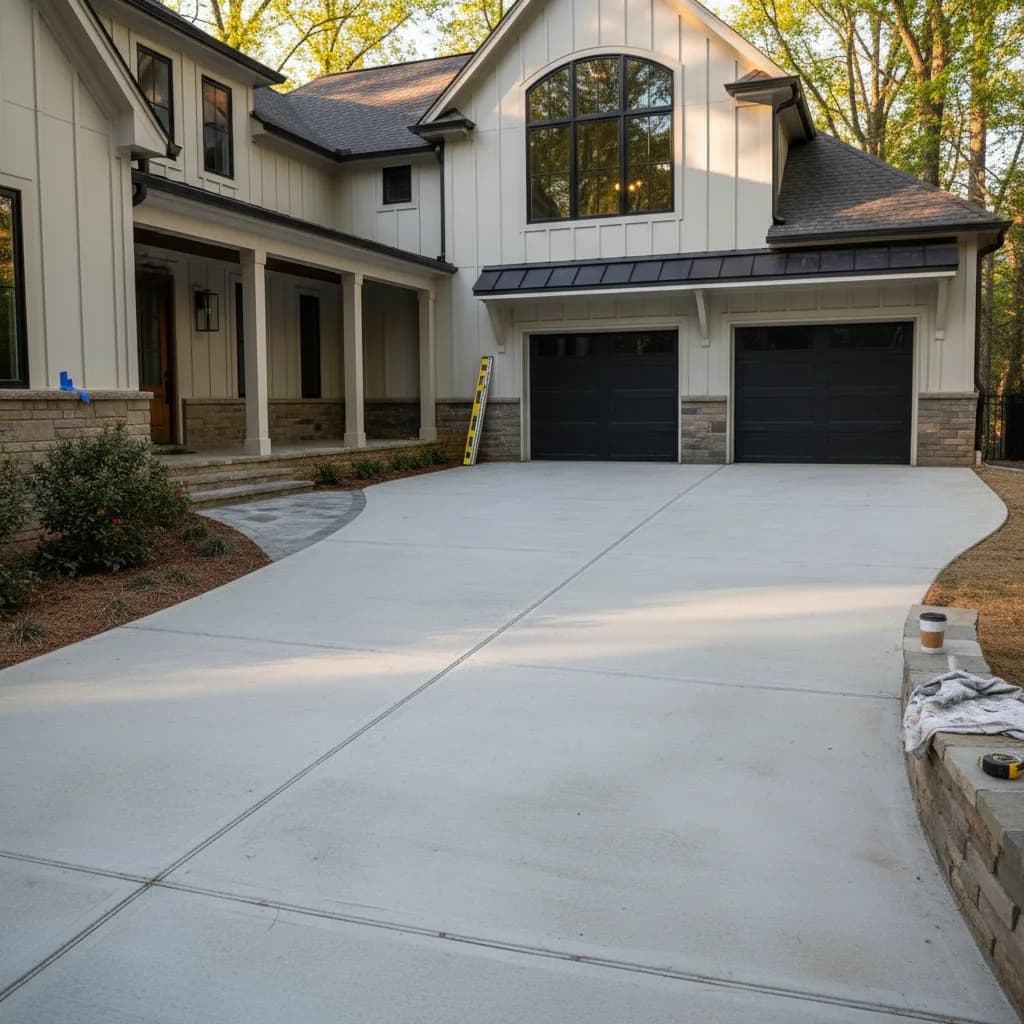
The simple concrete slab is officially a relic. In 2026, the driveway is the new foyer, a designed space setting the tone for the entire property. We're seeing this shift quantified in project scopes across Atlanta, where over seventy percent of new driveway installations quoted by top contractors now include integrated landscape lighting and permeable surfaces. It's a move from pure utility to a curated, textural arrival experience that begins at the curb.
In a Nutshell
- The Big Idea: The Curated Arrival. Driveways are no longer afterthoughts but integral, designed components of the home's exterior aesthetic and function.
- The Trends: Permeable pavers are becoming the default for their environmental and aesthetic benefits, dark and moody color palettes are replacing plain gray, and ribbon driveways with integrated greenery are breaking up monolithic surfaces.
- What's Being Replaced: Featureless poured concrete, asphalt, disjointed landscape edging, and basic floodlights.
- What's Next: Widespread adoption of heated systems for ice, smooth EV charger integration, and smart lighting that responds to your arrival.
Trend 1: Permeable Pavers Go Mainstream
The eco-conscious choice is now the aesthetic one. Permeable pavers, which allow stormwater to filter through to the ground below, are defining new driveway projects. Data from Belgard's Atlanta design center shows a forty percent year-over-year increase in inquiries for their permeable paver lines. This isn't just about managing Atlanta's heavy rains; it's about the sophisticated, modular look. Homeowners in Virginia-Highland and Morningside, dealing with smaller lots and runoff concerns, are leading the charge. Expect this to become the standard for any high-end installation by 2028.
Trend 2: Dark & Moody Palettes Dominate
The minimalist decade is over, and with it, the reign of light gray concrete. We're seeing a decisive shift toward deep, saturated colors like charcoal, slate, and even near-black. These dark palettes create a dramatic, grounding effect that makes landscape greenery pop. Paver manufacturers are responding, with products like Techo-Bloc's Blu 80 Slate in Onyx Black becoming a top seller. In historic Inman Park, these moody driveways are providing a stunning modern counterpoint to classic Victorian and Craftsman homes. This trend has legs, mirroring the interior design world's move toward cozier, more enveloping spaces.
Trend 3: The Ribbon Driveway Returns
What's old is new again, but with better materials. The classic "ribbon" or two-track driveway is seeing a major resurgence. Instead of basic concrete strips, designers are using large-format porcelain pavers or textured concrete for the tracks, with the central strip filled with lush turf, native groundcover, or crisp decomposed granite. This approach dramatically reduces the impervious surface area, improves curb appeal, and feels less imposing than a solid slab. It's a perfect fit for the stately homes of Druid Hills, where preserving the neighborhood's park-like feel is paramount.
Trend 4: Integrated Landscape Lighting is Standard
3 Atlanta driveway contractors, editor-screened. 4 questions.
See my 3 matchesForget the single, harsh floodlight mounted on the garage. Sophisticated, layered lighting is now considered a standard component of a driveway project, not an add-on. A well-designed driveway lighting plan includes multiple circuits for different effects: warm 2700K LED pucks embedded directly into the pavers for wayfinding, uplights accenting specimen trees along the border, and soft wall-washing on the home's facade. Renology's Project of the Day network shows that nearly every high-end driveway contractor in Atlanta now includes a lighting plan in their initial scope. This isn't just for aesthetics; it's a critical safety and security feature.
Trend 5: The Disappearing Edge
The hard, raised concrete curb is vanishing. The most forward-looking designs feature a smooth transition from the driveway surface to adjacent garden beds and walkways. This is achieved using flush steel edging, hidden below the grade, and by continuing the paver pattern directly into pedestrian paths. In other cases, a soft border of river rock or dark gravel creates a textural transition. This technique, seen increasingly in new builds in Sandy Springs, makes the driveway feel like a cohesive part of the landscape architecture, not a separate, utilitarian element.

Trend 6: Concrete Gets a Textural Upgrade
While pavers are gaining market share, poured concrete isn't disappearing. It's evolving. The dated look of stamped patterns is being replaced by subtle, sophisticated finishes that celebrate the material's inherent qualities. Exposed aggregate, where the top layer of cement is washed away to reveal the smooth stones beneath, is a popular choice for its durability and grip. We're also seeing salt finishes, which create a fine, pitted texture, and even board-formed concrete for a high-design, architectural statement. This is the new face of concrete for modern homes in areas like Ormewood Park.
Trend 7: The Grand Motor Court Reimagined
On larger properties, the driveway is being improved to a formal motor court, creating a powerful sense of arrival. This isn't just a wider parking area; it's a deliberately designed space, often circular or squared, with a central focal point like a mature Japanese maple, a modern sculpture, or a classic tiered fountain. The materials match the grandeur, with many projects in Buckhead and Tuxedo Park specifying reclaimed granite cobblestones or large-format porcelain pavers for a clean, contemporary look. It's a statement that declares the landscape is as important as the house itself.
Trend 8: Smart Systems Become Accessible
The connected home now extends to the driveway. While once the domain of luxury estates, integrated technology is becoming more accessible. Given Atlanta's susceptibility to occasional, but disruptive, ice storms, heated driveway systems are gaining traction as a practical upgrade. More common is the smooth integration of Level two EV chargers into the design, often housed in discreet bollards or posts that match the home's architecture. Paired with sensor-activated lighting that creates a welcoming pathway as you arrive, the driveway is becoming an active, intelligent part of the home.
Sources & Methodology
See the Renology Methodology for how sources are reviewed, ranges are normalized, and planning-data limits are handled.
Cost ranges in this guide draw on the following named industry sources, public agency datasets, and Renology editorial research.
- Belgard Design Studio Atlanta, Q1 2026 Installation Data (2026)
- Remodeling Magazine, Cost vs. Value Report 2026 (2026)
- Renology Project of the Day (POTD) field interviews, Atlanta Metro, 2025-2026 (2026)
- Georgia Department of Labor, Atlanta-Sandy Springs-Roswell MSA occupational wage data (2025)
- National Concrete Masonry Association (NCMA), Permeable Paver Design Projections (2025)
- City of Atlanta, Department of City Planning, Residential Permitting Guidelines (2026)
Renology Take
The throughline connecting these trends is a fundamental redefinition of the driveway's purpose. It’s no longer just a path for a car; it is the home’s first handshake. This shift is driven by a desire to maximize every square foot of a property, blurring the lines between the built and natural environments. In Atlanta, a city that prizes its lush tree canopy, this means driveways must work with the landscape, not pave over it. Permeable surfaces, integrated greenery, and soft edges all speak to this. The move toward richer textures and darker colors reflects the end of a sterile, minimalist era. Homeowners want warmth, character, and a sense of curated welcome from the moment they pull in.
Frequently Asked Questions
How much does a new driveway cost in Atlanta in 2026?
What are the best driveway materials for Atlanta's climate and soil?
Do I need a permit to replace my driveway in Atlanta?
How long does a permeable paver driveway last compared to concrete?
Atlanta · pre-screened
Get 3 Atlanta driveway bids in 48 hours.
Our editors already vetted Atlanta driveway contractors. Answer 4 questions and we send 3 written bids inside 48 hours, with the real price for your scope, not their inflated first-call number.
- Free, no commission
- Pre-screened locally
- Bids inside 48 hours
Takes about 60 seconds. We'll text you when bids arrive.
Sources
- Belgard Design Studio Atlanta, Q1 2026 Installation Data
- Remodeling Magazine, Cost vs. Value Report 2026
- Renology Project of the Day (POTD) field interviews, Atlanta Metro, 2025-2026
- Georgia Department of Labor, Atlanta-Sandy Springs-Roswell MSA occupational wage data
- National Concrete Masonry Association (NCMA), Permeable Paver Design Projections
- City of Atlanta, Department of City Planning, Residential Permitting Guidelines