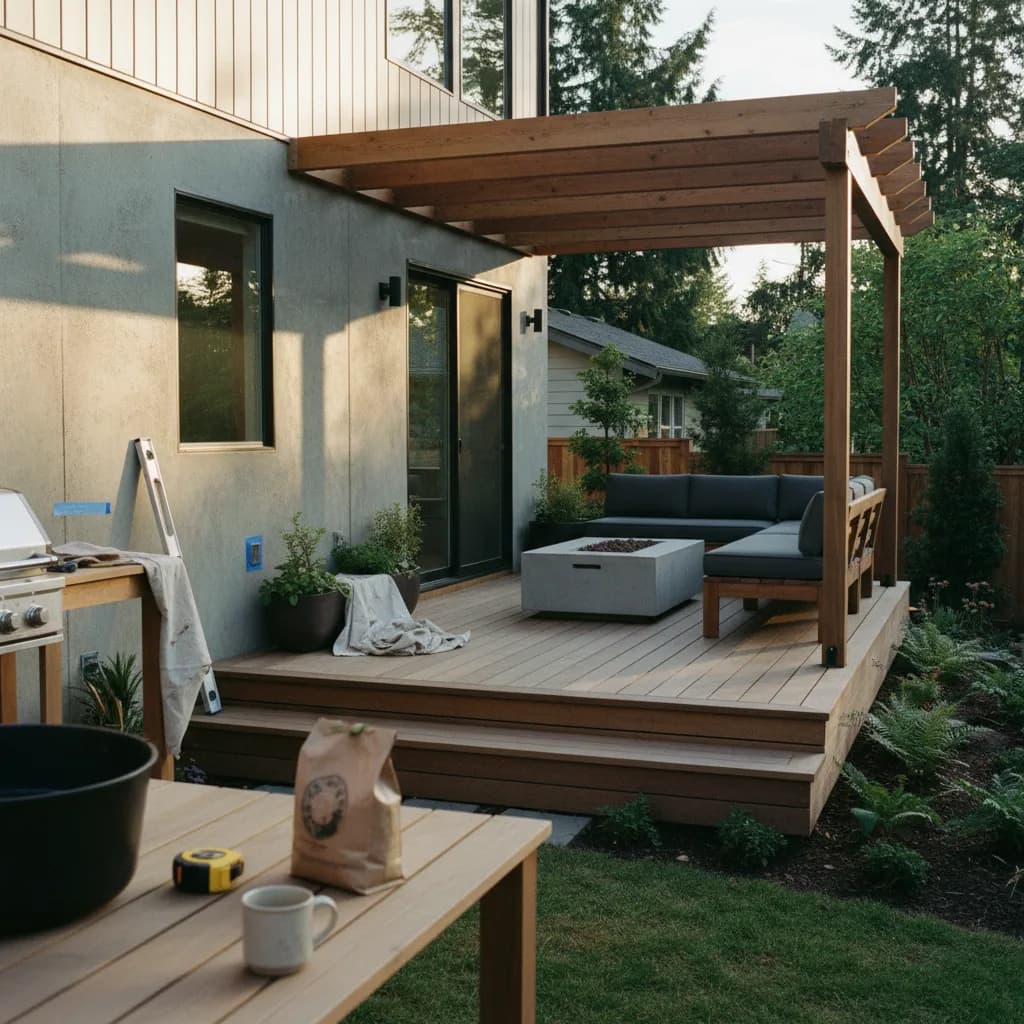
The simple backyard deck is dead. In its place, Seattle homeowners are building permanent, year-round outdoor rooms. In 2026, nearly seventy percent of new deck permits filed with the Seattle Department of Construction & Inspections include a substantial roof or pergola structure, a seismic shift from the untreated cedar platforms of a decade ago. This isn't just a deck; it's a third living room, designed with the same intention as an interior space.
In a Nutshell: The Deck as the Third Living Room
- Umbrella Theme: Decks are evolving from seasonal, open-air platforms into fully integrated, year-round outdoor living rooms with protection from the elements.
- Top Three Trends: The Covered Outdoor Room, Dark & Moody Palettes, and Biophilic Integration.
- What's Being Replaced: Basic pressure-treated lumber, exposed fasteners, thin wood railings, and the idea that a deck is only for July and August.
- What's Next: Fully integrated smart lighting and heating systems, multi-level designs that follow the topography, and the use of porcelain pavers over traditional decking for a patio-like feel.
Trend 1: The Covered Outdoor Room is the New Standard
The biggest shift in Seattle decks and pergolas is the expectation of a roof. Driven by our famously damp climate, homeowners are demanding spaces they can use from March through October. We're seeing a massive uptick in automated louvered pergolas from brands like StruXure and fixed, translucent polycarbonate roofing that lets in the soft Pacific Northwest light while blocking rain. Showrooms on the Eastside report that nearly every high-end deck project now starts with the question of coverage. This is the defining feature in new builds from Laurelhurst to West Seattle, cementing the deck's role as a true home extension.
Trend 2: Dark & Moody Palettes Dominate
The minimalist decade is over, and with it, the reign of light grey and tan composite decking. The new aesthetic is sophisticated, rich, and grounded in darker tones. Think deep charcoals, saturated browns, and near-blacks that recede into the landscape, making the surrounding greenery pop. Trex's Transcend Lineage in 'Jasper' and TimberTech's AZEK Vintage Collection in 'Dark Hickory' are the two most specified products we saw in Renology's Project of the Day network for Seattle in late 2025. These dramatic palettes are appearing in modern remodels in Ballard and Capitol Hill, where they provide a striking contrast to lighter home exteriors.
Trend 3: Biophilic Design Integrates Greenery
Instead of placing a few pots on a finished deck, designers are now building the garden into the structure itself. This is biophilic design in practice: integrated corten steel planters that double as retaining walls, cutouts for existing trees, and pergolas designed specifically as trellises for climbing wisteria or grapevines. It’s a response to a desire for more connection with nature, even in dense urban lots. We're seeing this trend executed beautifully in Madrona and Washington Park, where decks are designed to blur the line between the built environment and the garden. This is a long-term trend rooted in wellness and Pacific Northwest identity.
Trend 4: Glass Railings Maximize Water and Mountain Views
Why build a deck overlooking Puget Sound or the Cascades only to obstruct the view with clunky railings? Homeowners in view-centric neighborhoods like Queen Anne and Magnolia are overwhelmingly choosing tempered glass panel railings. The new standard is minimal framing, often just thin, powder-coated aluminum posts, creating an almost invisible barrier that prioritizes the vista. Cable rail was the top choice for years, but the clean, smooth look of glass has officially taken over for high-end projects. It's a functional choice that feels like a luxury upgrade, and its dominance in view properties is unlikely to wane.
Trend 5: Thermal Modification Makes Wood Desirable Again
3 Seattle deck builders, editor-screened. 4 questions.
See my 3 matchesFor years, the choice for a high-performance deck was between a tropical hardwood like Ipe or a high-end composite. Now, thermally modified wood offers a compelling third option that's both beautiful and sustainable. Woods native to North America, like ash and hemlock, are heated in a low-oxygen environment, changing their cellular structure to resist rot and moisture, a critical feature in Seattle. Brands like Thermory are gaining significant market share. This material offers the warmth and beauty of real wood without the environmental concerns of tropical deforestation, a story that resonates deeply with clients in eco-conscious areas like Bainbridge Island.
Trend 6: The Outdoor Kitchen Becomes a Full Prep Zone
The standalone grill on wheels is being replaced by a fully functional outdoor kitchen. This is more than just a built-in barbecue. We're talking about a true prep zone with an under-counter outdoor refrigerator from Perlick, a dedicated sink, and durable countertops made from materials like Dekton or honed absolute black granite that can withstand the elements. The layout often mimics an indoor galley layout or peninsula, complete with dedicated landing zones for platters and tools. This trend is most prominent in larger suburban lots in places like Bridle Trails and Mercer Island, where entertaining is a priority.
Trend 7: Smooth Transitions Erase the Doorway
The boundary between indoors and outdoors is dissolving. The key is installing large-format sliding or bifold glass door systems from manufacturers like NanaWall or LaCantina that create massive openings onto the deck. Critically, the deck's surface is built level with the interior floor, creating a single, uninterrupted plane. When the doors are open, the great room and the deck become one contiguous space. This requires careful planning for water management but is the single most impactful feature for making a home feel larger and more connected to its site. It’s a signature move in high-end remodels across the city.

Trend 8: Lighting as a Design Element, Not an Afterthought
Thoughtful lighting is what transforms a deck from a daytime space into a 24-hour destination. The new approach is layered and intentional. It includes low-voltage LED strip lighting recessed under stair treads for safety and ambiance, subtle downlights on railing posts to define the perimeter, and statement pendant or string lights hung from a pergola to create a focal point over a dining area. All of it is specified in a warm 2700K color temperature to create an inviting, cozy glow. A skilled decks pergola contractor in Seattle now brings a lighting designer into the conversation early, a practice once reserved for interior renovations.
Understanding Seattle Decks & Pergola Costs in 2026
Discussing the cost of a decks pergola project in Seattle requires looking at the interplay of high-end materials, skilled labor, and complex site conditions. The final price tag is a composite of these factors. A typical cost breakdown for a mid-to-high-end project is roughly 50-60% for labor, 30-40% for materials, and 5-10% for permits, design, and administrative costs. Labor costs are a significant driver in the region; Washington State L&I contractor licensing and labor rate data for King County shows that skilled carpentry wages are among the highest in the nation, reflecting the technical expertise required for these complex outdoor structures.
Three modeled project scenarios for 2026, built from the Renology Cost Index and typical local scopes. These are illustrative estimates, not completed client projects:
- The Composite Refresh ($22,000): A 250-square-foot deck in Ravenna where the existing structure was sound. The project involved removing old wood decking and railings, replacing them with Trex composite decking and a standard aluminum railing system.
- The Outdoor Living Room ($65,000): A 400-square-foot new cedar deck and custom-built cedar pergola in the Green Lake neighborhood. This project included new footings, a gas line for a fire pit, and a basic low-voltage lighting package.
- The Entertainer's Deck ($130,000+): A 550-square-foot, multi-level deck in Medina using thermally modified ash. The project featured a louvered pergola system, a full outdoor kitchen with stone counters, extensive integrated lighting, and glass railings to preserve Lake Washington views.
When budgeting, it's crucial to account for potential surprises, especially when dealing with Seattle's varied topography and older homes. The National Association of Home Builders recommends a ten to fifteen percent contingency on renovations in homes over thirty years old. This covers unforeseen issues like discovering rot in the house's ledger board or needing extra foundation work on a steep slope.
Sources & Methodology
See the Renology Methodology for how sources are reviewed, ranges are normalized, and planning-data limits are handled.
Cost ranges in this guide draw on the following named industry sources, public agency datasets, and Renology editorial research.
- Renology Project of the Day (POTD) Field Interviews, Seattle (2025-2026)
- Seattle Department of Construction & Inspections (SDCI) Permit Data (Q4 2025)
- Trex Dealer Network Sales Data, Pacific Northwest Region (2026)
- National Association of Home Builders (NAHB) (2026)
- Washington State L&I Contractor Wage Data (2026)
- Remodeling Magazine, Cost vs. Value Report (2026)
Renology Take
The thread connecting these eight trends is a fundamental re-evaluation of outdoor space. For decades, a deck was an amenity, an afterthought. Now, in a city with high property values and a culture that cherishes the outdoors, it's essential infrastructure. Homeowners are no longer building for a few sunny weekends. They are investing in permanence, creating all-weather, multi-season extensions of their homes that function as living rooms, kitchens, and dining rooms. The new Seattle deck isn't about escaping the house; it's about expanding its definition. This is a long-term investment in lifestyle, square footage, and property value, driven by the desire to maximize every inch of a Seattle lot, rain or shine. The demand for a quality decks pergola contractor in Seattle has never been higher because the projects have never been more ambitious.
Frequently Asked Questions
What is the average cost for a new deck and pergola in Seattle in 2026?
How long does it take to build a deck and pergola in Seattle?
Do I need a permit for a deck or pergola in Seattle?
What are the best decking materials for Seattle's rainy climate?
Seattle · pre-screened
Get 3 Seattle deck bids in 48 hours.
Our editors already vetted Seattle deck builders. Answer 4 questions and we send 3 written bids inside 48 hours, with the real price for your scope, not their inflated first-call number.
- Free, no commission
- Pre-screened locally
- Bids inside 48 hours
Takes about 60 seconds. We'll text you when bids arrive.
Sources
- Renology Project of the Day (POTD) Field Interviews, Seattle
- Seattle Department of Construction & Inspections (SDCI) Permit Data
- Trex Dealer Network Sales Data, Pacific Northwest Region
- National Association of Home Builders (NAHB)
- Washington State L&I Contractor Wage Data
- Remodeling Magazine, Cost vs. Value Report